ChatGPT
 Claude
A haircut identifier answers "what haircut is this?" by naming the closest common cut from a photo, but the name alone rarely gets you the right haircut. What your barber needs is four facts: how short the sides go, where that short part starts, how long the top is, and how it is styled. Get those from the photo and you can walk in without knowing a single trendy name.
You can pull those facts out yourself with the glossary below, check free photo matches with Google Lens, or upload the photo to Oakgen's AI haircut identifier. It returns the best match, the visible evidence, up to three alternatives, and a "What to Tell a Barber or Stylist" section. It can be wrong, especially from one angle, so bring the photos too.
Quick answer: ways to identify a haircut from a photo
| Method | Best for | Strength | Weakness | Cost note |
|---|---|---|---|---|
| Google Lens | Popular cuts from social posts and celebrity photos | Finds similar photos, often captioned with the cut's name | Doesn't explain the cut or what to ask for | Free |
| Pinterest or Instagram search | Building a set of reference photos once you know the name | Lots of angles and hair types | Captions are often wrong or vague | Free |
| Ask your barber | When you have side and back photos | A professional who can see your hair | Only as good as the photo and the conversation | Price of the cut |
| Describe it with a glossary (below) | Any cut, including ones with no "name" | Gets you the words barbers actually use | Takes a minute of looking | Free |
| Oakgen AI Haircut Identifier | Naming the cut and getting barber wording in one step | Best match, evidence, alternatives, upkeep notes | Can be wrong; no exact guard numbers | 5 credits (GPT-4o) or 3 (GPT-4o mini) |
If the photo is of a famous person with a well-known cut, try Google Lens first. It is free, and the matching photos frequently name the style. Use an identifier when Lens shows twenty different names or none.
A worked example: three angles of one cut
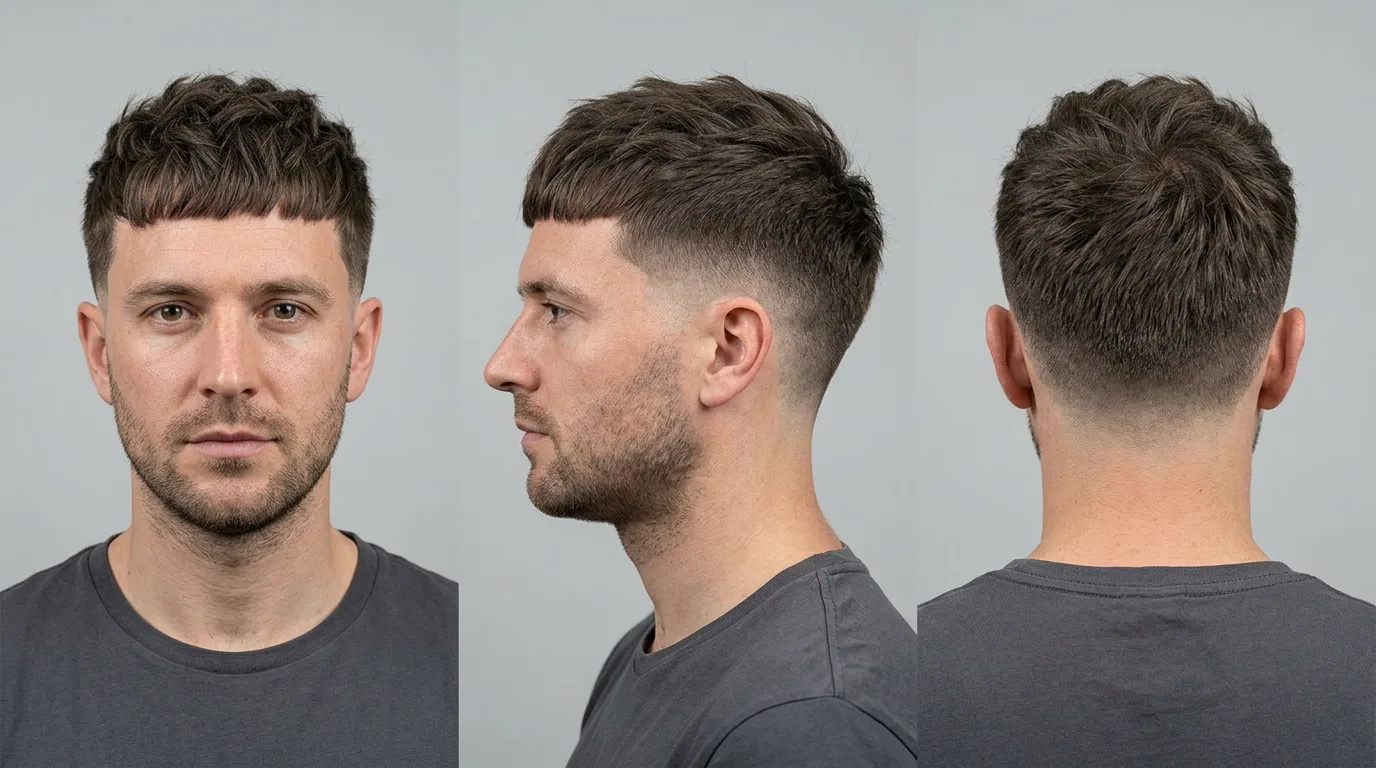
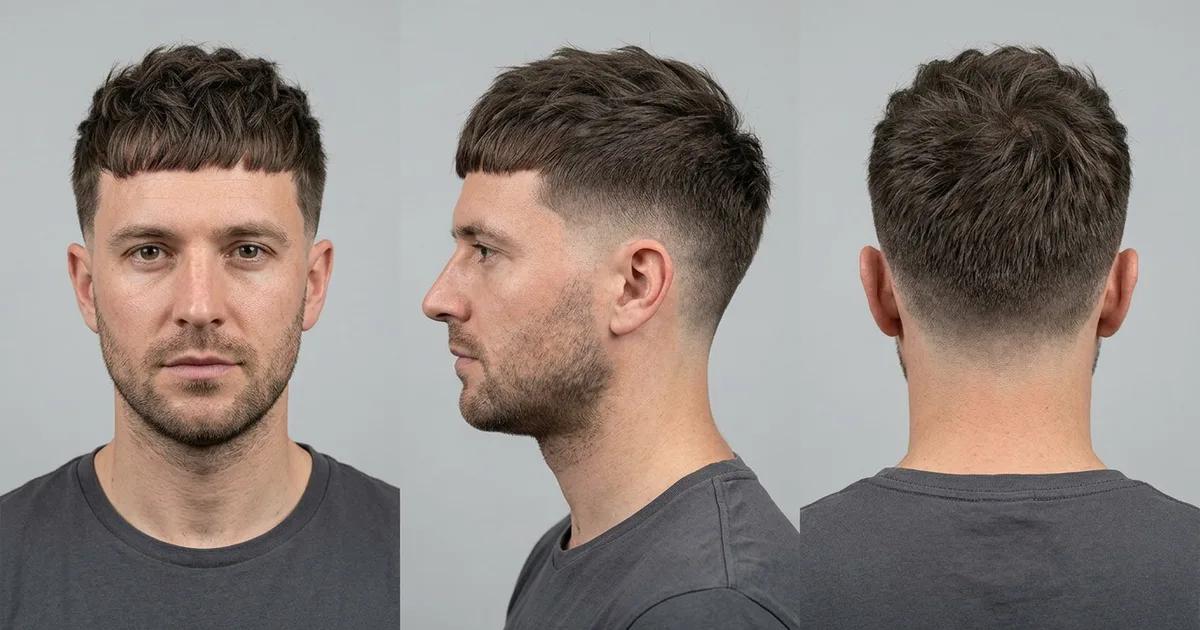
AI-generated image of a fictional person, made in Oakgen with Nano Banana 2.1 (14 credits). Not a real customer or a real haircut result.
Read it the way a barber would:
- Top: short, choppy texture pushed forward, finished with a short, blunt fringe straight across the forehead. That is the signature of a textured crop, sometimes called a French crop.
- Sides: the side view shows the hair getting shorter as it drops toward the ear, close to skin at the bottom. That is a fade, not just a tapered edge.
- Height: the short band reaches up the side of the head well above the ear but stops below the temple corner, so most people would call it a mid fade. Someone else might say high. That disagreement is exactly why the photos matter.
- Back: the back view confirms the fade wraps around, with a soft, tapered neckline rather than a squared one.
So the request becomes: "Textured crop with a short blunt fringe, mid skin fade, tapered neckline, natural hairline. Keep enough length on top to push forward." Notice we never needed a guard number. The barber will check your hair and suggest one, and you can agree it before the clippers come out.
The front view alone would have shown the fringe and little else. If you only have one photo, expect the identifier, the barber and you to guess at the sides and back.
Haircut name glossary: what it means and what to tell your barber
This is the asset to screenshot. It turns common names into the plain words that make them repeatable.
| Name you'll see | What it means | What to tell your barber |
|---|---|---|
| Taper | Edges near the ears and neckline get gradually shorter; sides keep most length | "Taper the edges only, keep length on the sides" |
| Low fade | Short band stays low, around the ears and nape | "Low fade, starting just above the ear" plus how short at the bottom |
| Mid fade | Short band reaches roughly the middle of the side of the head | "Mid fade" plus whether it goes to skin |
| High fade | Short band goes well up the sides toward the top | "High fade, down to skin" or "to a short guard" |
| Skin (bald) fade | The shortest point is bare skin | "Skin at the bottom"; mention if close shaving gives you bumps |
| Drop fade | The fade line curves down behind the ear | "Drop the fade behind the ear" |
| Burst fade | Fade arcs around the ear, leaving length at the back | "Burst fade around the ear, keep the back longer" |
| Textured or French crop | Short, choppy top pushed forward with a short fringe | "Textured top pushed forward, short blunt fringe" |
| Buzz cut | Clipped close all over, often one length | "Buzz all over" and agree the guard |
| Crew cut | Short tapered sides with a little more length on top | "Short tapered sides, about an inch on top" |
| Ivy League | Crew cut long enough on top to comb into a side part | "Enough on top for a side part" |
| Quiff or pompadour | Longer front swept up and back with volume | "Keep length at the front for volume" |
| Curtains or middle part | Longer top parted in the middle, falling to the sides | "Middle part, keep the front long enough to fall either side" |
| Mullet (modern) | Shorter front and sides, longer at the back | "Keep length at the back, shorter on top and sides" |
| Neckline: tapered, blocked or rounded | How the hair finishes at the nape | "Tapered neckline" (grows out softer) or "blocked" |
Low, mid and high describe where the short part ends, not how short it gets. Taper Trends puts it plainly: "Low, mid and high say where a fade starts. They don't say how short it finishes," and guard numbers "are labels, not guarantees" (Taper Trends, 2026-11-01). Donny Cutz, a Doncaster barber, breaks almost every fade name into two choices: how short the bottom is and how high the short part reaches (Donny Cutz, 2026-11-10). Shops use these words loosely, which is why you name both.
Not Sure What the Cut Is Called?
Upload a clear photo and get the best match, the visible evidence, alternatives and wording for your barber.
Photo checklist before you identify a haircut
- Three angles if you can: front, side and back. Oakgen's tool tells you the same: a front, side and back view usually produce a more useful answer.
- Even light. Harsh shadows hide where a fade starts.
- Hairline, sides and full length visible. Hats, hoods and hands ruin the read.
- Hair like yours. A cut on thick, straight hair looks different on curly or fine hair.
- Not mid-styling. Heavy product, wet hair or wind changes the silhouette.
How to use Oakgen's haircut identifier
- Open the haircut identifier. Signed out, you see an overview and pricing; sign in to run an analysis.
- Upload a JPG, PNG or WebP photo up to 20 MB.
- Add optional context, up to 500 characters: which part to identify, or the look you want to recreate.
- Choose GPT-4o (default, 5 credits) or GPT-4o mini (3 credits). Results take about 10 to 15 seconds; failed analyses are refunded automatically.
- Read the six sections: Best Match, Visible Evidence, What to Tell a Barber or Stylist, Texture, Finish, and Upkeep, Other Possible Matches, and Confidence and Limitations.
What it won't do, by design: invent clipper guard numbers, hidden layers, product brands or exact measurements. When a length is useful, it gives a range labeled as an estimate. It also analyzes the haircut only, and doesn't infer identity, gender, ethnicity or health. Oakgen has no free plan; credits come with a paid Oakgen plan.
Will it suit you? Two next steps
Knowing the name doesn't mean the cut will work on your face or your hair. Two things help before you book:
- Estimate your face shape with the AI face shape detector. It suggests hairstyles that usually suit the estimated shape, and it treats the result as an estimate, not a rule. Our guide to glasses and haircuts for your face shape explains how to use that advice sensibly.
- Preview the cut on your own photo with the hairstyle changer. It is a rough preview, not a promise of what the barber will deliver, but it catches obvious mismatches. For length changes, see the long hair filter guide.
Common mistakes
- Saying "a fade" and nothing else. Name the height and how short the bottom goes.
- Showing one front-facing selfie. The sides and back are where most cuts differ.
- Trusting a caption. Social posts mislabel cuts constantly. Check the actual shape.
- Asking for guard numbers you read online. Lengths vary by brand; agree them in the chair.
- Ignoring your texture. Curl shrinkage can make a long top look short. Mention it.
- Skipping the repeat-back. Ask your barber to say the plan out loud before they start.
- Forgetting upkeep. A high skin fade shows regrowth sooner than a low taper. Check the upkeep notes before choosing.
Related reading
- AI photo effects and identifiers guide, the hub for this series.
- What logo is this? uses the same crop, describe, confirm method for brand marks.
- AI age progression if you want to see how a look might age.
Frequently asked questions
How can I find out what haircut is in a photo?
Break the cut into four parts: how short the sides go, where the short part starts (low, mid or high), how long the top is, and how it's styled. Search those words, use Google Lens on the photo, or upload it to an AI haircut identifier that names the closest common cut and lists alternatives.
Is there a free haircut identifier?
Google Lens is free and will show visually similar hairstyle photos, which often come with the cut's name in the caption. It doesn't explain the cut. Oakgen's AI Haircut Identifier is paid: it uses credits from a paid Oakgen plan and returns a structured report with wording for your barber.
What should I tell my barber if I don't know the haircut name?
Describe the sides (fade or taper, and how short at the bottom), where the short part ends, the length on top, the fringe and the neckline, then show side and back photos. Ask the barber to repeat the plan back before they start.
What is the difference between a taper and a fade?
Barbers use the words loosely. Generally a taper shortens the edges near the ears and neckline and keeps most of the length on the sides, while a fade takes a wider band down very short, often to skin. If it matters to you, say exactly how high and how short you want it.
Can a haircut identifier tell me clipper guard numbers?
Not reliably from a photo. Oakgen's identifier is instructed not to invent guard numbers or exact measurements; when length matters it gives a labeled visual estimate. Agree the actual guard with your barber, because guard lengths can vary between brands.
Will the same haircut look the same on my hair?
Not always. Texture, curl, density, cowlicks and hairline change how a cut sits. Use a reference photo of someone with hair like yours, and ask your barber what will look different on you.
How much does Oakgen's haircut identifier cost?
As of 2026-11-16, each analysis costs 5 credits with GPT-4o (the default) or 3 credits with GPT-4o mini, and failed analyses are refunded automatically. Oakgen has no free plan.
Walk Into the Barbershop With the Right Words
Get the haircut name, the evidence behind it and a plain-language request you can read out in the chair.