ChatGPT
 Claude
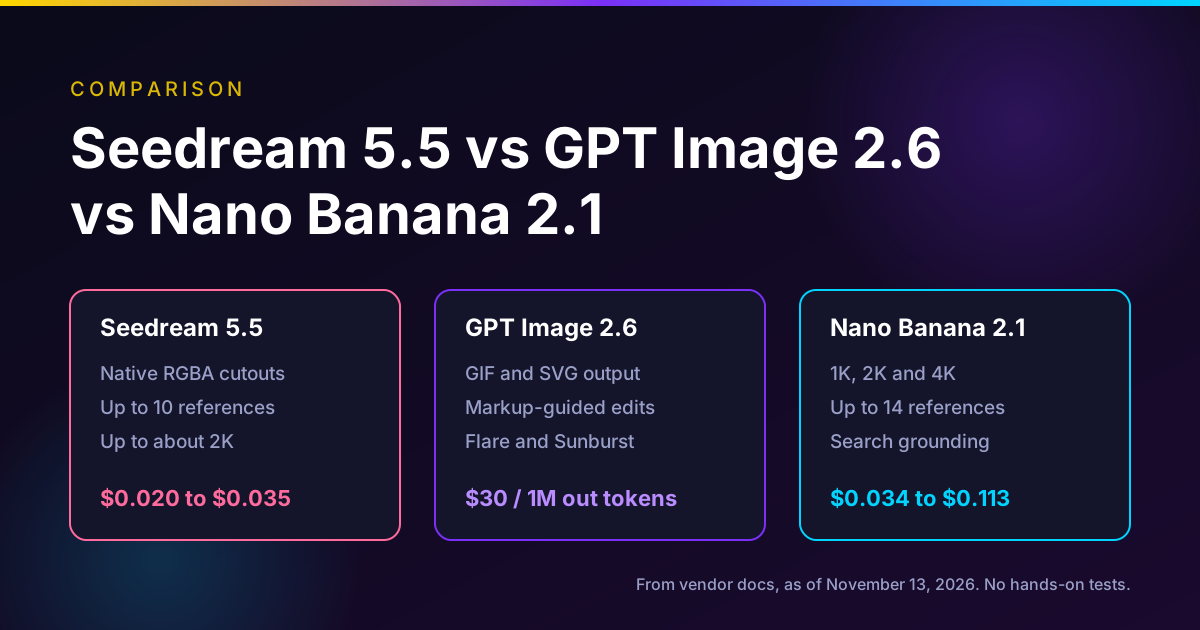
Seedream 5.5 vs GPT Image 2.6 vs Nano Banana 2.1 comes down to which output you need, because on paper the three are built for different jobs. As of November 13, 2026, the vendor docs say this. Seedream 5.5 is the one for transparent PNG assets and long edit chains. GPT Image 2.6 is the one for animated GIFs, SVG export and markup-guided edits. Nano Banana 2.1 has the highest documented resolution (4K), the most reference images (14) and Google Search grounding. On price, Seedream 5.5 is the cheapest per image at up to 2K, and Nano Banana 2.1 is the cheapest documented route to 4K.
We did not run tests for this post. Everything below comes from vendor documentation, pricing pages and launch posts, and every quality claim is the vendor's.
Try Nano Banana 2.1 at 4K
Generate or edit with up to 14 reference images in Oakgen's image generator and see the credit price before you run.
The quick comparison
| Seedream 5.5 | GPT Image 2.6 | Nano Banana 2.1 | |
|---|---|---|---|
| Maker and date | ByteDance Seed, Nov 9, 2026 | OpenAI, Nov 4, 2026 | Google, Oct 6, 2026 |
| Max documented output | About 4.6 MP (2K tier) | Not restated for 2.6 (2.5 docs: 3840 px edge, about 8.3 MP) | 4K, 4096x4096 at 1:1 |
| Reference images | Up to 10 | No maximum stated | Up to 14 (10 objects, 4 characters) |
| Transparent output | Yes, native RGBA, full and partial | Documented for 2.5, not restated for 2.6 | Not listed in docs |
| Editing headline | Stable edits across 100 rounds (vendor demo) | Markup-guided edits, complexity control | Conversational and mask-based editing |
| Special outputs | Layer decomposition, up to 99 layers | Animated GIF (2 to 16 frames), SVG | Search-grounded images, video-to-image |
| Speed claim | None published | 50% faster, Flare as fast as 6 s at low quality | "Flash-level speed" |
| API price | $0.020 to $0.035 per image, plus $0.008 per input image | $30 per 1M image output tokens | About $0.0336 (1K), $0.0504 (2K), $0.113 (4K) |
| In Oakgen as of Nov 13 | No | No (GPT Image 2.5 is) | Yes |
If you only read one row, read "Special outputs." That row is where the three differ most, and it maps straight to jobs: cutouts and layers, motion and vector, or high-resolution and grounded images.
Who this comparison is for
This is for a designer, marketer or developer who has seen three image launches in five weeks and needs to know which one to route work to. Typical jobs: "I need 40 product cutouts on transparent backgrounds." "I need a looping GIF of our mascot for social." "I need a 4K poster with readable small text." "I need the same character in eight scenes."
If you want a hands-on bake-off with scored images, this is not that post. It is the spec sheet you read before you spend money on a bake-off.
How we checked
On November 13, 2026 we opened each vendor's launch post, API docs, model page and pricing page, listed in the sources. For Seedream 5.5 we used ByteDance Seed's launch post and BytePlus ModelArk's tutorial, API reference, model list and price list. For GPT Image 2.6 we used OpenAI's launch post, image generation guide, Flare model page and API pricing page. For Nano Banana 2.1 we used Google's model page, image generation guide, pricing page and DeepMind model card.
What we did not do:
- We did not generate images with any of the three for this post, so we give no quality scores.
- We did not time generation. Speed lines are vendor claims.
- Where a doc page does not state a limit for the newest model, we say so instead of guessing from an older model.
Prices are API list prices, not app subscriptions, and can change. Last updated November 13, 2026.
Disclosure: Oakgen is our product. We include it because it is relevant to this workflow, but the comparison also covers where standalone tools may be better.
Seedream 5.5: built for assets you will keep editing
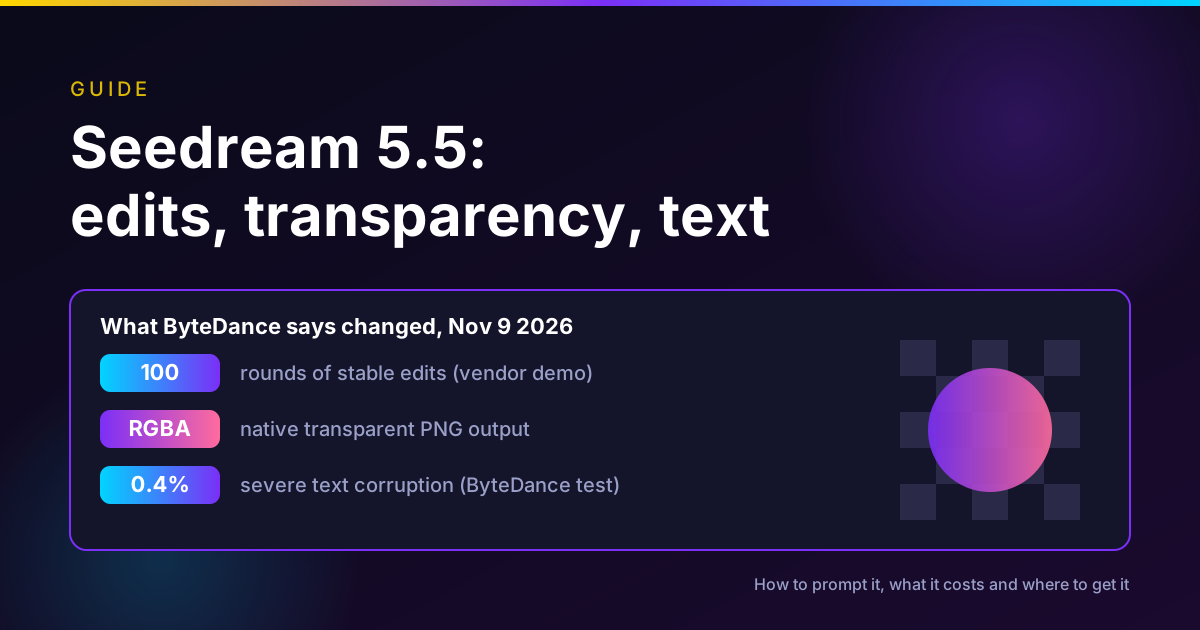
ByteDance Seed announced Seedream 5.5 on November 9, 2026 with three upgrades: more stable multi-turn editing, native RGBA output and more realistic images with clearer text.
Editing. ByteDance says the model preserves unedited regions at the pixel level and avoids color shifts there, which "supports continued work on the same image across 100 rounds of editing." The 100 figure comes from a ByteDance demo in which each round's output fed the next edit. Treat it as a stress test the vendor ran, not a guaranteed session length.
Transparency. Seedream 5.5 generates images with an alpha channel, including partial transparency, from text or from reference images. BytePlus's Seedream 5.5 tutorial says native RGBA works in text-to-image, single-reference and multi-reference modes, with up to 10 reference images and no alpha channel needed on the inputs. The model list adds layer decomposition: one base image plus up to 99 layers, with OCR of rich text.
Text. In ByteDance's own evaluation, the severe text corruption rate fell to 0.4% and the minor rate to 1.7% on Chinese and English text, including dense small text. ByteDance also says Seedream 5.5 leads GPT Image 2.5 Sunburst and Nano Banana 2.1 in "text structure" in its MagicArena tests. Those are vendor numbers, and the rival named is GPT Image 2.5, not 2.6.
Resolution and price. The API reference lists 1K, 1.5K and 2K presets, or custom sizes from 921,600 to 4,624,220 total pixels with aspect ratios from 1:16 to 16:1. There is no 4K tier. The ModelArk price list for dola-seedream-5-5-261028 is $0.020 per output image up to about 2.6 MP, $0.035 up to about 4.6 MP and $0.008 per input image.
Here is where it breaks. If your deliverable is a 4K print file, Seedream 5.5 cannot produce it directly. And ByteDance says a Pro version of the 5.5 series will follow, so the top tier may change soon.
GPT Image 2.6: built for motion, vector and precise edits
OpenAI released Images 2.6 on November 4, 2026 in ChatGPT, Codex and the API, with two API models: GPT-Image-2.6 Flare and GPT-Image-2.6 Sunburst.
Speed. OpenAI says Images 2.6 generates images 50% faster than before. With quality set to low, Flare "can generate images in as little as six seconds." Sunburst is pitched for "higher-quality image generation and even greater image consistency across edits" at medium or high quality. These are OpenAI's claims.
GIFs. The image generation guide documents output_format: "gif" on both the generation and edit endpoints, with 2 to 16 frames (default 9) and 20 to 2,000 milliseconds per frame. GIF output does not support streaming or partial images.
Markup, SVG and complexity. Image markup, already in ChatGPT, comes to the API, so you can circle the part to change. The guide says markup applies to the first input image, additional images serve as references, and the first image and markup layer can each be up to 16,777,216 pixels. SVG export is supported on both models. A new complexity field (low, medium, high, default high) controls how much the model plans before rendering. OpenAI recommends low complexity for quick edits.
Resolution, references and transparency. This is where the 2.6 docs are thin. The guide documents custom sizes up to a 3840 pixel edge and about 8.3 MP, and transparent backgrounds, for GPT-Image-2.5 Sunburst and Flare. It does not restate either for 2.6, and the Flare model page does not list sizes or a reference-image maximum. Test before you build a transparent-asset pipeline on 2.6.
Price. The API pricing page lists both 2.6 models at $5 per million text input tokens, $8 per million image input tokens and $30 per million image output tokens, the same rates as GPT-Image-2.5. Per-image cost depends on size and quality, so use OpenAI's calculator. No batch row for 2.6 appeared on the page we read.
For the full launch breakdown, see our sibling post on what's new in GPT Image 2.6. The previous generation, Flare and Sunburst 2.5, is on the GPT Image 2.5 model page in Oakgen.
Need GPT Image today?
Oakgen runs GPT Image 2.5 Flare and Sunburst now. GPT Image 2.6 is not in Oakgen yet as of November 13, 2026.
Nano Banana 2.1: built for resolution, references and grounding
Google rolled out Nano Banana 2.1 on October 6, 2026 across the Gemini app, AI Mode in Search, Google AI Studio, Flow, Stitch, Google Ads and Gemini Enterprise Platform. The DeepMind model card says it is based on Gemini 3.6 Flash. The API model id is gemini-nano-banana-2.1.
Resolution. The model page lists 1K, 2K and 4K output (default 1K) and says Google fixed tiling artifacts on wide ratios (1:4, 4:1, 1:8, 8:1) at 2K and 4K. The image generation guide lists 14 aspect ratios, with 4K at 4096x4096 for 1:1 and 6336x2688 for 21:9.
References. Up to 14 reference images, with character consistency for up to 4 characters and object fidelity for up to 10 objects. That is the highest documented count of the three.
Extras. Thinking levels (minimal, medium, high), grounding with Google Web and Image Search, and video-to-image. Every image carries a SynthID watermark. The docs do not list a transparent background option.
Price. The pricing page lists image output at $30 per million tokens, which it equates to $0.0336 per 1K image, $0.0504 per 2K image and $0.113 per 4K image. Batch halves those to $0.0168, $0.0252 and $0.0567. Input is $1.50 per million tokens. One oddity: the pricing page counts 3,780 tokens for a 4K image while the generation guide's size table shows 2,520. We use the pricing page figure.
Our older comparison of Seedream and Nano Banana 2 covers the previous generation of both models.
Side by side, feature by feature
Resolution
Nano Banana 2.1 is the only one of the three with a documented 4K tier for its current version. Seedream 5.5 stops near 2K. GPT Image 2.6 has no restated limit, and its 2.5 sibling allows about 8.3 MP with a 3840 pixel edge. For a social post this does not matter. For a print poster or a crop-heavy hero image, it does.
References and consistency
For "the same character in eight scenes," Nano Banana 2.1's documented 4 characters and 10 objects is the clearest promise. Seedream 5.5 allows 10 references and pitches reuse of transparent character assets across scenes. OpenAI says Sunburst gives "even greater image consistency across edits" but states no reference count.
Editing
Seedream 5.5's pitch is drift: keep editing one image without the untouched parts changing. GPT Image 2.6's pitch is precision: circle the area with markup and set complexity low. Nano Banana 2.1's pitch is conversation and masks, with multi-turn character consistency. Different ideas of "good editing," so test with your real edit chain.
Transparency
Seedream 5.5 is the only one whose current docs clearly promise native transparent output, including partial transparency and layer decomposition. If cutouts are the job, start there.
Text
All three vendors claim better text. Only ByteDance published error rates, and only against its own previous version and older rivals. Google's guide gives a practical tip: Gemini works best if you generate the text first and then ask for an image with that text.
Speed
OpenAI gives the only concrete number, six seconds for Flare at low quality. Google says "Flash-level speed." ByteDance gives none. None of these are independent timings.
What a batch of 100 images costs
Our arithmetic from the list prices above, for 100 text-to-image outputs with no reference images, as of November 13, 2026.
| Output size | Seedream 5.5 (ModelArk) | Nano Banana 2.1 (Gemini API, standard) | Nano Banana 2.1 (batch) |
|---|---|---|---|
| About 1K | $2.00 | $3.36 | $1.68 |
| About 2K | $3.50 | $5.04 | $2.52 |
| 4K | Not available | $11.30 | $5.67 |
This leaves out text input tokens for Nano Banana 2.1 and reference-image fees, which for Seedream 5.5 add $0.008 per image sent. GPT Image 2.6 is not in the table because its per-image price depends on quality and size settings that OpenAI prices through a token calculator rather than a flat per-image list.
Which one to use, by job
| Your job | Start with | Why |
|---|---|---|
| Product cutouts, stickers, UI elements | Seedream 5.5 | Native RGBA with partial transparency |
| Long revision chains on one approved image | Seedream 5.5, then test | Vendor demo of 100 stable rounds |
| Animated reaction or mascot loop | GPT Image 2.6 | Documented GIF output, 2 to 16 frames |
| Logo or icon you will edit as vector | GPT Image 2.6 | SVG export |
| "Change only this part" edits | GPT Image 2.6 | Markup-guided edits |
| 4K poster or print hero | Nano Banana 2.1 | Only documented 4K tier |
| One character across many scenes | Nano Banana 2.1 | 4 characters and 10 objects documented |
| Infographic with real-world facts | Nano Banana 2.1 | Google Search grounding |
| Lowest cost at 1K to 2K | Seedream 5.5, or Nano Banana 2.1 in batch | $0.020 vs $0.0168 per 1K image |
The mistake is choosing the model before choosing the job. A team that needs transparent assets and a team that needs GIFs will each be disappointed by the other's winner.
Common mistakes
Reading a vendor demo as a guarantee. The 100-round Seedream edit chain and the six-second Flare time are vendor results. Run your own five-round chain before promising a client anything.
Assuming 2.6 inherits every 2.5 limit. OpenAI's guide documents transparency and size limits for 2.5 and does not restate them for 2.6. Check the response before you build on it.
Comparing token prices to image prices. OpenAI and Google bill image output in tokens, ByteDance bills per image. Convert to cost per finished image at your size before comparing.
Forgetting reference fees. Seedream 5.5 charges $0.008 for every input image, including the first. A ten-reference composite adds $0.08 to each output.
Sending short prompts for text-heavy layouts. All three vendors say text improved. Google's own advice is to settle the wording first, then render.
Where Oakgen fits
As of November 13, 2026, Oakgen offers one of the three directly. Nano Banana 2.1 is in the image generator for text-to-image and editing, at 1K, 2K or 4K, with up to 14 input images when editing and up to 4 outputs per run. Its model page is Nano Banana 2.1 in Oakgen.
Oakgen offers GPT Image 2.5 Flare and Sunburst, not GPT Image 2.6. It does not offer Seedream 5.5, and its older Seedream 5 Lite and 4.5 entries have been retired. If transparent cutouts are your main job today, a Seedream 5.5 provider is the better route, and we would rather say that than pretend otherwise.
Where Oakgen helps is the comparison step. Image Arena runs one prompt across several image models side by side, which is the cheapest way to check vendor claims on your own brief. Our guide to picking a model with Image Arena walks through it, and you can finish with the image editor.
Test vendor claims on your own prompt
Run one brief across several image models in Oakgen Image Arena, then keep the winner.
For a deeper look at the newcomer, read our Seedream 5.5 guide. For an open-weights alternative with 16 MP output and a very different license, see MiniMax H3-Image explained.
FAQ
Which is best: Seedream 5.5, GPT Image 2.6 or Nano Banana 2.1?
It depends on the job, and we have not run our own tests. On paper, Seedream 5.5 is the one built for transparent assets and long edit chains, GPT Image 2.6 is the one with GIF and SVG output plus markup edits, and Nano Banana 2.1 has the highest documented resolution (4K), the most reference images (14) and Google Search grounding. Pick by the output you need, then test on your own prompts.
Which of the three can make a transparent PNG?
Seedream 5.5 documents native RGBA output with full and partial transparency in text-to-image, single-reference and multi-reference modes. OpenAI's guide documents transparent backgrounds for the GPT-Image-2.5 Sunburst and Flare models but does not restate it for 2.6, so check before you rely on it. Google's Nano Banana 2.1 docs do not list a transparent background option.
Which model has the highest resolution?
Nano Banana 2.1 documents 1K, 2K and 4K output, with 4096x4096 at 1:1. Seedream 5.5 on BytePlus ModelArk tops out at about 4.6 megapixels (roughly 2K). OpenAI's guide lists custom sizes up to a 3840 pixel edge and about 8.3 megapixels for GPT-Image-2.5 and does not give a separate limit for 2.6.
How much does each model cost per image?
As of November 13, 2026: Seedream 5.5 on BytePlus ModelArk is $0.020 per output image up to about 2.6 MP and $0.035 up to about 4.6 MP, plus $0.008 per input image. Nano Banana 2.1 on the Gemini API is about $0.0336 at 1K, $0.0504 at 2K and $0.113 at 4K, half that in batch. GPT Image 2.6 bills $30 per million image output tokens, so the per-image price depends on size and quality settings.
How many reference images can each model take?
Nano Banana 2.1 takes up to 14 (up to 10 objects and up to 4 characters, per Google). Seedream 5.5 takes up to 10 on BytePlus ModelArk. OpenAI does not state a maximum for GPT Image 2.6; its guide says that with markup, the first image is edited and additional images serve as references.
Is GPT Image 2.6 faster than GPT Image 2.5?
OpenAI says Images 2.6 generates images 50% faster than before, and that Flare can return an image in as little as six seconds at low quality. Those are OpenAI's claims. We did not time it.
Can I use Seedream 5.5, GPT Image 2.6 or Nano Banana 2.1 in Oakgen?
As of November 13, 2026, Oakgen offers Nano Banana 2.1 for generation and editing at 1K, 2K and 4K. Oakgen offers GPT Image 2.5 Flare and Sunburst but not GPT Image 2.6 yet, and it does not offer Seedream 5.5.
Did Oakgen test these models side by side?
No. This comparison is built from each vendor's documentation, pricing pages and launch posts. Quality claims in it, such as text error rates or realism, are the vendors' own numbers and are labelled that way.
Sources
- ByteDance Seed, Introducing Seedream 5.5, 2026-11-09 (read 2026-11-13)
- BytePlus ModelArk, Dola Seedream 5.5 tutorial, undated (read 2026-11-13)
- BytePlus ModelArk, Image generation API reference, undated (read 2026-11-13)
- BytePlus ModelArk, Model pricing, undated (read 2026-11-13)
- BytePlus ModelArk, Model list, undated (read 2026-11-13)
- OpenAI, Introducing Images 2.6, 2026-11-04 (read 2026-11-13)
- OpenAI API docs, Image generation guide, undated (read 2026-11-13)
- OpenAI API docs, GPT-Image-2.6 Flare model page, undated (read 2026-11-13)
- OpenAI API docs, Pricing, undated (read 2026-11-13)
- Google AI for Developers, Gemini Nano Banana 2.1 model page, updated 2026-10-29 (read 2026-11-13)
- Google AI for Developers, Nano Banana image generation guide, updated 2026-10-26 (read 2026-11-13)
- Google AI for Developers, Gemini Developer API pricing, updated 2026-10-30 (read 2026-11-13)
- Google DeepMind, Nano Banana 2.1 model card, 2026-10-06 (read 2026-11-13)
- Google on X, Nano Banana 2.1 rollout post, 2026-10-06 (read 2026-11-13)