ChatGPT
 Claude
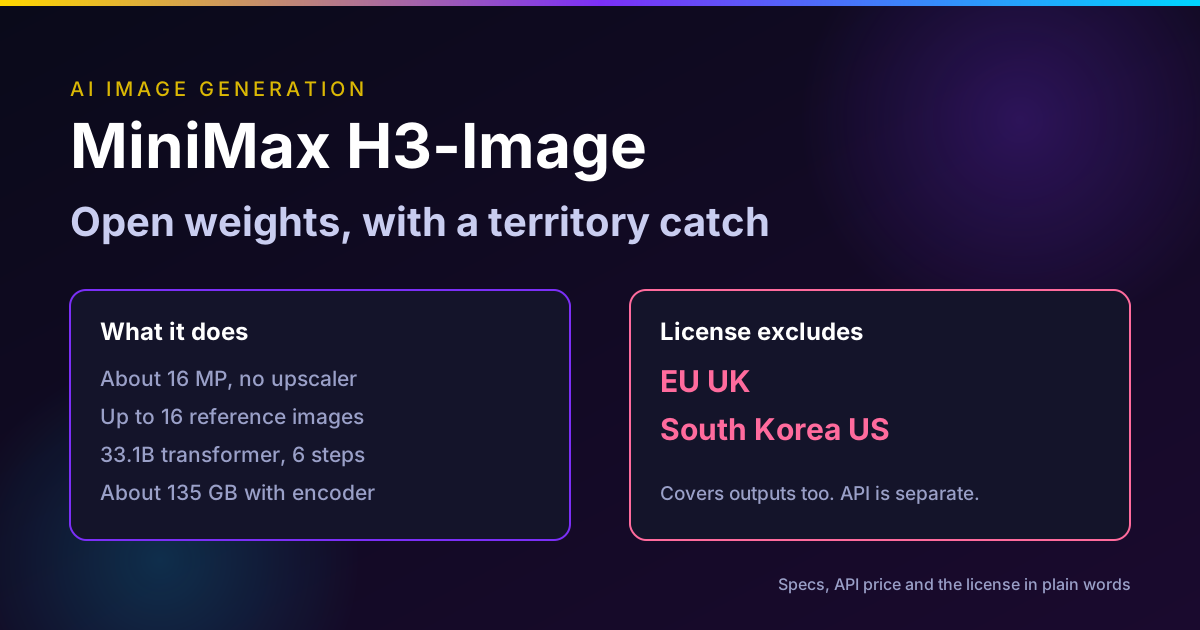
MiniMax H3-Image is an open-weight image model that MiniMax released on November 10, 2026. One checkpoint does text-to-image, reference-based generation and editing. It draws about 16 megapixels directly, such as 4096x4096, takes up to 16 reference images, and samples in 6 steps. It is also available through MiniMax's API, which costs about $0.069 for a 4K image at the Standard rate, and about half that during a launch offer that ends November 17.
The catch is the license. The open-weight license does not cover the European Union, the United Kingdom, South Korea or the United States. If you are in one of those places, the license does not let you run the weights, or display the images they make, without separate permission from MiniMax. The hosted API is a different route, and MiniMax says it stays available globally.
Oakgen does not offer H3-Image. For 4K images in Oakgen today, Nano Banana 2.1 is the option.
Need 4K images without a license puzzle?
Generate and edit at 4K with Nano Banana 2.1 in Oakgen, with the credit price shown before you run.
MiniMax H3-Image at a glance
| Item | What the docs say |
|---|---|
| Released | November 10, 2026 (license date and launch post) |
| Tasks | Text-to-image, reference-based generation, image editing, one checkpoint |
| Output | About 16 MP at every aspect ratio, 4096x4096 to 6272x2688, no upscaler |
| Reference images | Up to 16 |
| Model | 33.1B-parameter diffusion transformer, BF16, distilled to 6 steps, no CFG |
| Download | About 135 GB with the text encoder, plus an optional 17.9 GB prompt expander |
| Hosted access | MiniMax API, MiniMax Code, Hailuo AI (per MiniMax) |
| API price, Standard | About $0.022 (1K), $0.023 (2K), $0.069 (4K) per text-to-image |
| Not supported in API | Transparent backgrounds, masked edits, preview images |
| License | MiniMax-H3-Image Community License, excludes EU, UK, South Korea, US |
| In Oakgen | No |
The license, in plain words
This section comes first because it decides whether the rest matters to you. We read the license text dated November 10, 2026. This is our plain reading, not legal advice.
1. The license only works in its territory. The licensor is Nanonoble Pte. Ltd. It grants rights "solely within the Applicable Territory," which it defines as worldwide excluding the "Excluded Territories": the European Union, the United Kingdom, the Republic of Korea and the United States of America.
2. It covers the images, not just the files. Section V.4 says you may not use, reproduce, modify, distribute or display the H3-Image works "or any of their Outputs or results outside the Applicable Territory." So the restriction is not only about where the GPU sits. It reaches where the pictures are shown.
3. The excluded regions can ask for a license. The license says people in those territories "are welcome to contact us about obtaining a license," granted "based on robust controls and guardrails." MiniMax's license Q&A points to an application form and says the limit means "not yet," not "not ever."
4. Bigger companies need permission everywhere. Section IV.1 requires prior written authorization if the annualized revenue of you and your affiliates exceeds $1 million, or if you offer a hosted service to third parties. That applies inside the territory too.
5. Commercial products must name it. Section IV.2 says a commercial product or service using it must "prominently display 'MiniMax-H3-Image'" in its interface.
6. No training other models on it. Section V.3 bars using the works or their outputs to improve any other AI model. The license counts distillation and training on synthetic outputs as creating Model Derivatives.
7. Hong Kong law. Disputes go to the courts of Hong Kong.
Why MiniMax did this. In its Q&A, MiniMax says image models face a more complex regulatory picture than text or code models. It cites the EU AI Act, "similar regulatory uncertainties" in the UK and South Korea, and for the US, "ongoing copyright-related legal proceedings specifically concerning image or video generation AI" that MiniMax is involved in. It says open weights are harder to control once they leave its servers.
What about the API? The same Q&A says the API is "globally available with built-in safeguards," because MiniMax runs the servers and can enforce controls. The community license governs the weights. API use is governed by MiniMax's platform terms, which we did not review for this post. Read them before you ship.
One open question. In that Q&A thread, a user asked whether images can be posted to global platforms such as Instagram or X, which are visible in the excluded regions. When we read it on November 13, MiniMax had not answered on the page. If your plan depends on that answer, ask MiniMax or a lawyer, not a blog.
How this compares with the H3 video license
The video model's MiniMax H3 Community License, dated August 2, 2026, excludes the same four regions. Its authorization threshold is different: written permission is needed when your commercial products and services make more than $20 million a year. H3-Image sets the bar at $1 million in annualized revenue and adds any hosted service. The image license is the stricter of the two.
Who this is for
This is for three readers. A developer outside the excluded regions who wants a strong open image model to run on their own GPUs. A team inside the excluded regions that saw "open weights" on X and wants to know if it can use them. And a creator who just wants good 4K images and is deciding between H3-Image on Hailuo or the API and something else.
How we checked
On November 13, 2026 we read MiniMax's launch post, the Hugging Face model card, the full license text, MiniMax's license Q&A, the API image generation guide, the API pricing page, the Hailuo tool page and ComfyUI's tutorial.
We did not download or run the model, and we did not call the API. Speed and quality lines are MiniMax's claims. We are not lawyers, and the license section is a reading of the text, not advice. Last updated November 13, 2026.
Disclosure: Oakgen is our product. We include it because it is relevant to this workflow, but the comparison also covers where standalone tools may be better.
What H3-Image can do
16 MP directly. The model card says it "generates images of about 16 megapixels at every aspect ratio, from 4096x4096 (1:1) to 6272x2688 (21:9), directly and without an upscaler." Its working range is about 4 to 20 MP, and it gives the best results around 16 MP. Common sizes include 5472x3072 for 16:9 and 4736x3552 for 4:3. The API allows output areas up to 20,000,000 pixels and 1 to 10 images per request.
Up to 16 references. The API's edit endpoint takes 1 to 16 reference images, each 128 to 8,192 pixels per side, with up to a 4:1 aspect ratio. In the prompt they become Picture 1, Picture 2 and so on. One showcase on the model card composes an empty room and nine pieces of furniture into one living room.
Speed, as claimed. MiniMax says H3-Image makes a 4K (4096x4096) image "in under 10 seconds" and at "up to 5x the speed of mainstream alternatives." It says Standard mode is 1.5 to 2 times as fast as mainstream alternatives and Highspeed is 3 to 4 times. MiniMax does not name the alternatives, and we did not time it.
Prompts. The model expects a long, detailed English description. The API rewrites short prompts in any language with a step called H3-Image-Context-IR. Locally, you can run the optional prompt expander or write detailed prompts yourself.
What it does not do. The API guide lists "preview images, masked edits, transparent backgrounds" as not supported. If you need cutouts, see our Seedream 5.5 vs GPT Image 2.6 vs Nano Banana 2.1 comparison, where Seedream 5.5 is the transparent-asset option.
What it takes to run locally
This is not a laptop model in its full form.
| Component | Size (model card) |
|---|---|
| Transformer (33.1B, BF16) | 66.28 GB |
| Image VAE (FP32) | 2.34 GB |
| Text encoder (from the MiniMax-H3 repo) | 66.7 GB |
| Optional prompt expander (NVFP4) | 17.9 GB |
| Total without the expander | About 135 GB |
The text encoder is the full Qwen3-VL encoder from MiniMax-H3, unchanged. If you already have MiniMax-H3, it is not downloaded again.
The model card recommends SGLang, vLLM-Omni, Diffusers and ComfyUI. Its vLLM-Omni pointer names NVIDIA H200, RTX PRO 6000 Blackwell and AMD Instinct MI350X among supported accelerators. Three request rules trip people up: steps must be 6 or omitted, guidance must be 1 or omitted, and negative prompts are rejected.
For smaller machines, ComfyUI's tutorial uses a pruned INT8 diffusion model of 21 GB and an INT8 text encoder of 25.28 GB, and its templates open at 4 MP so low-VRAM machines do not run out of memory. The templates need ComfyUI 0.45.0 or newer.
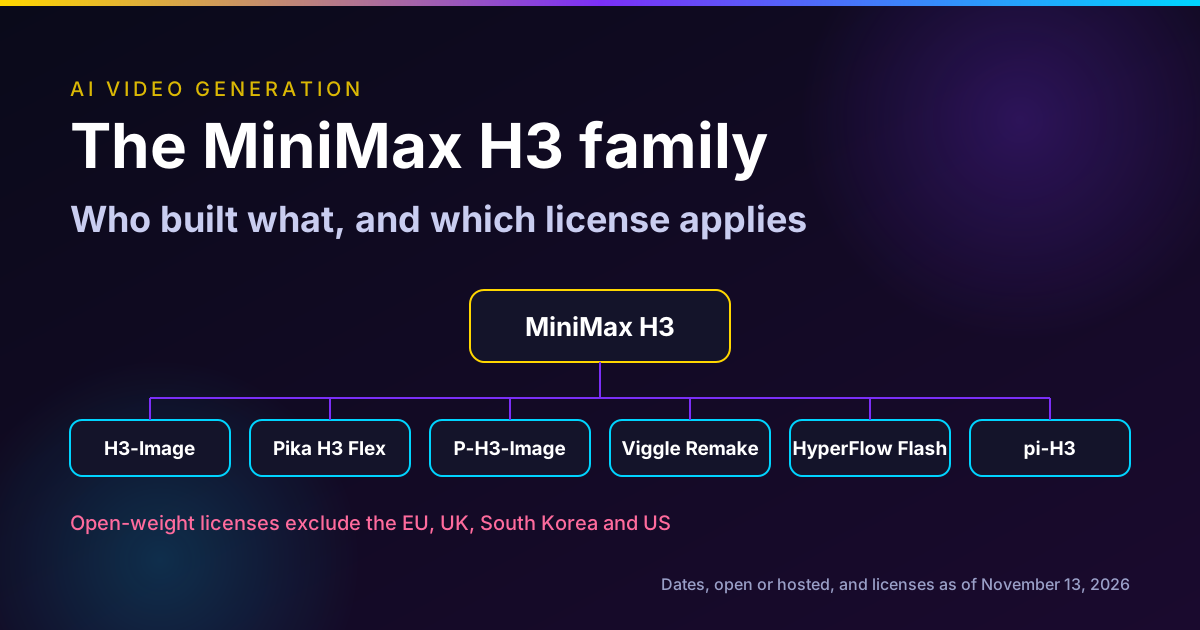
There is also a lighter cousin. Pruna AI's P-H3-Image, released November 3, is an image model built from the H3 video model, not from H3-Image. Pruna says its smallest set is a 20 GB download and runs 8 MP images in about 21 GB of VRAM. It carries the H3 license, so the same four regions are excluded. Our MiniMax H3 family map covers it and the other offshoots.
What the API costs
MiniMax bills H3-Image per million tokens, as of November 13, 2026.
| Model | Input text | Input image | Output image |
|---|---|---|---|
| MiniMax-H3-Image (Standard) | $2.30 | $1.50 | $3.80 |
| MiniMax-H3-Image-Highspeed | $2.30 | $3.00 | $7.60 |
MiniMax's own example costs per image, Standard model:
| Task | 1K | 2K | 4K (list) | 4K (launch offer) |
|---|---|---|---|---|
| Text-to-image | $0.02179 | $0.02333 | $0.06879 | $0.03439 |
| Edit with 1 reference | $0.02654 | $0.02658 | $0.07312 | $0.03656 |
| Edit with 3 references | $0.03563 | $0.04177 | $0.07914 | $0.03957 |
Highspeed examples run from $0.03529 at 1K to $0.13001 at 4K list, $0.06501 with the offer. MiniMax notes that real costs vary with the number of text tokens, including tokens added by prompt enhancement.
The launch offer is 50% off the whole request for both models when the delivered image has at least 16,600,000 pixels. It runs until November 17, 2026 at 16:00 UTC. A 4096x4096 image is 16,777,216 pixels, so it qualifies.
MiniMax also says its pricing is "50 to 70% of comparable mainstream offerings." For one reference point, Google lists Nano Banana 2.1 at about $0.113 per 4K image on the standard Gemini API tier, per its pricing page.
Compare models before you commit
Run one prompt across several image models in Oakgen Image Arena and see which output you would actually ship.
Where to use it
MiniMax API. The model ids are MiniMax-H3-Image and MiniMax-H3-Image-Highspeed, with text-to-image at /v1/images/generations and edits at /v1/images/edits. The guide also shows an OpenAI SDK example pointed at MiniMax's base URL.
Hailuo AI and MiniMax Code. MiniMax's launch post lists both. The Hailuo tool page we opened on November 13 said "model access depends on release and availability" and pointed to the image creator in your account, so it did not confirm access or price for us.
Hugging Face. Weights, examples and a demo Space are on the model page.
What I would do
If you are outside the excluded regions and under $1 million in revenue, with no hosted service, H3-Image is worth a local test. Use the ComfyUI INT8 build first. Put a detailed prompt in, check skin and text, and compare with your current model on ten real briefs.
If you are in the US, EU, UK or South Korea, do not grab the weights and hope. Either use the hosted API under MiniMax's platform terms, apply for a license, or pick another model. For 4K in a hosted tool, Nano Banana 2.1 is the documented alternative.
If you run a product with users, even outside the excluded regions, the hosted-service clause means you need MiniMax's written permission before you offer H3-Image to others. Plan for that lead time.
Common mistakes
Reading "open weights" as "use anywhere." The license is territorial, and it reaches outputs.
Forgetting the text encoder. The 66 GB transformer is half the story. The encoder adds another 66.7 GB at full precision.
Using short prompts locally. The API rewrites them for you. Your local server does not, unless you run the expander.
Assuming the launch price is the price. The 50% offer ends November 17 and only applies at 16.6 MP and above.
Planning cutouts on H3-Image. The API does not support transparent backgrounds.
Where Oakgen fits
Oakgen does not offer MiniMax H3-Image as of November 13, 2026, and we are not announcing it here.
What Oakgen does offer from this family is the MiniMax H3 video model for reference-to-video, in the AI video generator. It takes up to 9 reference images, 3 reference videos and 3 audio clips, makes 5 to 15 second clips with native audio, and Oakgen also uses it for its AI micro drama generator.
For still images at 4K, Oakgen offers Nano Banana 2.1 with up to 14 input images when editing. It is not 16 MP, and it does not run on your own hardware. It is the simpler choice if you are in an excluded region and want a hosted tool with prices shown upfront. For background on the bigger trade-off, see our post on open-source vs proprietary AI models, and for the copyright side, our AI image copyright law update.
Make H3 video, not just read about it
Turn character, scene and voice references into 5 to 15 second clips with MiniMax H3 in Oakgen's video generator.
FAQ
What is MiniMax H3-Image?
It is MiniMax's open-weight image model, released November 10, 2026. One checkpoint does text-to-image, reference-based generation and editing with up to 16 reference images. It outputs about 16 megapixels at every aspect ratio, from 4096x4096 to 6272x2688, without an upscaler, and samples in 6 steps.
Can I use MiniMax H3-Image in the US, EU, UK or South Korea?
Not under the open-weight community license. It grants rights only in an "Applicable Territory" that is worldwide minus the European Union, the United Kingdom, the Republic of Korea and the United States, and Section V.4 says you may not use, reproduce, modify, distribute or display the model or its outputs outside that territory. People there can apply to MiniMax for a separate license. MiniMax says its hosted API stays available globally under its own safeguards. This is a summary of the license text, not legal advice.
How big is MiniMax H3-Image to download?
The model card lists 66.28 GB for the transformer, 2.34 GB for the VAE and 66.7 GB for the text encoder, which is loaded from the MiniMax-H3 repository. That is about 135 GB before the optional 17.9 GB prompt expander. ComfyUI's INT8 build cuts the diffusion model to 21 GB and the text encoder to 25.28 GB.
How much does the MiniMax H3-Image API cost?
As of November 13, 2026, MiniMax's example costs for the Standard model are about $0.022 for a 1K text-to-image, $0.023 for 2K and $0.069 for 4K. Until November 17, 2026 at 16:00 UTC, images of at least 16.6 million pixels are 50% off, so a 4K image is about $0.034. The Highspeed model costs roughly twice as much per token.
Is MiniMax H3-Image really open source?
It is open-weight, not open source in the usual sense. You can download and run the weights, but the community license limits territory, requires MiniMax's written permission above $1 million in annualized revenue or for hosted services, requires commercial products to display "MiniMax-H3-Image", and bans using its outputs to improve other AI models.
Does MiniMax H3-Image make transparent PNGs?
Not through the API. MiniMax's API guide lists transparent backgrounds, masked edits and preview images as not supported.
Is MiniMax H3-Image on Hailuo AI?
MiniMax's launch post says H3-Image is available through the MiniMax API Platform, MiniMax Code and Hailuo AI. The Hailuo tool page we opened on November 13 did not confirm access or pricing, so check in your account.
Can I use MiniMax H3-Image in Oakgen?
No. As of November 13, 2026, Oakgen does not offer MiniMax H3-Image. Oakgen does offer the MiniMax H3 video model for reference-to-video, and for 4K images it offers Nano Banana 2.1.
Sources
- MiniMax, MiniMax H3-Image: Bringing 4K Image Generation into the 10-Second Era, 2026-11-10 (read 2026-11-13)
- MiniMax on Hugging Face, MiniMax-H3-Image model card, undated (read 2026-11-13)
- MiniMax on Hugging Face, MiniMax-H3-Image Community License Agreement, 2026-11-10 (read 2026-11-13)
- MiniMax on Hugging Face, Q&A About the License discussion, 2026-11-10 (read 2026-11-13)
- MiniMax API docs, Image Generation Guide, undated (read 2026-11-13)
- MiniMax API docs, Pricing Overview, undated (read 2026-11-13)
- Hailuo AI, H3 Image tool page, 2026-11-09 (read 2026-11-13)
- ComfyUI docs, MiniMax-H3-Image tutorial, undated (read 2026-11-13)
- MiniMax on Hugging Face, MiniMax H3 Community License Agreement, 2026-08-02 (read 2026-11-13)
- Pruna AI, P-H3-Image launch post, 2026-11-03 (read 2026-11-13)