ChatGPT
 Claude
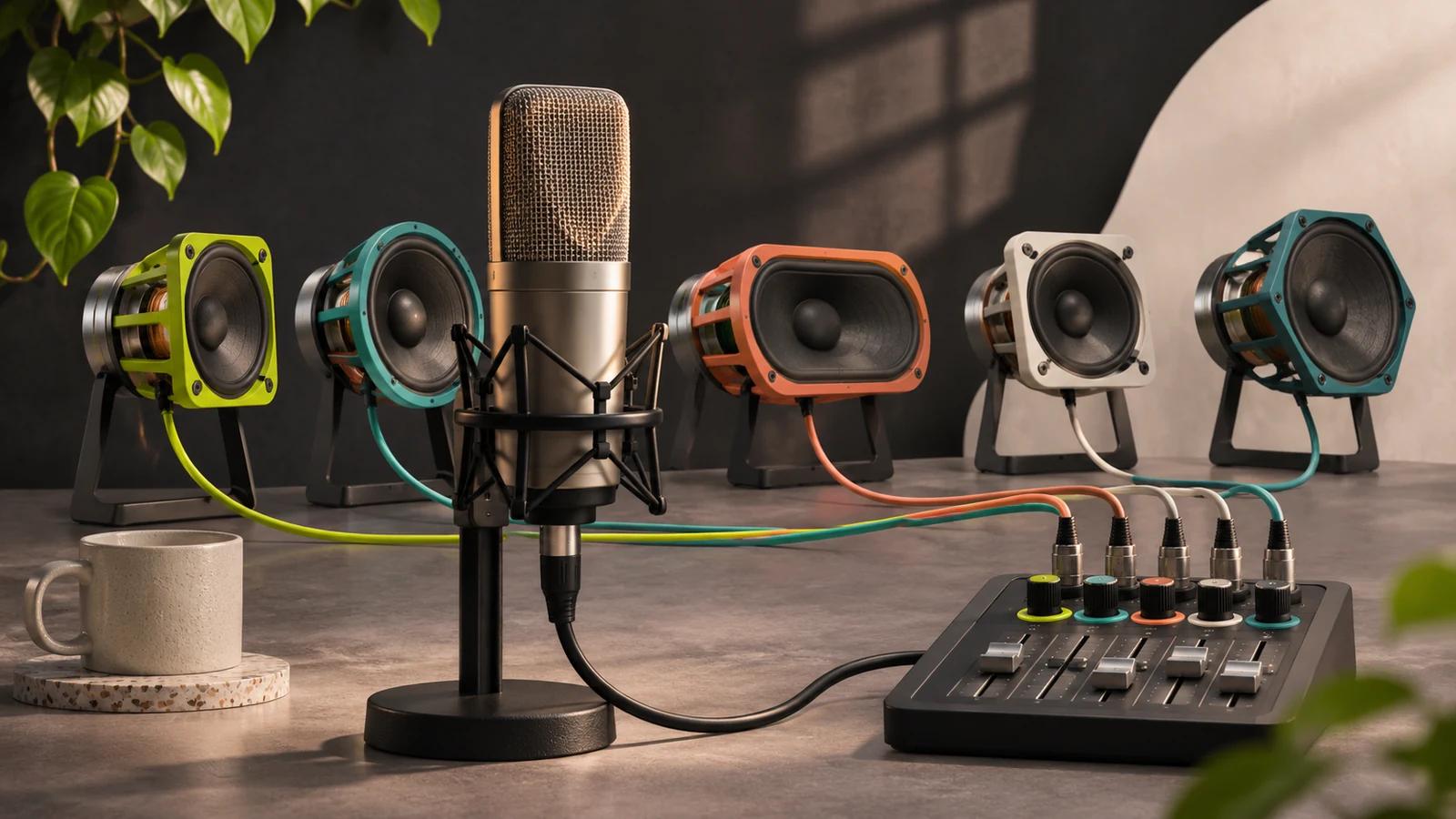
If you want an ElevenLabs alternative free of charge that you can also publish commercially, the clearest license path in November 2026 is an Apache-2.0 open-weight model you run yourself. Apache-2.0 allows commercial use with no revenue cap; if you redistribute the weights, keep the license and notices with them. Kokoro-82M suits English narration, Qwen3-TTS suits cloning a voice you own, and ZONOS3-Mini, released on November 12, 2026, covers 43 languages and runs in a browser.
If you cannot run code, Google's Gemini API has a free tier for several TTS models, under developer terms with data-use and regional rules (Gemini terms summary). ElevenLabs' own free plan still gives 10,000 credits a month, but it is non-commercial only (ElevenLabs terms summary).
Disclosure: Oakgen is our product. It has no free plan, so it is not ranked in the free list.
Need a voiceover you can use today?
Run ElevenLabs V4 or MiniMax Speech 2.8 HD in the Oakgen audio workspace and see the credit cost before you generate.
What are the best free ElevenLabs alternatives as of November 2026?
License and commercial-use terms for each free option. Each tool name links to the page behind its row, read on November 19, 2026.
| Tool | Type | Free access | License or free-plan terms | Commercial use | Languages | Voice cloning |
|---|---|---|---|---|---|---|
| Kokoro-82M | Open weights | Self-hosted | Apache-2.0 | Yes | 8 (v1.0) | No |
| Qwen3-TTS | Open weights | Self-hosted | Apache-2.0 | Yes | 10 | Yes, 3-second clip |
| ZONOS3-Mini | Open weights | Self-hosted or in browser | Apache-2.0 | Yes | 43 | Yes |
| Phonon 31m | Open weights | Self-hosted, on device | Apache-2.0 | Yes | English | Via Gradium Studio |
| Maya1 | Open weights | Self-hosted, one GPU | Apache-2.0 | Yes | Not stated on the card | Not documented, designs voices from text |
| Piper | Open engine | Self-hosted, offline | GPL-3.0 engine, voice rights from each voice's training data | Per voice; check each model card | 44 locales (voice list) | No |
| Chatterbox | Open weights, retired | Self-hosted | MIT archive | Yes, watermarked | 23+ (Multilingual V3) | Yes |
| Gemini API TTS | Hosted API | Free tier on 4 models | Gemini API terms | Developer terms with data-use and regional rules; Gemini terms summary | Over 130 (3.8 Flash TTS) | Paid tier only, with consent audio |
| ElevenLabs Free | Hosted app | 10,000 credits a month | Free plan terms | No, non-commercial only; ElevenLabs terms summary | 74 (pricing table) | Paid plans |
What changed since the 2026 edition?
Four things are different from our 2026 edition, last checked on October 25, 2026.
- Chatterbox is retired. Its GitHub README now says "As of August 2026, Chatterbox is retired research and is no longer maintained." The code stays public under MIT.
- Four permissive models join the list. Qwen3-TTS (released January 22, 2026), ZONOS3-Mini, Phonon 31m and Maya1 all ship Apache-2.0 weights.
- Fish Speech is now covered, under restricted licenses. The Fish Audio Community License covers the Fish Speech code and the Drama 3 weights, with a revenue cap, client and hosting limits and attribution duties; read the Drama 3 license summary before any commercial use. The older S2-Pro weights are under the Fish Audio Research License: research and non-commercial use only.
- Google set a paid-tier price rise. Its pricing page lists Gemini 3.8 Flash TTS audio output at $9.00 per million tokens through December 31, 2026, then $18.00, with no dated free-tier change.
How we checked this
On November 19, 2026 we read each vendor's own pricing page, license file, README or model card, linked inline; Cartesia's comparison was only a cross-check. We did not run these models or plans, so this compares access, licenses and documented features, not voice quality. Listen to official samples with your own script. Oakgen facts come from Oakgen's own pages and Terms.
What does the ElevenLabs free plan include in November 2026?
ElevenLabs Free is $0 with 10,000 credits a month, which the ElevenLabs pricing page estimates at about 10 minutes of text to speech.
The rights are the limit, not the minutes. The facts that decide commercial use, from the ElevenLabs help center as read on November 19, 2026:
- Free plan: no commercial use. "The free plan does not include a commercial license and cannot be used for any commercial purpose." Content created outside a paid subscription, before or after one, cannot be used commercially, so upgrading later does not clear it.
- Free plan: attribution. Published free-plan content must carry "elevenlabs.io" or "11.ai" in the title. For free-plan Eleven Music content, reference "Eleven Music" when distributing it.
- Paid plans. Paid plans include a commercial license, excluding Beta Services and subject to applicable product-specific terms in the Service-Specific Terms. You must also hold the rights to your content and follow the law, the Terms of Service and the Prohibited Use Policy. Whether paid content needs attribution depends on your agreement with ElevenLabs.
This is a summary, not legal advice. The terms have further conditions and use restrictions; read the ElevenLabs help page and the Terms it links in full before any commercial use.
Starter is the cheapest paid plan, at a list price of $6 a month for 30,000 credits as of November 2026. A Black Friday sale (a promo) runs to December 1, 2026 on the pricing page, so check the date before you compare sale prices.
The headline model is now Eleven v4, listed in the models docs with "90+ languages supported" and a 10,000 character limit per request (our v4 page). More free-plan detail is in our commercial-use guide.
Which open source TTS models can you use commercially?
Five open-weight models allow commercial use as of November 2026, plus Piper voices whose training data allows it and the unmaintained Chatterbox.
Kokoro-82M: the simplest free English narrator
The Kokoro-82M model card calls it "an open-weight TTS model with 82 million parameters" with "Apache-licensed weights". Its v1.0 release, published January 27, 2025, lists 8 languages and 54 voices.
Kokoro does not clone voices; you pick a preset. I would use it for explainer and course narration, not a character cast.
Qwen3-TTS: the permissive pick for cloning
Qwen3-TTS on GitHub is Apache-2.0 and comes in 0.6B and 1.7B sizes. The Base models clone a voice from a 3-second clip, VoiceDesign builds a voice from a written description, and CustomVoice offers 9 preset timbres. It covers 10 languages, including Chinese, English, Japanese, Korean and six European ones. The examples load on a CUDA GPU, so plan for one.
ZONOS3-Mini: the widest language coverage under Apache-2.0
The ZONOS3-Mini model card says it supports 43 languages, clones a voice from an audio sample, and runs "in real time on phones and laptops, including directly in the browser". The weights are Apache-2.0, and Zyphra's release post, published November 12, 2026, says its runtimes are MIT.
It is the newest model here, so expect fewer community guides. For Hindi, Tamil, Arabic or Vietnamese narration under a permissive license, start here.
Phonon 31m: a tiny English voice for apps
Gradium's Phonon blog post on Hugging Face, dated November 5, 2026, says "Phonon 31m is Apache 2.0, so you can use it for free, even in a commercial product." The phonon-31m-en card lists a 64.5 MB weights file and English only. The 40m models, a 40m English model plus French, German, Spanish, Portuguese and multilingual ones, are CC BY-NC 4.0: non-commercial only.
Phonon ships about 100 built-in voices; cloning and voice design happen in Gradium's hosted studio, which exports a voice file to load locally.
Maya1: voice design from a description
The Maya1 model card declares Apache 2.0 and about 3.3 billion parameters. You describe a voice in plain text and add inline tags such as whisper or laugh. It runs on a single GPU and documents voice design, not cloning.
Piper: offline, but check each voice
Piper is a fast local engine under GPL-3.0, and the Open Home Foundation is looking for maintainers. Its commercial use page says "The Piper project grants no license over voice models"; a voice's rights come from its training data and whoever trained it. The page lists voices with documented training-data rights, whose whole training chain allows commercial use, such as en_US-ljspeech-high (public domain). Check each voice's MODEL_CARD, where its licensing lives, and ship it with the voice. Many listed voices were retrained in late 2026, and a copy downloaded before the retrain does not qualify.
Chatterbox: still MIT, no longer maintained
Chatterbox Multilingual V3 covers 23+ languages and clones voices, and every file carries Resemble AI's PerTh watermark, according to its README. Existing projects can keep using it under MIT; I would not start a new one on it.
Skip the GPU setup
Generate narration with ElevenLabs and MiniMax voices in a browser, then turn it into video in the same account.
Which open models restrict commercial use?
Five popular downloads limit or bar commercial use as of November 2026, usually on the weights rather than the code. Four are non-commercial only; Drama 3 allows limited commercial use.
| Model | What the license says | What it means for a monetized video |
|---|---|---|
| XTTS-v2 (Coqui) | The Coqui Public Model License "allows only non-commercial use of a machine learning model and its outputs" | The audio inherits the restriction |
| F5-TTS | Code MIT, but the README says "The pre-trained models are licensed under the CC-BY-NC license" | Not for paid work with the official weights |
| Phonon 40m family | CC BY-NC 4.0 on the phonon-40m card | Non-commercial only; use the Apache-2.0 31m English model instead |
| Fish Audio Drama 3 | Restricted Community License: revenue cap, client and hosting limits, attribution duties | Read the Drama 3 summary below before any commercial use |
| Fish Audio S2-Pro | The Research License says "No commercial rights are granted under this Agreement" | Research license: research and non-commercial use only (summary below) |
Fish Audio Drama 3 and S2-Pro license summary
Drama 3. The Fish Audio Community License, version 1.0, updated October 13, 2026, covers the Fish Speech code, the Drama 3 weights and the audio codec, the codec solely for use with Drama 3 and its derivatives. It is not a non-commercial license, but commercial use is limited. As read on November 19, 2026:
- Research and non-commercial use is free. Commercial use is licensed only while your Annual Revenue, counting you and your affiliates together, is under USD 500,000. Once you reach it, only the commercial uses already under way continue, for a 90-day transition; after that, commercial use while at or above the cap needs a separate written license from Fish Audio.
- At any revenue, a Hosted Service needs a separate written license. The license defines it as making the model available so third parties can generate speech or other audio from text, audio or voice samples they supply, with a few listed exceptions.
- If you deploy, host or operate the model for a particular client, or give them a copy, that client must also be under the revenue cap. Delivering only finished audio you generate yourself, such as client voiceovers, falls outside that test.
- Distributing or making available the model, a derivative, or a product or service that uses them requires a prominent "Built with Fish Audio" display.
S2-Pro. The Fish Audio Research License, updated March 7, 2026, covers the S2-Pro weights: research and non-commercial use only. It says "No commercial rights are granted under this Agreement"; commercial use needs a separate written license from Fish Audio.
This is a summary, not legal advice. Both licenses have further conditions and use restrictions; read the Community License and the Research License in full before any commercial use.
Which hosted free tiers work without a GPU?
Six hosted services had a free tier on November 19, 2026. The consumer free plans (Cartesia, Fish Audio, ElevenLabs) are non-commercial; the developer APIs set rights in their own terms.
| Service | Free amount (list, Nov 2026) | Free-tier catch | Cheapest paid plan (list) |
|---|---|---|---|
| Gemini API TTS | Free tier on 3.8 Flash TTS, 3.8 Flash-Lite TTS, 3.1 Flash TTS Preview, 2.5 Flash Preview TTS | Data-use and regional rules; Gemini terms summary | Pay per token |
| Google Cloud TTS | 4 million characters (Standard, WaveNet), 1 million (Neural2, Chirp 3: HD, Studio) a month | Billing must be enabled | Pay per character |
| Azure Speech | 0.5 million Neural characters a month (F0) | Azure account required | Pay as you go |
| Cartesia | 20,000 credits a month, 1 credit per character | Commercial use license listed from Pro | Pro $5 a month |
| Fish Audio | 8,000 credits a month, up to 7 minutes | Personal, non-commercial only | Plus $15 a month |
| ElevenLabs | 10,000 credits a month, about 10 minutes | Non-commercial only; ElevenLabs terms summary | Starter $6 a month |
Google Cloud TTS has the largest free allowance, but its page says you "will be automatically charged if your usage exceeds the number of free characters". Set a budget alert first.
Gemini API terms: what the free tier allows
Google's speech generation docs list 30 prebuilt voices, an extended library of hundreds more, and over 130 languages for Gemini 3.8 Flash TTS. The Gemini API Additional Terms, effective March 23, 2026, call the free tier "Unpaid Services". The facts that decide whether you can build on it, as read on November 19, 2026:
- Who and where. It is for developers building for professional or business purposes, not consumer use. You must be 18 or older, and it cannot power an app directed towards or likely to be accessed by under-18s. Use it only in Google's available regions; apps offered to users in the EEA, Switzerland or the UK may use only Paid Services, which for the Gemini API means a Cloud project with an active billing account.
- Your data. On the free tier, Google uses what you submit and the responses to improve its products, human reviewers may read them, and the terms say "Do not submit sensitive, confidential, or personal information to the Unpaid Services."
- Output. Google won't claim ownership of generated content; you are responsible for your use of it and for its use by anyone you share it with.
- Cloning. Voice replication needs a paid-tier project plus consent audio from the same adult speaker, so it is not part of the free tier.
This is a summary, not legal advice. The terms have further conditions and use restrictions; read the Gemini API terms in full before any commercial use.
The free voice license check: six questions before you publish
- Is the license on the weights or plan commercial? Read the model card or the plan terms, not the code license. MIT code with CC-BY-NC weights is non-commercial.
- Does the license reach the audio? The Coqui license covers "its outputs". Some licenses only cover the model file.
- Is there an attribution rule? ElevenLabs Free and both Fish Audio licenses have one; see the ElevenLabs and Fish Audio summaries.
- Is there a revenue or usage cap? Drama 3 has a revenue cap plus client and hosting limits; read its summary before any commercial use. Hosted free tiers stop at a monthly allowance.
- Whose voice is it? A permissive model license does not give you rights to a person's voice. Clone only your own voice or one you have written permission to use.
- Who maintains it? A retired repo, like Chatterbox, gets no security or bug fixes. Write down the date you checked.
Route picker: which free option fits your situation?
| Your situation | Pick | Why | The catch |
|---|---|---|---|
| English narration for a monetized channel, you can run Python | Kokoro-82M | Apache-2.0, small, preset voices | No cloning |
| Clone your own voice, you have a GPU | Qwen3-TTS Base | Apache-2.0, 3-second clip | GPU needed |
| Non-English narration in Hindi, Arabic, Thai and similar | ZONOS3-Mini | 43 languages, Apache-2.0 | Brand new, fewer community guides |
| Voice inside a phone or offline app | Phonon 31m or Piper | Small, on-device | English only, or per-voice checks |
| No install, building an app prototype | Gemini API free tier | 130+ languages, voice design | Data-use and regional rules; Gemini terms summary |
| Personal listening, no publishing | ElevenLabs Free or Fish Audio Free | Polished apps | Non-commercial only |
Which free ElevenLabs alternative should you pick?
- Use Kokoro if you need one clean English narrator for videos you monetize and can follow a Python install.
- Use Qwen3-TTS if you want your own cloned voice under a permissive license and have a GPU.
- Use ZONOS3-Mini if your audience speaks a language outside Qwen3-TTS's 10, or you want to test cloning in a browser tab first.
- Use Gemini API TTS if you are a developer building an app or prototype and can work within its data-use and regional rules; read the Gemini terms summary first.
- Use Piper or Phonon 31m if the voice must work offline on a small device.
- Pay for ElevenLabs Starter if you need ElevenLabs' own voices, dubbing or Studio with a commercial license. Paid-plan rights exclude Beta Services and are subject to applicable product-specific terms (terms summary). At a $6 list price, it can cost less than your time spent on setup.
- Use a multi-format studio if the voiceover is one step in a video and you want voice, visuals and edit in one place.
Paid options are in our ElevenLabs alternatives hub.
What are the common mistakes with free TTS?
The most expensive mistake is reading the code license and ignoring the weights license, as with F5-TTS and XTTS-v2.
- Publishing ElevenLabs Free audio on a monetized channel. Free-plan audio is non-commercial only; read the ElevenLabs terms summary before you publish.
- Cloning a voice without the required permission or consent. A model license does not give you rights to a person's voice. The Drama 3 license bars imitating an identifiable person's voice without the required consent or another legal right (summary), and Gemini voice replication needs consent audio from the speaker (summary).
- Skipping pronunciation checks. Free models mispronounce names, acronyms and numbers. Our AI voice pronunciation guide has a fix list.
For a full rights walkthrough across free tools, see our free text-to-speech commercial use checklist.
Where does Oakgen fit, and where does it not?
Oakgen is not a free ElevenLabs alternative. It has no free plan, no signup credits and no trial, and generating needs a paid plan with credits. Current plan prices are on the pricing page.
It fits as the next step after free. The Oakgen audio workspace runs ElevenLabs V4, V4 Turbo, V3 and Multilingual V2 plus MiniMax Speech 2.8 HD from one credit balance. It also has voice cloning through MiniMax, for your own voice or one you have explicit permission to use. The credit cost appears before you generate, and credits for a failed generation go back to your balance automatically.
The same balance covers images, video and music, so a narration can go straight into the AI video generator or a talking photo. If your voiceover feeds a video, our Sora 2 replacements guide and the list of unlimited AI video generators in 2027 cover the video side.
Where another tool is the better choice:
- Zero budget. Use Kokoro, Qwen3-TTS or the Gemini free tier, within its terms. Oakgen costs money from the first generation.
- ElevenLabs' full product. Oakgen runs ElevenLabs speech models, but not ElevenLabs' Studio, Dubbing Studio or agents; for those, subscribe to ElevenLabs.
- Offline or on-device voice. Oakgen runs in the cloud. Piper or Phonon 31m work with no network.
- Training your own voice model. Oakgen offers no model training. Fine-tune Qwen3-TTS Base yourself instead.
On rights: eligible outputs can be used commercially under Oakgen's Terms and the model provider's terms, and Oakgen does not claim ownership of them; your right to use a voiceover commercially also depends on the law and your rights in the script and any reference voice. Our licensing guide explains section 4.4, and ElevenLabs vs MiniMax Speech compares the two providers.
Turn a script into a finished voiceover
Pick a voice, preview the credit cost, and export narration you can drop into a video edit.
Frequently asked questions
What is the best free ElevenLabs alternative in 2027?
It depends on how you will use the audio. As of November 2026, Kokoro-82M (Apache-2.0) is the clearest license path for English narration you run yourself, and Qwen3-TTS (Apache-2.0) is the permissive pick for voice cloning from a 3-second clip. If you cannot run code, Google's Gemini API has free-tier TTS for developers, but its terms carry data-use and regional rules. Read the Gemini terms summary in the hosted free tiers section of this post before you send scripts or ship an app.
Is Chatterbox still a good free ElevenLabs alternative?
It still works, but it is no longer maintained. The Chatterbox README says that as of August 2026 it is retired research, kept public as an MIT archive with no support or updates. The MIT license still allows commercial use, and every file it generates carries a PerTh watermark. For new projects, Qwen3-TTS or ZONOS3-Mini are newer alternatives with Apache-2.0 weights.
Can I use ElevenLabs' free plan commercially?
No. ElevenLabs' help center, read on November 19, 2026, says the free plan does not include a commercial license and cannot be used for any commercial purpose, and published free-plan content needs attribution. The commercial license comes with paid plans, starting at Starter, listed at $6 a month for 30,000 credits as of November 2026, excluding Beta Services and subject to applicable product-specific terms. Read the ElevenLabs terms summary in this post before any commercial use.
Which open source TTS models are free for commercial use?
Check the license of the weights, not only the code. As of November 2026, Kokoro-82M, Qwen3-TTS, ZONOS3-Mini, Maya1 and Phonon 31m ship Apache-2.0 weights, and Chatterbox is MIT. XTTS-v2, the F5-TTS pretrained models and the Phonon 40m models are non-commercial only. Fish Audio's Drama 3 weights are under a restricted license with a revenue cap, client and hosting limits and attribution duties; read the Drama 3 license summary in this post before any commercial use. Fish Audio's S2-Pro weights are under a research license: research and non-commercial use only.
Is Google Gemini text to speech free?
Partly. Google's Gemini API pricing page, read on November 19, 2026, lists a free tier for Gemini 3.8 Flash TTS, 3.8 Flash-Lite TTS, 3.1 Flash TTS Preview and 2.5 Flash Preview TTS, but not for 2.5 Pro Preview TTS. The free tier comes with data-use and regional rules in Google's Gemini API terms, and voice replication needs the paid tier. Read the Gemini terms summary in the hosted free tiers section of this post before you send scripts or ship an app.
Is Oakgen a free ElevenLabs alternative?
No. Oakgen has no free plan, signup credits or trial, so it is not a free option. It is a paid studio that runs ElevenLabs V4, V4 Turbo, V3 and Multilingual V2 plus MiniMax Speech 2.8 HD from one credit balance. Current plan prices are on Oakgen's pricing page.
Can I clone my own voice for free?
Yes, if you run an open model yourself. Qwen3-TTS Base clones from a 3-second clip and ZONOS3-Mini clones from a reference recording, both under Apache-2.0 weights as of November 2026. Clone only your own voice or one you have explicit written permission to use, and keep that permission on file.
Sources
- ElevenLabs pricing (read 2026-11-19)
- ElevenLabs help, can I publish the content I generate on the platform (read 2026-11-19)
- ElevenLabs models documentation (read 2026-11-19)
- Chatterbox on GitHub, Resemble AI (read 2026-11-19)
- Kokoro-82M model card, Hugging Face (read 2026-11-19)
- Qwen3-TTS on GitHub, Qwen team (read 2026-11-19)
- ZONOS3-Mini model card, Zyphra on Hugging Face (read 2026-11-19)
- Gradium, A closer look at Phonon TTS, Hugging Face blog (read 2026-11-19)
- phonon-31m-en model card, Gradium on Hugging Face (read 2026-11-19)
- Maya1 model card, Maya Research on Hugging Face (read 2026-11-19)
- Piper commercial use list, OHF-Voice on GitHub (read 2026-11-19)
- Piper supported languages, OHF-Voice on GitHub (read 2026-11-19)
- Coqui Public Model License, XTTS-v2 on Hugging Face (read 2026-11-19)
- F5-TTS on GitHub (read 2026-11-19)
- Fish Audio Community License, fish-speech on GitHub (read 2026-11-19)
- Fish Audio Research License, S2-Pro on Hugging Face (read 2026-11-19)
- Fish Speech README, fish-speech on GitHub (read 2026-11-19)
- Fish Audio plans (read 2026-11-19)
- Gemini API pricing, Google (read 2026-11-19)
- Gemini API Additional Terms of Service, Google (read 2026-11-19)
- Gemini API speech generation docs, Google (read 2026-11-19)
- Google Cloud Text-to-Speech pricing (read 2026-11-19)
- Azure Speech pricing, Microsoft (read 2026-11-19)
- Cartesia pricing (read 2026-11-19)
- Cartesia, Best open-source TTS models compared by license (read 2026-11-19)
- Zyphra, ZONOS3-Mini release post, Hugging Face blog (read 2026-11-19)
- Gemini API voice replication docs, Google (read 2026-11-19)
- ElevenLabs Service-Specific Terms (read 2026-11-19)
- phonon-40m-multilingual model card, Gradium on Hugging Face (read 2026-11-19)