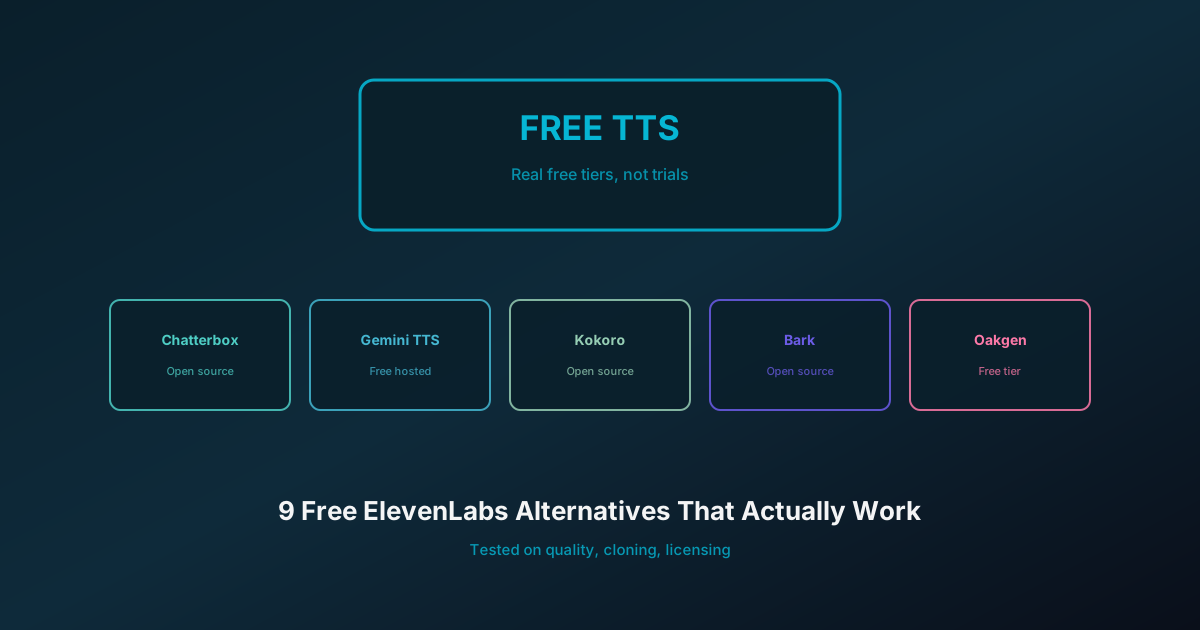
The best free ElevenLabs alternative depends on what you need after the voice is generated. Choose a hosted tool when you want the fastest test, an open-source model when you can manage local setup, or Oakgen when narration needs to move into an image or video workflow. Before publishing, verify two separate questions: whether the free tier still exists and whether its output can be used commercially.
That second question matters because ElevenLabs' own help center says its free plan does not include a commercial license. Its current pricing page lists 10,000 monthly credits on Free and puts the commercial license on Starter and above. The free plan remains useful for private evaluation, but it is not a free commercial voiceover plan.
This guide compares nine routes by free access, setup, voice control, and rights clarity. It does not pretend that a vendor's free plan or terms can never change. The details below were rechecked on August 13, 2026; verify the linked official terms again before a commercial release.
Generate a Voiceover, Then Build the Rest of the Asset
Use Oakgen's audio workspace for narration, then continue into image and video generation without rebuilding the creative brief.
"Free" can describe a demo, a recurring quota, open-source weights, or non-commercial access. Those are not equivalent. Record the plan, date, attribution requirement, and commercial-use status before you build a repeatable workflow around any tool.
The Shortlist by Job
| Your job | Start with | Why | Check before publishing |
|---|---|---|---|
| Voiceover that continues into image or video production | Oakgen AI voice generator | One creative workspace for voice, image, and video | Current plan, selected model, source rights |
| Local, technical, open-source experimentation | Chatterbox | Self-hosted model family with an MIT-licensed repository | Compute, model version, reference-voice consent |
| Fast personal prototype in a browser | A hosted free tier | Minimal setup | Export limit, attribution, commercial license |
| Monetized YouTube narration | A commercially licensed option | Rights are more important than the word “free” | Tool terms plus YouTube originality rules |
| High-volume or API production | A paid or self-hosted workflow | Predictable quota, formats, and automation | Cost per finished minute, retries, concurrency |
If commercial use is the deciding factor, read the dedicated ElevenLabs free-plan commercial-use guide and the free TTS commercial-use checklist. If cost is the blocker, use the ElevenLabs pricing and limits worksheet instead of comparing headline monthly prices.
For a two-model production decision, compare ElevenLabs with MiniMax Speech. If the model sounds right but misreads names, acronyms, prices, or codes, use the AI voice pronunciation workflow before changing models.
What "Free AI Voice" Actually Means
Before the list, three honest categories:
Category 1: Recurring free tiers on hosted platforms. These usually cap characters, minutes, models, downloads, or rights. A recurring quota is more useful than a one-time trial, but it can still be personal-use only.
Category 2: Open-source models you self-host. The software may have no subscription fee, but compute, setup, maintenance, and review still cost time. Check the code license, model license, and voice-reference rights independently.
Category 3: Freemium production platforms. These may be convenient for testing, while paid plans unlock commercial rights, cloning, higher-quality exports, or predictable capacity.
Most "free ElevenLabs alternative" lists conflate these. We'll call out which category each entry falls into.
The 9 Best Free ElevenLabs Alternatives, Ranked
1. Oakgen.ai (Best for a Connected Creative Workflow)
Category: Hosted all-in-one creative platform.
Best for: Creators who want voice generation plus image and video production in one account
Oakgen is most useful when speech is one layer of a larger asset. Write and generate narration in the audio workspace, then create the supporting image or video without managing a separate production stack. That makes it a practical starting point for a product demo, short-form explainer, ad concept, or narrated social clip.
- Workflow: Hosted voice generation connected to Oakgen's image and video tools
- Voice options: Available models and controls are shown in the current audio interface
- Commercial use: Depends on the Oakgen plan, selected provider, applicable terms, and rights in source material
- Setup: Browser-based; no local model installation
For a real project, start in the Oakgen audio workspace, generate a short audition, and review the current quote and terms before a larger batch.
2. Chatterbox (Open Source)
Category: Open-source, self-hosted model family.
Best for: Developers and technical creators who prefer local control over a hosted subscription
Chatterbox is a family of open-source TTS models maintained by Resemble AI. Its official repository lists English, multilingual, low-latency, and smaller CPU-oriented variants and publishes the repository under the MIT license. That makes it worth evaluating if you are comfortable running models yourself.
- Installation: Follow the current official repository instructions
- Voice cloning: Supported by parts of the model family; only use authorized reference audio
- Languages: Varies by model version
- License: Check the repository, selected weights, and dependencies for the version you deploy
- Hardware: Depends on the model; smaller variants reduce local resource requirements
For developers or technical creators, the tradeoff is clear: more control and no hosted subscription, in exchange for installation, compute, updates, and production responsibility.
3. Google Gemini TTS (via AI Studio)
Category: Hosted developer tools with current free-tier options.
Best for: Quick TTS for content creators who don't want to install anything
Google exposes speech-generation capabilities through Gemini developer tools. It is a useful route for developers already working in that ecosystem, but model access, free-tier availability, quotas, and output terms can differ by product and region. Check the current Gemini API pricing and terms before building around it.
- Pricing: Check the current Gemini Developer API pricing page
- Voice cloning: No
- Languages: Varies by model
- Commercial use: Subject to Google's current terms and your source rights
- Setup: Browser or API workflow, depending on the selected product
4. Kokoro (Open Source)
Category: Open-source, self-hosted model.
Best for: Creators who need lightweight, fast TTS for batch content
Kokoro is a lightweight open TTS route worth evaluating when local inference and simple narration matter more than a hosted production suite. Because multiple repositories, weights, and wrappers use the Kokoro name, evaluate the exact package you plan to deploy rather than relying on a generic license summary.
- Installation: Follow the selected model repository or package instructions
- Voice cloning: Limited
- Languages: Depends on the selected weights and voice pack
- Hardware: Benchmark the exact model on your target machine
- License: Check code, weights, and voices separately
5. GPT-SoVITS (Open Source)
Category: Open-source, self-hosted project.
Best for: Creators who need very high-quality voice cloning from short samples
GPT-SoVITS is designed for reference-led speech synthesis and voice cloning. It offers more control than a basic preset-voice reader, but that also creates more responsibility: use only reference recordings you own or are explicitly authorized to process.
- Voice cloning: Reference-led; quality depends on the sample and setup
- Languages: Depends on the current project release
- Setup complexity: Moderate (technical users)
- License: Check the current repository, weights, and dependencies
6. Bark (Open Source)
Category: Open-source, self-hosted model.
Best for: Creative content with music, laughter, and emotional effects
Bark is a generative audio model associated with expressive speech and non-speech cues. That can make it useful for experimentation, but less predictable than a production narrator when exact wording, timing, or pronunciation must remain stable.
- Voice variety: Pre-trained speakers plus creative modes
- Non-speech audio: Yes (laughter, music, effects)
- Commercial use: Check the code, model weights, and selected voice inputs
- Setup: Self-hosted Python workflow
7. Resemble AI Voice Creation
Category: Hosted voice-creation product plus an open-source Chatterbox route.
Best for: Creators who specifically need a cloned voice without paying
Resemble AI offers hosted speech and voice-cloning products. Treat any free access as an evaluation tier until its current pricing and terms confirm the minutes, export rights, and commercial permissions you need.
- Voice cloning: Available in the product; confirm current plan access
- Commercial use: Check plan terms
- Setup: Web signup, no install
8. Narration Box
Category: Hosted narration product with a free starting path.
Best for: Browser-based narration and voice auditioning
Narration Box is a hosted narration option with a large preset-voice catalog. It may suit users who prefer auditioning voices in a browser rather than installing a model, but current quotas and commercial-use terms should be checked directly.
- Voice library: Broad preset catalog; confirm the current count in-product
- Voice cloning: Confirm current plan access
- Commercial use: Check plan terms
9. NaturalReader
Category: Personal-use reader with separate commercial products.
Best for: Reading articles aloud and accessibility use cases
NaturalReader is less about content production and more about text-to-speech consumption -- reading articles, web pages, and documents aloud. Its help center says the Personal Version is for private listening and that shared or published audio requires its separate commercial product. It is a practical choice for accessibility-oriented workflows, but not a free commercial voiceover route.
- Use case: Reading text aloud, accessibility
- Voice variety: Moderate
- Apps: Web, mobile, Chrome extension
Full Comparison
| Tool | Category | Voice Cloning | Commercial Use | Languages |
|---|---|---|---|---|
| Oakgen | Hosted creative suite | Plan dependent | Check plan + provider terms | Model dependent |
| Chatterbox | Open source | Model dependent | Check code + weights + inputs | Model dependent |
| Google Gemini TTS | Hosted developer tools | No | Check Google terms | Model dependent |
| Kokoro | Open source | Limited | Check code + weights + voices | Weights dependent |
| GPT-SoVITS | Open source | Reference led | Check code + weights + consent | Release dependent |
| Bark | Open source | Preset/reference options | Check code + weights + inputs | Model dependent |
| Resemble AI | Hosted + open source | Product feature | Check product + model terms | Product dependent |
| Narration Box | Hosted | Plan dependent | Check current plan | Plan dependent |
| NaturalReader | Hosted/apps | No | Personal version is private-use only | Plan dependent |
| ElevenLabs (reference) | Freemium | Paid-plan feature | Free is non-commercial | Model dependent |
Which Free ElevenLabs Alternative Fits Your Use Case
For creators producing full content (video + voice + music) in one tool → Oakgen. You can keep the narration and visual workflow in one account.
For developers who want an actively maintained open-source family → Chatterbox. Compare the exact model version and local cost before committing.
For developers already using Gemini tools → Google's speech-generation workflow. Check the current model, pricing, and terms first.
For local batch TTS experiments → Kokoro. Benchmark throughput and stability on your own target hardware.
For reference-led voice experimentation → GPT-SoVITS. Reference quality, permission, and setup matter as much as model choice.
For expressive generative-audio experiments → Bark. Expect more variation than a tightly controlled production narrator.
For hosted voice cloning → Resemble AI. Confirm the current plan and permissions first.
For browser-based voice variety → Narration Box. Confirm the current free quota and commercial-use terms.
For accessibility (reading text aloud) → NaturalReader.
When to Upgrade from Free
Free tiers work until they don't. Upgrade to paid when:
- Generation volume exceeds the free quota consistently. If you keep rationing scripts or splitting projects across accounts, compare cost per approved minute instead of clinging to a $0 headline.
- You need commercial rights clarified. Some free tiers limit commercial use. A paid plan can make the license clearer, but you still need rights in the script and any reference voice.
- Voice quality matters for conversion. For sales content or client deliverables, run a controlled audition on the exact script rather than assuming one model wins every language and delivery style.
- You need an integrated workflow. Oakgen plans use one account and credit balance across voice, image, video, and other creative tools. Compare the current Oakgen pricing with the total cost of the separate tools you would otherwise keep.
See our deeper guides: ElevenLabs vs Google TTS for podcasts, best AI text-to-speech of 2026, and ElevenLabs alternatives hub.
A practical hybrid is to use an authorized local model for rough auditions and a hosted workflow for approved production. Measure the pattern by cost per finished minute, editing time, and rights clarity—not the number of free generations.
Common Free TTS Questions
Can I use free TTS for YouTube monetization? It depends on both licenses and content quality. Confirm the selected tool permits commercial use, use only authorized voices, and make the finished video original enough to satisfy YouTube's monetization rules.
Does voice cloning work on free tiers? Access varies by tool and plan. Even when the feature is available, only clone a voice you own or have explicit permission to use.
How do free tools compare to ElevenLabs for voice quality? Results vary by script, language, voice, and settings. Use the same test passage and score pronunciation, pacing, emotion, noise, long-form stability, and editing time.
Can I self-host ElevenLabs? No -- ElevenLabs is proprietary. But the top open-source alternatives (Chatterbox, Kokoro) are self-hostable.
Test a Real Voiceover in Oakgen
Use the exact script you plan to publish, compare the available voice options, and continue into image or video production from the same workspace.
Official Sources Checked
- ElevenLabs pricing — current plans, credits, and included TTS minutes
- ElevenLabs publishing and commercial-use guidance — free-plan and paid-plan licensing summary
- Chatterbox official repository — current model family, setup, and repository license
- Gemini Developer API pricing — current API pricing and free-tier details
- Gemini TTS documentation — current speech-generation workflow
- Kokoro official repository — project and model-card links
- GPT-SoVITS official repository — current setup and repository license
- Bark official repository — model behavior and repository license
- Resemble AI Voice Creation — current hosted and Chatterbox voice-creation routes
- Narration Box — current product and free-starting-path details
- NaturalReader Personal Version guidance — personal-use restrictions and commercial-product distinction