No. You cannot use ElevenLabs’ free plan commercially. ElevenLabs’ current help documentation says the free plan has no commercial license, and its terms limit free users to non-commercial purposes. Adding attribution does not change that. If the narration will appear in an ad, paid client project, sponsored post, monetized channel, product, course, or other revenue-linked work, generate the final audio while an eligible paid plan is active and keep evidence of the plan and terms.
ElevenLabs also says paid-plan output may be used commercially after the subscription ends, provided the output was generated during the paid period and the use follows its terms. Beta services are a notable exception.
Want to test voices before choosing a production route? Compare scripts in Oakgen’s audio workspace, then confirm the model-specific commercial terms before the final render.
This guide summarizes published provider terms; it is not legal advice. AI voice terms change. Check the live terms for your account, region, model, selected voice, and use case before release.
The short answer by situation
| Situation | Commercial use? | What to do |
|---|---|---|
| Audio generated on ElevenLabs Free | No | Keep it non-commercial or regenerate under an eligible paid plan |
| Free audio published with attribution | Still no | Attribution satisfies the free publishing condition; it does not create commercial rights |
| Audio generated during an eligible paid subscription | Generally yes | Keep the invoice, generation date, and applicable terms |
| Audio generated free, then account upgraded later | No retroactive license stated | Regenerate the final file while the paid plan is active |
| Audio generated with a Beta Service | Not for commercial or production use | Choose a production-eligible feature and regenerate |
| Cloned or third-party voice | Plan license alone is insufficient | Document consent and rights to the voice and source material |
This distinction is easy to miss because the free plan lets you create audio. Technical access is not the same as permission to commercialize the output. The account tier answers one question; the voice, script, likeness, and distribution rights answer several others.
What ElevenLabs actually says
This article was researched from ElevenLabs’ official pricing page, billing documentation, publishing help article, and terms. We did not infer the license from a pricing-table screenshot or test output quality.
The official guidance establishes five practical rules:
- Free-plan output is non-commercial. ElevenLabs’ terms say a free user may use the service only for non-commercial purposes.
- Public free output needs attribution. The help article instructs free users who publish output to attribute ElevenLabs using the specified naming, with a separate note for free Eleven Music output.
- Attribution does not replace a license. The same article separately says the free plan cannot be used for a commercial purpose.
- Paid-plan output keeps its commercial status. ElevenLabs says content generated during a paid subscription can be used commercially and indefinitely, subject to the agreement and applicable restrictions.
- Beta output is different. Its help guidance says Beta Services output cannot be used commercially or in a production environment.
The Starter tier is the first public creative subscription that ElevenLabs’ pricing page lists with a commercial license. That does not mean every possible use is automatically cleared. You still need rights to the script and voice, and the output must comply with the provider’s prohibited-use policy and applicable law.
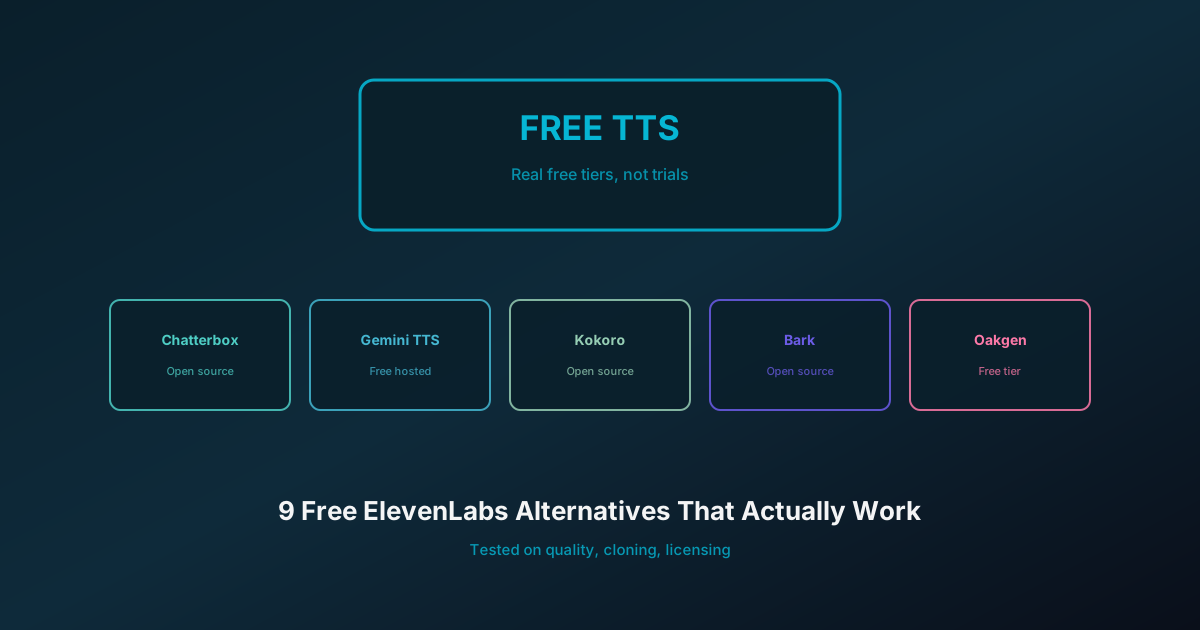
For a broader tool comparison, use our free ElevenLabs alternatives guide. If the license matters more than the brand name, the companion guide to free text-to-speech with commercial use separates genuinely commercial routes from non-commercial free plans.
What counts as commercial use?
ElevenLabs’ public guidance gives the governing rule but does not provide an exhaustive list for every creator business model. A useful working test is: does the audio help a person or organization earn money, sell something, fulfill paid work, market a business, or operate a product? If yes, treat it as commercial unless the provider confirms otherwise in writing.
Common examples include:
- narration on a monetized YouTube channel;
- a sponsored TikTok, Reel, podcast, or newsletter;
- an ad for your own or a client’s product;
- a paid course, audiobook, game, app, or membership;
- client deliverables produced by an agency or freelancer;
- an internal company training module used in business operations;
- a sales demo, product tour, phone system, or customer-support agent.
A private classroom experiment, personal prototype, or non-monetized creative test may be non-commercial, but context matters. A “test” embedded in a sales presentation may already support a business purpose.
Here is where this breaks: creators often decide based on the destination account rather than the purpose. A channel can be unmonetized today and still contain sponsored links, promote a paid service, or form part of a client campaign. Do not use the platform’s monetization toggle as your only license test.
Use free output for evaluation. Once the script, voice, pronunciation, and pacing are approved, generate a fresh final file through a route that explicitly covers your commercial use.
Does attribution make free output commercially usable?
No. Attribution and commercial permission are separate conditions.
ElevenLabs asks free users to include its specified attribution when publishing free output non-commercially. That tells the audience where the audio came from. It does not upgrade the account, turn a non-commercial license into a commercial one, or clear rights to a cloned voice.
The same mistake appears with open-source software. A license notice may be required even when commercial use is allowed. Conversely, giving credit does not cure a license that prohibits commercial use. Always read the permission clause first and the attribution or notice clause second.
Can you upgrade later and commercialize old free audio?
Do not assume so. ElevenLabs’ publishing guidance says content created outside a paid subscription cannot be used commercially. The clean workflow is to upgrade first, then regenerate the final narration while the eligible subscription is active.
That means keeping the original script and settings is useful. You can reproduce the approved read without trying to transform an old MP3 into a supposedly new asset.
Record these items with the final export:
- the generation date and time;
- the account and active plan;
- the model and feature used;
- whether the feature was marked beta;
- the selected voice and its source;
- the final script version;
- consent or contract for a cloned voice;
- a PDF or screenshot of the applicable terms;
- the downloaded master file and project ID.
If you create voiceovers repeatedly, Oakgen’s audio tools can keep model testing in one creative workflow. The final release check still belongs to you: verify the current commercial terms attached to the chosen route instead of assuming every model in a multi-model workspace shares one license.
Can paid-plan audio remain in a project after cancellation?
ElevenLabs says content generated during a paid subscription can be used commercially and indefinitely. That is valuable for a published video, game build, course, or ad that stays live after a subscription ends.
The generation date is therefore more important than the editing date. You may cut, mix, and publish later, but your evidence should show the source audio was created during the paid period.
There are still four boundaries:
- You must have the necessary rights to the input text and other supplied material.
- The voice must be used with appropriate authorization.
- The content and distribution must follow the terms and prohibited-use policy.
- A special product, beta feature, voice-library listing, or negotiated agreement may add restrictions.
If you plan to clone a voice, read the voice cloning ethics and use-cases guide before production. The account license is not consent from the person whose voice you copied.
The commercial voiceover clearance packet
This is the reusable asset I would keep for every paid narration job. One row per final master is enough.
| Clearance item | Evidence to save | Pass condition |
|---|---|---|
| Provider and route | Product page or API/model name | Exact service identified |
| Account tier | Invoice, receipt, or billing screenshot | Commercially eligible on generation date |
| Feature status | Product documentation screenshot | Not a restricted beta or preview |
| Generation record | Timestamp, project ID, output ID | Final master traces to eligible generation |
| Script rights | Authorship record or client approval | You may use and publish every line |
| Voice rights | Stock-voice terms or signed consent | Voice is authorized for this purpose |
| Distribution | Ad, podcast, app, course, game, client file | License covers the actual channel |
| Territory and duration | Campaign brief or contract | No conflict with voice agreement |
| Disclosure | Platform and legal review | Required synthetic-media notice prepared |
| Archive | Terms PDF, audio master, approvals | Evidence can be retrieved later |
This takes five minutes when done during generation. Rebuilding it after a takedown notice or client question takes much longer.
A practical workflow for creators and agencies
1. Use free access only for voice selection
Test a short paragraph containing the brand name, numbers, difficult terms, and one emotional sentence. You are evaluating pronunciation and fit, not producing the final deliverable.
2. Decide the real distribution before rendering
Write down where the audio will go: a monetized channel, paid ad, client project, app, course, or internal presentation. “Social” is too vague because an organic personal post and a sponsored brand video carry different risk.
3. Move to a commercially eligible route
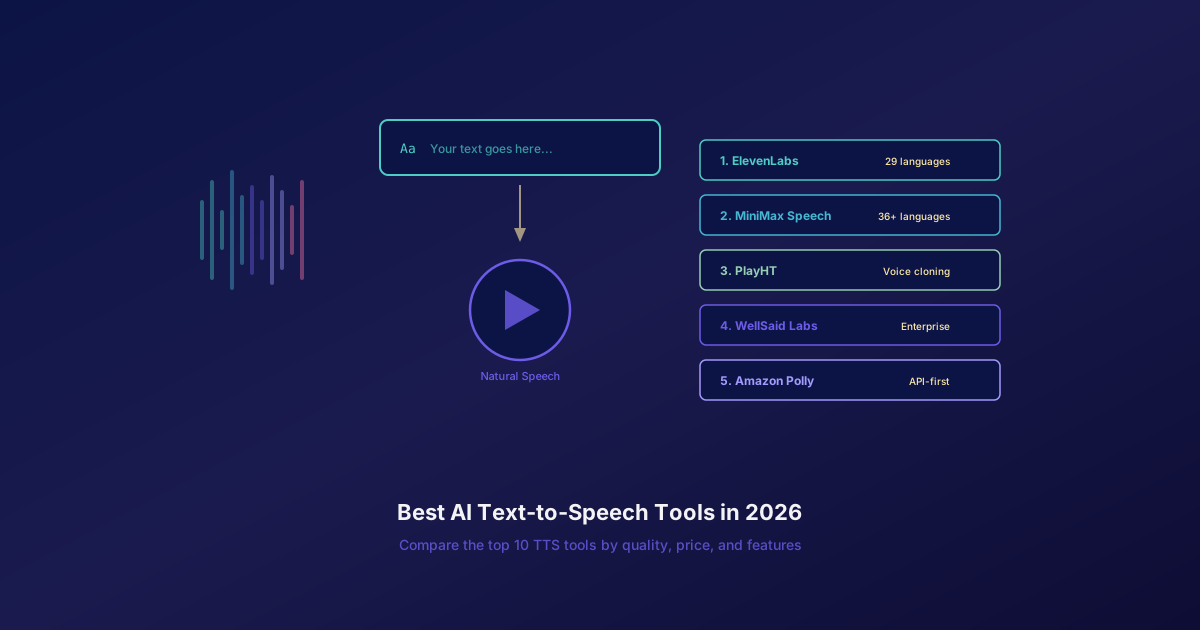
Confirm the current plan includes commercial use. If you need to compare other engines before paying, our best AI text-to-speech tools guide maps options by workflow rather than pretending one tool wins every job.
4. Clear the voice and script
Do not clone a customer, employee, performer, or public figure without the required permission. A provider accepting the upload does not prove you own it. Use a written agreement that covers synthetic generation, purpose, channels, territory, duration, and revocation or takedown handling.
5. Generate a fresh final master
Render the approved script while the eligible account is active. Save a lossless master when available, plus the distribution copy. Record the model, voice, settings, and date.
6. Review the actual publication
Check the final mix for accidental claims, misleading impersonation, and required disclosures. If a platform, jurisdiction, client, union agreement, or ad policy imposes stricter rules, follow the stricter rule.
Try the same script across voice options in Oakgen’s audio workspace, then put the selected final route through the clearance packet above.
Common mistakes
“It is free, so it is royalty-free”
Price and permission are different. A free allowance can have commercial rights, non-commercial rights, or no grant that fits your use.
“I credited ElevenLabs, so the ad is fine”
Attribution does not supply the missing commercial license.
“I upgraded before publishing”
The relevant event is generation. If the final audio was made on Free, regenerate it during the eligible paid period.
“The voice was in the library, so every use is cleared”
Check the current listing and provider rules. Never assume a public voice authorizes impersonation, endorsement, political persuasion, or deceptive use.
“The client is responsible for rights”
Your contract may allocate responsibility, but you still need a workflow that prevents unlicensed assets from reaching the client. Put the evidence packet in the project folder before delivery.
Frequently asked questions
Can I use ElevenLabs’ free plan for commercial projects?
No. ElevenLabs says its free plan does not include a commercial license and free users may use the service only for non-commercial purposes.
Can I monetize a YouTube video made with ElevenLabs Free?
Do not use a free-plan render as the final narration for a monetized video. Generate a fresh final file under an eligible paid plan and save evidence of the active plan and generation date.
Does attribution make ElevenLabs Free commercially usable?
No. Attribution is a condition for publishing free output non-commercially. It does not create commercial rights.
Can I upgrade later and use an old free render commercially?
ElevenLabs says content created outside a paid subscription cannot be used commercially. Regenerate the final audio after upgrading.
Can I use paid-plan output after I cancel?
ElevenLabs says content generated during a paid subscription can be used commercially and indefinitely, provided the use complies with the agreement, intellectual-property requirements, and applicable restrictions.
Are beta features included in the paid commercial license?
Not automatically. ElevenLabs’ help guidance says Beta Services output cannot be used commercially or in production. Verify the feature status.
Do I own a cloned voice because I paid for generation?
No. Paying for a service does not give you another person’s voice or likeness rights. Get the appropriate consent and document the allowed uses.
Sources and further reading
- ElevenLabs: Can I publish the content I generate?
- ElevenLabs Terms of Service
- ElevenLabs billing documentation
- ElevenLabs pricing
- Free text-to-speech commercial-use guide
- AI voice cloning and text-to-speech guide
Generate the final voiceover with a license trail
Use Oakgen’s audio workspace to compare voice options, keep the approved script stable, and generate the production take. Before you publish, save the provider, model, plan, terms, generation date, and voice authorization in the clearance packet. That is the difference between “I think this is allowed” and a commercial asset you can defend.