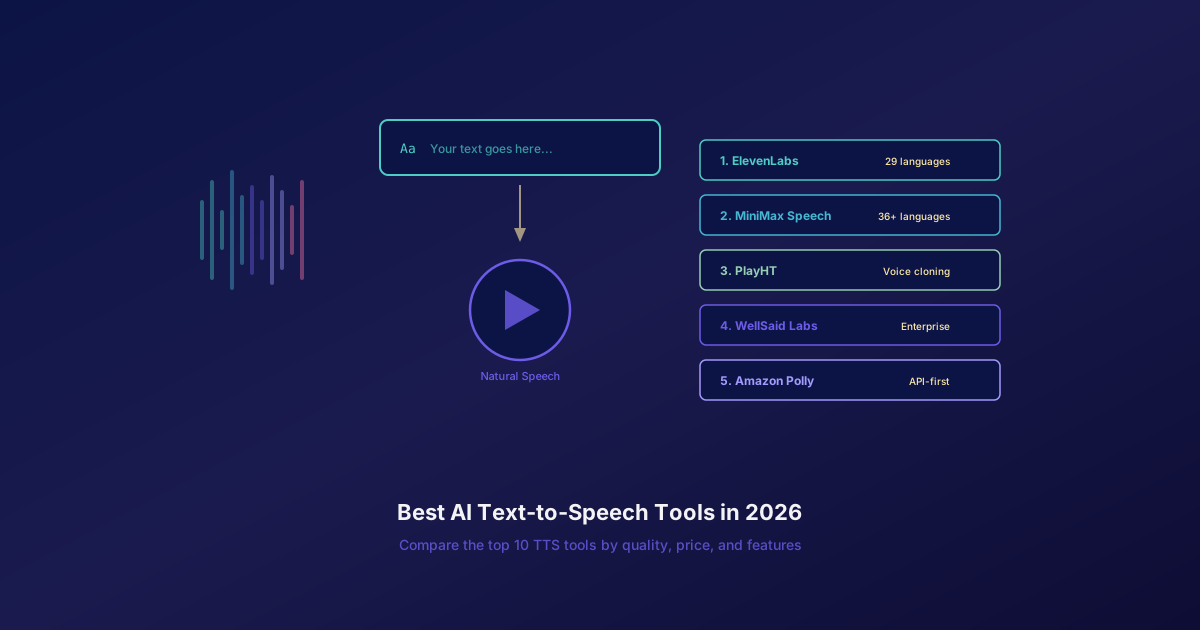
ElevenLabs vs MiniMax is a job-based choice, not a universal ranking. ElevenLabs is the stronger starting point when you need a large preset-voice workflow, expressive model options, low-latency speech, or formal pronunciation dictionaries. MiniMax deserves the first test when you need a rapidly cloned voice, wider pitch and speed ranges, language boosting, or a long-text API workflow. For a real project, render the same difficult script in both and score the accepted output—not the best demo on either homepage.
You can run this comparison in Oakgen's AI audio workspace, where voice generation sits beside the rest of a creative production workflow.
Oakgen is our product. We include it because it offers a practical way to use AI voice generation inside a broader creative workflow. This comparison was researched from current ElevenLabs and MiniMax documentation on August 13, 2026. We did not run a controlled listening test for this article, so we do not present subjective quality scores as fact.
ElevenLabs vs MiniMax: the quick recommendation
| Production job | Start with | Why | Verify before shipping |
|---|---|---|---|
| Expressive ad or character read | ElevenLabs | Eleven v3 is documented for expressive speech | Performance consistency across every line |
| Cloned founder or creator voice | MiniMax or ElevenLabs | Both document cloning workflows | Consent, sample quality, identity stability |
| Names, acronyms, technical terms | ElevenLabs | Pronunciation dictionaries support aliases and compatible phoneme rules | Every high-risk token in context |
| Pitch and broad speed changes | MiniMax | Its API exposes pitch, speed, and volume controls | Artifacts at extreme settings |
| Latency-sensitive app | ElevenLabs Flash | Official docs describe Flash v2.5 as a low-latency model | End-to-end latency in your own stack |
| Very long text by API | MiniMax | Its async T2A route accepts long-text tasks | Chapter joins, pronunciation drift, file handling |
| One voice inside a full creative campaign | Oakgen | Audio can stay beside image, video, and music work | Exact controls exposed by the selected provider |
This table is a shortlist, not a verdict. A documentary narrator, a real-time assistant, and a multilingual product ad have different failure conditions. The mistake is choosing a provider before defining the job.
Who this comparison is for
This guide is for creators, agencies, course teams, product marketers, and developers deciding where a script should go next:
- “I need one recognizable voice across a weekly channel.”
- “This script contains product names, version numbers, and acronyms that cannot be wrong.”
- “I need forty localized variations, not one hero take.”
- “The voice must react quickly inside an application.”
- “I already generate video and music; I do not want another disconnected production folder.”
If you need a wider market view first, read our best AI text-to-speech guide. If the problem is specifically pronunciation, use the AI voice pronunciation guide before judging either model.
Methodology: compare capabilities, then test the brief
We separated documented capabilities from production recommendations.
The documented layer comes from current model, TTS, cloning, and API pages. The recommendation layer asks whether a producer can repair a name, preserve a voice across languages, or deliver a clean file on deadline.
We did not treat provider marketing benchmarks as our own test results. We also avoided a fixed price winner because plans, included credits, and model rates change. A defensible cost comparison uses the same script, output format, and acceptance standard.
Model choice matters more than the provider logo
“ElevenLabs” and “MiniMax” each contain several speech models. Comparing only company names hides the decision that changes the output.
ElevenLabs' current model catalog lists Eleven v3 for expressive speech across 70-plus languages, Multilingual v2 for stable multilingual quality across 29 languages, and Flash variants for lower-latency work. Its product guide also says voice selection has the largest effect, followed by model selection and then settings. That ordering is useful: do not spend an hour tuning sliders around a voice that is wrong for the brief.
MiniMax's current API overview lists Speech 2.8, Speech 2.6, and Speech-02 HD and Turbo routes. It exposes synchronous and WebSocket T2A, asynchronous long-text generation, voice cloning, and voice design. On Oakgen today, the MiniMax path is focused on generating with a cloned voice through Speech-02 HD, while ElevenLabs provides the preset-voice TTS path.
If you need to audition established voices quickly, start in ElevenLabs. If the asset is a voice you are authorized to clone, MiniMax may fit sooner.
Test the Same Script in Both Voice Workflows
Keep the script fixed, change the voice path, and compare the accepted audio instead of relying on demos.
Voice quality: define what “better” means
“Natural” is too vague for a useful comparison. Break quality into five checks:
- Intelligibility: Can a listener transcribe names, numbers, and actions correctly?
- Prosody: Do emphasis, pauses, and sentence endings fit the meaning?
- Identity: Does the selected or cloned voice remain recognizable across paragraphs?
- Continuity: Do separately rendered lines sound like the same session?
- Repairability: Can you fix one failed token without rebuilding the entire performance?
ElevenLabs provides stability, similarity, style, speaker boost, and speed controls in the Oakgen form. Its own guide notes that output is non-deterministic, so a setting is a range rather than a promise of identical rerenders. That is good reason to save the accepted take and its settings together.
MiniMax exposes speed, pitch, volume, and language boosting in its documented API. Oakgen's current MiniMax controls cover a broad speed range, pitch in semitone steps, volume, and language selection. Those controls are useful when a cloned performance needs to sit inside an existing edit, but extreme values still need a listening check.
My practical recommendation: use the smallest control change that solves the problem. If a voice feels wrong at neutral settings, switch voices before forcing pitch or style.
Voice cloning: sample quality is the hidden variable
MiniMax documents rapid voice cloning from an uploaded source file between 10 seconds and 5 minutes, with an optional short prompt clip and transcript to improve stability. ElevenLabs documents both Instant Voice Cloning and Professional Voice Cloning. The labels and requirements differ, but the production rule is the same: poor source audio produces a poor reference.
A valid clone test needs:
- explicit permission from the speaker;
- one speaker only;
- minimal echo, music, and noise;
- natural conversational pacing;
- enough phonetic variety for the target script;
- a test sentence that does not appear in the source recording.
Judge a clone on unseen names, emotional changes, and long sentences—not text copied from its reference audio.
MiniMax is attractive when fast cloning is central to the brief. ElevenLabs remains relevant when the project also needs its wider voice ecosystem or a more specialized cloning tier. For the end-to-end process, see our voice cloning and text-to-speech guide.
Pronunciation control: ElevenLabs has the clearer documented system
This is the most concrete difference for scripts with strict wording.
ElevenLabs pronunciation dictionaries can map a written token to an alias, IPA pronunciation, or CMU pronunciation, depending on model compatibility. Its documentation says aliases are the fallback for models that do not use phoneme tags. That makes repeat corrections maintainable: one approved rule can cover a brand name throughout a project.
MiniMax offers language boosting and text parsing, but its public API overview does not document an equivalent project pronunciation dictionary. The provider-agnostic solution is to normalize the spoken script: replace ambiguous text with the exact words the listener should hear.
For example:
| Written source | Safer spoken input |
|---|---|
API | A P I or application programming interface |
$1.05 | one dollar and five cents |
v2.6 | version two point six |
03/04/26 | an unambiguous full date approved for the audience |
Use a dictionary when a term recurs across many scripts. Use a local rewrite when the correction is unique to one line. In either case, test the word inside the sentence; isolated pronunciation can change once surrounding words affect rhythm.
Languages and accents: count the model, not the headline
ElevenLabs lists different language coverage by model. Its help center also explains that the input text determines language while the voice influences accent and pronunciation. A voice cloned or designed in the wrong accent can drift even when the language is technically supported.
MiniMax currently lists 40 supported languages across its speech API and exposes a language-specific enhancement parameter. That is useful, but a supported language is not proof that a specific voice fits the regional brief.
For localization, use a native reviewer for names, numbers, and idioms; test the selected voice rather than a generic provider sample; and split languages into segments if code-switching causes accent drift. The platform with the larger number is not automatically the better regional performer. The accepted voice, script, and locale are the unit of evaluation.
Long-form narration and production scale
MiniMax documents an asynchronous long-text route that can accept up to one million characters, return sentence-level timestamps, and generate files outside the short synchronous request path. This is relevant for books, course libraries, or batch narration.
ElevenLabs has its own long-form creative workflows, but a creator should still test chapter consistency rather than assume one large request solves every problem. Long audio introduces new failure modes: energy drift, changing name pronunciation, poor paragraph joins, and expensive rerenders.
On Oakgen, the current voice-generation input is capped at 5,000 characters per generation. That favors a deliberate section workflow: render logical passages, approve them, then assemble the master. It is less convenient than a million-character API task for a book, but easier to repair when one paragraph fails.
Use a standalone provider API when automation and very large payloads are the main job. Use Oakgen Audio when voice is one part of a campaign that also needs generated images, video, or music.
The reusable six-clip decision pack
Use this same pack for every provider evaluation. It is a more credible asset than a one-line “sounds realistic” score.
| Clip | What to put in the script | Pass condition |
|---|---|---|
| 1. Clean narration | 80 words, neutral explanation | No odd pauses or ending drift |
| 2. Brand terms | Three names and one product version | Every term matches the approved reading |
| 3. Number stress | Price, date, percentage, unit, phone fragment | Meaning is unambiguous on first listen |
| 4. Emotional turn | Calm setup followed by urgency | Change supports the text without acting noise |
| 5. Long sentence | One 35–45 word sentence with clauses | Breath and emphasis remain intelligible |
| 6. Rerender | Regenerate only the weakest line | New line matches identity and room tone |
Score each clip from 0 to 2 on intelligibility, prosody, identity, continuity, and repair time. A model that produces one beautiful hero read but fails four repair tests is not the production winner.
Cost: measure accepted minutes, not listed characters
ElevenLabs and MiniMax both publish plans and API pricing, but the units and included capabilities are not perfectly interchangeable. Rates also change. Use current official pricing pages when you budget, then calculate:
finished cost = generation charges + cloning charges + rerenders + editing time
Run the six-clip pack at your expected model and output settings. Track how many generations you paid for before each clip was accepted. This turns a marketing price into a workflow cost.
Oakgen uses one credit system across its creative tools. That can be useful when voiceover is only one line item in a video campaign, but a dedicated high-volume speech API can make more sense when audio is the entire product.
Common comparison mistakes
Comparing different voices
A strong voice on one platform against a weak voice on another proves little. Match age, accent, energy, and use case as closely as possible.
Testing only easy English prose
Add the exact names, acronyms, numbers, and language switches that can break your production.
Treating a clone as permission
Technical access does not grant voice rights. Keep documented consent and a deletion process.
Ignoring rerenders
The first render is not the cost unit. Accepted audio is.
Choosing one provider for every job
Use the provider that removes the current bottleneck. A narration system and a real-time assistant need different defaults.
Final recommendation
Choose ElevenLabs first for expressive preset voices, low-latency model options, and repeatable pronunciation rules. Choose MiniMax first for rapid cloned-voice production, broader pitch and speed controls, language boosting, or very long API tasks. Choose Oakgen when you want to test voice inside the same workspace as the images, videos, and music it supports.
Then make the decision with the six-clip pack. The winning platform is the one that produces approved audio with the least repair work for your script.
Frequently asked questions
Is MiniMax better than ElevenLabs?
Not for every job. MiniMax is a strong fit for cloned-voice production, broad signal controls, and high-volume API workflows. ElevenLabs is a strong fit for expressive preset voices, low-latency options, and explicit pronunciation dictionaries. Test the same script in both before committing.
Which is better for voice cloning, ElevenLabs or MiniMax?
Both document voice-cloning workflows. MiniMax accepts a 10-second to 5-minute source file for rapid cloning, while ElevenLabs offers Instant and Professional Voice Cloning. The right choice depends on consent, sample quality, desired fidelity, and production workflow.
Which supports more languages?
The answer depends on the model, not only the provider. ElevenLabs lists 70-plus languages for Eleven v3 and 29 for Multilingual v2. MiniMax currently lists 40 languages across its speech API. Verify the exact model before production.
Which is better for correcting brand names and acronyms?
ElevenLabs has the clearer documented route because its pronunciation dictionaries support alias substitutions and, on compatible models, IPA or CMU phonemes. With any provider, rewriting difficult tokens into an approved spoken form remains a reliable first step.
Can I use ElevenLabs and MiniMax in Oakgen?
Yes. Oakgen's audio workspace exposes ElevenLabs text-to-speech voices and a MiniMax workflow for generating with cloned voices, so creators can keep voice work beside image, video, and music production.
How should I compare AI voice costs?
Use one approved script and calculate the cost of accepted audio, including rerenders. Provider units and plan allowances differ, so the cheapest listed character rate may not produce the lowest finished-minute cost.
Sources and further reading
- ElevenLabs model catalog
- ElevenLabs text-to-speech product guide
- ElevenLabs pronunciation dictionaries
- MiniMax speech API overview
- MiniMax voice cloning API
- Free ElevenLabs alternatives
Make the Voice Test Part of the Creative Workflow
Generate the narration, compare the accepted takes, and continue into the rest of your campaign in Oakgen.