Yes, free text-to-speech for commercial use exists, but “free” never proves commercial permission. The safest options fall into two groups: hosted services that explicitly allow generated audio in applications or media while offering a free usage allowance, and open-source TTS models whose code and model licenses permit commercial use. Google Cloud Text-to-Speech and Amazon Polly publish official language supporting output use and free usage routes. Permissively licensed models such as Chatterbox and Kokoro can also be candidates, but their weights, voices, dependencies, and notices still need review.
ElevenLabs Free is not in that group: ElevenLabs says its free plan is non-commercial.
Use Oakgen’s audio workspace when you want to compare voice directions in one creative workflow. Before a final commercial render, verify the exact provider, model, voice, plan, and current terms.
This is an operational licensing guide, not legal advice. Provider terms, cloud allowances, model licenses, and voice restrictions can change. Recheck the live source for the exact route you use.
Quick comparison: what “free commercial TTS” really means
| Route | Why it may be free | Commercial-use evidence | Main catch |
|---|---|---|---|
| Google Cloud Text-to-Speech | Monthly free usage for eligible voice classes; billing must be enabled | Google documents using created audio in applications and media, subject to its terms and law | Free allowance varies by voice class; usage above it is billed |
| Amazon Polly | AWS Free Tier or promotional credits for eligible accounts and engines | AWS documents storing output for redistribution or other use cases | Account eligibility, duration, region, and engine thresholds vary |
| Chatterbox | Self-hosted open-source model | Official repository identifies an MIT license | You operate compute and must audit dependencies, inputs, and voice consent |
| Kokoro-82M | Self-hosted open model | Official model card identifies Apache-2.0 | Review the exact model version, voice files, and notices |
| Piper | Self-hosted open-source engine | Archived official repository uses MIT for the software | Voice models can have separate licenses; original project is archived |
| ElevenLabs Free | Hosted free quota | Official terms say free use is non-commercial | Attribution does not add commercial rights |
The table is a starting shortlist, not a blanket clearance certificate. A hosted provider’s service terms govern your account. An open model can involve separate licenses for the inference code, weights, speaker files, training data, and dependencies.
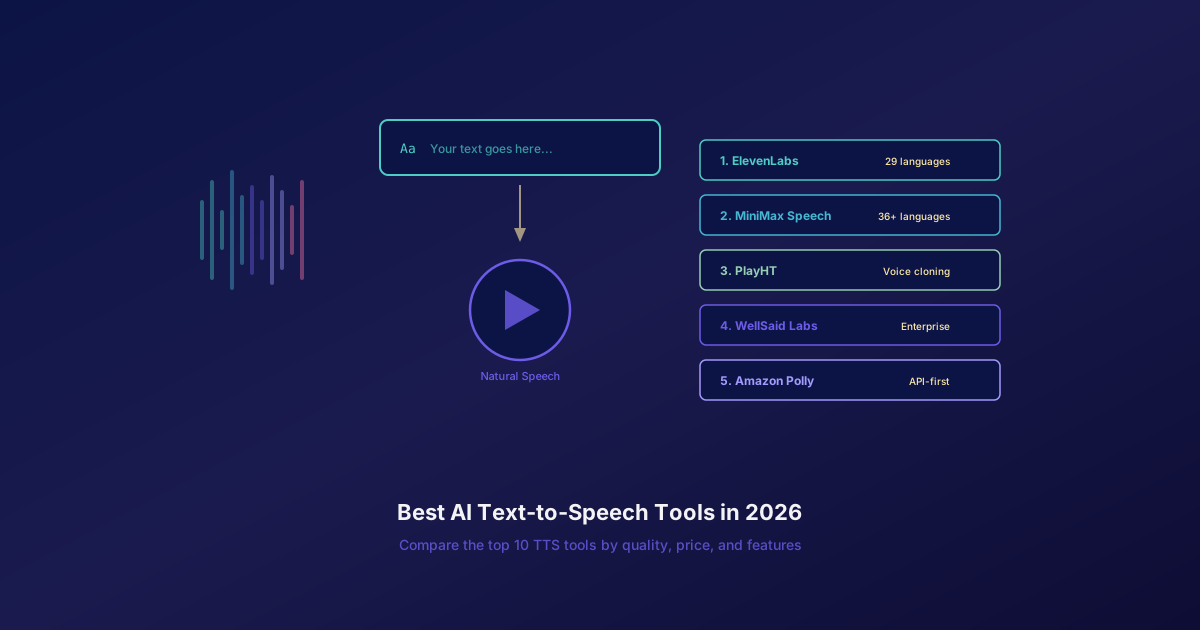
If you only need the best production fit rather than a free route, our best AI text-to-speech tools guide compares broader options. If you are specifically evaluating ElevenLabs, read can I use ElevenLabs Free commercially? before rendering a monetized asset.
The four meanings people collapse into “free”
The phrase free text to speech commercial use contains four different questions.
1. Is generation free?
The provider may offer a recurring allowance, introductory credits, a time-limited free tier, or open weights you run on your own machine. Even self-hosting has compute, storage, engineering, and review costs.
2. Is the output commercially licensed?
This decides whether you may use the audio in revenue-linked work. Look for explicit output-use language, not a “Start free” button.
3. Is the output royalty-free?
Royalty-free usually means you do not pay a recurring royalty for every play or sale. It does not necessarily mean the initial generation is free, and it does not remove other restrictions.
4. Do you have voice and script rights?
A service license cannot give you rights to text you copied without permission or a person’s voice you cloned without authorization. The provider layer and the input-rights layer must both pass.
Here is where this breaks: a creator sees “four million free characters,” generates an ad, and never reads the output-use terms. Another sees an MIT-licensed repository but downloads a third-party voice model with a different license. Both have a price answer and no complete rights answer.
Hosted free allowances that can support commercial work
Google Cloud Text-to-Speech
Google’s official Cloud TTS documentation says created audio files can power applications or augment media such as video and audio recordings, subject to the Google Cloud terms and applicable law. Its pricing documentation lists monthly free usage limits for specified voice classes and requires billing to be enabled; excess use is charged.
Why it is useful:
- the output-use language is published in first-party documentation;
- the API exports common formats and offers controls for repeatable production;
- a metered allowance can work for prototypes and modest workloads.
What to check:
- which voice class you selected;
- the current free allowance for that class;
- whether your Cloud billing account is eligible;
- the Google Cloud terms governing the project;
- script, trademark, privacy, and voice rights.
Do not describe the service as “unlimited free.” The allowance is metered and voice-dependent.
Amazon Polly
AWS describes Amazon Polly as a service for building speech-enabled applications and says generated speech can be cached and replayed. Its product page also says output can be stored in formats such as MP3 or OGG for redistribution, analysis, archiving, or other use cases at no extra output-replay cost. AWS currently describes free access through Free Tier structures or credits whose eligibility and duration depend on the account.
Why it is useful:
- official documentation addresses redistribution and replay;
- output can be generated through the console, CLI, or APIs;
- common app, learning, and accessibility workflows are documented.
What to check:
- whether your account receives a free plan, Free Tier credits, or neither;
- the voice engine and its threshold;
- the region and supported feature;
- current AWS Service Terms and Acceptable Use Policy;
- any disclosure, consent, and distribution obligations outside AWS.
Free cloud credits pay the bill; they are not the license. The service terms and product documentation provide the rights framework.
Why Azure is not in the “free commercial” recommendation row
Microsoft’s current Product Terms say commercial use of prebuilt neural TTS output is for customers of the paid tier TTS service. That makes the paid/free distinction material. Even if a pricing page offers a free allowance or account tier, do not infer that the free tier carries the paid-tier output right.
This is why a list based only on free-character quotas fails. You need the output-rights language too.
Choose a hosted route with explicit output-use documentation, generate a short QA sample, then save the terms, account tier, voice ID, script, timestamp, and final master together. That is easier to defend than a mystery web app with a “free download” button.
Open-source TTS that may permit commercial use
Open source can be the lowest recurring-cost route, but it creates a bigger audit surface.
Chatterbox
Resemble AI’s official Chatterbox repository identifies the project as open-source TTS under the MIT license. MIT generally permits use, modification, distribution, sublicensing, and sale while requiring the license notice to be preserved.
The practical checks are not finished there:
- pin the repository and model version;
- save the license file with the deployment;
- review bundled dependencies;
- verify where every reference voice came from;
- obtain consent for voice conversion or cloning;
- add abuse controls if the system is exposed to users.
Kokoro-82M
The official Hugging Face model card for hexgrad/Kokoro-82M identifies an Apache-2.0 license. Apache-2.0 is permissive and includes notice requirements and patent-related terms.
Before commercial deployment, capture:
- the exact model-card revision;
- the Apache license and any NOTICE file;
- the selected voice file and its terms;
- your text and distribution rights.
Do not turn “the model card says Apache-2.0” into “every community voice on the internet is cleared.” Audit the actual files you ship.
Piper
The original rhasspy/piper software repository uses MIT, but it was archived in October 2025 and points development to another project. More importantly, Piper voice models are separate artifacts and may carry their own model-card or dataset terms.
The licensing lesson is simple: engine license and voice license are two rows, not one.
A warning about Coqui XTTS-v2
The Coqui TTS code repository and the XTTS-v2 model do not share one simple commercial answer. Official project materials identify the XTTS-v2 model under the Coqui Public Model License rather than the code repository’s general software license. Do not assume XTTS-v2 is commercially cleared because the surrounding toolkit is open source.
That is the exact category error this article is designed to prevent.
Commercial TTS license audit: a reusable scorecard
Use this table before any generated voice reaches an ad account, app build, monetized channel, client, or paid course.
| Audit question | Pass evidence | Red flag |
|---|---|---|
| What exact service or repository generated the audio? | Provider, URL, repository, commit, or model revision | “A free TTS website” |
| What plan or billing tier was active? | Invoice, billing screenshot, account record | Free account with no output-rights clause |
| Does the license permit commercial use? | Saved terms or license with permission text | Attribution-only assumption |
| Does the selected model have separate terms? | Model card and version | Code license used as a proxy for weights |
| Does the selected voice have separate terms? | Voice listing, consent, or model card | Community voice with unknown origin |
| Do you own or license the script? | Authorship record or client approval | Copied article, book, or lyrics |
| Is cloning or likeness authorized? | Signed consent for purpose, channels, duration | “The sample was public” |
| Is the feature production-eligible? | Stable release status | Beta or research-only feature |
| Is distribution within scope? | Named ad, app, channel, course, game, or client use | “Commercial use” with no channel review |
| Can you reproduce the record? | Terms PDF, output ID, timestamp, master file | No history after export |
This scorecard is intentionally provider-neutral. It works whether you use a cloud API, a desktop model, or Oakgen’s voice workflow.
A production workflow that avoids licensing surprises
Step 1: Define the commercial job
Name the destination before the tool: monetized YouTube narration, a podcast sponsor read, a client ad, in-app speech, a course lesson, an audiobook, or a game character. Rights can differ by purpose, not just by file format.
Step 2: Shortlist routes by evidence
Reject a service if you cannot find current terms, a recognizable provider, a model name, or support contact. A polished UI is not licensing evidence.
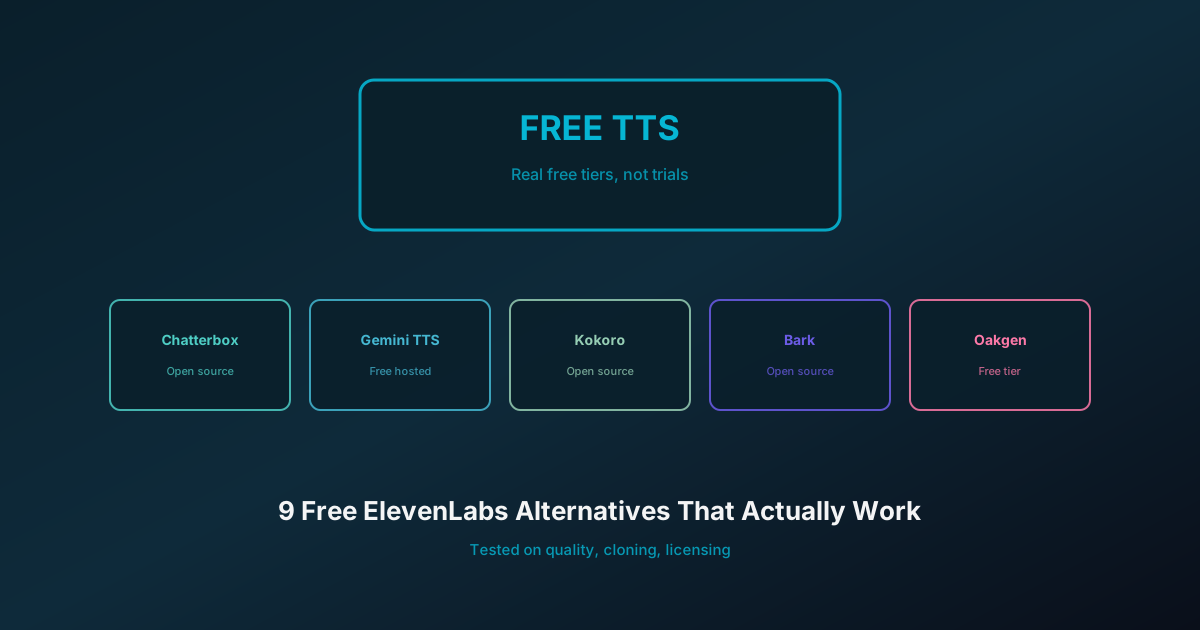
Use our free ElevenLabs alternatives guide for a wider shortlist, but redo the license check for your chosen route. Tool roundups age faster than provider terms.
Step 3: Test one rights-owned script
Use 20 to 30 seconds containing names, numbers, abbreviations, and the hardest pronunciation. Do not upload confidential client text or an unapproved voice just to audition a system.
Step 4: Audit the exact voice
Stock provider voice, custom clone, community voice, and locally trained speaker are different risk classes. Record the voice ID and source. For cloning, document consent before training, not after publishing.
Step 5: Generate and archive the master
Save the final WAV or highest-quality output, distribution copies, project ID, settings, date, and license evidence. If the account tier changes later, the record still shows what governed generation.
Step 6: Review disclosure and platform rules
Commercial permission from a TTS provider does not override ad rules, deceptive-impersonation restrictions, labor agreements, or synthetic-media disclosure requirements. Review the final use, especially when the voice resembles a real person.
You can audition different voice directions in Oakgen’s audio workspace, then apply the same scorecard to whichever model produces the final master.
How to choose between hosted and self-hosted TTS
I would use a hosted route for one-off ads, course narration, and client videos because the evidence trail is simpler. Consider self-hosting only when volume, offline use, or data control justifies owning deployment, security, quality, and license review.
Common mistakes
Treating a free tier as a commercial grant
Some free tiers allow commercial use; others expressly do not. Read the output-use clause.
Calling every generated file royalty-free
“No royalty per play” and “allowed in commercial work” are not identical. Use the language the provider actually publishes.
Checking only the code license
Weights, voices, datasets, and dependencies can have separate terms.
Ignoring the voice owner
The right to run a model is not the right to imitate a person.
Keeping no evidence
Terms change. Save what applied on the generation date, along with the output ID and plan.
Assuming Oakgen changes the underlying model rules
Oakgen helps creators compare and produce across models. It does not erase third-party model, voice, input, or distribution restrictions. Verify the current route used for the final asset.
Frequently asked questions
Is there free text-to-speech for commercial use?
Yes. Some hosted services publish commercial output-use language and offer free usage allowances, while some open-source models use permissive licenses. Confirm the exact plan, model, voice, and current terms.
Is ElevenLabs Free licensed for commercial use?
No. ElevenLabs says free users are limited to non-commercial use. Read our full ElevenLabs free commercial-use answer for upgrade timing, attribution, and evidence rules.
Does free TTS mean royalty-free?
No. Free refers to price. Royalty-free refers to recurring royalties. Commercial permission comes from the governing agreement.
Can I use free TTS on a monetized YouTube channel?
Only when the exact route permits commercial use and your script and voice are authorized. Save a license record before upload.
Can open-source TTS be used commercially?
Sometimes. Audit the code, model weights, selected voice, dependencies, and notice requirements. Do not infer the model license from the surrounding repository.
Which route is easiest for a small business?
A hosted service with explicit output-use documentation is usually easiest to operate and document. Self-hosting trades usage fees for engineering and compliance work.
Do I need consent to clone my employee or contractor’s voice?
Treat explicit written consent as the minimum operational standard. The agreement should cover synthetic generation, purpose, channels, territory, duration, compensation if relevant, and takedown handling.
Sources and further reading
- Google Cloud Text-to-Speech basics
- Google Cloud Text-to-Speech pricing
- Amazon Polly product page
- Amazon Polly documentation
- ElevenLabs publishing and commercial-use guidance
- Microsoft Azure Product Terms for TTS
- Chatterbox official repository
- Kokoro-82M official model card
- Piper software license
Make one commercially documented voiceover
Start with a script you own, compare voices in Oakgen’s audio workspace, and choose the route that fits the actual destination. Save the provider, plan, model, voice, terms, timestamp, and consent record with the final master. Publish only when that evidence confirms the intended commercial use is permitted.