ChatGPT
 Claude
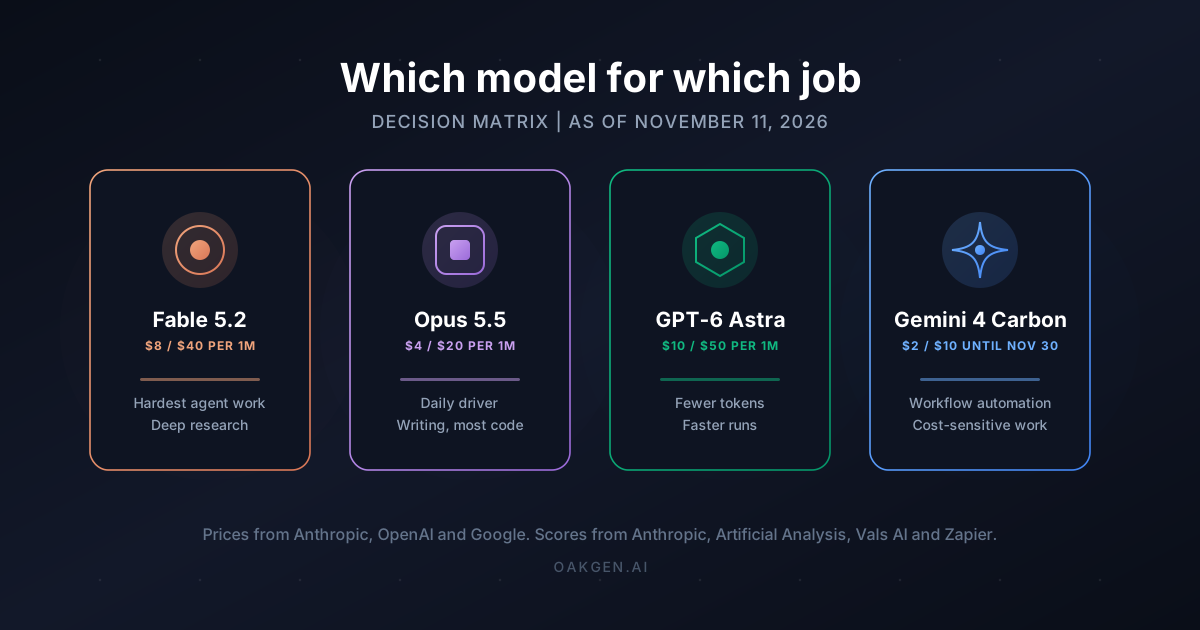
For fable 5.2 vs opus 5.5, make Opus 5.5 your default and treat Fable 5.2 as the upgrade you earn with a failing test. Anthropic says the same on its own launch page. Fable 5.2 wins most of the hard rows, meaning agentic coding, deep research and long autonomous runs. Gemini 4 Carbon wins business-workflow automation and costs a quarter as much per token through November 30. GPT-6 Astra is the pick for speed and token economy, not for accuracy.
Opus 5.5 still tops an independent ranking of professional deliverables, which makes it the writing pick. It is also the weakest of the four at reading charts in Anthropic's table.
Everything here was checked on 2026-11-11, and each score names who ran it.
Oakgen is our product. It is an AI creative studio, and it does not offer Fable 5.2, Opus 5.5, GPT-6 Astra or Gemini 4 Carbon as models you pick by name. We include Oakgen at the end because creative planning is where text models feed our workflow, and we say where you should go elsewhere.
The decision matrix at a glance
| Job | Pick | Runner-up | Where a rival wins |
|---|---|---|---|
| Coding | Opus 5.5 daily, Fable 5.2 for hard multi-file work | Gemini 4 Carbon for terminal work | Carbon leads Terminal-Bench 4.0 |
| Agents | Fable 5.2 for long unattended runs | Gemini 4 Carbon | Carbon leads Zapier's AutomationBench |
| Research | Fable 5.2 | Gemini 4 Carbon | Carbon shows the lowest hallucination rates |
| Data analysis | Opus 5.5 or Sonnet 5.5 plus a check | Fable 5.2 | Sonnet 5.5 matches Opus at lower cost |
| Writing | Opus 5.5 | Fable 5.2 | No independent prose data for Astra or Carbon |
| Chart reading | Fable 5.2, or Carbon on a budget | GPT-6 Astra | Carbon is within one point of Fable |
| Cost-sensitive work | Sonnet 5.5 or Carbon (until Nov 30) | Opus 5.5 at high effort | Astra costs less per task than Opus at max |
Plan with a text model, then make the media
Oakgen Agent Chat has Oakgen Auto, Max and Pro Max tiers for scripts and shot lists, then calls image, video and audio models in the same chat.
Who this is for
You are picking a model for a team, a product or a content operation, and you do not want to rerun every benchmark yourself. Maybe you pay for Opus 5.5 and wonder if Fable 5.2 is worth double the price. Maybe you are on OpenAI, or Gemini 4 Carbon's price caught your eye. The mistake is choosing the model before choosing the job.
How we checked this
We read the primary pages on 2026-11-11. That means Anthropic's launch post and model docs, OpenAI's pricing page, Google's Carbon announcement, and the live leaderboards at Artificial Analysis, Vals AI and Zapier. We opened every page that supplied a number.
We did not run these models ourselves, and we did not test them on Oakgen tasks. Three limits matter.
- Anthropic's benchmark table is Anthropic's. It chose the tests and ran or reported its rivals' results, and it has not been independently checked in full. Where we use it, we say "Anthropic's table".
- Artificial Analysis ran Fable 5.2, Opus 5.5 and Sonnet 5.5 with Anthropic's default fallback on. Requests that trip the cyber or biology safeguards go to another model, so those scores reflect safeguarded behavior.
- Effort settings differ by lab. A max-effort row and a medium-effort row are different products.
What each model costs and where you can get it
Prices are per million tokens, from the vendors' own pages.
| Model | Input / output | Notes | Source |
|---|---|---|---|
| Claude Fable 5.2 | $8 / $40 | Fast mode $16 / $80. 1M context, 128K output, default effort high | Anthropic docs and launch post |
| Claude Opus 5.5 | $4 / $20 | 1M context, 128K output, default effort medium | Anthropic docs |
| GPT-6 Astra | $10 / $50 | Fast mode $20 / $100 | OpenAI pricing page |
| Gemini 4 Carbon | $2 / $10 until Nov 30, then $4 / $20 | Paid Gemini API from Nov 10. Cyber version stays in Google's Fairwind program | Google announcement |
Two things stand out. Fable 5.2 is no longer the most expensive model, because Astra costs 25% more per token. And Carbon at its introductory price is a quarter of Fable's rate, then equal to Opus 5.5's list price after November 30.
Some older write-ups still call Carbon invitation only. Google's November 10 post says it is now open to paying developers. For Fable's history, see our explainer on Fable 5 and 5.1, and our Fable 5.2 pricing guide for effort levels and fast mode.
Coding
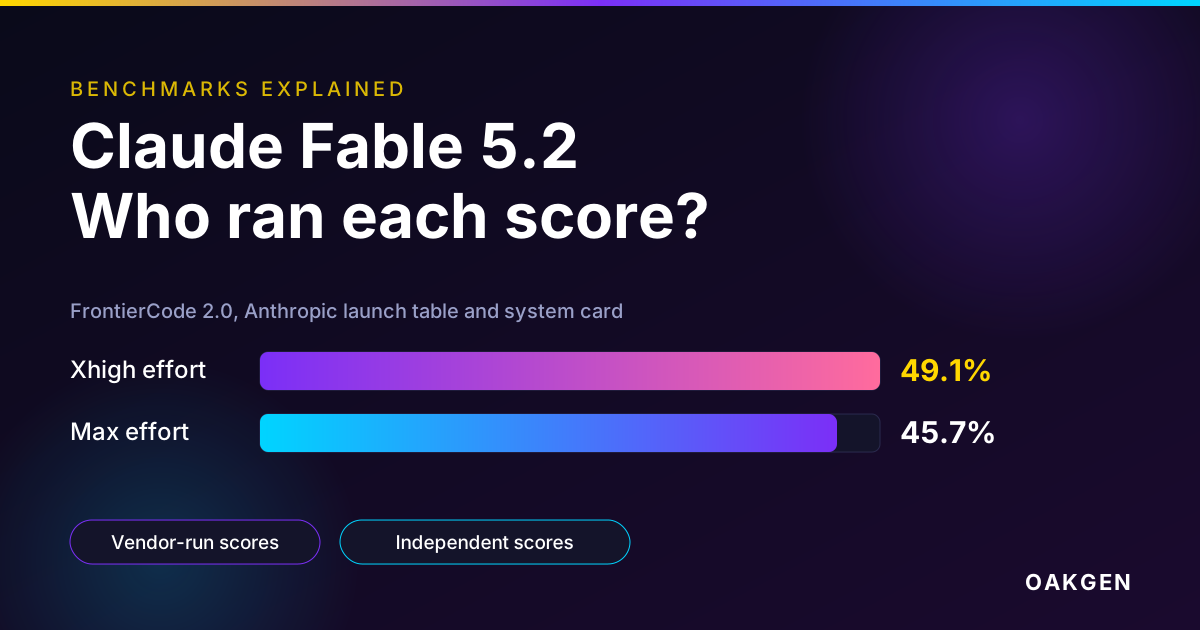
Fable 5.2 leads on hard, long coding work. On FrontierCode 2.0, which grades whether a maintainer would merge the change, Anthropic's table has Fable 5.2 at 49.1% (Xhigh effort), Opus 5.5 at 45.5%, GPT-6 Astra at 42.8% and Carbon at 41.1% (Medium effort). Artificial Analysis ran its own version and reports Fable at 49% and Opus 5.5 at 46% (OfficeChai's summary, November 9). It also found Fable at high effort matched Fable at max, both 49%.
Vals AI's index, dated November 9, points the same way. On its Vibe Code Bench, Fable scores 93.8%, Opus 5.5 90.3%, Astra 89.6% and Carbon 89.1%. On Code Migration it is 85.8%, 80.5%, 78.0% and 80.1%.
Where a rival wins. On Artificial Analysis's Terminal-Bench 4.0, Carbon at high effort scores 65.2%. Fable 5.2 and Opus 5.5 both score 59.6%, and Astra 59.1%. Sonnet 5.5 scores 63.6%. Anthropic's Carbon score on FrontierCode is at Medium effort only, so the true coding gap between Fable and Carbon is not settled.
A limit. Fable's safeguards block most penetration testing and exploit work, and hand those requests to an older Opus model, per Anthropic.
What I would do. Run Opus 5.5 at high effort for everyday code. Move to Fable 5.2 at high effort for migrations, big refactors and bugs Opus cannot close. Try Carbon for terminal-heavy work while its introductory price lasts. Every score is broken down in our Fable 5.2 benchmarks explainer.
Agents
Fable 5.2 is the pick for long, unattended runs. Anthropic's table has it at 41.3% on the Remote Labor Index at High effort, against 21.3% for Opus 5.5 and 20.8% for Astra. On OSWorld 2.1 computer use it scores 89.3%, ahead of Opus 5.5 at 87.2%, Carbon at 81.5% and Astra at 79.5%. Anthropic also reports a team of about 1,000 Fable agents formalizing Fermat's Last Theorem in 30 hours, where Opus 5.5 reached 26% in 18 hours. That was a single run for each model.
Where a rival wins. Zapier's AutomationBench scores the final state of a simulated company with fixed checks, no model judge. Carbon at high effort leads at 53.88% for $2.12 a task. Fable 5.2 at max scores 51.45% for $4.64. Opus 5.5 scores 42.47% for $1.44 and Astra 41.40% for $1.73. Carbon also tops Zapier's marketing, operations, support and finance domains. Anthropic's own table shows the same Carbon win, 53.9% to 51.4%.
What I would do. Use Fable 5.2 as the orchestrator or advisor when many sub-agents work for hours, as Anthropic suggests. Use Carbon for cross-app business workflows such as CRM updates and ticket routing. Keep Opus 5.5 for supervised loops where you read each step.
Research
Fable 5.2 is the strongest on hard, knowledge-heavy questions. Artificial Analysis, read 2026-11-11, has it first on AA-Omniscience at 67, with 79% accuracy. OfficeChai's summary of Artificial Analysis adds HLE-Diamond at 80% against 69% for Carbon. Anthropic's table has Humanity's Last Exam with tools at 74.2% for Fable, 67.7% for Opus 5.5 and 57.2% for Astra, and Perplexity's WANDR search benchmark at 82.1% against 72.3% for Opus.
Where a rival wins. Artificial Analysis lists Carbon among the lowest hallucination rates on AA-Omniscience, 4% at medium effort (tied with Gemini 4 Argon at high) and 11% at high. I did not read Fable's rate on that page. Google also claims Carbon is first on WANDR, but VentureBeat found no public score table to confirm it, so treat that as unverified.
What I would do. Pick Fable 5.2 when being wrong is expensive and the question is hard. Pick Carbon when a confident wrong answer is the bigger risk or volume is high. Opus 5.5 handles ordinary source summaries well enough.
Data analysis
No single clean benchmark covers this, so I would weigh three partial ones.
On Vals AI's finance tests, Fable scores 69.5% on Finance Agent v2.1, Opus 5.5 67.8%, Carbon 67.2% and Astra 60.4%. On its Excel modeling test the order is Fable 77.4%, Carbon 76.5%, Opus 75.8% and Astra 72.7%. Gaps of one or two points are close to noise.
Artificial Analysis's AA-AnalystAgent asks 80 spreadsheet questions five times each and counts a question only if all five runs are right. The page headline lists Gemini 3.7 Flash at 60.0%, then Sonnet 5.5 and Fable 5.1 at 57.5% each. I could not read Fable 5.2's, Opus's or Carbon's score from the page text. Consistency matters more than a one-shot score here, and cheaper models sit near the top.
Anthropic quotes Oracle saying two other models returned values five to eight times too high on one SQL test. That is a vendor-chosen customer quote, not a benchmark.
What I would do. Use Opus 5.5 or Sonnet 5.5, then verify with a second pass or a reconciliation query. Reserve Fable 5.2 for models where every cell matters. Astra is the weakest of the four on Vals's finance rows.
Writing
Opus 5.5 is the writing pick, and the evidence is thin. No independent benchmark scores prose quality across these four. The closest proxy is Artificial Analysis's GDPval-AA v2.1, which asks models for professional deliverables across 44 occupations and ranks them by blind pairwise votes. Opus 5.5 at max is first at 1866, ahead of Kimi K3.1 Pro at 1861 and Muse Wonder Full at 1857. Fable 5.2 is not in the top three. Gaps that small are a cluster, not a ranking.
Anthropic says testers find Fable 5.2 "communicate more clearly" than past Fable models, with no number attached. One independent author, Quantslant, ran a small Polish-language test and a GPT-6.1 Sol judge ranked Fable third of four, though that judge also scored itself. I found no prose data for Astra or Carbon.
What I would do. Draft with Opus 5.5 at half Fable's price. Run your own blind test of three samples before you pay more.
Chart reading
Fable 5.2 leads, Carbon is close, and Opus 5.5 trails. Anthropic's Chartography test, with no tools, has Fable at 73.4%, Carbon at 72.5%, Astra at 71.0% and Opus 5.5 at 64.4%. Anthropic adds that Fable at Medium effort scores 66.4%, ahead of Opus at Max, for under a tenth of the cost per attempt.
Artificial Analysis's MKA benchmark gives the independent view. It asks agents to read visually dense files such as drawings and schematics, then produce a deliverable. Fable at max scores 57%, Carbon at high 54%, Opus 5.5 at max 53%, and Astra ranks below them.
What I would do. For volume chart extraction, test Carbon first, since it is within a point of Fable on Anthropic's test and cheaper through November 30. For high-stakes figures, use Fable. Do not assume Opus 5.5 is good enough here.
Turn the script into finished ads
Write the hook and script in Agent Chat, then generate the UGC-style video, voice and variations in Oakgen.
Cost-sensitive work
List price and cost per task disagree, and the second one is what you pay. This table is Artificial Analysis's Intelligence Index v5.0.1 suite, read 2026-11-11.
| Model and effort | Index score | Cost per task | Time per task |
|---|---|---|---|
| Fable 5.2, max | 65 | $26.54 | 45.2 min |
| Fable 5.2, high | 62 | $9.08 | 17.3 min |
| Fable 5.2, medium | 56 | $3.80 | 7.8 min |
| Opus 5.5, max | 59 | $10.04 | 25.0 min |
| Opus 5.5, xhigh | 57 | $6.05 | 15.7 min |
| Opus 5.5, high | 52 | $3.46 | 9.5 min |
| Opus 5.5, medium | 48 | $2.45 | 7.1 min |
| Gemini 4 Carbon, high | 60 | $7.76 | 25.6 min |
| Gemini 4 Carbon, medium | 58 | $6.59 | 23.3 min |
| GPT-6 Astra, max | 57 | $6.24 | 22.9 min |
| GPT-6 Astra, high | 55 | $3.24 | 9.7 min |
| GPT-6 Astra, medium | 52 | $2.73 | 7.0 min |
Read it this way.
- Fable 5.2 at high beats Opus 5.5 at max on both axes. It scores 62 against 59 and costs $9.08 against $10.04. If you run Opus at max effort today, test Fable at high.
- Astra's list price misleads. At max effort it costs $6.24 a task, below Opus at max and Carbon at high, though its per-token price is the highest.
- Fable's max setting is the expensive one. The 65 costs 2.6 times Opus at max.
- Sonnet 5.5 is the quiet value pick. Vals AI puts it second at 70.85% and $16.18 per test, just under Fable's 71.31% at $17.94. The top four on that index sit within about one point, with error bars of roughly one point, so treat them as tied. Zapier has Sonnet 5.5 at 44.75% for $1.14 a task, ahead of Opus 5.5.
Speed and tokens favor Astra. On Vals AI's suite it used 8.15 million tokens and 33 minutes 39 seconds per test, against 31.31 million and 43 minutes 42 seconds for Fable, and 59.46 million and 1 hour 25 minutes for Opus 5.5.
What I would do. Cut effort before you cut the model. Use Sonnet 5.5 or Carbon for volume while Carbon's $2 and $10 price lasts, then re-price on December 1. Send classification and routing to Haiku 5.5, which lists from $0.10 and $0.50.
Compare Oakgen plans and credit prices
See what Agent Chat tiers and media generation cost in credits before you commit to a plan.
Where each competitor wins
- Opus 5.5. Professional deliverables and writing on Artificial Analysis's GDPval-AA, a tie with Fable on Terminal-Bench 4.0, and half the list price. Anthropic's own recommended starting point.
- Gemini 4 Carbon. Zapier's AutomationBench, Artificial Analysis's Terminal-Bench 4.0, the lowest hallucination rates on AA-Omniscience, Vals AI's legal and tax tests (Legal Research 55.8% against 46.2% for Fable and 50.5% for Opus, Tax 51.8% against 32.1% and 44.5%), and price.
- GPT-6 Astra. Speed and tokens per task. I found no accuracy benchmark in this comparison where it leads the other three. Anthropic picked the table, so that absence is weaker evidence than it looks.
- Fable 5.2. Intelligence Index at 65 against Carbon's 60, Opus's 59 and Astra's 57, and most of Anthropic's own rows. On Vals AI's index it leads at 71.31% (plus or minus 0.96).
When Opus 5.5 is enough, an eight-question checklist
Answer yes or no for the task you are about to buy Fable 5.2 for.
- Does a person read the output before it ships?
- Does the task fit in one session, not a many-hour unattended run?
- Is the work writing, editing, summarizing, drafting or spreadsheet logic?
- Is the code change within a few files, not a migration across a repository?
- Does your own test pass on Opus 5.5 at high effort?
- Is a wrong answer cheap to catch and fix?
- Does the job avoid chart-heavy or figure-heavy input?
- Do you run enough volume that twice the list price matters?
Seven or eight yes answers. Stay on Opus 5.5. Four to six. Run both on twenty real tasks at high effort and compare pass rate and cost per task. Three or fewer. Start with Fable 5.2.
Anthropic's models page gives the same rule, to use Fable for demanding reasoning and long-horizon agentic work, or when your evals on Opus 5.5 at higher effort still fall short. The scoring bands are my translation, not a tested threshold.
Decision framework
- Name the job. Use the matrix above, not a leaderboard rank.
- Start one rung down. Try Sonnet 5.5 or Opus 5.5 at high effort.
- Write a test from your real work. Twenty tasks beats any published score.
- Escalate on failure. Raise effort first, then move to Fable 5.2.
- Price the whole run. Cost per task includes retries and review time.
- Keep a fallback. Models lose access, and Carbon's price changes on December 1.
Common mistakes
- Choosing the model before the job. A top index score says little about spreadsheet consistency.
- Comparing different effort levels. Fable at Medium and Astra at Max are not a fair pair.
- Trusting one lab's table. Anthropic picked the tests and left out cheaper rivals such as GPT-6.1 Sol and Gemini 4 Argon.
- Reading list price as cost. Astra costs the most per token and less per task than Opus at max.
- Sending cyber work to Fable. Its classifiers block most of it. That path is Mythos 5.2, which needs vetted access.
- Paying for max effort by default. High effort matched max on Artificial Analysis's FrontierCode run, and its index cost per task is $9.08 against $26.54.
What this means for creative work on Oakgen
Fable-style planning helps creative work when the job is long, such as a thirty-episode micro drama bible, forty ad angles, or a storyboard that must stay consistent across shots. For a single hook, caption or product script, Opus-level quality is plenty. That is my judgment from the benchmark pattern above, not something we measured.
Oakgen does not sell these four models by name. Its Agent Chat offers Oakgen Auto, Max and Pro Max, and then calls image, video and audio models in the same conversation. For a worked planning flow, see our guide to using Fable 5.2 for creative work and our script to video storyboard workflow.
If a text model has written your script, the next step is media. The AI micro drama generator keeps a cast and voices consistent across vertical episodes. Our micro drama cost per episode post shows what that costs.
Make the micro drama your script describes
Lock a cast and voices, then generate vertical episodes from the scenes your planning model wrote.
If you only need to call a frontier text model from your own code, go to Anthropic, OpenAI or Google. Oakgen is a workspace, not an API reseller for these models.
Test creative models in one workspace
Browse the image, video and audio models you can run in Oakgen, with the credit price for each.
Frequently asked questions
Is Claude Fable 5.2 better than Claude Opus 5.5?
On most hard benchmarks, yes. Artificial Analysis, read 2026-11-11, scores Fable 5.2 at 65 on its Intelligence Index at max effort against 59 for Opus 5.5 at max. But Fable 5.2 lists at $8 input and $40 output per million tokens, twice Opus 5.5's $4 and $20, and Anthropic itself tells most users to start with Opus 5.5. Opus 5.5 still tops Artificial Analysis's GDPval-AA v2.1 ranking of professional deliverables, and it ties Fable 5.2 on Terminal-Bench 4.0 at 59.6%. Move up to Fable when your own test fails on Opus 5.5 at higher effort.
Which model is best for coding, Fable 5.2, Opus 5.5, GPT-6 Astra or Gemini 4 Carbon?
Fable 5.2 leads agentic coding on Anthropic's own table, with 49.1% on FrontierCode 2.0 at Xhigh effort against 45.5% for Opus 5.5, 42.8% for GPT-6 Astra and 41.1% for Gemini 4 Carbon at Medium effort. Artificial Analysis's independent run of the same benchmark has Fable at 49% and Opus 5.5 at 46%. Carbon wins one coding-adjacent test, Terminal-Bench 4.0, at 65.2% against 59.6% for Fable and Opus (Artificial Analysis, 2026-11-11). For daily coding, start with Opus 5.5 and escalate to Fable 5.2 for long multi-file work.
Is Gemini 4 Carbon publicly available and what does it cost?
Google made Gemini 4 Carbon available on November 10, 2026 through the paid Gemini API in AI Studio and Gemini for business, and to Google AI Ultra subscribers in the Gemini app, AI Mode and Antigravity. The introductory API price is $2 per million input tokens and $10 per million output tokens until November 30, 2026. After that it is $4 and $20, the same list price as Claude Opus 5.5. Google says the cyber version stays in its Fairwind program. Availability by country is not fully published, so check your region.
Is GPT-6 Astra worth $10 and $50 per million tokens?
Its list price is the highest of the four, but cost per task is a different story. Artificial Analysis, read 2026-11-11, puts GPT-6 Astra at max effort at $6.24 per Intelligence Index task and a score of 57, against $10.04 for Opus 5.5 at max (59) and $26.54 for Fable 5.2 at max (65). Astra also finished Vals AI's index suite with far fewer tokens than the Claude models. I found no accuracy benchmark in this comparison where Astra leads. Choose it for speed, token economy or an existing OpenAI stack, not for the top score.
Which model is best for reading charts and figures?
On Anthropic's Chartography test with no tools, Fable 5.2 scores 73.4%, Gemini 4 Carbon 72.5%, GPT-6 Astra 71.0% and Opus 5.5 64.4%, all at each model's highest effort (Anthropic, November 9, 2026). On Artificial Analysis's independent MKA benchmark of visually dense project files, Fable 5.2 scores 57%, Carbon 54% and Opus 5.5 53%. Carbon is within a point on Anthropic's test and cheaper at its introductory price, so it is the value pick. Opus 5.5 is the weakest of the four on the Anthropic chart test.
When is Opus 5.5 enough, so I do not need Fable 5.2?
Opus 5.5 is enough when a human reviews the output, the task fits in one session, your test passes at high effort, and the work is writing, drafting, summarizing, normal code changes or spreadsheet logic. It is not enough when your own test still fails at Opus's higher effort levels, when you run agents unattended for hours, or when you orchestrate many sub-agents. The post has an eight-question checklist. Anthropic's own docs say the same, to start with Opus 5.5 and move up when your evals fall short.
Can I use Fable 5.2, Opus 5.5, GPT-6 Astra or Gemini 4 Carbon on Oakgen?
Not by those names. Oakgen is an AI creative studio for images, video, audio, UGC ads and micro drama. Its Agent Chat offers Oakgen's own tiers, Oakgen Auto, Oakgen Max and Oakgen Pro Max, and needs an active subscription. It does not list Fable 5.2, Opus 5.5, GPT-6 Astra or Gemini 4 Carbon as models you can pick. To call those models directly, use Anthropic, OpenAI or Google. Oakgen is our product and we have not tested these four on Oakgen creative tasks.
Sources
- Anthropic, Introducing Claude Fable 5.2 and Claude Mythos 5.2, November 9, 2026 (read 2026-11-11)
- Claude Platform docs, Models overview with prices and default effort (read 2026-11-11)
- Artificial Analysis, LLM leaderboard with Intelligence Index, cost and time per task (read 2026-11-11)
- Artificial Analysis, Terminal-Bench 4.0 results (read 2026-11-11)
- Artificial Analysis, Multimodal Knowledge Agent benchmark results (read 2026-11-11)
- Artificial Analysis, GDPval-AA v2.1 results (read 2026-11-11)
- Artificial Analysis, AA-Omniscience results (read 2026-11-11)
- Artificial Analysis, AA-AnalystAgent results (read 2026-11-11)
- Vals AI, Vals Index leaderboard, November 9, 2026 (read 2026-11-11)
- Zapier, AutomationBench leaderboard v1.0.6 (read 2026-11-11)
- Google, Gemini 4 Carbon is now available, November 10, 2026 (read 2026-11-11)
- OpenAI API docs, pricing (read 2026-11-11)
- VentureBeat, Gemini 4 Carbon is now publicly available, November 10, 2026 (read 2026-11-11)
- OfficeChai, Anthropic jumps to top of the Artificial Analysis Intelligence Index, November 9, 2026 (read 2026-11-11)
- Quantslant, Claude Fable 5.2 vs GPT-6 Astra and Gemini 4 Carbon, November 10, 2026 (read 2026-11-11)