ChatGPT
 Claude
The Fable 5.2 Reddit reactions, and the X and Hacker News ones that came with them, were louder than the facts they argued about. I read the launch threads on November 9 to 11, 2026 and checked each claim against Anthropic's pages and independent data. The price cut is real per token and false per task at Max effort. The Max-versus-Xhigh confusion is a benchmark quirk. Usage burn is real and Anthropic's own help page says so. "Cannot tell it from Opus 5.5" is right for everyday work and wrong for hard science and long agent runs. Writing quality is unproven. The safety blocks are narrower than the complaints, but not gone.
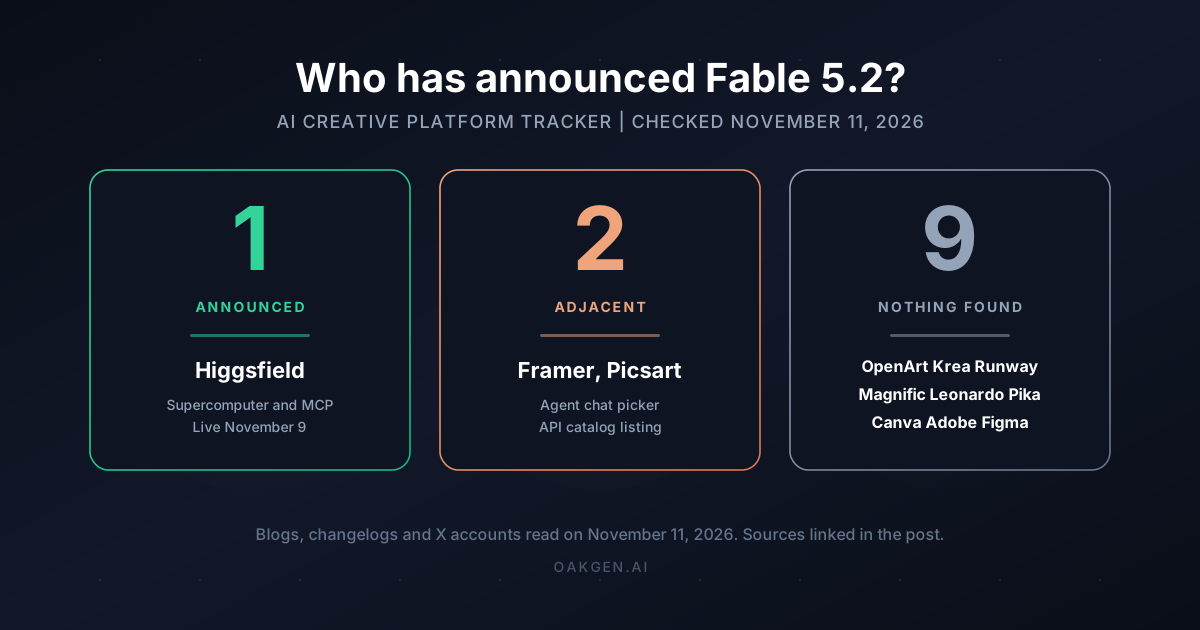
Oakgen is our product. We have a stake in creative AI, not in which text model wins. Fable 5.2 is a text and agent model, and I did not find it in Oakgen's catalog, so nothing here claims Oakgen offers it.
Plan a creative job, then let the studio build it
Describe the image, video or audio you need in Oakgen Agent Chat and review the plan and cost before anything is generated.
Fable 5.2 community reactions at a glance
Each row is checked in its own section below, and the full claim vs evidence table comes after.
| Theme | What the crowd said | Verdict | Best evidence |
|---|---|---|---|
| Price cut | "20 percent cheaper" against "not cheaper than 5.1" | Both true, at different settings | $8/$40 per million tokens, but $26.54 vs $12.99 per task at Max (Artificial Analysis) |
| Max vs Xhigh | Max scores lower and costs more | True on one chart, false on another | Anthropic's FrontierCode chart vs Artificial Analysis's index, where Max scores 65 |
| Usage burn | One prompt eats a window | Confirmed by Anthropic and many users | Help article says Fable uses limits faster; SemiAnalysis logs show more testing and subagents |
| Opus 5.5 parity | "Cannot tell them apart" | True for routine work, false for hard work | Tie on Terminal-Bench 4.0, big gap on HLE-Diamond |
| Writing quality | "Cleaner" against "joyless" | Unproven | One professor's report and single side-by-sides, no independent benchmark I could read |
| Safety and refusals | Fewer blocks against still blocked | Fewer, not zero | Anthropic claims 55% fewer blocks; security and biology users still report them |
Who this is for
Developers and founders deciding whether Fable 5.2 earns a place in the stack, and creators who plan scripts and prompts with a language model and generate media elsewhere. For background, see our guide to Fable 5 and 5.1. The sibling post on Fable 5.2 benchmarks goes deeper on the numbers. This one is about the argument, and who was right.
How I checked this
As of November 11, 2026, I opened and read these pages.
- Reddit. Eight threads across r/ClaudeAI, r/ClaudeCode and r/claude, plus the r/singularity discussion of Ethan Mollick's post. I quote only comments I read on the page.
- Hacker News. The launch thread (about 890 points and over 1,000 comments when I opened it) and the Artificial Analysis thread (375 points, 269 comments).
- X. Posts from @claudeai, @ArtificialAnlys, @SemiAnalysis_, Anthropic's Felix Rieseberg and Yuchen Jin.
- Primary sources. Anthropic's launch page, system card, help article and effort docs, plus Artificial Analysis's leaderboard and comparison pages.
The limits matter. Vote counts move hourly, so I cite almost none. Every's Fable 5.2 review is paywalled after its opening paragraph, so I do not quote its writing verdicts. Anthropic's benchmark table has not been independently checked in full, and I say whose number each one is. The r/ClaudeAI moderator bot writes its TL;DR summaries automatically, so I treat them as a pointer, not evidence. Threads over-sample complainers and agent-fleet power users. I ran no Fable 5.2 tests of my own.
Theme 1, the price cut
The claim. Anthropic's launch post says Fable 5.2 is "available at a lower price", $8 per million input tokens and $40 per million output, down from $10 and $50. A top r/ClaudeAI thread answered "WTF Fable 5.2 Cost per task is Insane It's not cheaper than Fable 5.1".
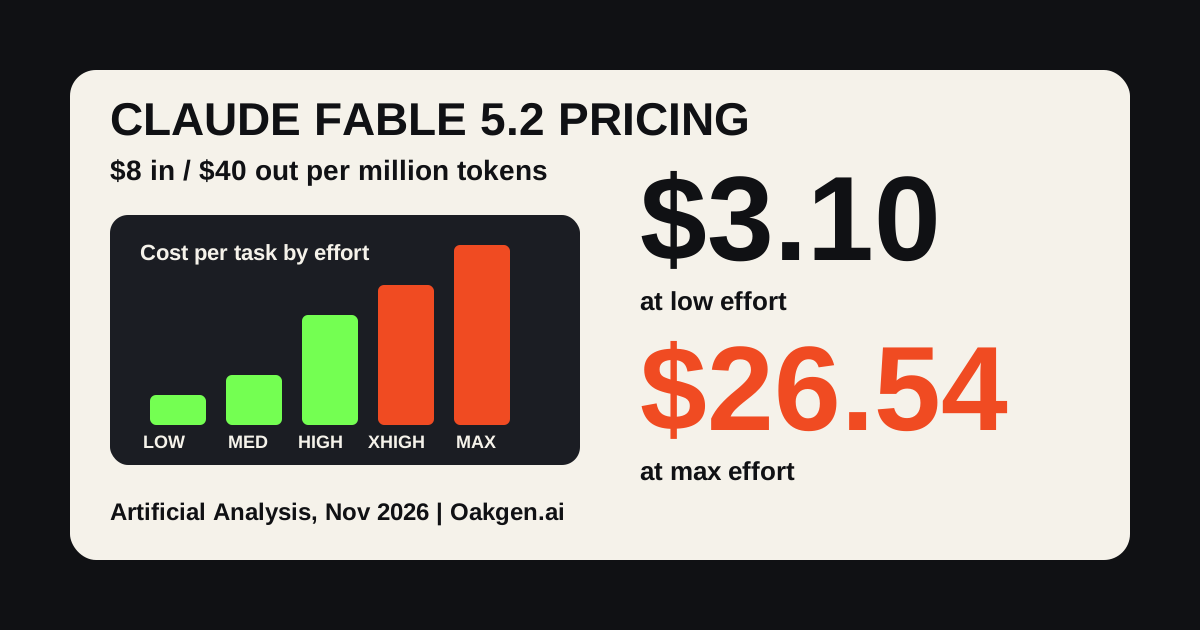
What the data says. Both are right. Artificial Analysis measured cost per Intelligence Index task at Max effort. Fable 5.2 cost $26.54, Fable 5.1 cost $12.99 and Opus 5.5 cost $10.04. The cause is verbosity, with about 274k output tokens per task for Fable 5.2 against about 118k for Fable 5.1 and 173k for Opus 5.5. SemiAnalysis saw the same on its GDPx benchmark, where cost per task rose 31 percent, from $67.16 to $88.15, "despite Fable 5.2 being 20% cheaper per Mtok".
The thread's own replies pushed back. One asked for a sticky banning Max-only cost charts, and another said Fable 5.2 "massively overthinks at Max".
Here is the cost table I built from Artificial Analysis's leaderboard as read on November 11, 2026, with the Intelligence Index score and dollars per index task.
| Setup | Index score | Cost per task |
|---|---|---|
| Fable 5.2 Low | 54 | $3.10 |
| Fable 5.2 Medium | 56 | $3.80 |
| Fable 5.2 High | 62 | $9.08 |
| Fable 5.2 Xhigh | 62 | $14.83 |
| Fable 5.2 Max | 65 | $26.54 |
| Opus 5.5 Medium | 48 | $2.45 |
| Opus 5.5 High | 52 | $3.46 |
| Opus 5.5 Xhigh | 57 | $6.05 |
| Opus 5.5 Max | 59 | $10.04 |
Read it by score, not by label. Fable 5.2 High scores 62 for $9.08, beating Opus 5.5 Max at 59 for $10.04. Fable 5.2 Medium scores 56 for $3.80, four points above Opus 5.5 High for 34 cents more.
Verdict. The per-token cut is true. The per-task cut is false at Max and unproven at Medium. Our pricing and cost per task guide covers the rest of the ladder.
Theme 2, the Max-versus-Xhigh confusion
The claim. An early, top-sorted comment in the r/ClaudeAI launch thread looked at Anthropic's FrontierCode 2.0 chart and asked why moving "from Fable Xhigh to Max" meant the model "thinks longer, costs more...and performs worse". On X, Yuchen Jin posted "Don't use Fable 5.2 Max man."
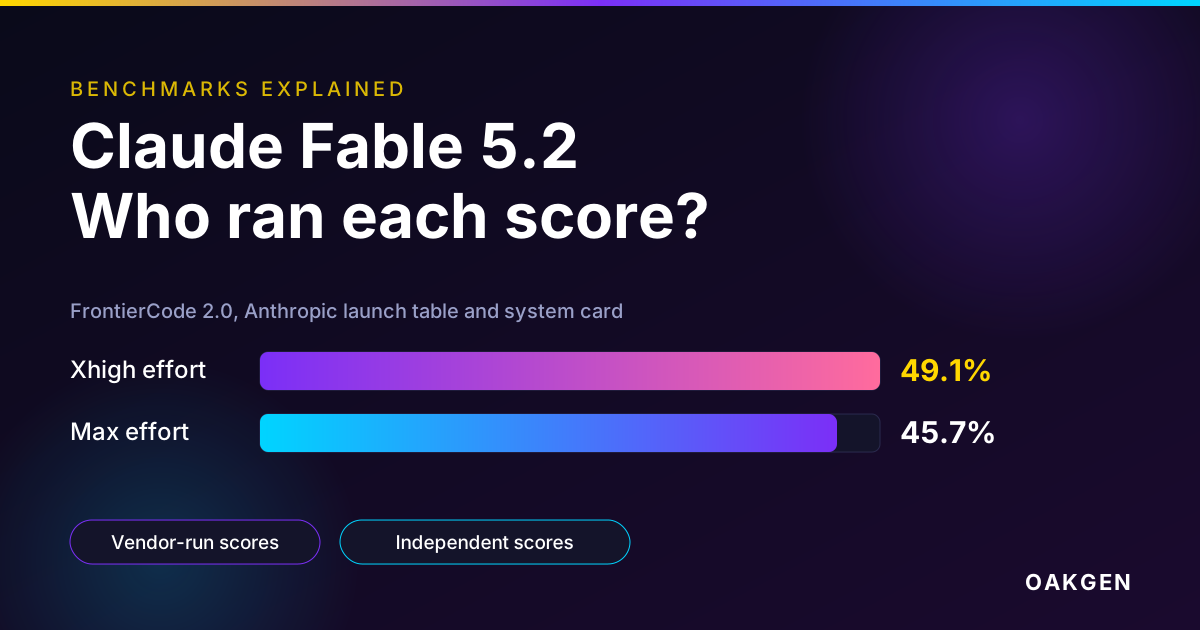
What the data says. Anthropic leads with Xhigh. It reports 49.1 percent on FrontierCode 2.0 at Xhigh, "the highest score of any released model we've tested". I could not read the Max point off Anthropic's chart as text, so I quote no Max score from it.
Artificial Analysis shows something different on its own index. Max scores 65, while High and Xhigh both score 62. On FrontierCode it wrote that "High effort scores the same as max (49%)". So whether Max loses depends on the benchmark, and the extra three index points cost 1.8 times the Xhigh price.
Anthropic's effort docs say as much. They advise starting at High, since most of the gain in capability is already present there, and to "Reserve max for measuring the model's ceiling" because it "runs slower and costs more than at xhigh, often for only a small gain".
Verdict. Not a bug and not a scandal. Max sounds like a better mode, and charts printed at the top setting taught people to expect better. A Hacker News user summed up the fix as "Stop looking at fable max."
Theme 3, usage-limit burn
The claim. On Hacker News, one user said a code review "used up my 5-hour token budget in half an hour". Another wrote it "burned through my entire 5-hour limit in about 10 minutes", though the review was nearly done. A third put it at 25 percent of the Fable limit on the $200 plan in one evening. On r/claude a user said it "used my entire Pro 5 hour window in under one question".
What the data says. Anthropic's help article says it plainly. "Fable models use your usage limits faster than other Claude models."
SemiAnalysis supplies a mechanism. In its run logs, Fable 5.2 "will often generate hundreds or even thousands of test cases, whereas Opus 5.5/Fable 5.1 stopped at just ~20", and is "much more eager to launch subagents for independent re-derivation and auditing". A Hacker News user described the fan-out from the user side, saying it will "spin up fable subagents and burn through usage laughably quick" unless you tell it how to use them.
I found nobody who measured plan-limit percentage in a controlled way. The reports are self-measured and lean toward people who post when something goes wrong. An Ultra user in the r/ClaudeCode reset thread said an hour-plus of hard work left them at 75 percent.
The resets confused people. Per Anthropic's help article, a Fable reset gives back the weekly usage you spent on Fable and refills the five-hour window, without raising any limit. Pro plans and standard Team seats get Fable included at up to 50 percent of the weekly limit through November 16, 2026, 11:59 pm Pacific, plus one reset. One poster summed up the gripe, "The issue with the fable resets is that they are fable resets."
Verdict. Confirmed by the vendor and many users, with a plausible mechanism. The size for your workload is unknown until you measure it. Start at Medium or High, cap subagents, and check Settings > Usage after your first real session.
Write the brief once, before you spend tokens
Turn a product and goal into a structured creative brief in Oakgen, then hand the same brief to any model or to the studio.
Theme 4, parity with Opus 5.5
The claim. The most repeated line was some version of "I cannot tell it apart from Opus 5.5". A Hacker News user wrote "I personally have a hard time telling the difference between Fable 5.2 and Opus 5.5 for ordinary coding tasks." Another tested 30 regular coding tasks and found "Fable 5.2 and Opus 5.5 both solved 26" while Fable 5.1 got 25, which is one person's test.
What the data says. The independent numbers match the feeling. Here is Artificial Analysis's side-by-side at Max effort, read on November 11, 2026.
| Evaluation | Fable 5.2 | Opus 5.5 |
|---|---|---|
| Intelligence Index | 65 | 59 |
| Terminal-Bench 4.0 | 59.6% | 59.6% |
| GDP.pdf all-pass | 24.2% | 26.2% |
| HLE-Diamond | 80.2% | 67.9% |
| Terminal-Bench-Science 0.1 | 73.3% | 59.0% |
| AA-Omniscience v1.1 | 67 | 48 |
Artificial Analysis noted Fable 5.2 improves on Fable 5.1 "but sometimes only to Opus 5.5 levels", in agentic knowledge work and terminal coding. The gap opens on science, knowledge and long-horizon work. Anthropic says "For most coding and knowledge tasks, we recommend that users start with Claude Opus 5.5, our strongest daily driver." Felix Rieseberg, who works at Anthropic, wrote on X that "I often still prefer Opus 5.5 for everyday work."
The people who saw a big gap were doing a different job. One Hacker News user said regular coding was about the same, but a "deep thorough audit of the codebase and the system" caught more problems than Opus. Another found design and architecture "night and day different". All single accounts.
Verdict. Both camps are right about different work. For routine coding and writing you are in the Opus 5.5 camp. For hard, ambiguous or long jobs the data favors Fable 5.2 at High. The Fable 5.2 vs Opus 5.5 vs GPT-6 Astra comparison matches models to jobs.
Theme 5, writing quality
The claim. Anthropic says testers found Fable 5.2 and Mythos 5.2 "communicate more clearly than past Fable and Mythos models". A Hacker News user comparing it with Opus 5.5 on one prompt found Fable "got right to the point" and "still showed signs of the cleaner writing style compared to Opus".
What the data says. The best-documented account is Ethan Mollick's. He had early access and says he takes no money from AI labs. He found Fable's first course website "accurate and joyless", a 182-page paper with "Claudespeak" in it, and a habit of returning to favorite themes. His key point is about judgment. "Knowing when your own work is not good enough is a large part of what makes someone an expert, and it is the part Fable does least reliably." The model did not see these problems itself, so he had to.
I looked for an independent writing score. Artificial Analysis publishes a style-related evaluation, but I could not read the Fable 5.2 value reliably from the page, so I cite none. Verdict. Unproven, and the place the hype misses most. Fable 5.2 is billed as a coding and science model, and nothing I could verify shows it writes best in the Claude line. Draft the same brief with two models, hide the labels and have a person pick.
Turn a brief into ad scripts you can shoot
Generate UGC-style ad scripts from a product and an angle in Oakgen, then edit them the way you would edit any draft.
Theme 6, safety and refusals
The claim. Anthropic says Fable 5.2's safeguards "are as robust as those of Fable 5.1 but produce fewer unnecessary blocks", about 55 percent fewer in early testing across claude.ai, Claude Code and Cowork. The r/ClaudeAI launch summary still listed guardrail complaints for cybersecurity and biology.
What the data says. The system card reports an overrefusal rate of 0.19 percent on claude.ai for Fable 5.2, against 0.33 for Opus 5.5 and 0.34 for Fable 5.1. Those are Anthropic's own runs on a single-turn benign-prompt set. That is a different measure from the dual-use security and biology work people complained about, so it cannot settle this.
Users split by field. On r/claude, someone doing drone flight-test work said "It didn't give me a single safeguard rail and kept working great". Someone in cybersecurity said they get "knocked down for like 90% of the work", and a reply said "We're in the verification program and we still get knocked down". On Hacker News, one user ran 30 coding tasks with "no runs hitting a safeguards stop", where Fable 5.1 had hit many.
A Hacker News user also asked how you know when you have tripped a fallback. Anthropic's page says blocked cybersecurity requests get an answer from Opus 4.8 and blocked biology requests one from Opus 5. Whether users see that clearly is the open question.
Verdict. Fewer blocks than 5.1 is plausible and partly supported. Zero blocks is not what anyone reports. For general coding, content and research, expect few stops. For security or biology, plan on Mythos access through a verification program, or another tool.
The claim vs evidence table
This is the original asset of this post. Each row is a claim I saw in the threads, the evidence I found and its source.
| Claim | Where it appeared | Evidence | Verdict |
|---|---|---|---|
| Fable 5.2 is 20% cheaper | Anthropic on X, Nov 9 | $8/$40 vs $10/$50 per million tokens, Anthropic | True per token |
| It costs more per task than 5.1 | r/ClaudeAI, Nov 9 | $26.54 vs $12.99 at Max, Artificial Analysis; $88.15 vs $67.16 on GDPx, SemiAnalysis | True at Max, not shown at Medium |
| Max scores lower than Xhigh | r/ClaudeAI launch thread | Anthropic's FrontierCode chart vs Artificial Analysis index, 65 at Max vs 62 at Xhigh | Benchmark dependent |
| Fable burns usage faster | Hacker News, Reddit | Anthropic help article; SemiAnalysis logs show far more tests and subagents | Confirmed |
| It is the same as Opus 5.5 | Hacker News, Reddit | Tie on Terminal-Bench 4.0; 12 point gap on HLE-Diamond, Artificial Analysis | True for routine work only |
| It is a better writer | Hacker News | One side-by-side; Mollick found "accurate and joyless" output | Unproven |
| Fewer false blocks | Anthropic launch page | About 55% fewer than Fable 5.1, Anthropic's own early testing | Plausible, unchecked |
| Cyber and biology work is still blocked | Reddit, Hacker News | Anthropic says Fable blocks most cyber tasks by design | True by design |
| It should have been called 5.5 | Reddit, Hacker News | SemiAnalysis calls it "a marginal improvement"; Anthropic gave no reason | Opinion |
| The "lobotomised" post is real | r/ClaudeCode | Commenters call it satire and the author account is deleted | Joke, ignore |
Test more than one model on the same creative job
Compare image and video models inside Oakgen before you commit a campaign to one of them.
What the hype misses
The dial is the product. Fable 5.2 has five effort settings, and cost per task swings 8.6 times from Low to Max on Artificial Analysis. Most of the argument was people on different settings comparing results.
Where the gap is real, it is narrow. The big wins are science, long-horizon agent work and ambiguous problems. Anthropic's showcase is a 1,000-agent run formalizing Fermat's Last Theorem in 30 hours. That is not your Tuesday.
The naming. SemiAnalysis said it is "clear why Anthropic named this model Fable 5.2 and not Fable 5.5". The top theory in the r/ClaudeAI launch summary was that a bigger model is being held back. Neither view is verified, and waiting for a rumored model is a good way to ship nothing.
Where this touches creative work
Fable 5.2 is a text and agent model. It plans, writes, audits and orchestrates. It does not generate images, video or audio. I checked Oakgen's model catalog and code on November 11, 2026 and found no Fable 5.2, so I will not tell you to look for it there. Oakgen generates images, video, audio and UGC-style ads.
The honest fit is the handoff. A planning model helps with scripts, shot lists and the brief, then you run the media in a studio. Write the brief once with the creative brief template. Our guide to agentic creative pipelines shows how the steps map, and best AI creative agents compares the products. I have not tested Fable 5.2 output inside Oakgen, so I make no quality claim about that pairing.
Decision framework
| Your situation | Start with | Why |
|---|---|---|
| Everyday coding, routine docs | Opus 5.5 at Medium or High | Anthropic recommends it, and independent data shows a tie on routine work |
| One hard, ambiguous or long job a week | Fable 5.2 at High | Score 62 for $9.08 beats Opus 5.5 Max at 59 for $10.04 |
| Big agent fleets | Fable 5.2 as orchestrator, Opus 5.5 as workers | Anthropic's suggested pattern; cap the subagents |
| Final copy that must read well | Whichever you prefer blind, then a human edit | No verified writing winner |
| Cybersecurity or biology research | Mythos 5.2 through a verification program, or another tool | Fable blocks most of this by design |
What I would do. Default to Opus 5.5. Give Fable 5.2 the hardest job of the week at High. Never judge it from a Max-only chart, and read the usage meter after the first session.
Common mistakes
- Reading Max-only charts. The loudest cost posts did exactly this, and the sub's own members corrected it.
- Calling per-token price cost. Tokens per task changed more than the price did.
- Taking the moderator bot's TL;DR as evidence. It is an automatic summary of one day's comments.
- Quoting satire. The "lobotomised" r/ClaudeCode post was a joke.
- Using a Fable reset when other models ate your weekly limit. It only restores Fable usage there.
- Letting subagents run free. Several users blamed fan-out for the burn.
Plan with any model, produce in one studio
Take your brief, script and shot list into Oakgen and generate the images, video and audio in one place.
Frequently asked questions
What did Reddit say about Claude Fable 5.2?
In the r/ClaudeAI launch thread the moderator bot summarized the mood as mixed and leaning underwhelmed, with Opus 5.5 on High still named the go-to model for most work. The loudest complaints were about Max-effort cost charts, Fable-only usage resets and cybersecurity and biology blocks. Power users running agent fleets reported large gains. That is from threads read on November 11, 2026, and the bot summaries are auto-generated.
Is Fable 5.2 cheaper than Fable 5.1?
Per token, yes. Anthropic lists $8 per million input tokens and $40 per million output tokens, down from $10 and $50. Per task at Max effort, no. Artificial Analysis measured $26.54 per Intelligence Index task for Fable 5.2 at Max against $12.99 for Fable 5.1, because Fable 5.2 used about 274k output tokens per task against about 118k. SemiAnalysis also measured 31 percent more cost per task on its GDPx benchmark. At lower effort levels the picture is better, but Anthropic's claim of fewer tokens at Medium has not been fully checked by an independent tester.
Does Fable 5.2 Max score lower than Xhigh?
On Anthropic's FrontierCode 2.0 chart, users read Max as scoring below Xhigh, and Anthropic's headline score is the Xhigh one at 49.1 percent. On Artificial Analysis's Intelligence Index, Max scores higher at 65 against 62 for Xhigh and High, at 1.8 times the cost of Xhigh. So the answer depends on the benchmark. Anthropic's own docs say Max often brings only a small gain and should be reserved for measuring the model's ceiling.
Why does Fable 5.2 burn through usage limits so fast?
Anthropic's help article says Fable models use usage limits faster than other Claude models. SemiAnalysis found in its run logs that Fable 5.2 writes hundreds or thousands of test cases where Opus 5.5 and Fable 5.1 wrote about 20, and launches subagents to audit its work. Several Hacker News users reported the same pattern, including subagent fan-out. Starting at Medium or High and capping subagents are the usual fixes.
Is Fable 5.2 better than Opus 5.5?
On hard science, knowledge and long agentic work, yes by a measurable margin. Artificial Analysis scored Fable 5.2 at 80.2 percent on HLE-Diamond against 67.9 for Opus 5.5, and 73.3 against 59.0 on Terminal-Bench-Science. On Terminal-Bench 4.0 the two tie at 59.6 percent. Anthropic itself tells most users to start with Opus 5.5, and an Anthropic engineer said on X that he often prefers it for everyday work.
Is Fable 5.2 good at writing?
Not settled. Anthropic says testers found it communicates more clearly than past Fable models. Ethan Mollick found its first course website accurate and joyless and said it did not notice that itself. One Hacker News user found its prose cleaner than Opus 5.5 in a single side-by-side. I found no independent writing benchmark for it that I could read, so treat writing claims as anecdote.
Did Anthropic really cut cybersecurity and biology blocks in Fable 5.2?
Anthropic says early testing showed about 55 percent fewer blocks than Fable 5.1, about 60 percent fewer in cybersecurity and 40 percent fewer in biology. That is Anthropic's own number. Users in the launch threads still reported blocks on reverse engineering, security work and biology questions, including users inside the Cyber Verification Program. Fable is designed to block most cybersecurity tasks, and Mythos 5.2 is the version for vetted organizations.
Can I use Fable 5.2 inside Oakgen?
I found no Fable 5.2 in Oakgen's model catalog or code on November 11, 2026, so this post does not claim it. Fable 5.2 is a text and agent model, while Oakgen generates images, video, audio and UGC-style ads. You can plan with any model and then run the creative work in Oakgen.
Sources
- Anthropic, Introducing Claude Fable 5.2 and Claude Mythos 5.2, Nov 9 2026 (read 2026-11-11)
- Anthropic, Claude Fable 5.2 and Mythos 5.2 System Card (read 2026-11-11)
- Claude Help Center, Claude Fable 5.2 launch offers (read 2026-11-11)
- Claude Platform Docs, Effort (read 2026-11-11)
- Artificial Analysis on X, Fable 5.2 takes #1 on the Intelligence Index, Nov 9 2026 (read 2026-11-11)
- Artificial Analysis, LLM Leaderboard with cost per task by effort level (read 2026-11-11)
- Artificial Analysis, Claude Fable 5.2 vs Claude Opus 5.5 (read 2026-11-11)
- Artificial Analysis, Claude Fable 5.2 vs Claude Fable 5.1 (read 2026-11-11)
- SemiAnalysis on X, Fable 5.2 on the GDPx leaderboard, Nov 10 2026 (read 2026-11-11)
- Hacker News, Claude Fable 5.2 and Mythos 5.2 launch thread (read 2026-11-11)
- Hacker News, Claude Fable 5.2 scores 65 on Artificial Analysis, highest so far (read 2026-11-11)
- Reddit r/ClaudeAI, Fable 5.2 just landed (read 2026-11-11)
- Reddit r/ClaudeAI, WTF Fable 5.2 Cost per task is Insane (read 2026-11-11)
- Reddit r/ClaudeCode, Fable 5.2 reset fiasco (read 2026-11-11)
- Reddit r/claude, Fable 5.2 is INSANE (read 2026-11-11)
- Reddit r/singularity, Fable 5.2 and Jagged AGI (read 2026-11-11)
- Ethan Mollick, Fable 5.2 and Jagged AGI, One Useful Thing, Nov 9 2026 (read 2026-11-11)
- Claude on X, Introducing Claude Fable 5.2 and Claude Mythos 5.2, Nov 9 2026 (read 2026-11-11)
- Felix Rieseberg (Anthropic) on X, Nov 9 2026 (read 2026-11-11)
- Yuchen Jin on X, Don't use Fable 5.2 Max, Nov 9 2026 (read 2026-11-11)
- Every, Vibe Check Fable 5.2, Katie Parrott, Nov 9 2026, paywalled after the opening (read 2026-11-11)