ChatGPT
 Claude
The Claude Fable 5.2 benchmarks come from two kinds of source, and mixing them up is the most common mistake. Anthropic's launch table reports 14 evaluations, and nine of them have no outside confirmation we could find. The independent checks published so far, as of November 11, 2026, come from Artificial Analysis (Intelligence Index 65 at Max effort), Vals AI (Vals Index 71.31% at High effort, first of 36 by 0.46 points) and ARC Prize (93.8% on ARC-AGI-2 at Xhigh).
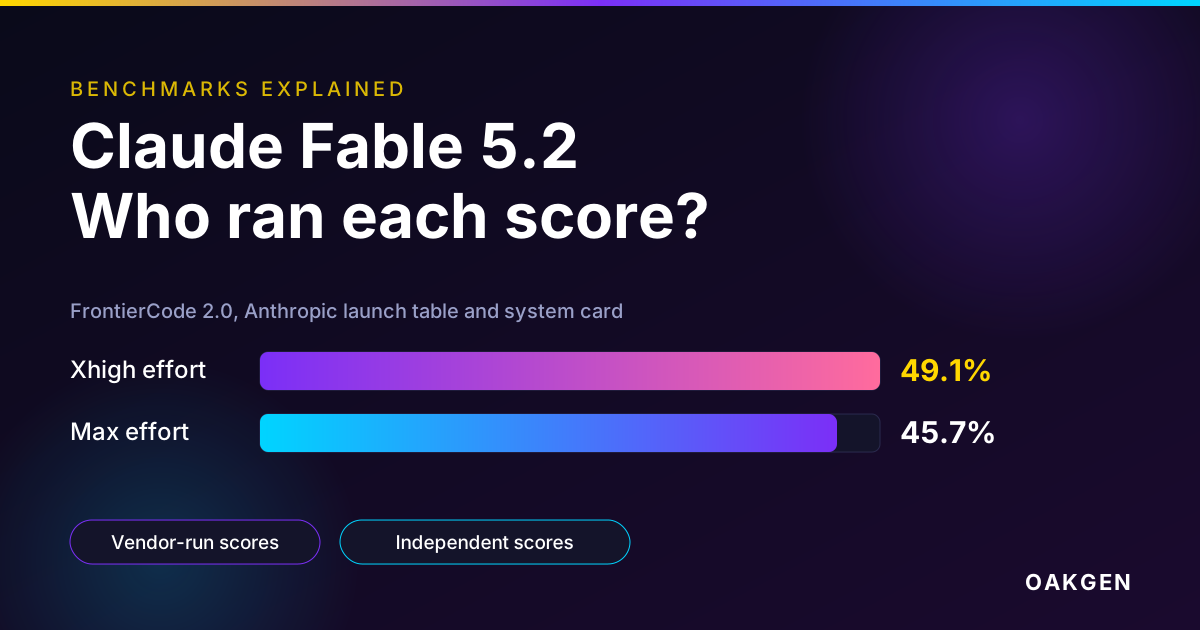
Fable 5.2 leads most rows but not all of them. It loses AutomationBench to Gemini 4 Carbon, the AA-Briefcase Elo rating to Opus 5.5, and several Vals legal and tax tests. The effort setting changes the answer too. On FrontierCode 2.0 it scores 49.1% at Xhigh and 45.7% at Max.
Test your own brief, not a leaderboard
Run the same creative brief through Oakgen Agent Chat and compare the plan, the script and the generated assets before you decide what a model is worth to you.
The short version
| Question | Short answer | Who ran it |
|---|---|---|
| Headline coding score | FrontierCode 2.0 is 49.1% at Xhigh effort and 45.7% at Max | Cognition's board lists 49.1%; the Max figure is Anthropic's system card |
| Best overall independent rank | Artificial Analysis 65 at Max (62 at High); Vals Index 71.31% at High | Independent |
| Abstract reasoning | ARC-AGI-2 93.8% at Xhigh | ARC Prize, with a caveat about an earlier checkpoint |
| Vendor-only claims | CVE Rediscovery 89.6%, binder design 85.1%, CyScenarioBench 76.3% | Anthropic only, scored on Mythos 5.2 |
| Where it loses | AutomationBench, AA-Briefcase Elo, Vals tax and legal tests, cost | Both |
| Price | $8 per million input tokens, $40 output, 20% below Fable 5.1 | Anthropic |
Disclosure: Oakgen is our product. We are not a model lab and we ran none of these benchmarks. The Oakgen section near the end says plainly what Oakgen does and does not offer.
Who this is for
You are choosing a model for an agent, a coding workflow or a creative pipeline, and a launch post says "highest of any released model tested". You want the numbers that hold up when someone else runs them.
For background on the earlier models, read our Claude Fable 5 and 5.1 explainer. For price and effort cost, see the pricing and cost per task post.
How we checked this
On November 11, 2026 we opened Anthropic's launch page and system card, and the pages of every outside publisher named below. Every number in the tables comes from the publisher's own page. Where we relied on a secondary report, we say so.
We did not run any benchmark ourselves. Anthropic's table has not been independently checked in full, by us or, as far as we found, by anyone else. Several boards were one or two days old, and scores will move.
Three labels for every score
- Vendor-run. Anthropic reports it and no outside page lists the same number. Anthropic says it ran its internal evaluations. For the rest we treat the numbers as Anthropic's runs.
- Owner board. The benchmark's maintainer lists the same score as Anthropic. That is consistent with an outside run, but the pages do not say who ran the model, so we do not call it independent.
- Independent. A third party ran the model on its own harness and published its own result.
Scorecard 1. Anthropic's 14 launch benchmarks
This is Anthropic's launch table, with what each test measures and what we could check outside Anthropic. "Rival" means the best other model in Anthropic's own table. Anthropic says each score is at the model's highest available effort unless a row says otherwise.
| Benchmark and owner | What it measures | Fable 5.2 against best rival (Anthropic's table) | Label and outside check |
|---|---|---|---|
| FrontierCode 2.0, Cognition | Would maintainers merge the code change | 49.1% at Xhigh against Opus 5.5 45.5% | Owner board matches. Artificial Analysis's variant gives 49.1% at High, 48.8% at Max |
| FrontierSWE v2, Proximal | 34 engineering tasks, 20 hours each | 69.9% against GPT-6 Astra 65.5% | Owner board matches |
| AutomationBench, Zapier | Business workflows across 47 simulated tools | 51.4% against Gemini 4 Carbon 53.9% | Owner board matches (51.45% at Max). Carbon leads |
| Terminal-Bench-Science 0.1, Stanford and Laude Institute | 70 expert-written research workflows | 74.6% against Astra 68.1% | Vendor-run. AA got 73.3% at Max, Vals 55.71% at High. Not on the official board |
| CyScenarioBench, Irregular | Multi-stage cyber operations | 76.3% (Mythos 5.2) against Opus 5.5 67.6% | Vendor-run, private 10-challenge subset. Each lab's scores use different tasks |
| CVE Rediscovery, Anthropic | Known vulnerabilities found in pre-fix code | 89.6% (Mythos 5.2) against Opus 5.5 81.3% | Vendor-run, 1,829 CVEs |
| De novo binder design, Anthropic | 24-hour protein design, 15 targets | 85.1 (Mythos 5.2) against Opus 5.5 82.6 | Vendor-run |
| WANDR, Perplexity | Wide data collection with evidence, 500 tasks | 82.1% relaxed score against Opus 5.5 72.3% | Vendor-run. Perplexity's post reports soft and hard F1 instead |
| OSWorld 2.1, XLANG Lab | Long computer-use workflows, 82-task offline set, partial credit | 89.3% against Opus 5.5 87.2% | Vendor-run. XLANG's board not checked |
| RoboDojo Sim | Simulated two-arm robot from camera images | 64.9% against Opus 5.5 39.4% | Vendor-run, every model on one harness |
| AA-Briefcase v1.1, Artificial Analysis | Knowledge-work tasks, rubric and Elo | Rubric 66.1% against 61.8%. Elo 1785 against Opus 5.5 1800 | Owner lists 1785 Elo. Opus 5.5 wins Elo |
| Remote Labor Index, CAIS and Scale AI | Paid freelance projects, human-judged | 41.3% at High against Opus 5.5 21.3% | Owner board matches |
| Humanity's Last Exam with tools, CAIS and Scale AI | 2,500 expert questions | 74.2% against Opus 5.5 67.7% | Vendor-run |
| Chartography without tools, Surge AI | Reading professional charts | 73.4% against Gemini 4 Carbon 72.5% | Vendor-run. Not on the Surge page we read |
A BenchCAD 2.1 chart sits further down Anthropic's page. At Max with tools Fable 5.2 scores 83.5 against Opus 5.5 at 65.3, and BenchCAD's site credits Anthropic's system card for the Claude results.
What the table tells you
Five rows have an owner board that matches, and nine are vendor-run. That is not a charge against Anthropic, because tests like CVE Rediscovery are its own and cannot be run elsewhere. But the strongest-sounding claims, on cyber and protein design, rest on Anthropic's word and are scored on Mythos 5.2, which most users cannot access.
The harness effect is the bigger lesson. Anthropic reports 74.6% on Terminal-Bench-Science. Artificial Analysis, on its own harness, gets 73.3% at Max and 70.0% at High. Vals, at High, gets 55.71%. The official leaderboard has no Fable 5.2 row and lists Opus 5.5 at 63.3% where Anthropic's table says 58.7%. Same benchmark name, a spread of nearly 19 points for one model.
AutomationBench shows the opposite trap. Artificial Analysis publishes AutomationBench-AA at 76.4%, which looks 25 points above Zapier's 51.45%. They are different task sets, so never chart them together.
Anthropic's footnote says scores are at each model's highest available effort unless noted. FrontierCode is labelled Xhigh and the Remote Labor Index is labelled High. Skip the label and you compare the wrong setting.
Scorecard 2. What outside testers published
Independent and owner-board results in one place, dated and labelled, all read on November 11, 2026. The Proximal and CAIS boards that match Anthropic are in scorecard 1.
| Publisher and date | Test | Effort | Fable 5.2 result | Context | Label |
|---|---|---|---|---|---|
| Artificial Analysis, Nov 9 | Intelligence Index v5.0.1 (nine evaluations) | Max / High / Xhigh | 65 / 62 / 62 | Gemini 4 Carbon High 60, Opus 5.5 Max 59 | Independent |
| Vals AI, Nov 9 | Vals Index v2.2 (finance, coding, legal, tax) | High | 71.31% plus or minus 0.96, first of 36 | Sonnet 5.5 70.85%, Carbon 70.45%, Opus 5.5 70.14% | Independent |
| Vals AI, Nov 9 | Vibe Code Bench / Finance Agent v2.1 / Science Index | High | 93.77% first / 69.47% first / 63.74% second | Astra leads Science at 65.09% | Independent |
| Vals AI, Nov 9 | Tax Agent Bench / Legal Research Bench / HLAB-Vals-1.1 | High | 32.09% (27th of 84) / 46.15% (19th of 93) / 5.00% (tied 29th of 37) | Carbon scores 51.78% on tax | Independent |
| ARC Prize, Nov 9 | ARC-AGI-1 / ARC-AGI-2, semi-private | Xhigh | 98.5% / 93.8% | Max scores 97.5% / 92.5% | Independent, verified |
| Artificial Analysis, Nov 9 | Terminal-Bench-Science 0.1 | Max / High / Xhigh | 73.3% / 70.0% / 67.6% | mini-swe-agent, three repeats | Independent |
| Cognition, Nov 9 | FrontierCode 2.0 leaderboard | Xhigh | 49.1%, first, $17.73 per rollout | Opus 5.5 45.5%, Astra 42.8% | Owner board |
| Zapier | AutomationBench v1.0.6 | Max / Xhigh / High | 51.45% / 47.95% / 44.29% | Carbon High 53.88% | Owner board |
| Cursor | CursorBench 4.0 | Max / High | 60.0% at $32.79 / 56.9% at $9.70 | Carbon High 60.4% at $9.22 | Third-party company |
| Arena, Nov 10 | WebDev (human votes) | Xhigh | 1836, first, 994 votes | Opus 5.5 Max 1814 | Independent |
See the models Oakgen runs for images, video and audio
Fable 5.2 plans the work. Image, video and audio models make it. Browse the library before you decide what the plan should call for.
Three cautions. First, ARC Prize says the released Fable 5.2 uses different tuning at Medium and Xhigh than the earlier checkpoint it tested. Low, High and Max are unchanged. So the 93.8% Xhigh figure may not describe the model you can call today.
Second, the Vals margin of error is about 0.96 points and the gaps to second and third place are 0.46 and 0.86. Vals also reports a 1.88% fallback rate, and Anthropic says blocked requests are answered by an Opus model. Third, Arena's score rests on 994 votes for Fable 5.2 against 4,187 for Opus 5.5, so the lead is likely, not certain.
Where Claude Fable 5.2 loses
Anthropic says Fable 5.2 is "a step above Opus 5.5 in almost all the capabilities we evaluated". "Almost" is accurate. Here is the rest.
In Anthropic's own table
- AutomationBench. Gemini 4 Carbon scores 53.9% against 51.4%, and Zapier's board agrees.
- AA-Briefcase Elo. Opus 5.5 is on 1800 against 1785, though Fable 5.2 leads the rubric score.
- Chartography. It leads, but only by 0.9 points.
In independent tests
- Vals Tax Agent Bench. 32.09%, 27th of 84. Vals's comparison page lists Gemini 4 Carbon at 51.78% and Sonnet 5.5 at 41.96%.
- Vals Legal Research Bench. 46.15%, 19th of 93, behind Carbon (55.77%), Gemini 4 Argon (54.81%), Opus 5.5 (50.48%) and Sonnet 5.5 (48.08%).
- Vals SWE-bench Multimodal. 62.29%, second to Opus 5.5 at 70.21%.
- Artificial Analysis Terminal-Bench 4.0. 59.6% at Max against 65.2% for Gemini 4 Carbon at High.
- CursorBench 4.0. Carbon High scores 60.4% for $9.22 per task. Fable 5.2 Max scores 60.0% for $32.79.
- Cost. Artificial Analysis lists $26.54 per task for Max, about three and a half times Carbon High at $7.76.
The pattern is steady. Fable 5.2 is strongest on long agentic coding, finance agents, reasoning and science, and weaker on tax, legal research and some workflow tests, where cheaper models match or beat it.
The effort wrinkle, explained
Anthropic's system card gives the numbers. At Max effort Fable 5.2 scores 45.7%, against 45.5% for Opus 5.5. The Max score "includes the graded scores of 22 attempts (out of 660) that timed out". Counting those as zero gives 44.4%, "below Opus 5.5 at 45.5%". The card adds that none of the attempts timed out at lower effort levels. Anthropic's launch page gives High as 45.3% and Xhigh as 49.1%.
So the headline is the best setting, not the top one. Now compare the same five effort levels across the sources.
| Source | Low | Medium | High | Xhigh | Max |
|---|---|---|---|---|---|
| Anthropic, FrontierCode 2.0 | not given | not given | 45.3% | 49.1% | 45.7% |
| Artificial Analysis, FrontierCode-AA 2.0 | 38.4% | 41.3% | 49.1% | 47.6% | 48.8% |
| Artificial Analysis, Intelligence Index | 54 | 56 | 62 | 62 | 65 |
| Artificial Analysis, cost per task | $3.10 | $3.80 | $9.08 | $14.83 | $26.54 |
| Cursor, CursorBench 4.0 | 53.2% | 54.8% | 56.9% | 56.3% | 60.0% |
| Zapier, AutomationBench | not read | not read | 44.29% | 47.95% | 51.45% |
| ARC Prize, ARC-AGI-2 | 86.7% | 89.6% | 90.4% | 93.8% | 92.5% |
| Vals Index | not read | not read | 71.31% at $17.94 | not read | lower, about seventh, $49.62 |
The Vals Max figures come from AlphaSignal's report of Vals's data. We did not open the Vals post itself.
What the table shows.
- More effort is not monotonic. Max beats Xhigh on the Artificial Analysis index, CursorBench, AutomationBench, FrontierCode-AA and Terminal-Bench-Science. It loses on Anthropic's FrontierCode and on ARC Prize.
- Max loses where there is a clock. Anthropic names timeouts on FrontierCode. ARC Prize says 28 of 55 ARC-AGI-3 games ran the full 12-hour limit at Max, and its standard-harness score is 65.7% at Max against 81.2% at Xhigh. AlphaSignal's report says Vals saw incomplete runs at Max.
- Max wins on CursorBench and AutomationBench, where the sources report no timeouts, at 2.7 to 3.4 times the cost of High.
- High and Xhigh tie on the Artificial Analysis index at 62, but Xhigh costs $14.83 against $9.08.
What we would do. Start at the default. Test High and Xhigh on 20 of your own tasks and log cost and timeouts. Use Max only for jobs that need long persistence and have generous time limits.
What these benchmarks do not tell you about creative work
None of the 14 rows tests ad copy, script quality, storyboard coherence or brand voice. The closest are the Remote Labor Index, which includes freelance design and video animation projects, and AA-Briefcase, which covers knowledge work. Neither scores taste.
Anthropic itself recommends starting with Claude Opus 5.5 for most coding and knowledge tasks, and moving up to Fable for the most ambitious technical work. A script, a shot list or an ad-variation plan is usually well served by a cheaper tier, and a wrong guess costs your credit balance, not the leaderboard.
One honest Oakgen note. Fable 5.2 is a text and agent model and does not make images, video or audio. Agent Chat has Oakgen's own Auto, Max and Pro Max tiers and does not list Fable 5.2 by name as of November 11, 2026, so do not assume it is available. The model fits the planning step, covered in how to use Claude Fable 5.2 for creative work and our script to storyboard workflow.
To test any agent on a creative brief, use our 100-point creative agent scorecard. For the wider picture, see agentic creative pipelines.
Turn a Fable-style plan into product creative
Take a brief, a script and a shot list into Oakgen's AI product creative studio and generate the images and video the plan calls for.
Decision framework
Use the job, not the headline, to choose which benchmark to trust.
- Long coding tasks. Cognition, Proximal, Vals Vibe Code and Arena all put it first. Strong. Test High against Xhigh first.
- Finance agents. First on Vals Finance Agent v2.1 at 69.47%, though the Vals Finance Index ranks it sixth of 39.
- Legal or tax research. 19th of 93 and 27th of 84 on Vals. Skip it on headline scores.
- Business workflows. Third on Zapier behind Carbon. Test Carbon first.
- Science. Second on the Vals Science Index. Test against GPT-6 Astra.
- Creative planning. No benchmark covers it. Run the scorecard on two tiers.
Common mistakes
- Reading a vendor table as a leaderboard. Anthropic picks its benchmarks and its comparison models.
- Ignoring the effort label. Xhigh is not Max, and the cost differs by a factor of two or more.
- Comparing across harnesses or variants. Terminal-Bench-Science runs from 55.71% to 74.6% for one model, and AutomationBench-AA is a different task set.
- Trusting Mythos rows for Fable. Three launch rows are scored on Mythos 5.2.
- Calling a 0.5 point lead a win. The Vals lead is inside its margin of error.
What we would do
We would use Fable 5.2 for long agentic coding and hard science, and keep Opus 5.5 or Sonnet 5.5 as the everyday default.
For creative teams, pick the cheapest model that writes a brief you would approve and spend the saved budget on generation. Oakgen Agent Chat lets you compare tiers on your own brief, and the Opus 5.5 and GPT-6 Astra comparison covers the head-to-head.
Plan with an agent, then generate the assets
Start with your brief in Oakgen Agent Chat. Compare the plan across tiers, approve the cost, and move to image, video and audio generation from the same workspace.
Frequently asked questions
What benchmarks does Anthropic report for Claude Fable 5.2?
Anthropic's launch table of November 9, 2026 lists 14 evaluations. They are FrontierCode 2.0, FrontierSWE v2, AutomationBench, Terminal-Bench-Science 0.1, CyScenarioBench, CVE Rediscovery, de novo binder design, WANDR, OSWorld 2.1 (offline set, partial), RoboDojo Sim, AA-Briefcase v1.1 (rubric and Elo), Remote Labor Index, Humanity's Last Exam with tools, and Chartography without tools. CyScenarioBench, CVE Rediscovery and binder design are scored on Claude Mythos 5.2, the same model with fewer safeguards. A BenchCAD 2.1 chart sits lower on the page.
Which Claude Fable 5.2 scores are independent?
As of November 11, 2026, the clearest independent results are Artificial Analysis (Intelligence Index 65 at Max effort), Vals AI (Vals Index 71.31% at High effort) and ARC Prize (93.8% on ARC-AGI-2 at Xhigh, on an earlier checkpoint for some effort levels). Cursor, Arena and Artificial Analysis also publish their own tests. Cognition, Zapier, Proximal and the Remote Labor Index list scores that match Anthropic's numbers, but their pages do not say who ran the model.
Why is Fable 5.2 49.1% on FrontierCode at Xhigh but lower at Max?
Anthropic's system card reports 45.7% at Max effort. It says 22 of 660 Max attempts timed out and were graded as they stood, and that counting them as zero gives 44.4%. It also says no attempts timed out at lower effort levels. So the 49.1% headline is the best effort setting, not the highest one. Other tests show the same pattern where time or token caps apply, but on CursorBench and the Artificial Analysis index, Max scores higher.
Where does Claude Fable 5.2 lose?
In Anthropic's own table it loses AutomationBench to Gemini 4 Carbon (51.4% against 53.9%) and the AA-Briefcase Elo rating to Opus 5.5 (1785 against 1800). On Vals AI it ranks 27th of 84 on Tax Agent Bench, 19th of 93 on Legal Research Bench, trails Opus 5.5 on SWE-bench Multimodal and trails GPT-6 Astra on the Vals Science Index. On CursorBench 4.0 Gemini 4 Carbon High scores 60.4% at $9.22 per task, against 60.0% at $32.79 for Fable 5.2 Max.
Is Fable 5.2 better than Opus 5.5?
On most published tests yes, by a margin that depends on the test. Vals puts it first by 0.46 points over Claude Sonnet 5.5 and 1.17 points over Opus 5.5, with a margin of error of about 0.96. Anthropic itself recommends starting with Opus 5.5 for most coding and knowledge tasks, and moving up to Fable for the most ambitious technical work. Test both on your own tasks before paying more per token.
What effort level should I use for Claude Fable 5.2?
Anthropic says Medium is the default in Claude apps and Claude Code. We did not verify the API default against Anthropic's docs. Vals found High gave its best Vals Index score, and Anthropic's FrontierCode data peaks at Xhigh. Start at the default, test High and Xhigh on 20 of your own tasks, and keep Max for jobs that need long persistence and have generous timeouts.
What does an Artificial Analysis Intelligence Index of 65 mean?
It is the average of nine evaluations in Artificial Analysis's index v5.0.1, run by Artificial Analysis on Fable 5.2 at Max effort. It is a relative score, so the useful reading is that Gemini 4 Carbon at High effort scored 60 and Opus 5.5 at Max scored 59 on the same index. The cost matters too. Artificial Analysis lists $26.54 per task for Max, against $9.08 for High, which also scores 62.
Does Oakgen offer Claude Fable 5.2?
Not as far as we can verify. Fable 5.2 is a text and agent model. Oakgen's Agent Chat offers Oakgen's own Auto, Max and Pro Max tiers and does not list Fable 5.2 by name as of November 11, 2026. Oakgen is our product, so check the model picker in Agent Chat for the current list.
Sources
- Anthropic, Introducing Claude Fable 5.2 and Claude Mythos 5.2, Nov 9 2026 (read 2026-11-11)
- Anthropic, Claude Fable 5.2 and Claude Mythos 5.2 System Card, Nov 9 2026 (read 2026-11-11)
- Artificial Analysis, Claude Fable 5.2 (max) model page, Nov 9 2026 (read 2026-11-11)
- Artificial Analysis, Release Comparison Tool, Fable 5.2 by effort level (read 2026-11-11)
- Artificial Analysis, Terminal-Bench-Science 0.1 results (read 2026-11-11)
- Vals AI, Claude Fable 5.2 model page, Nov 9 2026 (read 2026-11-11)
- Vals AI, Vals Index leaderboard and methodology (read 2026-11-11)
- Vals AI, model comparison table, Nov 9 2026 (read 2026-11-11)
- Artificial Analysis, model leaderboard, Intelligence Index v5.0.1 (read 2026-11-11)
- AlphaSignal, Claude Fable 5.2 tops 36 models but Max reasoning backfires, reporting Vals AI data (read 2026-11-11)
- ARC Prize, Claude Fable 5.2 verified results, Nov 9 2026 (read 2026-11-11)
- Cognition, FrontierCode leaderboard (read 2026-11-11)
- Proximal, FrontierSWE leaderboard (read 2026-11-11)
- Zapier, AutomationBench leaderboard (read 2026-11-11)
- Cursor, CursorBench 4.0 (read 2026-11-11)
- Arena, WebDev leaderboard, Nov 10 2026 (read 2026-11-11)
- Center for AI Safety and Scale AI, Remote Labor Index (read 2026-11-11)
- Terminal-Bench-Science, official leaderboard (read 2026-11-11)
- BenchCAD, programmatic CAD benchmark (read 2026-11-11)
- Surge AI, Chartography benchmark, Jul 2026 (read 2026-11-11)
- Perplexity Research, WANDR benchmark, Jul 14 2026 (read 2026-11-11)
- XLANG Lab, OSWorld-V2 repository (read 2026-11-11)
- Center for AI Safety, Humanity's Last Exam (read 2026-11-11)