ChatGPT
 Claude
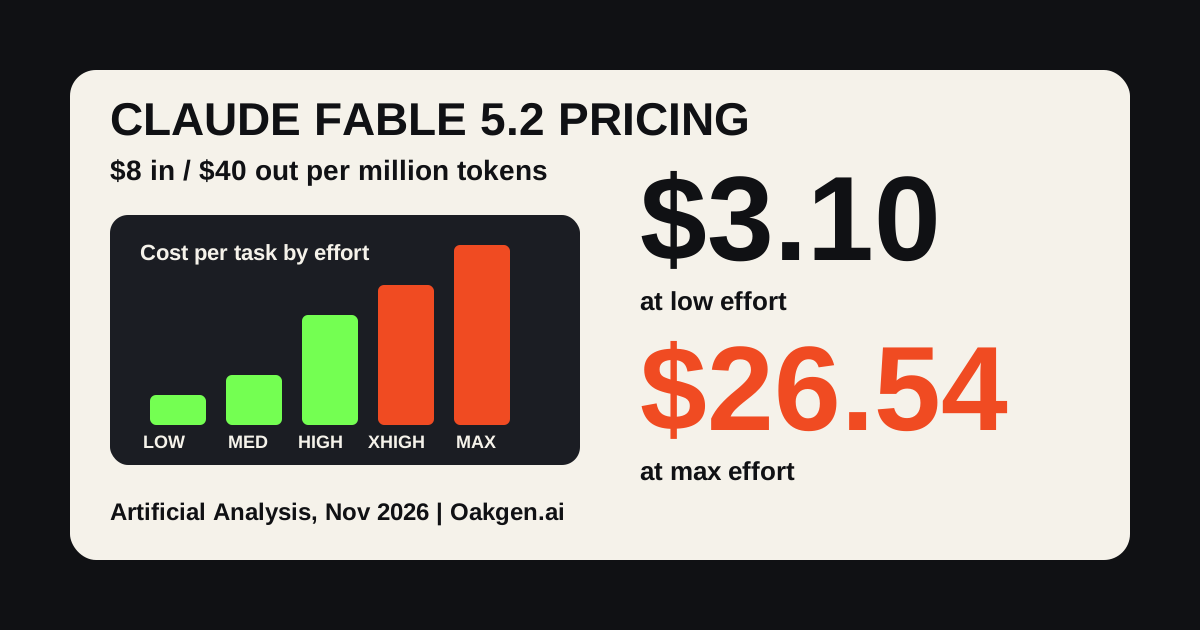
Claude Fable 5.2 costs $8 per million input tokens and $40 per million output tokens on the Claude API. That is 20% below Fable 5.1's $10 and $50, per Anthropic's launch post of November 9, 2026. The list price is the easy part. What you pay per task swings with effort level. Artificial Analysis measured $3.10 per task at low effort and $26.54 at max, on the same model.
My short answer on Claude Fable 5.2 pricing is to run it at high effort, never max by default. At high it scored 62 on Artificial Analysis' Intelligence Index for $9.08 per task, against 59 for Claude Opus 5.5 at max for $10.04. Start everyday work on Opus 5.5, as Anthropic itself advises, and move a task up only when your own test shows Opus failing it. Prices and scores are as of November 11, 2026.
Disclosure: Oakgen is our product, and it does not sell Fable 5.2 by name. We cover this model because creative teams may route scripts and planning to it, and the cost traps are worth knowing first.
Claude Fable 5.2 pricing at a glance
USD per million tokens on the Claude API, from Anthropic's pricing and model pages, read November 11, 2026.
| Item | Fable 5.2 | Opus 5.5 | Fable 5.1 |
|---|---|---|---|
| Input | $8 | $4 | $10 |
| Output (includes thinking) | $40 | $20 | $50 |
| 5-minute cache write | $10 | $5 | $12.50 |
| 1-hour cache write | $16 | $8 | $20 |
| Cache read | $0.20 | $0.20 | $0.25 |
| Batch input / output | $4 / $20 | $2 / $10 | $5 / $25 |
| Fast mode input / output | $16 / $80 | $8 / $40 | Not listed |
| Context window | 1M | 1M | 1M |
| Default effort (API) | high | medium | high |
Two details change the math. Fable 5.2 costs exactly twice Opus 5.5 on input and output, but the same $0.20 on cache reads. And Opus 5.5 defaults to medium effort while Fable 5.2 defaults to high, so swapping the model ID without setting effort raises your cost twice.
Plan with Fable-class models, then make the creative
Oakgen Agent Chat turns a brief into scripts, images, video and audio in one conversation, billed in credits.
What the list price leaves out
Five modifiers decide the real bill, per Anthropic's pricing and fast mode pages.
- Caching. A read costs 2.5% of base input. A 5-minute write costs 1.25 times base input and a 1-hour write 2 times. In agent loops the writes are where money goes.
- Batch. The Batch API takes 50% off, so $4 and $20. It suits overnight jobs and cannot be combined with fast mode.
- Fast mode. Up to 2.5 times the output tokens per second for exactly double the price, $16 and $80. The gain is in output speed, not time to first token. It has its own rate limit, it is unavailable with Batch or Priority Tier, and falling back to standard speed causes a cache miss. It buys speed, never savings.
- Long context. The full 1M window is billed at standard rates. A 900k token request costs the same per token as a 9k one.
- Residency and retention. US-only inference adds 1.1 times on every token category. Fable 5.2 also requires 30-day data retention and is not available under zero data retention unless Anthropic expressly authorizes it.
Fable 5.2 uses the Opus 4.7 tokenizer, which Anthropic says yields about 30% more tokens than earlier Claude tokenizers for the same text.
Effort levels and token use
Effort is the main cost control. It governs all output tokens, including thinking, tool calls and text. Fable 5.2 supports low, medium, high, xhigh and max.
Anthropic's guidance is blunt. Start at high, because "most of the gain in capability is already present at high". Use xhigh where you have measured a gain. Reserve max for measuring the ceiling, because at max the model "optimizes for capability without regard to token cost".
Artificial Analysis' independent numbers show the same shape. Its Intelligence Index v5.0.1 is a nine-benchmark mix of agentic coding, knowledge work and reasoning, and cost per task is the average list-price cost of one index task. Read November 11, 2026, from its leaderboard and model pages.
| Model and effort | Index score | Cost per task | Time per task |
|---|---|---|---|
| Fable 5.2 low | 54 | $3.10 | 6.3 min |
| Fable 5.2 medium | 56 | $3.80 | 7.8 min |
| Fable 5.2 high | 62 | $9.08 | 17.3 min |
| Fable 5.2 xhigh | 62 | $14.83 | 26.1 min |
| Fable 5.2 max | 65 | $26.54 | 45.2 min |
| Opus 5.5 medium | 48 | $2.45 | 7.1 min |
| Opus 5.5 high | 52 | $3.46 | 9.5 min |
| Opus 5.5 xhigh | 57 | $6.05 | 15.7 min |
| Opus 5.5 max | 59 | $10.04 | 25.0 min |
Three readings matter.
First, xhigh bought nothing on this index. It cost 63% more than high for the same 62. Max added 3 points for another 79%.
Second, Fable 5.2 low beats Opus 5.5 high, 54 against 52, and costs less, $3.10 against $3.46.
Third, token use explains the gap. At max, Artificial Analysis counts 274k output tokens per task for Fable 5.2 against 173k for Opus 5.5, about 1.6 times as many. Output costs twice as much per token and cache reads cost the same, so the overall gap lands near 2.6 times. Against GPT-6.1 Sol at max, which OpenAI lists at $2 input and $10 output, Fable 5.2 uses about four times the tokens and costs $26.54 against $1.27 per task. It scores 65 to Sol's 55, so you pay about 21 times as much for 10 more points.
Two cautions. This is a mixed benchmark, not your task. And effort barely changes reply length, per Anthropic, so control length in the prompt. Output costs five times input, and in an agent loop each long answer is paid for again as input on every later turn.
Worked cost calculator (illustrative arithmetic)
The workloads below are my own assumptions, not measurements. They show how list prices combine with token counts. Swap in your logged usage.
| Workload | Token assumptions per task |
|---|---|
| A. Ad script item | 3,000 input (brief plus style guide), 6,000 output including thinking, no caching |
| B. Agent session | 400,000 input (10,000 uncached, 30,000 written to a 5-minute cache, 360,000 read from cache), 60,000 output including thinking |
| C. Long document pass | One request, 800,000 input and 20,000 output, no caching |
| Workload | Fable 5.2 | Opus 5.5 | Fable 5.2 batch | Fable 5.2 fast mode | Fable 5.2 per 1,000 tasks |
|---|---|---|---|---|---|
| A. Ad script item | $0.264 | $0.132 | $0.132 | $0.528 | $264 |
| B. Agent session | $2.85 | $1.46 | Not applicable | $5.70 | $2,852 |
| C. Long document pass | $7.20 | $3.60 | $3.60 | $14.40 | $7,200 |
Check B on Fable 5.2. Uncached input is $0.08, the cache write $0.30, the cache read $0.072 and the 60,000 output tokens $2.40, for $2.852. Opus 5.5 gives $1.462. Batch does not apply because an interactive loop is not a batch job.
Two takeaways. First, at equal token counts Fable 5.2 costs about twice Opus 5.5, because output dominates and cache reads are the same price. So the break-even rule is simple. Fable 5.2 must use under half the output tokens, or finish tasks Opus cannot, to cost less per finished task.
Does it use half? Rarely, on this evidence. Quantslant's launch-day run (27 mixed tasks, medium effort, one run) found Fable 5.2 used 16,434 tokens against 23,839 for Opus 5.5, about 69%, so it cost 1.44 times as much, $0.75 against $0.52, and all four models scored 100% on its code, puzzle and vision tasks. AI/ML API's single bug-fix run passed 22 of 22 tests on Fable 5.2 for $0.11 and Opus 5.5 for $0.04. Illustrations, not rates.
Second, cache long documents. The first request on C writes the 800,000 tokens to a 5-minute cache for $8.00 and pays $0.80 for its answer. A later question that reads the cache pays $0.16 plus $0.80. Two questions cost $9.76 cached against $14.40 uncached. Ask the second inside the cache window or pay the write again.
Draft the scripts, then make the ads
At the Workload A assumptions, 20 scripts cost about $5.28 on the Fable 5.2 API. Oakgen's UGC ad script generator drafts editable timed scripts you can take into video.
The Plotly data point, $35.74 against $2.61
Plotly ran Fable 5.2 through its private 43-question data analytics exam on November 10, 2026. It passed all 43, as did GPT-6.1 Sol. The full run cost $35.74 on Fable 5.2 and $2.61 on GPT-6.1 Sol, about 13.7 times as much for the same score. Fable 5.2's run was the second most expensive of the 45 models on Plotly's board. Opus 5.5 scored 41 of 43 for $13.31.
The anatomy of the bill is the useful part. Plotly reports Fable 5.2 used 10.1 million tokens against 9.0 million for Fable 5.1, and its run cost more than Fable 5.1's $31.49 despite the 20% lower list price. Most of the bill was cache writing. The run wrote 2.1 million tokens to the cache, about $21 at $10 per million, plus about $13 of output and about $1.50 of cache reads.
Plotly's caveats apply. One pass per model, through OpenRouter, in its own harness. Repeat runs of other models moved by up to three points. Fable 5.2's median question took 40 seconds against 18 for GPT-6.1 Sol.
What I take from it is that harness design drives agent cost. A long tool loop that rewrites its cache prefix pays $10 per million each time. Anthropic's docs warn that editing earlier turns invalidates thinking blocks and that dropping them can raise output tokens. Keep history append-only, which also keeps cache hits high.
Ultralytics, cost per 1,000 images
Ultralytics tested Fable 5.2 as an auto-annotator on November 10, 2026, using 360 images from 36 detection datasets at the default high effort. It is the closest public cost number for image-reading work such as checking ad frames.
| Model | mAP50 (higher is better) | Provider cost per 1,000 images |
|---|---|---|
| GPT-6.1 Terra | 0.560 | $4.36 |
| Claude Fable 5.2 | 0.544 | $37.55 |
| Gemini 4 Argon | 0.537 | $7.60 |
| Claude Opus 5.5 | 0.527 | $13.92 |
| Claude Haiku 5.5 | 0.429 | $0.37 |
| Claude Fable 5.1 | 0.427 | $43.75 |
Ultralytics ranks Fable 5.2 second of 44 and says Opus 5.5 "reaches 97% of Fable 5.2's mAP50 at 37% of the cost". The $37.55 is Anthropic-reported token use at list prices, before Ultralytics' $1.00 platform fee per 1,000 images. It also reports Fable 5.2 refused all 10 security X-ray scans, which means a retry on another model.
Anthropic's claim, High effort matches Opus 5.5 Max at half the cost
Anthropic's launch post says that in early FrontierCode 2.0 testing, "Fable 5.2 at High effort scored about level with Opus 5.5 at Max effort, for roughly half the cost per task." The scores are 45.3% against 45.5%. This is Anthropic's own run, its table has not been independently checked in full, and I have not reproduced it.
Independent data agrees on quality and not on size. Artificial Analysis has Fable 5.2 high at 62 against Opus 5.5 max at 59, but the cost gap is $9.08 against $10.04, about 10%, not half. Different benchmark mix, different answer. Commenters in the Hacker News thread read those two figures the same way and argued about the larger jump in cost per task. Treat that as opinion. Anthropic's other cost claims, such as matching Opus 5.5's top WANDR score at medium effort for about 40% of the cost, come from its own charts with no independent check I could find.
My reading is that the direction is right and the size depends on the task. Fable 5.2 at high can replace Opus 5.5 at max without costing more. Whether it halves your bill only your tasks can say.
How to test it yourself
Anthropic's docs tell you to run your own effort sweep rather than carry settings between models. An afternoon is enough.
- Pick 30 to 50 real tasks and write a pass rule for each before you run anything.
- Fix everything except model and effort. Set
max_tokensto at least 64,000 for agent work. In Anthropic's cost page, a 16,384 cap ended 85% of Fable 5.2 attempts and solved 20.3% of tasks, against 77.4% at 64,000. A low cap makes a model look expensive and weak. - Run Opus 5.5 at medium, high and max, and Fable 5.2 at medium, high and xhigh. Run each cell three times.
- Log the four usage fields on every response and convert to dollars with the snippet below.
- Compare cost per solved task, not cost per call.
- Try a cascade. Anthropic's page shows Opus 5.5 at low with failures re-run at high cost about 17 cents per task against 29 cents at high throughout, with a slightly higher pass rate, provided you have a reliable failure signal such as tests.
The snippet ignores 1-hour writes, fast mode and US-only residency.
Who should pay for Fable 5.2
Anthropic says Fable and Mythos are best for "the most ambitious, open-ended technical work" and recommends starting most work on Opus 5.5. I agree.
| Situation | Start with | Why | Cost watch-out |
|---|---|---|---|
| Everyday scripts, summaries, drafts | Opus 5.5 medium or Sonnet 5.5 | Cheapest setting that clears your bar | Fable 5.2 doubles the per-token price |
| Hard coding or multi-hour agent runs | Fable 5.2 high | 62 against Opus max 59 at $9.08 per task on Artificial Analysis | xhigh and max add cost faster than score |
| Cheap quality floor | Fable 5.2 low | 54 at $3.10 beat Opus 5.5 high at 52 and $3.46 | Low can stop early on long agent work, per Anthropic |
| Live, latency-sensitive use | Fable 5.2 fast mode | Up to 2.5 times the output speed | Double the price, cache miss on fallback |
| Simple tasks at huge volume | Haiku 5.5 or a cheaper vendor | GPT-6.1 Sol max scored 55 at $1.27 per task | Check accuracy on your data |
Test several models on the same creative brief
Disclosure, Oakgen is our product. Browse the image, video and audio models available in Oakgen and pick one per job.
Common mistakes
- Leaving effort unset after swapping from Opus 5.5. You change two things at once and cannot tell which caused the bill.
- Running max everywhere. On Artificial Analysis max cost 2.9 times high for 3 more index points.
- Capping spend with a low
max_tokens. It ends attempts and wastes the tokens already spent. Use effort and workspace spend limits. - Using fast mode to save money. It doubles the rate. Use it when a person is waiting.
- Ignoring subagents. Anthropic says subagents can account for a large part of a session's cost. Check which model they run on.
- Trusting one run. Plotly saw up to three points of drift between repeat runs.
What I would do
For ads, short films or social content, I would draft routine copy on Opus 5.5 at medium. I would use Fable 5.2 at high for work that otherwise falls over, such as a series bible that must stay consistent across 40 episodes or a large brand archive you reason over once and cache.
Then spend the real budget on image, video and audio generation, where creative money goes. Our AI micro drama generator takes a plan to filmed episodes, the AI storyboard workflow shows how a script becomes shots, and 25 AI UGC ad script hooks covers hooks. For prompts that suit this model, see how to use Fable 5.2 for creative work.
Where Oakgen stands today. It is a creative studio, not an API reseller, so it will not lower your Claude API bill. Agent Chat offers Oakgen Auto, Oakgen Max and Oakgen Pro Max. The prices here are Anthropic's API prices and do not describe Agent Chat billing. See pricing for credits and plans.
Plan with Agent Chat, then generate the creative
Use Agent Chat to turn a brief into a script and shot list, then generate the images, video and voiceover from the same conversation.
Methodology and limits
On November 11, 2026 I read Anthropic's launch, pricing, model, what's-new, effort, fast mode, prompting and cost pages, Artificial Analysis' model pages, Plotly's and Ultralytics' posts, two launch-week tests, OpenAI's Sol pricing and one Hacker News thread.
Who measured what. Prices are Anthropic's and OpenAI's list prices. Cost per task and index scores are Artificial Analysis' independent runs. The $35.74 and $2.61 are Plotly's independent run, and the $37.55 per 1,000 images is Ultralytics'. The FrontierCode half-cost claim and the other launch cost claims are Anthropic's own runs. Anthropic's benchmark table has not been independently checked in full.
What I did not do. I did not run Fable 5.2 myself, the calculator is arithmetic on stated assumptions, and I did not read values off chart axes on Anthropic's page. Prices, scores and effort calibration can change, so recheck before you commit a budget. For scores see Fable 5.2 benchmarks explained, for model choice see Fable 5.2 vs Opus 5.5 vs GPT-6 Astra, and for earlier models see our Claude Fable 5 explainer.
Last updated November 11, 2026.
Frequently asked questions
How much does Claude Fable 5.2 cost?
On the Claude API, Fable 5.2 costs $8 per million input tokens and $40 per million output tokens. A 5-minute cache write costs $10 per million, a 1-hour cache write $16, and a cache read $0.20. The Batch API takes 50% off, so $4 and $20. Those are Anthropic's list prices on its pricing page, read on November 11, 2026. Thinking tokens are billed as output.
Is Claude Fable 5.2 cheaper than Fable 5.1?
Per token, yes. Fable 5.1 lists $10 input and $50 output, so Fable 5.2 is 20% lower. Per task it can be higher. Artificial Analysis measured $26.54 per Intelligence Index task for Fable 5.2 at max effort and $12.99 for Fable 5.1 at max effort. Plotly's data analytics run cost $35.74 on Fable 5.2 and $31.49 on Fable 5.1, because Fable 5.2 used more tokens.
How much does Claude Fable 5.2 fast mode cost?
Fast mode costs $16 per million input tokens and $80 per million output tokens, exactly double the standard rate. Anthropic says it delivers up to 2.5 times higher output tokens per second on the same model. It is set with speed fast on the Messages API, it is not available with the Batch API or a Priority Tier commitment, and cache multipliers stack on top of the fast price. It buys speed, not savings.
Does Fable 5.2 charge extra for the 1M context window?
No. Anthropic's pricing page says Claude 4.6 and later models, except Haiku 5.5, include the full 1M token context window at standard pricing, so a 900k token request is billed at the same per-token rate as a 9k token request. Fast mode pricing also applies across the full context window. The practical cost of long context is the number of tokens you send, not a surcharge.
What is the real cost per task of Claude Fable 5.2?
It depends on effort and task. On Artificial Analysis' Intelligence Index, an average task cost $3.10 at low, $3.80 at medium, $9.08 at high, $14.83 at xhigh and $26.54 at max. That is a mixed benchmark workload, not your workload. In Plotly's 43-question data analytics exam, the whole run cost $35.74. Measure your own tasks before you budget.
Is Fable 5.2 at high effort as good as Opus 5.5 at max for half the cost?
That is Anthropic's claim from its own FrontierCode 2.0 run, where Fable 5.2 at High scored 45.3% against 45.5% for Opus 5.5 at Max. Artificial Analysis' independent index points the same way on quality, with Fable 5.2 high at 62 against 59 for Opus 5.5 max, but the cost gap is $9.08 against $10.04, about 10%, not half. The half-cost figure is specific to Anthropic's benchmark.
Which effort level should I use for Claude Fable 5.2?
Start at high, which is the API default. Anthropic's docs say most of the capability gain is already present at high, to use xhigh only where you have measured a gain, and to reserve max for measuring the ceiling. Drop to medium or low where your own tests show quality holds. Set effort explicitly if you are moving from Opus 5.5, whose default is medium.
Can I use Claude Fable 5.2 in Oakgen?
Not by name. As of November 11, 2026, Oakgen's Agent Chat offers Oakgen Auto, Oakgen Max and Oakgen Pro Max. Oakgen does not sell Fable 5.2 by name. Oakgen is a creative studio for image, video and audio, not an API reseller. To call claude-fable-5-2 directly, use the Claude API or a cloud platform that lists it.
Sources
- Anthropic, Introducing Claude Fable 5.2 and Claude Mythos 5.2, Nov 9 2026 (read 2026-11-11)
- Claude Platform docs, Pricing (read 2026-11-11)
- Claude Platform docs, Claude Fable 5.2 model overview (read 2026-11-11)
- Claude Platform docs, What's new in Claude Fable 5.2 (read 2026-11-11)
- Claude Platform docs, Effort (read 2026-11-11)
- Claude Platform docs, Fast mode (read 2026-11-11)
- Claude Platform docs, Prompting Claude Fable 5.2 (read 2026-11-11)
- Claude Platform docs, Optimizing for cost and intelligence (read 2026-11-11)
- Artificial Analysis, Claude Fable 5.2 release page, Intelligence Index v5.0.1 (read 2026-11-11)
- Artificial Analysis, Claude Fable 5.2 (max) vs Claude Opus 5.5 (max) (read 2026-11-11)
- Artificial Analysis, Claude Fable 5.2 (max) vs GPT-6.1 Sol (max) (read 2026-11-11)
- Artificial Analysis, LLM leaderboard with cost per task (read 2026-11-11)
- Plotly, Claude Fable 5.2 Benchmark Results for Data Analysis, Nov 10 2026 (read 2026-11-11)
- Ultralytics, Claude Fable 5.2 is here, and it refuses to look at security X-rays, Nov 10 2026 (read 2026-11-11)
- Quantslant, Claude Fable 5.2 vs GPT-6.1 Sol vs Gemini 4 Argon, Nov 9 2026 (read 2026-11-11)
- AI/ML API, Claude Fable 5.2 vs GPT-6.1 Sol vs Opus 5.5: Our Tests, Nov 10 2026 (read 2026-11-11)
- OpenAI, Introducing GPT-6.1 Sol (read 2026-11-11)
- Hacker News, discussion of Fable 5.2 cost per task (read 2026-11-11)