AI text-to-speech has become indistinguishable from human speech. In blind listening tests, the best TTS models now fool listeners more than 70% of the time -- a threshold that would have been impossible just two years ago. ElevenLabs' $11 billion valuation in early 2026 demonstrates the market's confidence in the technology, and for good reason: creators are using TTS for YouTube narration, podcast production, e-learning content, audiobooks, app development, and advertising at an unprecedented scale.
But the market has expanded well beyond ElevenLabs. Ten serious contenders now offer production-quality voice synthesis, each with different strengths in language coverage, voice cloning, latency, and pricing. This guide ranks the 10 best AI text-to-speech tools in 2026 to help you find the right one for your use case.
If your shortlist is already down to the two models available in Oakgen, use the focused ElevenLabs vs MiniMax Speech comparison. If licensing or budget is the constraint, start with the free ElevenLabs alternatives guide and its linked commercial-use checks.
Oakgen offers ElevenLabs Multilingual V2 and MiniMax Speech HD directly in the platform. Generate natural-sounding speech in 30+ languages without separate subscriptions -- pay only for what you use with unified credits.
How We Evaluated TTS Tools
We tested each platform across seven criteria:
- Voice naturalness -- Prosody, intonation, breath patterns, and emotional expression. Does it sound human?
- Language support -- Number of languages and quality across non-English languages
- Voice cloning -- Ability to create custom voices from audio samples, and clone quality
- Latency -- Time from request to first audio byte (critical for real-time applications)
- Pricing model -- Cost structure transparency, per-character rates, and free tier availability
- API availability -- Documentation quality, SDK support, and integration complexity
- Emotion and style control -- Ability to adjust delivery style, speed, pitch, and expressiveness
Each tool was tested with identical scripts across English, Spanish, Japanese, and Arabic to evaluate both quality and multilingual consistency.
The 10 Best AI Text-to-Speech Tools of 2026
1. ElevenLabs
The market leader for voice naturalness
ElevenLabs remains the gold standard for AI speech quality in 2026. Its Multilingual V2 model produces the most natural-sounding speech across all competitors, with remarkably human prosody, breath patterns, and emotional inflection. The voice cloning capability is best-in-class -- Professional Voice Cloning produces near-identical reproductions of a speaker's voice from 30 minutes of audio.
- Best for: YouTube narration, audiobooks, premium content requiring maximum naturalness
- Languages: 29 languages with high quality across all
- Voice cloning: Yes -- Instant (5 seconds of audio) and Professional (30 minutes of audio)
- Key models: Multilingual V2, Turbo V2.5, English V1
- Latency: 200-500ms (Turbo V2.5: under 200ms)
- Pricing on Oakgen:
$0.0001666/character ($1.00 per 6,000 characters) - Stability/similarity controls: Yes -- fine-tune consistency vs. expressiveness
- Available on Oakgen: Yes
Strengths: Best naturalness, excellent cloning, extensive fine-tuning controls, strong API. Weaknesses: More expensive per character than MiniMax, 29 languages vs. competitors offering 40+.
2. MiniMax Speech HD
The best value with exceptional multilingual coverage
MiniMax Speech HD has emerged as the strongest challenger to ElevenLabs in 2026. It supports 36+ languages -- more than ElevenLabs -- and offers excellent voice quality at roughly 60% of ElevenLabs' per-character cost. The built-in voice cloning requires only 10 seconds of audio (compared to ElevenLabs' 30-minute requirement for Professional cloning), making it the most accessible option for custom voice creation.
- Best for: Multilingual content, budget-conscious creators, high-volume generation
- Languages: 36+ languages with strong non-English quality
- Voice cloning: Yes -- 10 seconds minimum audio, $0.80 per clone
- Controls: Pitch, speed, volume, emotion presets
- Latency: 300-600ms
- Pricing on Oakgen:
$0.0001/character ($0.10 per 1,000 characters) - Available on Oakgen: Yes
Strengths: Cheapest per character, most languages, low barrier voice cloning, pitch/volume control. Weaknesses: Slightly less natural than ElevenLabs on long-form English content, fewer fine-tuning parameters.
Earn 25% recurring on every referral.
Share Oakgen, get paid every month they stay.
3. PlayHT
Ultra-realistic voices with excellent cloning
PlayHT has carved out a strong position with its PlayHT 3.0 model, which produces exceptionally realistic voices with natural breathing and micro-pauses. The voice cloning is competitive with ElevenLabs, requiring only 30 seconds of audio for high-quality clones. The platform also offers a generous API with streaming support.
- Best for: Podcasts, conversational content, voice cloning projects
- Languages: 30+ languages
- Voice cloning: Yes -- 30 seconds of audio, high accuracy
- Pricing: Subscription model starting at $29/month for 200K characters
- Available on Oakgen: No
Strengths: Very natural conversational tone, strong cloning, streaming API. Weaknesses: Subscription-only pricing, no pay-as-you-go option.
4. WellSaid Labs
Enterprise-grade voice avatars
WellSaid Labs targets enterprise teams that need brand-consistent voice avatars across all their content. The studio includes collaboration tools for teams, version control for voice assets, and compliance features for regulated industries. Voice quality is excellent, though the consumer-facing options are limited.
- Best for: Enterprise teams, brand voice consistency, regulated industries
- Languages: 12 languages (English-focused)
- Voice cloning: Custom brand voices (enterprise contracts)
- Pricing: Enterprise pricing starting at $49/month per seat
- Available on Oakgen: No
Strengths: Team collaboration, brand consistency, enterprise compliance features. Weaknesses: Limited language support, no consumer plan, enterprise-focused pricing.
5. Amazon Polly
The developer's workhorse at scale
Amazon Polly remains the go-to choice for developers building speech into applications at scale. Its Neural TTS voices are high quality (though not quite at the ElevenLabs tier), and the pricing is unbeatable for high-volume use cases -- $4.00 per million characters for neural voices. SSML support gives developers fine-grained control over pronunciation, pausing, and emphasis.
- Best for: App development, high-volume API usage, AWS-integrated projects
- Languages: 33 languages, 60+ neural voices
- Voice cloning: No
- Pricing: $4.00/million characters (neural), $16.00/million characters (generative)
- Available on Oakgen: No
Strengths: Cheapest at scale, rock-solid API, SSML support, AWS ecosystem integration. Weaknesses: Less natural than ElevenLabs/MiniMax, no voice cloning, limited expressiveness control.
6. Google Cloud Text-to-Speech
The multilingual powerhouse
Google Cloud TTS leads in raw language coverage with 40+ languages and 220+ voices across Standard, WaveNet, Neural2, and Studio voice types. Neural2 voices are excellent quality and significantly cheaper than ElevenLabs. The SSML support is comprehensive, and the API integrates seamlessly with other Google Cloud services.
- Best for: Multilingual applications, Google Cloud users, localization at scale
- Languages: 40+ languages, 220+ voices
- Voice cloning: Custom Voice (enterprise, requires 100+ hours of audio)
- Pricing: $4.00/million characters (Neural2), $16.00/million characters (Studio)
- Available on Oakgen: No
Strengths: Most languages, extensive voice library, strong SSML, affordable at scale. Weaknesses: Custom voice requires massive audio dataset, less natural than dedicated TTS platforms.
7. Microsoft Azure TTS
The largest voice library with lip sync support
Microsoft Azure offers the single largest voice library in the market: 400+ neural voices across 140+ languages. The standout feature is viseme support -- the API returns facial animation data synchronized with speech, enabling lip sync for avatars, virtual characters, and interactive applications. This makes Azure the clear choice for developers building apps that need synchronized visual and audio output.
- Best for: Apps with lip sync, avatar animation, maximum language coverage
- Languages: 140+ languages, 400+ neural voices
- Voice cloning: Custom Neural Voice (enterprise)
- Pricing: $15.00/million characters (neural), custom pricing for Custom Neural Voice
- Available on Oakgen: No
Strengths: Largest voice library, viseme/lip sync support, 140+ languages, enterprise features. Weaknesses: Higher per-character cost than Polly/Google, Custom Neural Voice is enterprise-gated.
8. Murf.ai
The creator-friendly studio
Murf.ai is designed for content creators who want a polished studio experience without API complexity. The UI makes it easy to sync voiceover with video, add emphasis to specific words, and adjust pacing visually. It is the closest thing to a "GarageBand for voiceover" in the TTS space.
- Best for: YouTube creators, podcast producers, video voiceover
- Languages: 20+ languages, 120+ voices
- Voice cloning: Yes (Enterprise plan)
- Pricing: $29/month (Creator), $59/month (Enterprise)
- Available on Oakgen: No
Strengths: Intuitive UI, video sync tools, emphasis controls, no technical skill required. Weaknesses: Limited API, subscription-only, fewer languages than competitors.
9. Speechify
Consumer-focused reading assistant
Speechify started as a reading accessibility tool and has expanded into a full TTS platform. Its core strength is the consumer experience: the Chrome extension reads any webpage aloud, the mobile app converts documents to audio, and the API powers third-party integrations. The AI voices are natural, though not quite at ElevenLabs' level.
- Best for: Accessibility, reading assistance, consuming written content as audio
- Languages: 30+ languages
- Voice cloning: Yes (Premium plan)
- Pricing: Free tier available, $139/year (Premium)
- Available on Oakgen: No
Strengths: Best consumer experience, Chrome extension, mobile app, accessibility focus. Weaknesses: Voice quality below top-tier platforms, limited API, consumer-focused pricing.
10. Resemble AI
Real-time voice cloning with emotion control
Resemble AI targets the interactive and gaming markets with real-time voice cloning and granular emotion control. The platform can clone a voice from just 3 seconds of audio (the lowest in the market), and the Emotion API lets developers programmatically control anger, happiness, sadness, and surprise in generated speech. This makes it uniquely suited for game dialogue, interactive fiction, and dynamic voice experiences.
- Best for: Gaming, interactive apps, real-time voice synthesis
- Languages: 24 languages
- Voice cloning: Yes -- 3-second minimum, real-time inference
- Pricing: $0.006/second of audio generated
- Available on Oakgen: No
Strengths: Fastest cloning (3 seconds), real-time inference, granular emotion control, gaming-optimized. Weaknesses: Smaller voice library, fewer languages, less polished for long-form content.
Full Comparison
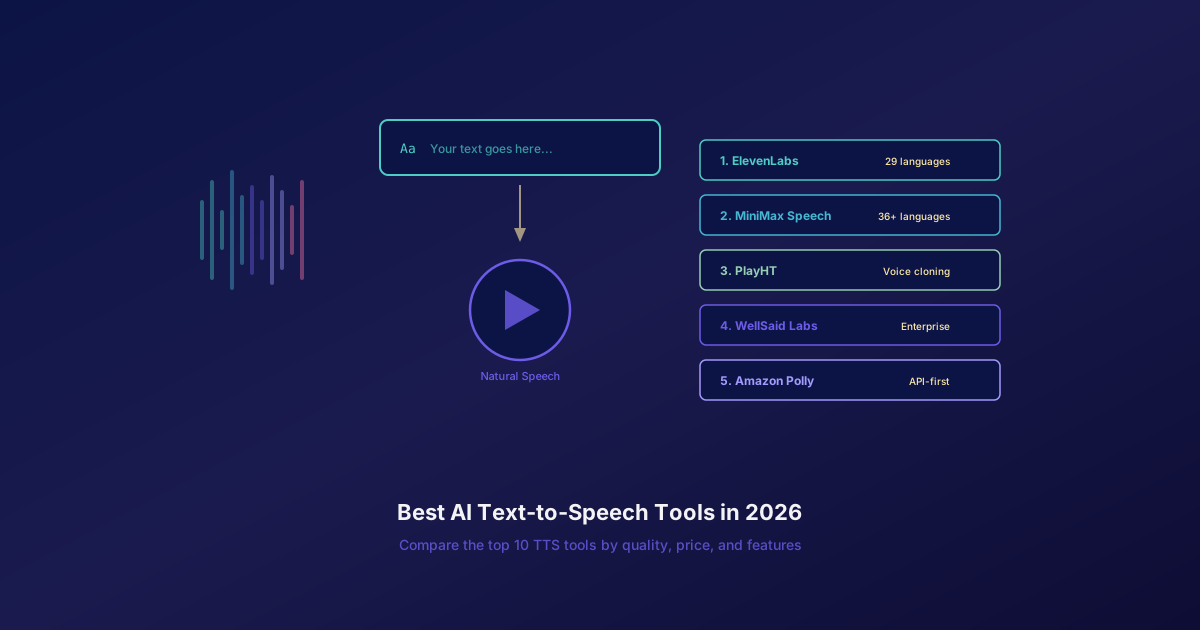
| Tool | Languages | Voice Cloning | Price Range | Best For | On Oakgen |
|---|---|---|---|---|---|
| ElevenLabs | 29 | Yes (Instant + Pro) | $0.10-0.30/1K chars | Premium narration | Yes |
| MiniMax Speech HD | 36+ | Yes ($0.80/clone) | $0.10/1K chars | Budget multilingual | Yes |
| PlayHT | 30+ | Yes (30s audio) | $29+/month | Podcasts | No |
| WellSaid Labs | 12 | Enterprise only | $49+/month | Enterprise teams | No |
| Amazon Polly | 33 | No | $4/M chars | App development | No |
| Google Cloud TTS | 40+ | Enterprise only | $4-16/M chars | Multilingual apps | No |
| Azure TTS | 140+ | Enterprise only | $15/M chars | Lip sync apps | No |
| Murf.ai | 20+ | Enterprise only | $29-59/month | YouTube creators | No |
| Speechify | 30+ | Yes (Premium) | $139/year | Accessibility | No |
| Resemble AI | 24 | Yes (3s audio) | $0.006/second | Gaming/real-time | No |
Best TTS by Use Case
Choosing the right TTS tool depends entirely on your specific use case. Here is our recommendation for each:
YouTube narration -- ElevenLabs for maximum naturalness, or MiniMax Speech HD if you produce high volumes of content and need to keep costs down. Both are available directly on Oakgen, so you can test both with the same script before committing. For a full walkthrough, see our AI voice cloning and TTS guide.
Audiobook production -- ElevenLabs is the clear winner. Long-form content requires consistent voice delivery across hours of narration, and ElevenLabs' stability slider (set to 0.7-0.8) maintains consistent delivery across chapters without drift. For a full workflow walkthrough, see our guide on audiobook narration without a narrator.
Multilingual content -- Google Cloud TTS (40+ languages at low cost) or MiniMax Speech HD (36+ languages with higher quality per voice). If you need professional quality in non-English languages, MiniMax offers the best balance of quality and language breadth.
App development -- Amazon Polly for the lowest API cost at scale, or Microsoft Azure if you need the most voice options and lip sync/viseme data. Both integrate well with their respective cloud ecosystems.
Voice cloning -- ElevenLabs for the highest quality clone (requires 30 minutes of audio), or Resemble AI for the fastest cloning from minimal samples (3 seconds). For accessible voice cloning without enterprise contracts, MiniMax Speech HD on Oakgen requires only 10 seconds of audio. See our voice cloning tutorial for step-by-step instructions.
Podcast production -- Murf.ai for creators who want a visual studio experience with video sync, or ElevenLabs for pure audio quality. For a head-to-head on the two most common podcast TTS options, see ElevenLabs vs Google TTS for podcasts. If you are combining AI voices with AI talking avatar videos, ElevenLabs on Oakgen gives you a unified workflow.
For long-form content like audiobooks, ElevenLabs' stability slider is crucial. Set it to 0.7-0.8 for consistent delivery across chapters. Too low and the voice varies unpredictably between paragraphs; too high and it sounds robotic and monotone. The sweet spot produces consistent yet natural speech that maintains listener engagement over hours.
Voice Cloning Compared
Voice cloning is one of the most powerful -- and most nuanced -- features in modern TTS. Here is how the top three cloning platforms compare:
ElevenLabs Professional Voice Cloning requires approximately 30 minutes of high-quality audio. The result is the most accurate clone available -- capturing not just voice timbre but speaking patterns, emphasis habits, and micro-expressions. The Instant Clone option (5 seconds of audio) is useful for quick tests but noticeably less accurate.
MiniMax Voice Clone requires only 10 seconds of audio and costs $0.80 per clone. The quality is impressive for the minimal input required -- it captures the core vocal characteristics well, though it may miss subtle speaking patterns that ElevenLabs' Professional tier captures. The low barrier makes it ideal for experimentation and projects that need many custom voices.
Resemble AI offers the fastest cloning at just 3 seconds of audio with real-time inference. The clones are optimized for interactive use cases where latency matters more than perfect accuracy -- gaming dialogue, virtual assistants, and dynamic applications. The emotion control API adds a dimension that other platforms lack, letting developers programmatically adjust emotional delivery.
Ethical considerations: Only clone voices you have explicit rights to use. Using someone's voice without consent raises serious legal and ethical issues. Most platforms require you to verify that you have permission to clone a voice, and several jurisdictions now have laws specifically governing synthetic voice reproduction.
Free TTS Options
If you want to test AI text-to-speech before committing to a paid plan, several platforms offer meaningful free tiers:
ElevenLabs -- Free tier includes 10,000 characters per month with access to pre-made voices. No voice cloning on the free tier. Enough for testing voice quality but not for production use.
Google Cloud TTS -- 1 million characters free per month for Standard voices, 1 million characters free for WaveNet voices (first 90 days). Generous enough for development and testing.
Amazon Polly -- 5 million characters free per month for the first 12 months (Standard voices) or 1 million characters (Neural voices). The most generous free tier for developers.
Microsoft Azure -- 500,000 characters free per month for Neural voices. Enough for development and small-scale testing.
Getting Started on Oakgen
Generating speech on Oakgen takes under a minute. For a detailed walkthrough, see our how to use AI voice generator guide. And because narration rarely ships alone -- pair your TTS output with AI background music on the same platform, no separate subscriptions.
- Go to the Audio page -- Navigate to oakgen.ai/audio
- Paste your text -- Enter up to 5,000 characters per generation
- Choose your provider -- Select ElevenLabs Multilingual V2 for maximum naturalness, or MiniMax Speech HD for the best value per character
- Select a voice -- Browse the voice library by gender, accent, tone, and language
- Adjust settings -- Fine-tune speed and stability (ElevenLabs) or pitch, speed, and volume (MiniMax)
- Generate -- Click Generate. ElevenLabs returns audio synchronously in seconds
- Download -- Save as MP3 or WAV for use in your project
If you need to create AI-powered video content with these voices, check out our guide on how to make a UGC ad in 10 minutes using Oakgen's combined audio and video tools. Wondering if it's worth switching from a per-tool subscription? Our breakdown of Oakgen pricing explained shows exactly when unified credits beat separate ElevenLabs and MiniMax plans.