A radio ad script is a timed piece of copy that makes one offer, names the brand at least twice, and ends with a single action the listener can remember without a pen. For length, plan on about 28 to 35 words for a 15-second spot, 55 to 70 words for 30 seconds, and 100 to 140 words for 60 seconds. Those numbers come from a conversational read speed of roughly 2.5 words per second, minus the time you need for music, sound effects and a breath. Spotify's own specs are stricter: no more than 65 words for a 30-second ad and about 100 for a 60-second ad.
Radio ad script word counts for 15, 30 and 60 seconds
| Spot length | Ceiling at 2.5 words/sec | Practical target | Spotify guidance | What fits |
|---|---|---|---|---|
| 15 seconds | 37 words | 28 to 35 words | Not specified | Brand, one benefit, one action |
| 30 seconds | 75 words | 55 to 70 words | 65 words maximum | Hook, problem, offer, proof, action |
| 60 seconds | 150 words | 100 to 140 words | About 100 words | A short scene or story, offer, repeated action |
The ceiling column assumes wall-to-wall talking, which no real spot has.
The math behind the word count
Use this formula:
Words = (spot length - non-voice seconds) x read speed
Non-voice seconds are everything that is not the announcer talking: a two-second sonic logo, a sound effect that sets the scene, a pause before the offer. Read speed depends on the voice and the mood. About 2.5 words per second is a brisk, energetic delivery. A warm, trustworthy read (healthcare, finance, anything premium) sits closer to 2 words per second.
Worked example for a 30-second spot with a 3-second jingle tag and one 1-second pause:
- 30 - 4 = 26 seconds of voice
- 26 x 2.3 words per second = about 60 words
That lines up with Spotify's recommendation of 65 words or fewer. Spotify's 60-second figure of about 100 words works out to roughly 1.7 words per second, which tells you what the platform expects: longer ads should breathe and make room for music and sound instead of doubling the copy.
Read the script aloud at the pace you want the final voice to use and time it with your phone. If it runs long, cut words. Do not speed up the voice to make it fit. Rushed reads are the most common reason a spot sounds cheap.
The radio ad script template
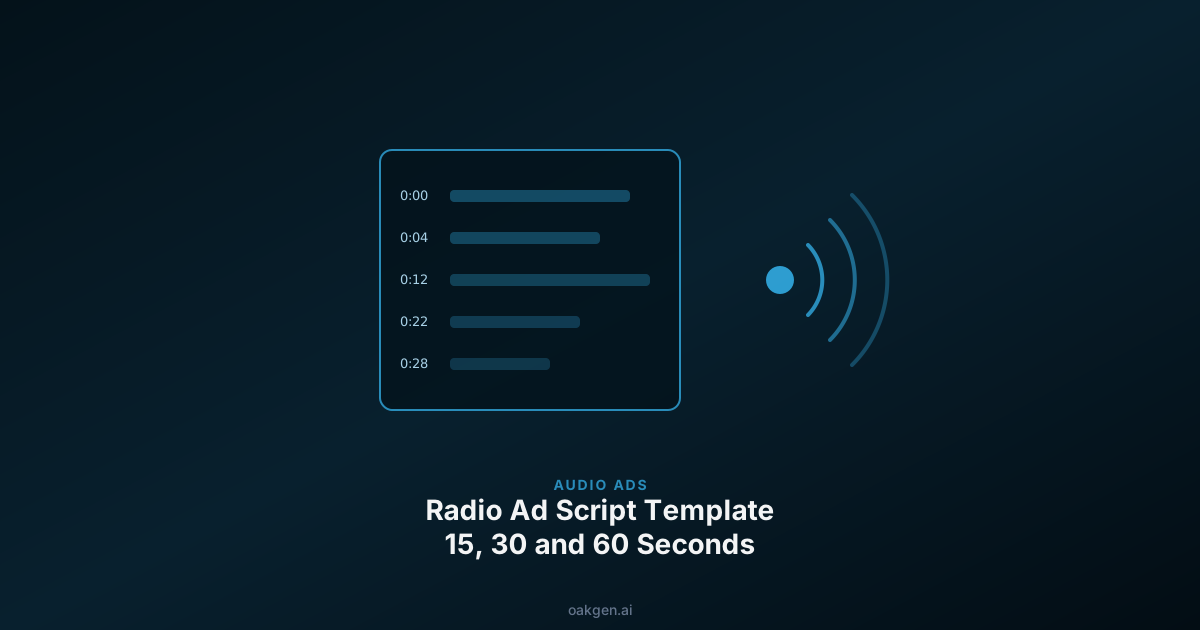
Copy this, fill in the brackets, then cut until it fits your word budget. Timing marks assume a 30-second spot.
RADIO / AUDIO AD SCRIPT
Client: [BRAND]            Spot length: [15 / 30 / 60] sec
Title: [INTERNAL NAME]     Format: [straight read / dialogue / testimonial / jingle-led]
Voice: [age range, tone, accent, pace]   Word budget: [number]
Music bed: [genre, tempo, mood, "under voice"]   Target: [radio station / Spotify / podcast]

0:00-0:04  HOOK
  SFX or MUSIC: [optional scene-setting sound]
  VOICE: [A question or situation the listener recognizes in one line.]

0:04-0:12  PROBLEM OR MOMENT
  VOICE: [One sentence that makes the problem feel specific.]

0:12-0:22  OFFER + ONE PROOF POINT
  VOICE: [BRAND] [does what] so you can [outcome].
  VOICE: [One concrete fact: price, hours, location, guarantee, number.]

0:22-0:28  CALL TO ACTION
  VOICE: [Single action]. [Easy-to-remember destination, said twice if possible.]

0:28-0:30  BRAND TAG
  MUSIC: [sonic logo or jingle tag]
  VOICE: [BRAND]. [Tagline, optional.]

LEGAL / DISCLAIMER (if required): [Exact wording, read at normal pace, time budgeted.]
As you cut, protect the basics. Stick to one message; if you have two offers, write two spots. Say the brand name within the first eight seconds and again at the end. And ask for a single action, either "visit the site" or "come in Saturday," never both with a phone number on top.
Voice Your Script in Minutes
Paste your script, pick a voice, and adjust pace and stability before you commit to a studio session.
Radio ad formats: which one to pick
| Format | Best for | Voices | Risk | Skip it when |
|---|---|---|---|---|
| Straight read | Offers, openings, promotions, most small businesses | 1 | Sounds generic if the copy is generic | Never; it is the safe default |
| Dialogue | Relatable problems, services people feel awkward about | 2 | Stilted, fake-sounding conversation | Your budget cannot cover good casting or careful direction |
| Testimonial | Services where trust decides the sale | 1 customer + 1 announcer | Legal and credibility trouble if the quote is invented | You do not have a real, consenting customer |
| Jingle-led | Brands that will run the same spot or melody for months | 1 + music | Costly to get right; annoying if weak | You are running a one-off promotion |
A few opinions from writing a lot of these. Straight reads win more often than people expect, because the listener only has to track one voice. Dialogue ads fail when the characters speak in full marketing sentences no person would say. If you want the jingle route, read our guide on how to make a jingle first; a jingle that is not catchy in the first two seconds just burns airtime.
Six radio ad script examples you can adapt
Every business below is fictional. The scripts are original and written for this guide. Word counts are for spoken voice lines only. Most of the 30-second examples land in the 50s, well under 65, because a sound effect, a second voice or a sung tag eats the rest of the time.
1. Local restaurant, 30 seconds, straight read (56 words)
Format: straight read     Voice: warm, mid-30s, smiling     Music: light acoustic, 95 BPM, under voice
SFX: sizzle on a hot pan, 2 seconds, then music in

VOICE: That sound? That's Friday at Marlow's Kitchen.
VOICE: Wood-fired pizza, fresh pasta made every morning, and a patio that stays warm
       even when the evenings don't.
VOICE: This month, kids eat free every Tuesday with any adult entree.
VOICE: Marlow's Kitchen, on Fifth Street across from the library.
VOICE: Book a table at marlows kitchen dot com. Marlow's. Come hungry.
The sound effect does the hooking here, the landmark replaces a street number nobody will remember, and the offer is one sentence.
2. Dental clinic, 30 seconds, dialogue (54 words)
Format: dialogue     Voices: FRIEND 1 (30s, casual), FRIEND 2 (30s, casual), ANNOUNCER (calm)
Music: none under dialogue, soft piano under announcer

FRIEND 1: You've been chewing on one side for a week.
FRIEND 2: It's fine. I just don't have time for the dentist.
FRIEND 1: Brightside does early mornings. I went at seven, back at work by eight.
FRIEND 2: Seven A.M.? Okay, that I can do.
ANNOUNCER: Brightside Dental. Open from seven, weekdays.
ANNOUNCER: New patients book online at brightside dental dot com.
The conversation stays short and sounds like real people, and the one benefit (early hours) is the whole point of the spot.
3. B2B SaaS, 30 seconds, straight read for Spotify (52 words)
Format: straight read     Voice: confident, conversational, 30s-40s     Music: minimal electronic, 110 BPM
Target: Spotify music ad (companion image + "Sign up" button)

VOICE: If your team still chases invoices over email, this is for you.
VOICE: Ledgerly sends reminders, matches payments, and tells you who's late
       before the month closes.
VOICE: Teams switch in an afternoon, with no new software for your customers.
VOICE: Try Ledgerly free for fourteen days.
VOICE: Tap the banner, or search Ledgerly. That's L-E-D-G-E-R-L-Y.
This one stays under Spotify's 65-word limit, and its call to action matches the platform (the companion banner and button). Spelling the name out is worth the seconds for any invented brand name.
4. Car dealership, 60 seconds, straight read with disclaimer (116 words plus legal line)
Format: straight read + legal tag     Voice: upbeat, trustworthy, 40s
Music: driving rock bed, 120 BPM, ducked under voice     SFX: engine start at 0:00, door close at 0:45

VOICE: You know that feeling when you finally stop putting off the car decision?
VOICE: This is the weekend.
VOICE: Harbor Road Motors is holding its fall sales event, Friday through Sunday.
VOICE: Every used vehicle on the lot has been through a one-hundred-fifty-point inspection,
       and every one comes with a free history report. No surprises after you sign.
VOICE: Bring your trade-in. Our team will appraise it in thirty minutes while you
       test-drive whatever caught your eye.
VOICE: And if you've been waiting for the right financing, we work with local credit unions
       to find you a payment that actually fits.
VOICE: Harbor Road Motors. Route nine, next to the water tower.
VOICE: Harbor Road dot com, or just come by this weekend.

LEGAL (normal pace, separate line): Financing subject to credit approval. See dealer for details.
With a full minute, the script can give three concrete reasons to visit (inspection, fast appraisal, financing) instead of repeating one. The legal line gets its own seconds at normal speed. Your actual disclaimer wording depends on your state and lender, so have it reviewed.
5. Community event, 15 seconds, straight read (28 words)
Format: straight read     Voice: bright, energetic     Music: brass-heavy festival bed, 128 BPM

VOICE: Forty food trucks. Three stages. One Saturday.
VOICE: The Riverside Night Market is back, September twelfth, five till eleven.
VOICE: Free entry. Riverside Park.
VOICE: Riverside Night Market. See you there.
Fifteen seconds holds exactly one date, one place and one reason. Fragments are fine in audio because listeners don't hear punctuation.
6. E-commerce DTC brand, 30 seconds, jingle-led (44 spoken words plus sung tag)
Format: jingle-led     Voice: relaxed, friendly, late 20s     Music: 4-note sung hook at open and close
Target: Spotify music ad or podcast streaming insertion

JINGLE (sung, 3 sec): "Sleep like a Cloudnest..."
VOICE: Most pillows go flat in a year. Cloudnest pillows are filled with
       adjustable foam, so you add or remove fill until it's exactly right.
VOICE: Try one for a hundred nights. If you don't love it, send it back.
VOICE: Get yours at cloudnest dot com.
JINGLE (sung, 3 sec): "...Cloudnest."
Six seconds of melody leaves about 24 seconds of voice, so the copy drops to under 45 words, and the sung open and close make the brand name the most repeated thing in the spot. To pair the jingle with a short, repeatable brand sound, see our sonic logo guide.
A testimonial structure (fill with a real customer)
We did not write a sample testimonial on purpose. Invented testimonials are a credibility and legal problem. Use this structure with a real customer's own words, recorded or approved by them:
CUSTOMER (real, consenting): [What was wrong before, in their words, one sentence.]
CUSTOMER: [The specific moment it changed.]
CUSTOMER: [The result, stated as their experience, not a guarantee.]
ANNOUNCER: [BRAND]. [Offer]. [Single call to action].
Spotify audio ad specs (as of September 2026)
These come from Spotify Advertising's official audio ad specs page, accessed September 26, 2026. Check the page again before you upload; specs change.
| Spec | Requirement |
|---|---|
| Music ad length | 30 seconds maximum |
| Long-form music ads | Up to 60 seconds in select markets, Direct campaigns only, skippable after 30 seconds |
| Podcast ads (streaming ad insertion) | 30 seconds maximum |
| Audio file types | MP3, WAV or OGG |
| File size | 50 MB maximum |
| Sample rate | 44.1 kHz |
| Bit rate | 192 kbps minimum, 320 kbps maximum |
| Loudness | -16 LUFS, plus or minus 1.5 LUFS |
| Channels | Stereo |
| Script length | No more than 65 words for 30 seconds; about 100 words for 60 seconds |
| Companion display image | 1:1, minimum 600 x 600 px, JPEG or PNG, 200 KB maximum |
| Logo | 1:1, minimum 600 x 600 px, JPEG or PNG |
| Advertiser name (music ads) | 25 characters maximum |
| Tagline | 40 characters maximum |
| Canvas (optional) | 9:16, 720 x 1280 px, MP4 or MOV, 3 to 8 seconds, 200 KB maximum |
| Podcast CTA card image | 640 x 640 px, JPG, 200 KB maximum |
Details that catch people out:
- The CTA is a button, not a phrase you choose freely. Spotify offers a fixed list of button labels such as "Shop now," "Sign up," "Book now" and "Learn more." Write the spoken call to action so it matches the button you pick.
- Podcast ads need their own CTA script. Spotify's example is "Visit (URL), or tap the banner now to learn more." If a campaign uses both streaming and dynamic ad insertion, each needs a different CTA script.
- A 60-second radio spot usually will not run as a standard Spotify ad. Cut a 30-second version from the same script instead of trimming the audio file.
Spotify also offers free, AI-assisted ad creation tools inside Ads Manager. They are fine for a first test. You get more control over the voice, the music bed and the sound design when you build the pieces yourself, which is the workflow below.
Score the Spot With a Generated Music Bed
Describe the genre, tempo and mood, set a duration, and generate a bed for your streaming or podcast spot. Check broadcast rights before it goes on air.
How to make a radio ad with AI: script to finished file
This is the workflow we recommend on Oakgen. Every step also works with other tools; the point is the order.
Step 1: Lock the script and a timing sheet
Fill in the template, read it aloud against a timer, and mark where each sound effect and music change happens. Changing the script after you generate the voice costs more time than anything else in the process.
Step 2: Generate the voice
Open the AI voice generator, paste the script, and pick a voice that matches the brief. The ElevenLabs models give you speed (0.7 to 1.2), stability and style controls. Lower stability gives a more expressive, varied read; higher stability gives a steadier, more consistent one. Generate two or three takes and pick the best.
For brand names, acronyms and street names, spell them phonetically in the script until the voice says them right. Our AI voice pronunciation guide covers the tricks. If you are choosing between TTS engines, see our comparison of the best AI text-to-speech tools in 2026.
Voice cloning caveats. Oakgen can clone a voice from a sample (at least 10 seconds recommended), and you must confirm you have consent before cloning. Oakgen's terms prohibit cloning anyone's voice unless it is your own or you have their explicit permission, and they ban celebrity and public-figure impersonation. A local business owner voicing their own ads is a good use. A sound-alike of a famous announcer would break those terms.
Step 3: Generate the music bed
In the music generator, describe the bed the way the template does: genre, tempo, mood, and "instrumental, sits under a voiceover, no lead melody." Eleven Music lets you set a duration (from 3 to 400 seconds; the slider moves in 10-second steps), so generate slightly longer than the spot and trim. For a 30-second spot that means the 33-second setting. Lyria 3 Pro does not take a duration input, so plan to trim and fade its output.
Check music rights before a radio buy. ElevenLabs' Eleven Music model-specific terms allow online and offline commercial use on its self-serve plans but exclude film, TV and radio, which need an enterprise music license. Do not assume an Eleven Music bed is cleared for a radio station. For a broadcast spot, check the provider's current terms or confirm broadcast rights with Oakgen first, or use a bed from a licensed music library or a composer. Streaming and podcast spots are a separate question, so read the terms for those too. ElevenLabs also says different users can receive the same or similar output, so a generated bed is made for you but is not guaranteed to be unique.
A sung hook like the Cloudnest example is a separate jingle project. Start with our jingle guide.
Step 4: Generate the sound effects
Sound effects set the scene faster than words: a sizzle, a door, an engine, a crowd. Oakgen generates them from text with ElevenLabs Sound Effects (clips from 0.5 to 30 seconds) through Agent Chat. Describe the sound, its length and the space it happens in ("single car door closing, parking garage, 1 second"). For prompt patterns, read our AI sound effects guide.
Step 5: Mix and master
Oakgen does not have a multitrack audio editor. You will assemble the final spot in a DAW or editor such as Audacity (free), Reaper, GarageBand or Descript.
Starting points for the mix (adjust by ear):
| Element | Starting level | Notes |
|---|---|---|
| Voice | Loudest element, the reference | Light compression so every word lands at a similar level |
| Music bed under voice | Roughly 15 to 20 dB below the voice | Duck it further under fast or dense copy |
| Music with no voice (intro, tag) | Up to near voice level | Bring it back up only in gaps |
| Sound effects | Briefly near voice level | Never under a spoken word |
| Final master (Spotify) | -16 LUFS integrated, plus or minus 1.5 | Export 44.1 kHz stereo, 192 to 320 kbps MP3, or WAV |
| Final master (radio) | Per the station's spec | Ask the station or rep; they differ |
Listen once on phone speakers and once in a car if you can. Most audio ads are heard on bad speakers, and a bed that sounds rich on studio monitors often buries the voice on a phone.
What it costs on Oakgen
Figures come from Oakgen's live pricing config as of September 2026, and each charge is confirmed on screen before anything generates.
| Asset | Model | Credits |
|---|---|---|
| Voiceover, 65-word script (about 380 characters) | ElevenLabs V3 | About 10 to 11 per take |
| Music bed for a 30-second spot (33-second setting, trimmed) | Eleven Music | 50 |
| Music bed, any length | Lyria 3 Pro | 21 per generation |
| 3-second sound effect | ElevenLabs Sound Effects | 4 |
| Voice clone (one-time per voice) | MiniMax voice clone | 300 |
A realistic 30-second spot with three voice takes, two music attempts and three sound effects comes to roughly 145 credits, a small slice of the 2,000 monthly credits on the Basic plan. Current plans are on the pricing page.
Common radio ad script mistakes
Reading a phone number. Listeners are driving or cooking. They will not remember seven digits heard once. Use a short web address, "search [brand]," or a landmark. If you must use a number, make it a vanity number and repeat it.
Packing in three messages. Sale, new location and hiring in one 30-second spot means the listener remembers none of them.
Saying the brand name once. Name it early and at the end. In a 60-second spot, three times is not too many.
Writing for the eye. Parentheses, slashes, "&," and "www" read badly aloud. Write "and," write "dot com," and write numbers the way you want them spoken.
Speeding up the voice to fit. If the spot runs long, cut copy. Speeding the voice makes the brand sound desperate.
Visual calls to action. "Click the link below" does not exist on radio. On Spotify, point to the banner or the button you selected.
A music bed that competes with the voice. Beds with a strong lead melody or vocals fight the announcer. Ask for an instrumental with no lead line.
Ignoring the platform length. Writing a 45-second spot is writing a spot nobody can buy airtime for. Standard lengths are 15, 30 and 60 seconds, and Spotify's standard cap is 30.
Compliance notes for audio ads (not legal advice)
Audio ads have one big compliance trap: the disclaimer read at double speed at the end. US FTC staff guidance on digital advertising disclosures says audio claims need audio disclosures, delivered at a volume and cadence that a reasonable consumer can hear and understand. The speed-reading habit from old car ads is exactly what that guidance warns against.
Practical habits:
- Budget time for the disclaimer in your word count. A 30-second spot with a 5-second legal line has about 25 seconds for everything else.
- Keep the voice speed at a normal setting for the legal line. Do not use the fastest TTS speed to squeeze it in.
- Put qualifying information right next to the claim it qualifies. A line tacked on at the very end doesn't cover it.
- Automotive, financial services, healthcare, alcohol, gambling and political ads often carry extra rules that vary by country and state. Stations and platforms also have their own creative policies. Get the final script reviewed by someone qualified before it airs.
- Only use testimonials from real customers, with their consent, reflecting their actual experience.
Building out the rest of your sound
A sonic logo gives every spot the same ending, and a jingle can carry across seasons. Running the same campaign in several languages is covered in our guide to multilingual ad campaigns with AI voice, and the reasons a voice persuades more than on-screen text are in the psychology of voice marketing. Branded podcasts need a different kind of music; our podcast intro music guide covers that.
Produce the Whole Spot in One Account
Voice, music bed and sound effects from one credit balance. Plans start with 2,000 monthly credits.
Sources
- Spotify Advertising: Audio ad specs and requirements (accessed 2026-09-26)
- Spotify Advertising: Audio ads overview, including free AI-assisted creation tools (accessed 2026-09-26)
- US Federal Trade Commission: .com Disclosures, How to Make Effective Disclosures in Digital Advertising (PDF) (accessed 2026-09-26)
- Oakgen model and pricing configuration for ElevenLabs V3, Eleven Music, Lyria 3 Pro, ElevenLabs Sound Effects and MiniMax voice cloning (checked 2026-09-26)
- ElevenLabs: Eleven Music model-specific terms (accessed 2026-09-26)
- ElevenLabs: Terms of Use (accessed 2026-09-26)
- Oakgen Terms of Service, voice cloning and output sections (accessed 2026-09-26)