A sonic logo is a one-to-three-second sound that identifies your brand without a single word or image. Think of Intel's five tones, NBC's three chimes, or the "ta-dum" that plays when Netflix opens. It is the audio version of a logo mark: short, identical every time, and placed at the same moments so people learn it. You can make a usable one today with an AI music generator plus a sound effects tool, then trim it in any editor. Most of the real work goes into a tight brief and a test on a bad phone speaker.
Brand histories and legal points below come from primary sources (the USPTO, the eCFR, the U.S. Copyright Office, company releases, and contemporary news reports). The Oakgen product details reflect our model setup as of September 2026. Every source is listed at the end.
Sonic logo vs jingle vs audio logo vs sonic identity
People use these terms loosely. Here is how they split in practice:
| Term | Typical length | Words? | Job | Example |
|---|---|---|---|---|
| Sonic logo (audio logo, sound logo) | 1-3 seconds | Usually none | Instant brand ID at fixed moments | Intel's five tones |
| Jingle | 15-60 seconds | Yes, often the brand name | Make an ad memorable and singable | A 30-second radio spot that sings the brand name |
| Sonic identity (sonic branding system) | A family of sounds | Varies | Keep every touchpoint sounding related | Mastercard's melody, adapted to ringtones and checkout sounds |
| Sound mark | Any | Varies | The legal term for a sound registered as a trademark | NBC's G-E-C chimes |
"Audio logo" and "sonic logo" mean the same thing. Sonic branding is the wider discipline: the logo, plus the music, voice, and interface sounds around it. If you need the full ad song instead, read our guide on how to make a jingle. If you want the psychology behind why any of this works, sound branding psychology goes deep on memory and emotion.
Famous sonic logo examples, and what they teach
Every example below was checked against a primary or contemporary source. I skipped popular stories I could not confirm.
Intel: five notes that say the name
Walter Werzowa built Intel's audio signature in his Sherman Oaks garage studio, according to a 1999 Los Angeles Times profile. Intel's brief asked for something that suggested innovation and the inside of a computer while sounding corporate and inviting. The first tone is a "sparkle" layered from more than 20 sounds, including a tambourine, an anvil, and an electric spark. The next four notes (D flat, G flat, D flat, A flat) blend xylophone, marimba, and bells, and follow the syllables of "In-tel In-side," so the melody mirrors the way people say the brand. A UCLA marketing professor quoted in the same piece summed it up: "It is clean and it has very few notes."
NBC: three notes, registered as a trademark
NBC's chimes are one of the oldest registered sound marks in the US. The registration (No. 0916522, registered in 1971) describes chime-like notes in the key of C: G, E, and C, with the G just below middle C. That is the entire logo: three notes in a single timbre, which is exactly why it was simple enough to describe in a registration.
Netflix: a sound so recognized it named a website
When Netflix launched its fan site Tudum in December 2021, The Hollywood Reporter described the name as a riff on the sound that plays with the logo when subscribers open the service. A two-syllable thud became a brand asset big enough to name a product. So a melody is optional. A distinctive sound effect can do the job if it plays at the same moment every time.
Mastercard: one melody, many versions
Mastercard introduced its sonic brand in February 2019 as a full sound architecture. The company says the core melody was built with musicians around the world, including Mike Shinoda of Linkin Park, and adapts across genres. The same melody underpins its sound logo, ringtones, hold music, and point-of-sale acceptance sounds.
Treat your logo as the short end of a system in the same way. If your five notes can also become a checkout chime and a hold loop, you get more repetition for free.
THX Deep Note: a sound as a promise of quality
THX says its Deep Note was composed by Lucasfilm engineer Dr. James "Andy" Moorer and first played at the 1983 premiere of Return of the Jedi. Moorer refreshed it in 2015. It is a long, swelling chord rather than a tune, and it signals "the sound in this theater is about to be good." Here the identity lives entirely in timbre and dynamics.
Anatomy of a good sonic logo (spec sheet)
Most weak sonic logos fail the same way: too long, too many notes, and a sound that disappears on a phone. Use this sheet before you generate anything. It's my own working template, so adjust it for your brand.
| Element | Recommendation | Why |
|---|---|---|
| Length | 1-3 seconds, with a clean tail | Fits end cards, app opens, and intros without slowing them down |
| Notes | 2-5 | Intel uses a sparkle plus four notes. NBC uses three |
| Melodic shape | One clear rise or fall, or one surprising leap | Easy to hum back, hard to confuse with generic stock |
| Timbre | One hero instrument, plus an optional texture layer | The instrument carries mood (bells feel bright, a low piano feels premium) |
| Midrange | Main energy between the low mids and upper mids | Phone and laptop speakers cannot reproduce deep bass |
| Ending | Resolves, or ends on a deliberate "open" note | Resolution feels finished. An open end suits "coming up next" moments |
| Versions | Full, short (1 second), and a quiet UI version | Different moments need different weights |
| Placements | Pick 3 you control and use them every time | Repetition is how a sound becomes a brand |
On that last row: the mere exposure effect explains why consistent repetition matters more than a clever first listen.
How to make a sonic logo with AI on Oakgen
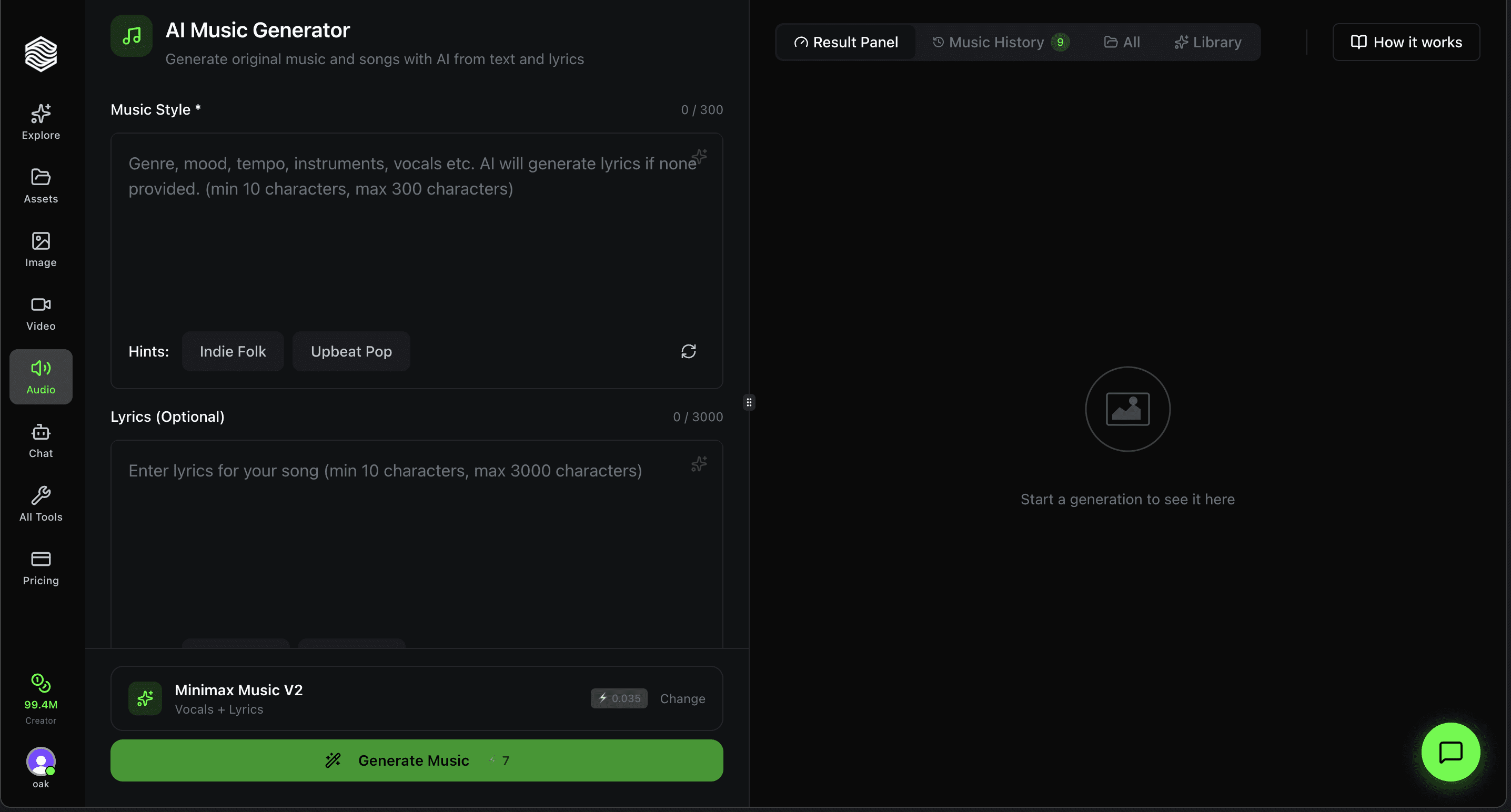
Oakgen gives you two pieces that matter here: the AI music generator for melodic ideas, and ElevenLabs sound effects, which you generate through Agent Chat or the Oakgen MCP server, for sparkles, whooshes, and textures. The audio studio itself has voice generation and voice cloning tabs, not a sound effects tab. The workflow below keeps generation cheap and puts your judgment where it counts.
Generate a Sonic Logo
Draft melodic ideas with Lyria 3 Pro or Eleven Music, then trim the best two seconds into your brand sound.
Step 1: Write a one-paragraph brief
Before prompting, answer five questions in plain words. What three adjectives describe the brand? Where will the logo play first? Should it feel like it resolves or leans forward? Which instrument fits? What should it never sound like? Use the template below. It is plain text, so paste it into a doc or straight into a prompt.
SONIC LOGO BRIEF
Brand: [name]
Three adjectives: [e.g. warm, precise, optimistic]
First placement: [video end card / app launch / podcast intro]
Length target: [1-3 seconds]
Notes: [2-5], shape: [rising / falling / one leap]
Hero instrument: [e.g. celesta, muted piano, marimba, synth pluck]
Texture layer (optional): [e.g. soft shimmer, airy whoosh]
Ending: [resolved / open]
Never sounds like: [e.g. game show, horror, generic corporate stock]
Tempo feel: [calm / medium / quick]
Step 2: Generate melodic drafts in the music generator
Oakgen's music generator currently offers two models:
- Eleven Music. Takes a text prompt of up to 4,100 characters and a duration slider that starts at 3 seconds. ElevenLabs documents it as supporting vocals or instrumental output. Use it when you want tight control over length.
- Lyria 3 Pro. Google's music model. On Oakgen it takes a prompt of up to 1,500 characters and up to 10 reference images. Google documents instrumental mode, vocals, and lyrics support. Use it when you want a richer arrangement, or want to feed in your visual logo or brand board as a mood reference.
For a sonic logo, set Eleven Music to its shortest duration and generate several variations of the same prompt. Say "instrumental" and "no vocals" explicitly. Describe the note count and shape in words ("four ascending notes, then one bright sustained chord") rather than hoping the model reads your mind. New to music prompting in general? Start with our AI music generation guide.
Step 3: Generate a texture layer with sound effects
Many great audio logos layer a non-musical sound over the notes, like Intel's sparkle. In Agent Chat, ask for a sound effect, give the duration, and describe the texture: "short bright digital shimmer, rising, clean tail, 1 second." Oakgen's ElevenLabs sound effects model accepts a text description of up to 450 characters and a duration from half a second to 30 seconds. There is also a prompt influence setting: turn it up to stick closer to your words, or down for looser variations. For more on writing SFX prompts, see our AI sound effects guide.
Step 4: Trim, stack, and fade in an editor
Import the best music take and the best texture into any audio editor (Audacity, GarageBand, Descript, or your DAW). Find the strongest 1-3 seconds. Put the texture a beat before the first note or right on it. Add a short fade-out so the tail does not click. Export a WAV master and an MP3 copy.
Step 5: Build your three versions
Cut a full version, a one-second short version (usually the last note or two), and a quieter version with the low end rolled off for UI sounds. Name them clearly. You will reuse these for years.
Oakgen does not have a dedicated "sonic logo" mode. Eleven Music's shortest setting is 3 seconds, and Lyria 3 Pro on Oakgen has no duration or tempo controls (only the prompt and reference images). You will almost always trim the final 1-2 seconds yourself in an editor. Budget for 10 to 30 generations before one feels right. You'll see each model's credit cost before you commit, and plan details live on the pricing page.
12 sonic logo prompts by brand personality
Copy these into the music generator and swap in your own instrument or mood. Each one says "instrumental" because stray vocals are the most common way a logo draft goes wrong.
| Brand personality | Prompt |
|---|---|
| Trustworthy finance | "Instrumental sonic logo, 3 seconds. Four calm ascending notes on a warm felt piano, ending on a resolved major chord with soft strings underneath. Confident, steady, no percussion, no vocals." |
| Playful consumer app | "Instrumental audio logo, 3 seconds. Three bouncy marimba notes with a quick upward leap, finished by a bright pop and a tiny sparkle. Cheerful, light, no vocals." |
| Premium or luxury | "Instrumental sonic logo, 3 seconds. A single low cello note swelling into a sparse two-note harp motif, lots of air, slow and elegant, resolved ending, no vocals." |
| Tech or SaaS | "Instrumental audio logo, 3 seconds. Clean synth pluck, four notes rising in a quick arpeggio, subtle digital shimmer, ends on an open, forward-leaning note. Modern, precise, no vocals." |
| Wellness or health | "Instrumental sonic logo, 3 seconds. Soft singing bowl tone followed by two gentle kalimba notes falling, warm reverb, calm and reassuring, no vocals." |
| Sports or energy drink | "Instrumental sonic logo, 3 seconds. Punchy drum hit, then three distorted synth brass notes rising fast, ending on a big stadium impact. Aggressive, bold, no vocals." |
| Kids or education | "Instrumental audio logo, 3 seconds. Glockenspiel plays a simple rise-then-fall melody of five notes, like a nursery tune, with a soft cartoon boing at the end. Friendly, no vocals." |
| Food and restaurant | "Instrumental sonic logo, 3 seconds. Upbeat acoustic guitar strum and two whistled-style notes on a flute, warm and homey, resolved ending, no vocals." |
| Gaming or esports | "Instrumental sonic logo, 3 seconds. Retro 8-bit chip tune, four quick notes with a leap up, then a power-up sweep. Punchy, nostalgic, no vocals." |
| Podcast or media | "Instrumental audio logo, 3 seconds. Deep sub hit followed by two muted electric piano chords, then a short tape-stop effect. Warm, conversational, no vocals." |
| Local services (plumber, cleaner) | "Instrumental sonic logo, 3 seconds. Friendly ukulele plays three rising notes, finished with a bright bell ding. Helpful, reliable, no vocals." |
| Creative agency | "Instrumental sonic logo, 3 seconds. Reversed piano swell into two unexpected jazz chords on a Rhodes, slightly off-kilter, confident ending, no vocals." |
A tip on prompting: describe shape and instrument more than genre. "Four ascending notes on a felt piano" gives you something usable. "Corporate logo music" gives you stock.
Sonic logo testing checklist
Do not trust your studio headphones. Run every finalist through this before you commit:
- Phone speaker test. Play it in mono on a phone at medium volume. If the melody vanishes, move energy out of the bass.
- Three-context test. Drop it on (1) a video end card, (2) the start of a podcast or voiceover, and (3) a silent app-style screen. It should feel right in all three.
- Noisy room test. Play it with a TV or cafe noise in the background. Does the first note still cut through?
- Recall test. Play it for five people who have not heard it. The next day, ask them to hum it or describe it. If nobody can, simplify.
- Confusion test. Ask those people what it reminds them of. If they name another brand, start over.
- Repetition test. Listen to it 20 times in a row. Anything grating on repeat will annoy customers too.
- Short version test. Does the one-second cut still sound like the same brand?
- Voice test. Place it right after a voiceover line. Our guide to the psychology of voice marketing is useful for matching voice tone to your sound.
Most drafts fail the recall test, and learning that now costs far less than learning it after the logo is on every ad.
Where to use your sonic logo
Pick placements you control and use them every single time:
- Video end cards and pre-roll bumpers.
- Podcast intros and outros. Pair the logo with a longer bed from podcast intro music.
- Radio and streaming audio ads. Put it at the end, right after the brand name. Our radio ad script template shows where it fits in 15, 30, and 60-second spots.
- App launch, success, and notification sounds, using the quiet version.
- Hold music and on-site audio. If you run a store, background music and buying behavior explains how in-store sound shapes shopping.
- Events and livestreams, as a stinger between segments.
Trademark and copyright basics for audio logos
Nothing in this section is legal advice. If a sonic logo matters to your business, have a trademark attorney look at it.
You can register a sound as a trademark
The USPTO registers sound marks. Its examples page lists NBC's chimes, the MGM roaring lion, the THX logo theme, Intel's chimes, ESPN's six notes, the Nokia guitar notes, and the Yahoo yodel. Under 37 CFR 2.52(e), you do not need a drawing for a mark that consists only of a sound, but you must submit a detailed description of it. NBC's registration shows what that looks like: it names the key and the exact three notes.
The USPTO's basics page makes a few points that matter here. You start building trademark rights by using the mark with your goods or services, but those rights are limited to your geographic area. Federal registration is optional, and it gives broader rights. Protection is tied to specific goods and services. And creative, distinctive marks are easier to protect than generic ones, which is another argument against stock-sounding logos.
AI output and copyright
The U.S. Copyright Office's January 2025 report on copyrightability says AI-generated outputs are protected only where a human author has determined sufficient expressive elements. Prompts alone do not count. Human arrangement or modification of AI material can be protected. In practice, the trimming, layering, and arranging you do in Step 4 is human work. Keep your project files and drafts as a record.
Commercial use on Oakgen
Under Oakgen's Terms, Oakgen claims no ownership of your inputs or eligible outputs. Commercial use still depends on the Terms, the law, the model provider's policies, and your rights in whatever you upload or type in. Oakgen also makes no promise that an output is original or protectable, which is one more reason to run the confusion test. ElevenLabs' self-serve Eleven Music terms also exclude film, TV, and radio, so check the provider's terms or confirm broadcast rights with Oakgen before an Eleven Music logo goes into a TV or radio spot. Read the full Oakgen Terms and check your plan on the pricing page.
Sources
- Los Angeles Times, "The Man Who Created Intel's Audio 'Signature'" (Oct 20, 1999): https://www.latimes.com/archives/la-xpm-1999-oct-20-fi-24321-story.html (accessed 2026-09-26)
- USPTO, Sound mark examples: https://www.uspto.gov/trademarks/soundmarks/trademark-sound-mark-examples (accessed 2026-09-26)
- Justia Trademarks, NBC sound mark, serial 72349496 (via Internet Archive): https://trademarks.justia.com/723/49/n-a-72349496.html (accessed 2026-09-26)
- The Hollywood Reporter, "Netflix Launches News Site Tudum" (Dec 9, 2021): https://www.hollywoodreporter.com/business/digital/netflix-launches-news-site-tudum-1235059676/ (accessed 2026-09-26)
- Mastercard, "Sound on: Mastercard debuts sonic brand" (Feb 2019): https://www.mastercard.com/news/press/2019/february/sound-on-mastercard-debuts-sonic-brand/ (accessed 2026-09-26)
- THX, Deep Note: https://www.thx.com/deepnote/ (accessed 2026-09-26)
- eCFR, 37 CFR 2.52 (drawing requirements, sound marks): https://www.ecfr.gov/current/title-37/chapter-I/subchapter-A/part-2/subpart-C/section-2.52 (accessed 2026-09-26)
- USPTO, What is a trademark: https://www.uspto.gov/trademarks/basics/what-trademark (accessed 2026-09-26)
- U.S. Copyright Office, Copyright and Artificial Intelligence: https://www.copyright.gov/ai/ and NewsNet 1060: https://www.copyright.gov/newsnet/2025/1060.html (accessed 2026-09-26)
- ElevenLabs, Music capability docs: https://elevenlabs.io/docs/overview/capabilities/music (accessed 2026-09-26)
- Google Cloud, Lyria 3 model docs: https://docs.cloud.google.com/vertex-ai/generative-ai/docs/models/lyria/lyria-3 (accessed 2026-09-26)
- ElevenLabs, Eleven Music model-specific terms: https://elevenlabs.io/eleven-music-model-specific-terms (accessed 2026-09-26)
Your next step: the brief
Fill in the brief template, generate a batch of short instrumental drafts, add one texture layer, and trim. Then run the phone speaker and recall tests before anyone sees it. Once the logo holds up, build the rest of your sound around it, starting with a jingle or a podcast intro.
Make Your Audio Logo
Generate instrumental drafts in the music generator, add a sound effects layer through Agent Chat, then export the best take for editing.