ChatGPT
 Claude
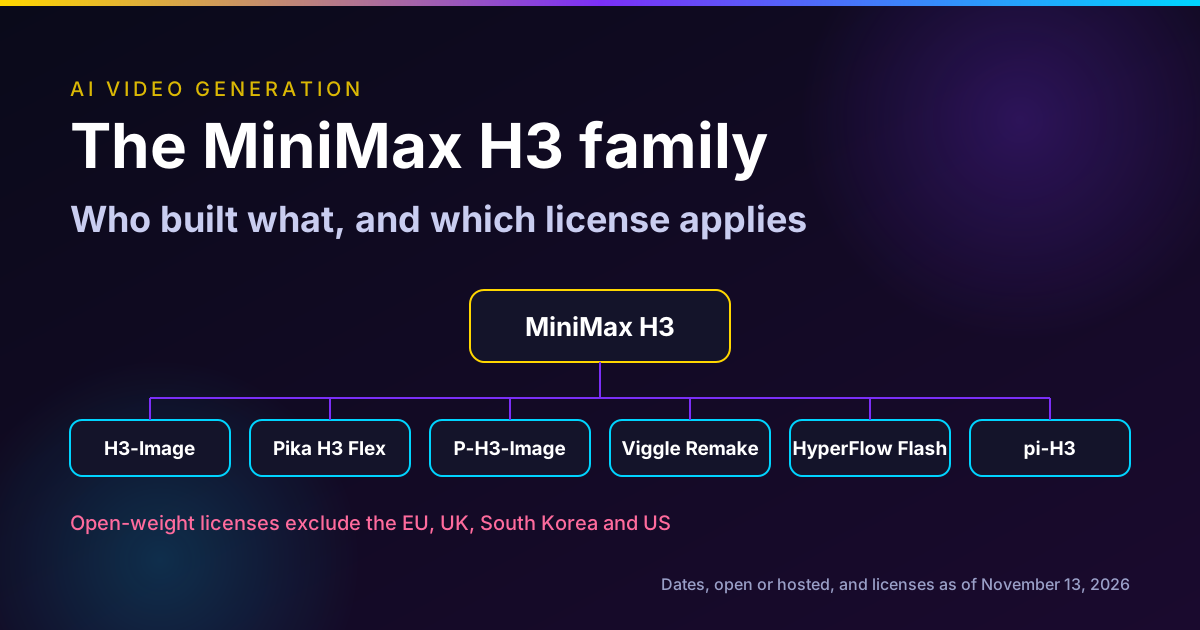
The MiniMax H3 model family is one open video model and a fast-growing set of models built on it. MiniMax announced H3, a video model with native stereo audio, on July 31, 2026, and released its weights under a license dated August 2. Since then MiniMax added hosted variants and an image model, H3-Image (November 10). Other teams shipped their own versions: Pika H3 Flex (October 29), Pruna P-H3-Image (November 3), Viggle Remake (November 4), HyperFlow H3 Flash from Video Rebirth (code November 6) and the pi-H3 research model (November 10). ComfyUI v0.44.0 (November 4) added native support for much of it.
Two facts tie the family together. Every offshoot we checked reuses H3's base weights or architecture. And every open release we checked carries a MiniMax license that excludes the EU, UK, South Korea and the US.
Run MiniMax H3 without a GPU
Oakgen offers MiniMax H3 reference-to-video with native audio, 5 to 15 second clips, priced before you run.
The H3 family at a glance
| Model | Made by | Date | What it is | Open or hosted | License |
|---|---|---|---|---|---|
| MiniMax H3 | MiniMax | Jul 31, 2026 (license Aug 2) | Video with native stereo audio, up to 15 s | Open weights and hosted API | MiniMax H3 Community License |
| MiniMax H3 Highspeed, Lite, Max | MiniMax | Listed on API pricing | Faster, cheaper and multi-asset tiers | Hosted API only | MiniMax API terms |
| MiniMax H3-Image | MiniMax | Nov 10, 2026 | 16 MP image generation and editing, 16 references | Open weights and hosted API | MiniMax-H3-Image Community License |
| Pika H3 Flex | Pika | Oct 29, 2026 | H3 post-trained to 6 steps, 12 references | Open adapters; 4K, stems hosted | MiniMax H3 Community License (adapters) |
| P-H3-Image | Pruna AI | Nov 3, 2026 | Image model rebuilt from H3 video, 8 steps | Open weights | MiniMax H3 License plus Apache 2.0 parts |
| Viggle Remake | Viggle | Nov 4, 2026 | Two LoRAs that re-shoot existing footage | Open LoRAs; hosted in Viggle app | MiniMax H3 License (weights), Apache 2.0 (code) |
| HyperFlow H3 Flash | Video Rebirth | Nov 6, 2026 (code) | Compressed 13.7B H3, 4 to 8 steps | Open weights | MiniMax H3 License (weights), Apache 2.0 (code) |
| pi-H3 | Hansheng Chen et al. | Nov 10, 2026 | 2 to 4 step H3 with no VAE decoder | Demo now, weights promised | Not stated yet |
| ComfyUI support | Comfy-Org | v0.44.0, Nov 4, 2026 | Native nodes, upscaler, context windows | Open-source app | ComfyUI's own license |
"Open adapters" means the release is a small add-on that loads on top of the H3 base weights you download from MiniMax. You still need the base model.
Who this map is for
This is for three people. A creator who keeps seeing "H3" in model pickers and wants to know which one they are using. A developer choosing which H3 build to run on their own hardware. And a team lead in the US or Europe who needs to know, before anyone downloads anything, what the license allows.
How we checked
On November 13, 2026 we opened each maker's primary page: MiniMax's launch posts, model cards, licenses and API pricing; Pika's launch post and Hugging Face card; Pruna's launch post and model card; the pi-H3 project page; Video Rebirth's GitHub README; Viggle's Hugging Face card; and the ComfyUI v0.44.0 release notes and tutorial. Where a date came only from a third party, we say so. Viggle Remake's November 4 date comes from the Kombitz roundup of November 7.
We did not run any of these models. Every speed, size and quality figure is the maker's own, and makers measure differently, so do not line their numbers up as a benchmark. The license notes are our reading of the text, not legal advice. Last updated November 13, 2026.
Disclosure: Oakgen is our product. We include it because it is relevant to this workflow, but the comparison also covers where standalone tools may be better.
The base: MiniMax H3
MiniMax's July 31 post describes H3 as "a general-purpose multimodal generation model" that understands text, images, video and audio together and generates "video with native stereo sound, up to 15 seconds at 2K resolution."
The model card gives the details. Output is 4 to 15 seconds at 24 fps with 32 kHz stereo audio, and stable dialogue in 11 languages. The base model renders at 768p. The open release has two checkpoints: FL2VA for text-to-video and first or last frame to video, and Ref2VA for references, which takes up to 9 images, 3 videos and 3 audio clips, 12 files in total. The transformer is a 33B-parameter dense model, of which about 13B sit in branches that can be precomputed for inference.
Three parts are not in the open release, per the card. The prompt-rewriting system, H3-Context-IR, is API only. The 2K step, H3-Regenerate-2K, "is not yet open-sourced." And the sparse-attention implementation will come later. So the open weights give you 768p, and 2K needs MiniMax's API or a community upscaler.
Hosted tiers. MiniMax's API pricing page lists four video models as of November 13, 2026.
| API model | Resolution | Price per output second |
|---|---|---|
| MiniMax-H3 | 2K / 768P | $0.13 / $0.08 |
| MiniMax-H3-Highspeed | 768P / 480P | $0.06 / $0.04 |
| MiniMax-H3-Lite | 768P / 480P | $0.04 / $0.025 |
| MiniMax-H3-Max | 768P / 480P | $0.08 / $0.05 |
The first 5 input images per task are free on the flagship tiers, 2 on Max. Audio input is free.
License. The MiniMax H3 Community License, dated August 2, 2026, grants rights only in an "Applicable Territory": worldwide, excluding the EU, the UK, the Republic of Korea and the US. Section V.4 bars use or display of the works "or any of their Outputs" outside it. Section IV.1 needs MiniMax's written authorization if your commercial products and services make more than $20 million a year, and IV.2 requires "MiniMax H3" to be shown in a commercial product's interface. MiniMax's license Q&A says it will keep the H3 API "available globally."
That license defines "Model Derivatives" to include fine-tunes and distilled models. That is why nearly every offshoot below inherits it.
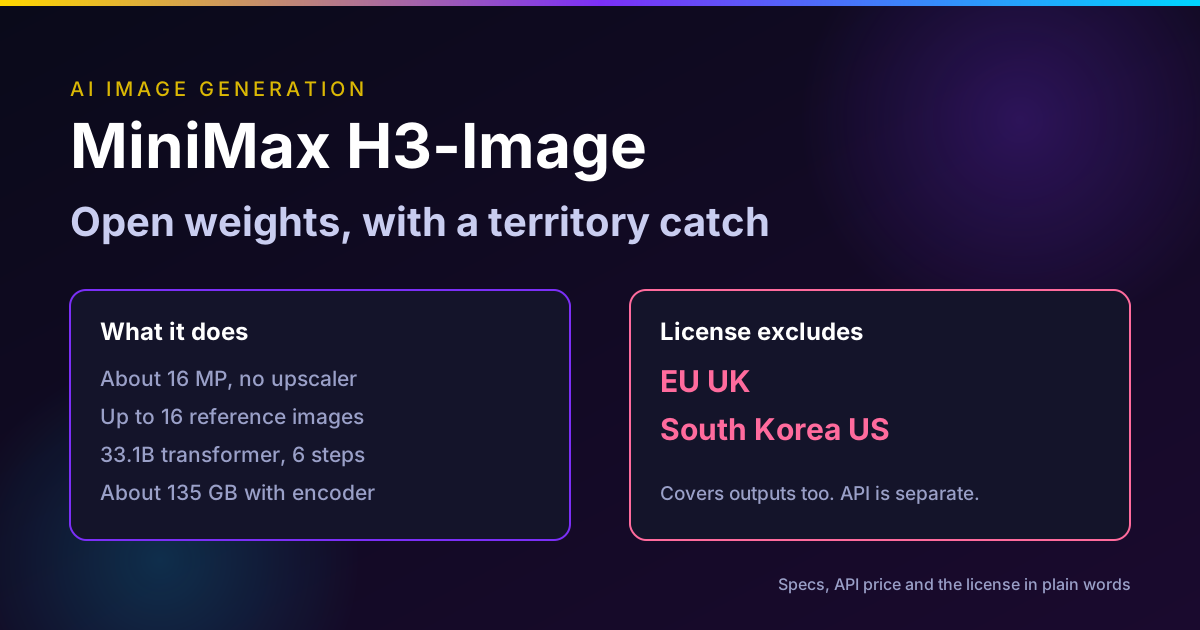
MiniMax H3-Image
MiniMax's own image model, released November 10, 2026. One checkpoint covers text-to-image and editing with up to 16 references, at about 16 MP without an upscaler, in 6 steps. The download is about 135 GB with the text encoder. The API costs about $0.069 for a 4K text-to-image at the Standard rate.
Its license is separate and stricter. The MiniMax-H3-Image Community License excludes the same four regions, but asks for written permission above $1 million in annualized revenue or for any hosted service. Our full write-up is MiniMax H3-Image explained.
Pika H3 Flex
Pika announced H3 Flex on October 29, 2026 as "our post-trained MiniMax H3 model." Pika says it post-trained H3 "to generate in six steps instead of 50," that Flex takes up to 12 reference files, and that it can make a 15-second 768p clip with audio "in as little as seven seconds of transformer computation." Pika also says Flex ranked first among open-weight models and seventh overall on DesignArena's text-to-video board at the time of writing. All of that is Pika's claim.
What is open and what is not matters here. Pika released "Flex's generator adapters and inference code" for text-to-video, first and last frame, and reference-to-video at 480p and 768p. The 1080p, 2K and 4K upsampler, five audio stems (dialogue, score, SFX, foley, ambience), prompt enhancement and fast serving are Pika-hosted. The Hugging Face card says the adapters are Model Derivatives of MiniMax H3 under its Community License, with example code under Apache 2.0. Pika said Flex would reach its creation product on November 2.
Pruna P-H3-Image
Pruna AI released P-H3-Image on November 3, 2026. It is an image model built from the H3 video model, not from H3-Image. Pruna says it renders 2 to 16 MP images, edits with up to 9 input images and does best at photorealism and cinematic scenes.
Pruna reworked the prompt upsampler, cut the 32B text encoder to 4B by distillation, reduced sampling from 50 steps to 8, trained a new decoder and quantized everything. Its claims: 7 times smaller than H3 (a 20 GB download in its smallest set, against 143 GB), about 5 times faster (2.6 s instead of 12.4 s for a 4 MP image on one B200), and about 21 GB of VRAM for 8 MP images in 4-bit.
License: P-H3-Image is under the MiniMax H3 Community License, with the Qwen-based text encoder parts and upsampler under Apache 2.0 and the ComfyUI nodes under MIT. Pruna repeats that it "excludes the European Union, the United Kingdom, the Republic of Korea, and the United States unless you have a separate license from MiniMax."
Viggle Remake
Viggle Remake is "a pair of LoRAs for MiniMax H3 that re-render video you already have," per the Kombitz roundup, which dates it to November 4. The Viggle model card describes two modes: swap replaces people and characters, and edit swaps, removes or inserts objects and changes the setting, weather or light. Original motion, camera, timing and soundtrack stay. You paint one to four keyframes to show the change.
Practical limits from the card: about 12 seconds per render, so longer clips are split into windows. The full route needs the roughly 144 GB H3 base and an 80 GB GPU at bf16, while ComfyUI int8 and GGUF builds go down to 12 GB. There is an MCP server so a coding agent such as Claude Code can cut a film into windows, render each and splice the result. No GPU? Viggle runs Remake in its own app.
The weights are a Model Derivative of MiniMax H3 under its license; the code is Apache 2.0. The card is blunt that the model cannot verify identity or consent. Only use it on footage and likenesses you have the right to change.
HyperFlow H3 Flash
Video Rebirth's HyperFlow H3 Flash is "a compressed, few-step version of MiniMax-H3" that keeps joint video and stereo audio. The GitHub repository was created on November 6, 2026. The README says plainly it is not an official MiniMax product.
The numbers, all Video Rebirth's: 13.7B parameters (13.9B for reference work), "less than half of the ~31B MiniMax-H3 transformer"; 4, 6 or 8 sampling steps without CFG; 5.2 to 15 second clips at 1344x768 and 24 fps. A 5.2-second clip at 6 steps takes 8.7 seconds on four B200s, 36 seconds on one H200 and 92 seconds on an RTX 5090. The smallest GGUF build is 9.1 GB and runs on 24 GB and 32 GB GPUs in PCs with 16 GB of system RAM.
How: it drops a few transformer blocks, factors and quantizes linear layers to INT8 behind a Hadamard rotation, and adds two-time conditioning so it can sample in few steps. The README names NVIDIA's SOL-H3 engine as an acceleration partner for real-time output on four Blackwell GPUs.
License: repository code is Apache 2.0, the ComfyUI nodes GPL-3.0, and the weights are a Model Derivative under the MiniMax H3 Community License, which the README says "does not cover use in the European Union, the United Kingdom, the Republic of Korea, or the United States without MiniMax's authorization."
pi-H3
pi-H3, published November 10, 2026 by Hansheng Chen and co-authors from Stanford, with part of the work done during an internship at Luma AI, calls itself "the fastest version of MiniMax H3 yet." It samples in 2 or 4 steps and predicts pixels directly at the last step, skipping the video VAE decoder. The authors report a 5-second 768p video with stereo audio in 3.8 seconds on one B200 with 2 steps, and 15-second videos in 18.6 seconds.
Status as of November 13: the Hugging Face demo is live. Weights and inference code are promised for the week of November 16, training code later in November, with ComfyUI support through a ComfyUI-piFlow extension. The page calls it "an open-source research project" but does not state a license for the weights. Because the H3 license treats distilled models as Model Derivatives, we would expect the H3 license to apply when the weights ship. Check the release before you use it.
ComfyUI support
ComfyUI v0.44.0, released November 4, 2026, is where much of this becomes usable without custom code. Its release notes list support for the MiniMax-H3 latent upscaler, MiniMax Sol-H3-VAE, context windows for MiniMax-H3 (for longer videos) and partner nodes for H3 Max: Recast, Extend, Reframe, Insert, Lip Sync and Camera Control. The Kombitz roundup also reports native P-H3-Image support in this release, with stock nodes and official templates.
For the image model, ComfyUI's MiniMax-H3-Image tutorial says its templates need ComfyUI 0.45.0 or newer, with a 21 GB INT8 diffusion model. HyperFlow and Viggle ship their own node packs on top.
Running a node does not change the license question. If a workflow loads the H3 weights on your machine, the community license applies to you and to the output.
Skip the setup
No 144 GB download, no GPU. Generate MiniMax H3 reference-to-video clips with native audio in Oakgen.
Which H3 should you use?
| Your situation | Start with | Why |
|---|---|---|
| No GPU, need clips now | MiniMax API, or a hosted tool such as Oakgen | No download; hosted terms apply |
| 24 to 32 GB consumer GPU | HyperFlow H3 Flash | 9.1 GB GGUF, runs with 16 GB RAM per its README |
| Fast drafts, 4K finish for one pick | Pika H3 Flex | Native 768p drafts, hosted 4K upsampler |
| Re-shoot existing footage | Viggle Remake | Keeps motion and soundtrack, edits by painted frames |
| Still images on a mid-size GPU | P-H3-Image | 21 GB VRAM at 8 MP in 4-bit, per Pruna |
| Highest-resolution stills | MiniMax H3-Image | About 16 MP directly |
| Research on few-step sampling | pi-H3 | 2 to 4 steps, decoder-free, code coming |
| You are in the US, EU, UK or South Korea | Hosted services, or apply for a license | Open-weight licenses exclude you |
The mistake is choosing by speed headline. Pika's seven seconds counts transformer time only, pi-H3 measures end to end on a B200, and HyperFlow includes four GPUs. Pick by your hardware, your license position and the job.
Common mistakes
Assuming an offshoot has its own clean license. P-H3-Image, Pika H3 Flex, HyperFlow and Viggle Remake all inherit the MiniMax H3 license for their weights. Apache 2.0 on the code does not cover the model.
Forgetting the base download. LoRA releases such as Pika H3 Flex and Viggle Remake need the H3 base, which Viggle puts at about 144 GB.
Expecting 2K from the open base. MiniMax's 2K regeneration step is not open-sourced yet.
Confusing P-H3-Image with H3-Image. One is Pruna's image model built from H3 video, the other is MiniMax's own image model, and they carry different licenses.
Treating "real time" as your real time. Most of these speed figures come from data-center GPUs.
Where Oakgen fits
As of November 13, 2026, Oakgen offers MiniMax H3 reference-to-video and MiniMax H3 Max (text, image and reference modes) in its AI video generator. It accepts up to 9 reference images, 3 reference videos and 3 audio clips, makes 5 to 15 second clips with native audio, and offers 480P and 768P plus upscaled 2K and 4K. Oakgen's AI micro drama generator uses the same model to voice each shot.
Oakgen does not offer MiniMax H3-Image, Pika H3 Flex, HyperFlow H3 Flash, pi-H3, P-H3-Image or Viggle Remake. If you need Pika's audio stems, Viggle's footage re-shoot or a local build on your own GPU, those makers are the better route.
For how H3's predecessor line performed on a budget, see our MiniMax Hailuo 2.3 review and Hailuo vs Kling for budget video. For the bigger open versus closed question, read open-source vs proprietary AI models. For a shot-type comparison of current video models, see our best AI video generator by shot type.
Make a micro drama with H3
Script, cast and voice short episodes in Oakgen, with MiniMax H3 rendering each shot with native audio.
FAQ
What is the MiniMax H3 model family?
MiniMax H3 is an open-weight video model with native stereo audio that MiniMax announced on July 31, 2026. Around it, MiniMax added hosted variants and an image model (H3-Image), and other teams released faster or specialised versions: Pruna's P-H3-Image, the pi-H3 research model, Video Rebirth's HyperFlow H3 Flash, Pika H3 Flex and Viggle Remake. ComfyUI added native support for much of it.
Which MiniMax H3 models are official?
MiniMax's own releases are the H3 video model (open weights plus the hosted MiniMax-H3, Highspeed, Lite and Max API models) and MiniMax H3-Image. P-H3-Image, pi-H3, HyperFlow H3 Flash, Pika H3 Flex and Viggle Remake are made by other teams on top of H3. HyperFlow's own repository says it is not an official MiniMax product.
Can I use MiniMax H3 models in the US, EU, UK or South Korea?
Not under the open-weight licenses. The MiniMax H3 Community License and the MiniMax-H3-Image Community License both exclude the European Union, the United Kingdom, the Republic of Korea and the United States, and the derivative models we checked carry the H3 license. MiniMax offers an application route for those regions and says its hosted API stays available globally. This is a reading of the license text, not legal advice.
Which H3 version runs on a consumer GPU?
Per the makers' own numbers: HyperFlow H3 Flash has a 9.1 GB Q4_K_M build that runs on 24 GB and 32 GB GPUs, Viggle Remake has int8 and GGUF builds down to 12 GB, and Pruna's P-H3-Image runs 8 MP images in about 21 GB of VRAM in its 4-bit set. The full MiniMax H3 base model is about 144 GB of files.
What is the fastest MiniMax H3 version?
By the makers' claims, pi-H3 makes a 5-second 768p clip with audio in 3.8 seconds on one B200 with 2 steps, and Pika says H3 Flex can make a 15-second 768p clip in as little as seven seconds of transformer computation. These are vendor numbers measured in different ways, so they are not directly comparable, and we did not time them.
Does Pika H3 Flex really output 4K?
Only through Pika's hosted service. Pika says the open adapters generate natively at 480p or 768p, while the 1080p, 2K and 4K upsampler, five audio stems and prompt enhancement are Pika-hosted features.
Which version of ComfyUI supports MiniMax H3?
ComfyUI v0.44.0, released November 4, 2026, added the MiniMax-H3 latent upscaler, Sol-H3-VAE, context windows for H3 and H3 Max partner nodes for Recast, Extend, Reframe, Insert, Lip Sync and Camera Control. ComfyUI's MiniMax-H3-Image templates need version 0.45.0 or newer.
Can I use MiniMax H3 in Oakgen?
Yes, the MiniMax H3 video model for reference-to-video and MiniMax H3 Max for text, image and reference modes, as of November 13, 2026. It takes up to 9 reference images, 3 reference videos and 3 audio clips and makes 5 to 15 second clips with native audio. Oakgen does not offer H3-Image, Pika H3 Flex, HyperFlow H3 Flash, pi-H3, P-H3-Image or Viggle Remake.
Sources
- MiniMax, MiniMax H3: An Open Model Breaking the Boundaries Between Tasks and Modalities, 2026-07-31 (read 2026-11-13)
- MiniMax on Hugging Face, MiniMax-H3 model card, undated (read 2026-11-13)
- MiniMax on Hugging Face, MiniMax H3 Community License Agreement, 2026-08-02 (read 2026-11-13)
- MiniMax API docs, Pricing Overview, undated (read 2026-11-13)
- MiniMax, MiniMax H3-Image launch post, 2026-11-10 (read 2026-11-13)
- MiniMax on Hugging Face, MiniMax-H3-Image Community License Agreement, 2026-11-10 (read 2026-11-13)
- Pruna AI, P-H3-Image: Turning a SOTA Video Model into an Efficient Open Image Model, 2026-11-03 (read 2026-11-13)
- Hansheng Chen et al., pi-H3: Video Generation in 2 to 4 Steps Without a VAE Decoder, 2026-11-10 (read 2026-11-13)
- Video Rebirth on GitHub, hyperflow-h3-flash repository, created 2026-11-06 (read 2026-11-13)
- Pika, Introducing Pika H3 Flex, 2026-10-29 (read 2026-11-13)
- Pika on Hugging Face, Pika-H3-Flex model card, undated (read 2026-11-13)
- Viggle on Hugging Face, Viggle-Remake model card, undated (read 2026-11-13)
- Kombitz, AI Image and Video Model News Roundup, 2026-11-07 (read 2026-11-13)
- Comfy-Org on GitHub, ComfyUI release v0.44.0, 2026-11-04 (read 2026-11-13)
- ComfyUI docs, MiniMax-H3-Image tutorial, undated (read 2026-11-13)