You generated an image with AI, listed it on Etsy, and sold 200 prints in the first month. Then someone downloaded your listing image, started selling the same design on Redbubble, and you cannot do a thing about it. Or can you?
The short answer: it depends on the model, the platform, and your country. AI art copyright in 2026 is not a single question with a single answer -- it is a patchwork of rulings, platform policies, and unresolved gray areas that every creator selling AI-generated work needs to understand. What was murky in 2024 has become partially clearer, but "partially" is doing a lot of work in that sentence.
This is not legal advice -- consult an attorney for specific situations. But every creator monetizing AI-generated images needs to understand where the lines are drawn right now.
What Changed Between 2024 and 2026
The last two years brought developments that shifted the ground under AI copyright:
The Thaler appeal was denied (2024). The D.C. Circuit upheld: works created entirely by AI, with zero human authorship, cannot receive copyright protection in the United States. Settled appellate precedent.
The EU AI Act took effect (2025). Transparency requirements for AI-generated content are now enforced, including mandatory disclosure in certain commercial contexts.
Getty v. Stability AI reached partial resolution (2025-2026). Early rulings clarified that AI model providers -- not end users -- bear primary liability for training data disputes. This reduces (but does not eliminate) downstream risk for creators.
China expanded its pro-authorship position. Following the 2023 Li v. Liu ruling, additional Chinese courts upheld that users who demonstrate creative direction through prompting and iterative refinement can hold copyright in AI-generated output.
Platform indemnification expanded. Multiple AI providers now offer commercial indemnification for paid users, shifting risk from individual creators to platform companies.
Scenario 1: Selling Prints and Digital Downloads
This is the most common commercial use case -- selling AI-generated art as prints, posters, phone cases, or digital downloads on platforms like Etsy, Redbubble, Society6, or your own Shopify store.
What You Can Do
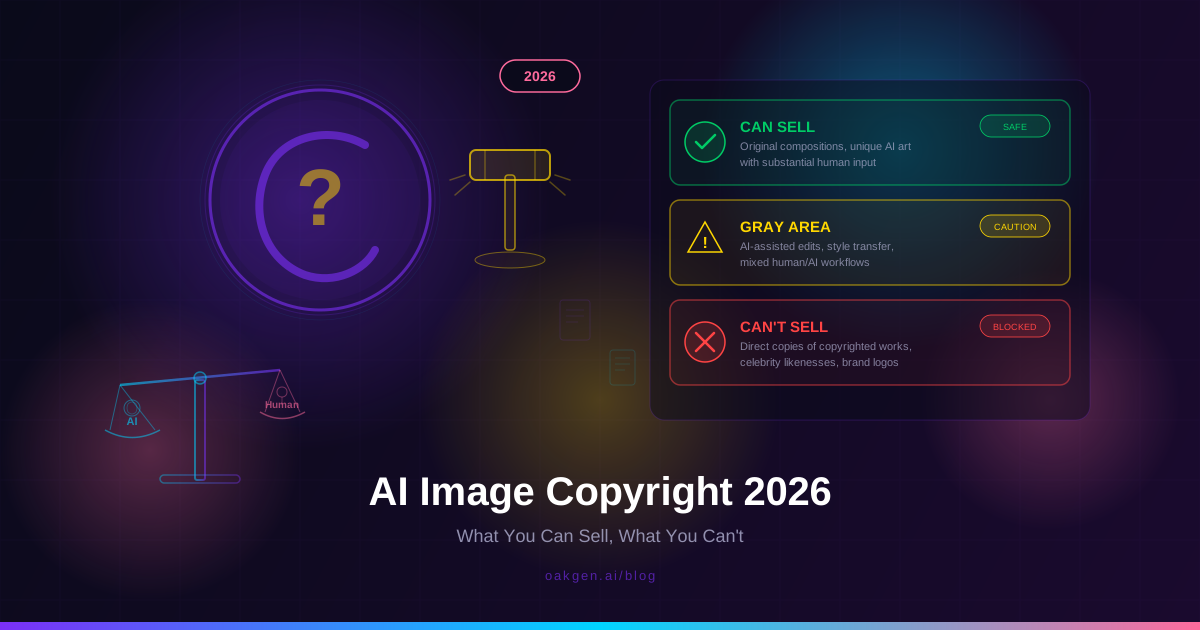
You can sell AI-generated images commercially. No law in any major jurisdiction prohibits the sale of AI-generated art. The question is not permission to sell -- it is whether you can stop others from copying what you sell.
On platforms like Oakgen's image generator, the terms of service grant you full commercial usage rights to generated output on paid plans. You own the files. You can sell them. You can license them. This is a contractual right between you and the platform, separate from copyright law.
What You Cannot Do (or Might Not Be Able to Do)
You likely cannot enforce exclusive copyright on a purely AI-generated image in the United States. Under current U.S. law, an image where your only contribution was typing a prompt and pressing generate is not copyrightable. If someone copies your design, you may have no legal mechanism to force them to stop.
This sounds catastrophic, but in practice it matters less than you might expect. Here is why:
- Most sellers are never copied. The market for AI art prints is large enough that most individual designs do not attract copycats.
- Platform policies provide some protection. Etsy, Redbubble, and similar marketplaces have their own content policies and takedown processes that operate independently of copyright law.
- First-mover advantage is real. Established listings with reviews, SEO ranking, and sales history outperform copies.
How to Strengthen Your Position
The single most impactful step: do not sell raw AI output. Add human creative work to every piece you sell commercially.
- Edit, composite, and refine. Color grade the image. Composite multiple AI-generated elements. Add hand-drawn details or typography. Each modification strengthens the human authorship argument.
- Create collections with a cohesive vision. The creative selection and arrangement of a curated collection may be copyrightable even if individual pieces are not.
- Document your creative process. Save your prompt iterations, your rejected outputs, your editing history. This paper trail demonstrates human creative decision-making.
If you are running a print-on-demand business at scale, building these habits into your workflow costs almost nothing and provides meaningful protection.
Yes, someone could theoretically copy your purely AI-generated design without legal consequence under U.S. copyright law. But copyright is only one layer of protection. Trademark registration for your brand, platform-specific content policies, first-mover advantage, and the practical friction of copying all work in your favor. Treat copyright as one tool in a broader protection strategy, not the only one.
Scenario 2: Commercial Campaigns and Client Work
Using AI-generated images in advertising campaigns, brand assets, social media marketing, or client deliverables raises different considerations than selling prints.
What You Can Do
You can use AI-generated images in commercial marketing materials. Major brands are already doing this at scale. The commercial usage rights granted by AI platforms (including Oakgen) explicitly cover this use case on paid plans.
For freelancers delivering AI-generated assets to clients, the platform terms typically transfer usage rights to you, and your client contract transfers them to the client. The chain of rights is clean as long as every link grants commercial use.
What You Need to Watch
Client contracts should address AI use. If your client assumes they are receiving fully copyrightable assets, you have an obligation to clarify. A growing number of agencies include AI disclosure clauses in their contracts, specifying that AI-assisted deliverables may have different copyright characteristics than fully human-created work.
Industry-specific regulations apply. Financial services, healthcare, and pharmaceutical advertising have disclosure requirements that may extend to AI-generated imagery. If you are producing regulated advertising, check whether your industry has specific rules about AI-generated content.
Brand safety matters. AI models are trained on broad datasets, and there is a non-zero probability that generated output could inadvertently resemble existing copyrighted or trademarked imagery. For high-visibility campaigns, run a reverse image search on your AI-generated assets before publishing. Use Oakgen's agent chat to iterate on creative direction while maintaining control over the output.
The Indemnification Question
If a client is sued over an AI-generated image you provided, who pays? It depends on your platform's indemnification policy, your professional liability insurance, and your client contract. All three should explicitly address AI-generated work. For high-value projects, the safest approach remains using AI for ideation, then producing final assets with substantial human creative input.
Scenario 3: E-Commerce Product Images
AI-generated product photography sits in a different legal position than AI art. When you use AI to generate a product shot -- placing your physical product against a generated background or scene -- the copyright analysis is more favorable.
The product itself is real. Your creative direction of the scene, lighting, and composition involves substantial human input. The AI is functioning as a tool (like Photoshop or a virtual studio), not as the sole creator. This workflow is much more likely to produce copyrightable output.
For e-commerce sellers, this distinction matters: your AI-generated product photos are almost certainly protectable because they combine real products with human-directed AI scene generation. The AI is a sophisticated backdrop generator, not the creative author.
| Platform | Commercial Use Allowed? | Copyright to User? | Indemnification? | Key Terms |
|---|---|---|---|---|
| Oakgen (paid plans) | Yes | Yes, full rights | Yes, paid plans | Commercial use on all paid tiers |
| Midjourney (paid) | Yes | Yes, full rights | No | Free tier: CC-BY-NC license |
| DALL-E / ChatGPT | Yes | Yes, full rights | Enterprise only | No content policy restrictions vary |
| Adobe Firefly | Yes | Yes, full rights | Yes, enterprise | Trained on licensed data |
| Stable Diffusion (self-hosted) | Depends on model license | You control output | No (self-hosted) | Open weights, your infra |
| Flux Pro (via API) | Yes | Yes, per API terms | Varies by host | Check host platform terms |
What the Law Says Right Now: Country by Country
Copyright law is territorial. Here is where the major markets stand as of mid-2026.
United States: AI-generated images are not copyrightable unless they contain sufficient human authorship. Prompt-only creation is generally insufficient. Substantial editing, compositing, and arrangement may qualify. Multiple bills in Congress address AI copyright, but none have passed.
European Union: Similar to the U.S. -- copyright requires human intellectual creation. The AI Act adds transparency obligations: AI-generated content must be disclosed in certain commercial contexts. If you sell in EU markets, plan for disclosure requirements.
United Kingdom: The CDPA 1988 includes a provision for "computer-generated works" where copyright belongs to the person who made the arrangements for creation. This could mean AI-generated works are copyrightable in the UK, but no court has tested this with modern generative AI.
China: The most creator-friendly jurisdiction. Chinese courts have recognized copyright in AI-generated images where users demonstrate creative direction through prompting, parameter selection, and output curation.
The Training Data Problem (and Why It Affects You)
Even if you have clear commercial usage rights from your AI platform, there is a second layer of risk: the training data. If a model was trained on copyrighted images without permission, generated output could theoretically be challenged as a derivative work -- the core allegation in Getty v. Stability AI.
The practical risk for individual users is low. Courts suggest that platform providers, not end users, bear primary liability. Platforms that offer indemnification (including Oakgen on paid plans) absorb this risk on your behalf. Some models have cleaner provenance -- Adobe Firefly is trained exclusively on licensed content. And style replication is generally not infringement; style itself is not copyrightable. But output that is substantially similar to a specific existing work could be problematic.
While generating art "in the style of Monet" (a public domain artist) is clearly fine, prompting for the style of living, working artists creates unnecessary legal risk. Even if it is not technically infringement, it can trigger takedown requests, platform policy violations, and public backlash. Use descriptive style terms instead of artist names.
Selling Platform Policies: The Rules That Actually Matter Day-to-Day
In practice, platform terms of service govern more of your business than copyright law does. Every major selling platform now allows AI-generated content with mandatory disclosure: Etsy, Redbubble, Society6, Amazon Merch/KDP, Adobe Stock, and Shutterstock all require you to tag AI-generated listings. Each platform also has its own IP reporting and takedown processes that operate independently of copyright law -- a competitor can file a takedown even if your work is not technically copyrightable.
The key differences: Adobe Stock requires submissions be made with Adobe Firefly specifically. Etsy's search algorithm may rank AI-generated listings differently from handmade items. Amazon's automated enforcement sometimes catches false positives, so consistent branding and original post-processing reduce that risk.
How to Sell AI Art Legally: A Practical Checklist
Regardless of how the gray areas resolve, these steps protect you today and position you well for any future regulations:
- Use a platform with clear commercial terms. Generate on platforms like Oakgen that grant commercial usage rights on paid plans.
- Add human creative value. Edit, composite, curate. AI should be a starting point, not the entire process.
- Document your process. Save prompts, iterations, editing steps. This is your primary evidence if challenged.
- Disclose AI involvement where required. Etsy, Amazon, stock platforms, and EU markets all require it.
- Know your selling platform's policies. Copyright law and platform policies are two separate systems -- comply with both.
- Register trademarks for your brand. Even if individual images are not copyrightable, your brand name and logo can be trademarked.
- Carry professional liability insurance. If you produce AI assets for clients, confirm your E&O policy covers AI-assisted work.
Earn 25% recurring on every referral.
Share Oakgen, get paid every month they stay.
Frequently Asked Questions
Can I legally sell AI-generated images?
Yes. No law in any major jurisdiction prohibits selling AI-generated images. The question is whether you can enforce copyright if someone copies your work. You can sell on Etsy, Redbubble, your own store, or any platform that allows AI-generated content (most do, with disclosure). Use a platform with clear commercial terms, add human creative value, and disclose AI involvement where required.
Do I own the copyright to images I generate with AI?
In the United States, purely AI-generated images (prompt in, image out, no further editing) are currently not copyrightable. Images with substantial human creative input -- editing, compositing, curating, arranging -- may qualify for copyright protection on the human-authored elements. The UK and China may offer broader protection. Platform terms of service grant you usage rights regardless of copyright status, meaning you have the contractual right to use and sell the images even if copyright law does not protect them.
Can someone legally copy my AI-generated art and sell it?
Under current U.S. law, if your art is purely AI-generated with no significant human creative input, another person could reproduce it without copyright consequences. However, practical protections exist: platform takedown policies, trademark protection for your brand, first-mover advantage, and the reality that copying someone's exact AI output is more effort than generating new images. Adding substantial human editing to your work closes this gap by making the result copyrightable.
Is AI art print-on-demand legal?
Completely legal. Print-on-demand with AI-generated designs is a legitimate and growing business model. The key requirements are: use a generation platform that grants commercial rights (free tiers may not), disclose AI involvement on selling platforms that require it (Etsy, Amazon), and avoid prompting for output that closely mimics specific copyrighted works or trademarks. Adding post-processing and human creative elements strengthens both your legal position and your product differentiation.
What happens if my AI-generated image accidentally looks like someone else's copyrighted work?
A real risk, though statistically rare. If it happens, the copyright holder could file a takedown or infringement claim. Your defenses: no intent to copy, coincidental similarity, and platform indemnification. For high-visibility commercial work, run a reverse image search before publishing. Avoid prompts that reference specific copyrighted characters, logos, or artworks.
Do I need to disclose that my images are AI-generated?
It depends on where and how you are selling. Etsy, Amazon, Adobe Stock, and Shutterstock all require AI disclosure. The EU AI Act requires disclosure in certain commercial contexts. The U.S. does not currently have a federal AI disclosure law for general commerce, but several states are considering legislation. Even where not legally required, voluntary disclosure is increasingly considered best practice and builds consumer trust.
How does AI art copyright differ from AI music or AI video copyright?
The same principles apply across media types: works created solely by AI lack copyright protection, while works with substantial human contribution may qualify. The practical difference is enforcement intensity -- the music industry has stronger litigation mechanisms and the RIAA is aggressively pursuing AI music cases. For video, the multi-step production process naturally involves more human input, which strengthens the copyright position.
Should I register my AI-assisted artwork with the Copyright Office?
If the work has commercial value and includes substantial human creative input, yes. Registration is inexpensive, creates a legal presumption of validity, and is required before filing an infringement lawsuit in the U.S. You must disclose AI involvement in the application and describe your human authorship clearly. The Copyright Office evaluates these registrations case by case, so there is no guarantee of acceptance, but registration is the strongest formal protection available.
What to Read Next
- Who Owns AI-Generated Art? Copyright Law Explained for Creators -- The foundational guide to AI art copyright, covering the Thaler and Zarya of the Dawn rulings in detail.
- AI Product Photography for E-Commerce: Cut Studio Costs by 80% -- How e-commerce brands use AI product photography with stronger copyright positions than pure AI art.
- AI Influencer Monetization Guide -- How creators are building revenue streams with AI-generated content, including licensing and brand deals.