ChatGPT
 Claude
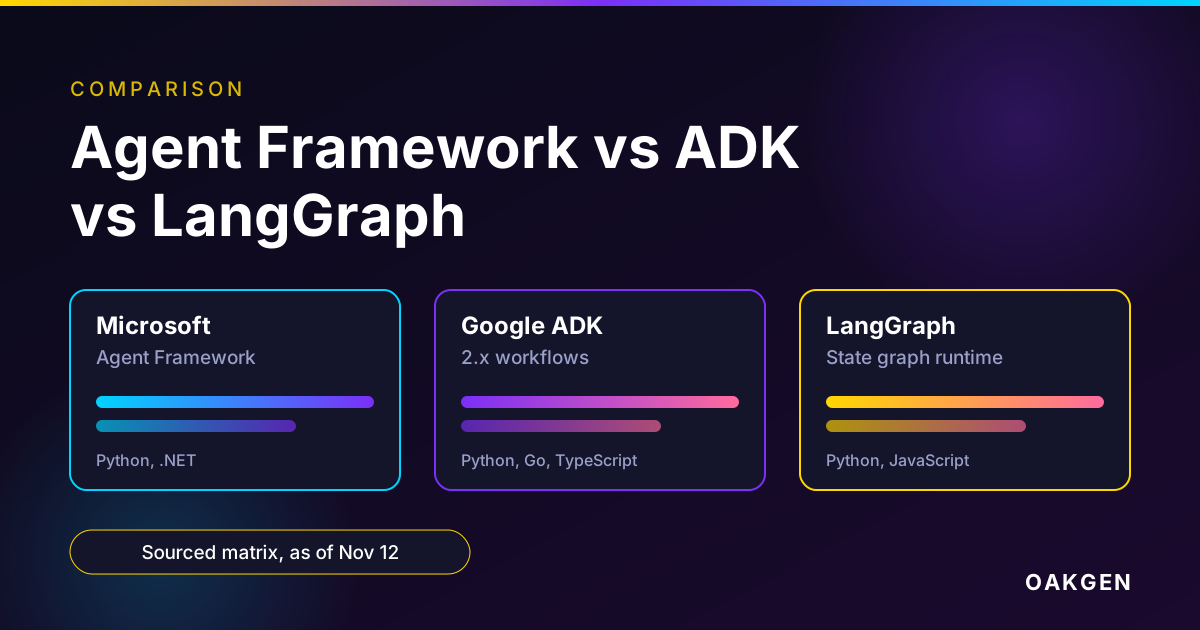
Microsoft Agent Framework vs Google ADK vs LangGraph comes down to your language, your cloud and how much of the runtime you want to own. Choose Microsoft Agent Framework for .NET or Azure, Google ADK for Google Cloud, Go or TypeScript, and LangGraph when you want explicit state control and will pair it with LangSmith for hosting and tracing.
As of November 12, 2026, all three are open source, past version 1.0, and support graph workflows plus MCP and A2A. The differences are in packaging, hosting and which pieces are still beta. Microsoft Ignite runs November 17 to 20, so parts of this may shift within a week.
See what an agent calls when the job is creative work
Whichever framework you pick, the agent still needs tools. Oakgen MCP exposes image, video and voice models to any MCP client. Oakgen is our product.
The short version
| Microsoft Agent Framework | Google ADK 2.x | LangGraph | |
|---|---|---|---|
| Latest we found | Python 1.25.0, .NET 1.28.0 | Python 2.14.0 | Python 1.2.20 |
| Languages | Python, .NET (Go in preview) | Python, Go, TypeScript at 2.0 | Python, JavaScript |
| Model of orchestration | Graph workflows plus five prebuilt patterns | Graph and dynamic workflows, coordinator with sub-agents | Low-level state graph, no fixed agent shape |
| License | MIT | Apache-2.0 | MIT |
| Natural home | Azure and Foundry | Google Cloud | LangSmith, or your own Kubernetes |
| Biggest caveat | A2A and some hosting packages are beta | 2.0 changed the event and session schema | Agent Server features need a LangSmith plan or license |
Who this is for
You are picking a framework for a team that will keep it for a year or more. You might lead a platform group, own one agent product, or run a creative operation whose agents call media tools. You want facts you can check, not a ranking.
For the protocol layer under these frameworks, read our MCP versus A2A guide. For the patterns themselves, see our explainer on agent orchestration patterns.
How we checked this
On November 12, 2026 we opened each project's own documentation, GitHub release pages, package registry pages and LICENSE files. Versions come from PyPI, npm, NuGet and GitHub, and every matrix row links its sources. We did not run any of the three frameworks, benchmark them, or test their hosting products, so we make no claim about speed, cost per task or reliability.
Disclosure: Oakgen is our product. This is an infrastructure comparison. Oakgen appears in two short places and in the call-to-action boxes.
Secondary sources such as blogs and news aggregators were used only to find primary pages. Where a cell says "not verified", we could not confirm it in the project's own material, and we left it blank rather than guess. The Workday story is vendor-reported, and we label it that way below.
The verified feature matrix
This is the part to bookmark. Each row links where we read it. Versions were current when we read them on November 12, 2026.
Release and platform
| Row | Microsoft Agent Framework | Google ADK 2.x | LangGraph | Sources |
|---|---|---|---|---|
| Current release and date | Python 1.25.0 (PyPI, Nov 7). .NET 1.28.0 (changelog, Nov 6) | Python 2.14.0 (changelog Nov 4, PyPI Nov 7). TypeScript 2.4.0 (npm, Oct 28) | Python 1.2.20 (Nov 5). JavaScript 1.7.3 (GitHub, Nov 9) | MAF releases, ADK v2.14.0, LangGraph releases |
| 1.0 or 2.0 GA | 1.0 on Apr 3, 2026 per the release post, though the Build post says Apr 2 | 2.0 GA Python May 19, Go Jun 30, TypeScript Aug 21 | 1.0 designated a long-term support release | MAF 1.0 post, ADK 2.0, LangChain release policy |
| License | MIT | Apache-2.0 | MIT | MAF, ADK, LangGraph |
| Languages | Python and .NET GA. Go is public preview in a separate repo | Python, Go, TypeScript at 2.0. Java latest found is 1.14.0. Kotlin 2.x not verified | Python and JavaScript. Others not verified | MAF Go, ADK 2.0, ADK Java releases, LangGraph overview |
| Python floor | 3.11, enforced from 1.25.0 | 3.11 on PyPI for 2.14.0 | 3.10 on PyPI | MAF 1.25.0 notes, ADK on PyPI, LangGraph on PyPI |
Orchestration, state and protocols
| Row | Microsoft Agent Framework | Google ADK 2.x | LangGraph | Sources |
|---|---|---|---|---|
| Core model | Graph workflows run in supersteps. Prebuilt sequential, concurrent, handoff, group chat and Magentic | Graph workflows where agents, tools and functions are nodes. Dynamic code workflows. Coordinator with sub-agents | Graph of shared state, nodes and edges. No prescribed prompts or agent shape | MAF orchestrations, ADK 2.0, LangGraph overview |
| Human in the loop | Approval-required tools pause the workflow | A RequestInput node pauses until a person replies | Pause, inspect or edit state, then continue | MAF orchestrations, ADK human input, LangGraph overview |
| State and persistence | Sessions, history and context providers. Workflow checkpoints (in-memory, file, Cosmos DB in Python). Durable extension | Sessions and memory services, with database, SQLite and Agent Engine backends. Retry attempt count not saved across a pause | Checkpointers per thread, stores across threads. Postgres and SQLite savers | MAF checkpoints, MAF durable, ADK CLI, ADK retries, LangGraph persistence |
| MCP as client | Yes, over stdio and Streamable HTTP tools | Yes, McpToolset. 2.9.0 added MCP SDK 2.x beside 1.x | Through LangChain tools. langchain.mcp is beta | MAF observability, ADK MCP, LangChain MCP |
| MCP spec revision | Not verified | Not verified | Agent Server accepts 2024-11-05 through 2026-07-28 | LangGraph MCP endpoint |
| Agent exposed as MCP server | agent-framework-hosting-mcp exists, Alpha on PyPI. Behavior not verified | to_mcp_server, MCP agent server stable in 2.14.0 | /mcp on Agent Server, Streamable HTTP | MAF 1.25.0 notes, ADK MCP, LangGraph MCP endpoint |
| A2A | Client and hosting. Package is Beta (1.0.0b261106). .NET 1.28.0 limits the built-in server to message responses | Python integration stable in 2.14.0. Experimental in Go, Java and Kotlin | /a2a on Agent Server, v1.0 JSON-RPC only. gRPC and HTTP+JSON not implemented | MAF A2A hosting, MAF A2A on PyPI, ADK A2A, LangGraph A2A |
| Observability | OpenTelemetry GenAI traces, logs, metrics | OpenTelemetry, GenAI v2 schema by default in 2.14.0 | LangSmith tracing, with an OpenTelemetry option | MAF observability, ADK v2.14.0, LangSmith OTel |
| Hosting | Self-host, Foundry Hosted Agents, Durable extension | adk deploy to Cloud Run or Agent Engine | Library runs anywhere. Agent Server via LangSmith Deployment | MAF Build post, ADK CLI, LangSmith Deployment |
Try the tool side before you pick the framework
Agent Chat lets you test a creative brief, compare model prices and run a job from a prompt, so you know which tools your agents will call.
Microsoft Agent Framework in practice
Microsoft's overview describes the framework as the direct successor to Semantic Kernel and AutoGen, built by the same teams. The core is Production/Stable on PyPI. The edges are not. When we checked, agent-framework-orchestrations was stable, while agent-framework-a2a and agent-framework-foundry-hosting were Beta and agent-framework-hosting-mcp was Alpha.
Orchestration has two layers. Graph workflows give explicit execution paths, and Microsoft's checkpoint page says a checkpoint is written at the end of each superstep. On top sit five prebuilt patterns. The Build 2026 post adds a handoff builder where you declare agents and directed edges, and the framework injects the handoff tools.
Two details matter for planning.
- A2A is moving. Microsoft's April release post said A2A 1.0 support was coming. Python migrated to the A2A SDK v1 in May, and .NET 1.28.0 on November 6 limited its built-in A2A server to message-based responses, deferring reliable task resumption across hosts.
- Python 3.10 is gone. Release 1.25.0 marks it a breaking change and requires 3.11.
For hosting, Microsoft's Build post describes Foundry Hosted Agents as your container on managed infrastructure that scales to zero and resumes with its filesystem intact. That is Microsoft's description of its own service. We did not test it.
Google ADK 2.x in practice
ADK 2.0 changed the engine. The docs say BaseAgent now subclasses BaseNode, so agents, tools and functions all run as nodes in a graph runtime, replacing the hierarchical executor. Google's July 1, 2026 blog says workflows were available in Python from March, ahead of the May 19 GA.
The docs list three workflow styles beyond the older template agents.
- Graph-based workflows. Deterministic routing between agent and function nodes.
- Dynamic workflows. Plain code with loops and branching.
- Collaborative workflows. A coordinator agent with sub-agents.
Human input is a node that yields RequestInput. Retries are per-node policy with backoff. The retry docs carry an honest limit. The attempt count is held in memory, so a node that resumes after a pause or restart starts again from attempt 1.
The 2.0 upgrade is not free. ADK's docs warn that Event now carries node_info and output, so a custom session store with rigid database columns must be migrated, and strict JSON validators downstream will reject 2.0 events. Release 2.14.0 added more breaking changes, including enum tool arguments arriving as enum members.
2.14.0 also graduated A2A, evaluation and execution environments from experimental. Its eval tooling includes multi-run scoring through adk eval --num_runs.
LangGraph in practice
LangGraph calls itself a low-level orchestration framework and runtime. You model state, nodes and edges, and it does not prescribe prompts or agent architecture. LangChain's overview says to start with Deep Agents or LangChain agents if you want a higher-level loop, and use LangGraph for explicit control.
Persistence is its strongest documented feature. Checkpointers store a thread's state for resume, time travel and fault tolerance, and stores hold cross-thread memory. LangChain's docs warn that the in-memory saver loses everything on restart and that checkpoints grow without a retention policy.
The protocol endpoints belong to Agent Server, not the open source library. Agent Server serves /mcp and /a2a, and the docs say it speaks A2A v1.0 over JSON-RPC while accepting four v0.3 method names. It does not yet support SubscribeToTask or push notification config.
Hosting is where cost enters. LangSmith Deployment offers Cloud, hybrid, self-hosted with a control plane, and standalone. LangChain's docs say Cloud requires a Plus plan or above, and standalone servers need your own PostgreSQL, Redis and a LangSmith license. On November 12, 2026 langchain.com listed Plus at $39 per seat per month plus usage. That is a vendor price that can change.
The Workday case study, vendor-reported
LangChain's blog of November 10, 2026 says Workday built an internal agent platform on LangGraph and LangSmith. It claims prototype time fell from 4 to 5 months to under a day and that the team grew from 4 to roughly 30 people. It also says every Agent Server was already A2A and MCP compliant. This is LangChain describing its customer. We did not verify it with Workday, and it credits a whole platform, not the graph library alone.
Also consider
Two other options came up often enough to check. We did not put them in the full matrix.
| AWS Strands Agents | OpenAI Agents SDK | |
|---|---|---|
| Latest found | Python 1.64.0 (PyPI, Nov 4). TypeScript 1.24.0 (npm, Nov 4) | Python 0.24.0 (PyPI, Oct 15), with a pre-release alpha on Nov 8. TypeScript 0.21.0 (npm, Oct 20) |
| License | Apache-2.0 | MIT |
| Orchestration | Agents as tools, Graph, Swarm, and a workflow pattern | Handoffs and agents as tools, with guardrails |
| MCP and A2A | MCP tools. A2A as client and server, not in Swarm | MCP tool calling built in. A2A not verified |
| Worth knowing | Documented hosting path is AgentCore Runtime | Still 0.x. Tracing is unavailable under zero data retention |
Strands documents its multi-agent patterns and A2A on its own site, and its AgentCore deployment guide covers AWS hosting. The OpenAI SDK is small by design, with built-in sessions and tracing. Neither is a drop-in answer to a .NET or Google Cloud requirement.
The decision guide by team type
Match your situation to a row, then check the "watch" column against the matrix.
| Your team | Start with | Why | Watch |
|---|---|---|---|
| .NET team on Azure | Microsoft Agent Framework | GA .NET SDK, Foundry hosting, OpenTelemetry to Azure Monitor | A2A and several hosting packages are still beta |
| Python team on Google Cloud | Google ADK | One CLI path to Cloud Run or Agent Engine | 2.x breaking changes and the session schema |
| TypeScript team | ADK TypeScript or LangGraph JavaScript | Both have current JS packages. We saw no TypeScript SDK for Agent Framework | ADK TypeScript reached 2.0 GA on Aug 21, later than Python |
| Go team | ADK Go 2.0 | GA since June 30, 2026. Agent Framework Go is preview | A2A is experimental in ADK Go |
| Platform team serving many internal teams | LangGraph with Agent Server, or Agent Framework with Foundry | Ready MCP and A2A endpoints, or managed hosting | Plan, license and per-seat costs |
| Long human approvals | Any, chosen by where state lives | All three document pause and resume | Test a restart mid-approval before you commit |
| AWS shop | Strands Agents | Documented AgentCore Runtime path | Check A2A limits in Swarm |
| One agent, OpenAI models | OpenAI Agents SDK | Fewest primitives | 0.x versioning |
Our matching rule is simple. Language and cloud decide most of it. Orchestration style decides little, because all three do graphs.
How a creative team would apply this
Oakgen is our product, so weigh this accordingly. A creative team's agent mostly needs tools for briefs, model choice, pricing, generation and approval. Oakgen's MCP server is one such tool surface, and the three frameworks all document MCP client support. We have not tested the pairing, so run a small job and check auth first.
Whatever you pick, put the approval step in the workflow, not the prompt. Our post on human approval for creative AI agents shows where, and agentic creative pipelines shows chained steps.
Give your agent a creative studio to call
Once the framework is chosen, the work is still images, video and audio. Oakgen's AI product creative studio turns an approved brief into finished assets. Oakgen is our product.
What may change at Ignite
Microsoft lists Ignite 2026 for November 17 to 20 in San Francisco on its event site. Agent Framework had a full announcement round at Build on June 3, and Ignite may add more. We found no verified agenda of agent framework announcements, so we make no prediction.
The rows most likely to age are version numbers, A2A status for Microsoft's package and Go support. Google and LangChain ship every few weeks too. ADK Python released 2.14.0 about three weeks after 2.12.0, and LangGraph shipped 1.2.20 on November 5.
Common mistakes
- Choosing on a vendor case study. The Workday numbers are LangChain's own, and credit a platform, not one library.
- Treating "supports A2A" as one feature. Transports, task handling and versions differ, as the matrix shows.
- Ignoring package maturity. A stable core with a beta A2A package is a real risk for cross-team agents.
- Skipping the restart test. Pause an approval, restart the process and resume. ADK documents that retry counts reset.
- Upgrading ADK 1.x blind. Check custom session stores before writing 2.0 events to a shared database.
- Using in-memory persistence in production. LangGraph's docs say its in-memory saver loses checkpoints on restart.
- Expecting hosting to be free. LangGraph's Agent Server features need a plan or license.
Decision framework
Ask in this order.
- Which language must the team write? That removes one or two options.
- Where will it run? Azure points to Agent Framework, Google Cloud to ADK, your own Kubernetes to LangGraph standalone or any library.
- Do other teams or agents need to call yours? Check the A2A row, then your transport needs.
- Must a person approve steps? Test pause and resume against your own database.
- Which parts are beta today? List them. Decide if you can wait.
What I would do
I would pick by language and cloud first, then spend a day on a thin slice. One tool call, one human approval, one restart, one trace in your real observability backend. That day shows more than any matrix.
For a mixed team without a cloud preference, I would start with LangGraph because its state model is the most explicit, but I would price LangSmith Deployment before promising a hosted runtime. I would not choose Agent Framework's A2A path for a cross-team contract until its package leaves beta. I would not upgrade a production ADK app to 2.x without a copy of the session database.
Then I would recheck this matrix after Ignite. Our companion guides on single-agent versus multi-agent design and agent observability and evals cover what to test next, and Agent Skills versus MCP covers how tools and know-how fit alongside any of these.
Build the tool layer for your agent
Connect an MCP client to Oakgen and let your agent search models, check prices and run image, video and audio jobs. Oakgen is our product.
For related reading, see what changed in MCP spec 2026-07-28, the Agentic AI Foundation explainer, and our ranking of AI creative agents.
Frequently asked questions
Which is better, Microsoft Agent Framework, Google ADK or LangGraph?
None wins on everything. As of November 12, 2026 all three are open source, versioned past 1.0, support graph-style workflows, and can act as MCP and A2A clients. Pick Microsoft Agent Framework if you build in .NET or on Azure, Google ADK if you deploy to Google Cloud or write Go and TypeScript, and LangGraph if you want the most explicit control over state and are happy to pair it with LangSmith. The matrix in this post links a source for every row.
Do all three support MCP and A2A?
Yes, with caveats. Each can use MCP tools. For A2A, Google ADK marked its Python A2A integration stable in release 2.14.0, LangGraph's Agent Server exposes an A2A v1.0 JSON-RPC endpoint but not gRPC or HTTP+JSON, and Microsoft's agent-framework-a2a package is still published as a beta (1.0.0b261106 on PyPI when we checked). Support for a specific MCP spec revision is documented only for LangGraph's Agent Server, up to 2026-07-28. For the others we mark it not verified.
Are these frameworks free to use?
The libraries are open source. Microsoft Agent Framework and LangGraph use the MIT license, and Google ADK uses Apache-2.0. Running them costs whatever your model provider and hosting cost. LangChain's managed LangSmith Deployment needs a Plus plan or above, which langchain.com listed at $39 per seat per month plus usage on November 12, 2026. A standalone self-hosted LangGraph Agent Server still needs a LangSmith license key, per LangChain's docs.
Which programming languages does each framework support?
Microsoft Agent Framework is generally available for Python and .NET, with a Go version in public preview in a separate repository. Google ADK 2.0 is generally available for Python (May 19, 2026), Go (June 30) and TypeScript (August 21), and the latest Java release we found is 1.14.0. LangGraph has Python and JavaScript packages. We did not verify other languages for LangGraph or ADK 2.x for Java and Kotlin.
Is the Workday case study proof that LangGraph is faster to build with?
No. LangChain's own blog of November 10, 2026 says Workday cut agent prototype time from 4 to 5 months to under a day and grew its platform team from 4 to roughly 30 people. That is a vendor-reported result about an internal platform built on LangGraph, Agent Server and LangSmith together. We did not verify it with Workday, and it does not isolate what the graph library contributed.
Will Microsoft Ignite change this comparison?
It might. Microsoft lists Ignite 2026 for November 17 to 20 in San Francisco on ignite.microsoft.com. Agent Framework had a major announcement round at Build in June 2026, so Ignite could bring more. We did not find a verified list of Ignite agent framework announcements, so this post is a snapshot dated November 12, 2026. Recheck the version and A2A rows after the event.
Does Oakgen work with these frameworks?
Oakgen is our product. It offers a remote MCP server for image, video, speech, music and sound effects generation, and all three frameworks document MCP client support. We have not tested Oakgen MCP with Microsoft Agent Framework, Google ADK or LangGraph, so treat a connection as likely but unconfirmed, and test auth and approval prompts first.
Sources
- Microsoft Agent Framework, GitHub releases, python-1.25.0 and dotnet-1.28.0 (read 2026-11-12)
- Microsoft Agent Framework Version 1.0, Microsoft devblog, Apr 3 2026 (read 2026-11-12)
- Microsoft Agent Framework at BUILD 2026, Microsoft devblog, Jun 3 2026 (read 2026-11-12)
- Microsoft Learn, Agent Framework overview (read 2026-11-12)
- Microsoft Learn, Workflow orchestrations in Agent Framework (read 2026-11-12)
- Microsoft Learn, Workflows checkpoints (read 2026-11-12)
- Microsoft Learn, Agent Framework Durable Extension (read 2026-11-12)
- Microsoft Learn, Host agents with A2A (read 2026-11-12)
- Microsoft Learn, Agent Framework observability (read 2026-11-12)
- PyPI, agent-framework-a2a, beta 1.0.0b261106 (read 2026-11-12)
- microsoft/agent-framework-go, public preview README (read 2026-11-12)
- Microsoft Ignite 2026, event home page (read 2026-11-12)
- Google ADK, Welcome to ADK 2.0, GA dates (read 2026-11-12)
- google/adk-python, release v2.14.0, changelog dated Nov 4 2026 (read 2026-11-12)
- Google Developers Blog, Why we built ADK 2.0, Jul 1 2026 (read 2026-11-12)
- ADK docs, Model Context Protocol tools (read 2026-11-12)
- ADK docs, Agent2Agent (A2A) Protocol for ADK (read 2026-11-12)
- ADK docs, Human input for agent workflows (read 2026-11-12)
- ADK docs, Retries and timeouts (read 2026-11-12)
- ADK docs, CLI reference (read 2026-11-12)
- LangChain docs, LangGraph overview (read 2026-11-12)
- LangChain docs, LangGraph persistence (read 2026-11-12)
- LangChain docs, Release policy (read 2026-11-12)
- langchain-ai/langgraph, GitHub releases, langgraph 1.2.20 (read 2026-11-12)
- LangChain docs, A2A endpoint in Agent Server (read 2026-11-12)
- LangChain docs, MCP endpoint in Agent Server (read 2026-11-12)
- LangChain docs, LangSmith Deployment (read 2026-11-12)
- LangChain docs, Self-host standalone servers (read 2026-11-12)
- LangChain docs, Trace with OpenTelemetry (read 2026-11-12)
- LangChain, LangSmith plans and pricing (read 2026-11-12)
- LangChain blog, How Workday Built an Enterprise-Scale AI Agent Platform, Nov 10 2026, vendor-reported (read 2026-11-12)
- Strands Agents docs, Coordinate multiple agents (read 2026-11-12)
- Strands Agents docs, Agent-to-Agent (A2A) Protocol (read 2026-11-12)
- OpenAI Agents SDK docs, Python (read 2026-11-12)
- OpenAI Agents SDK docs, TypeScript tracing guide (read 2026-11-12)