ChatGPT
 Claude
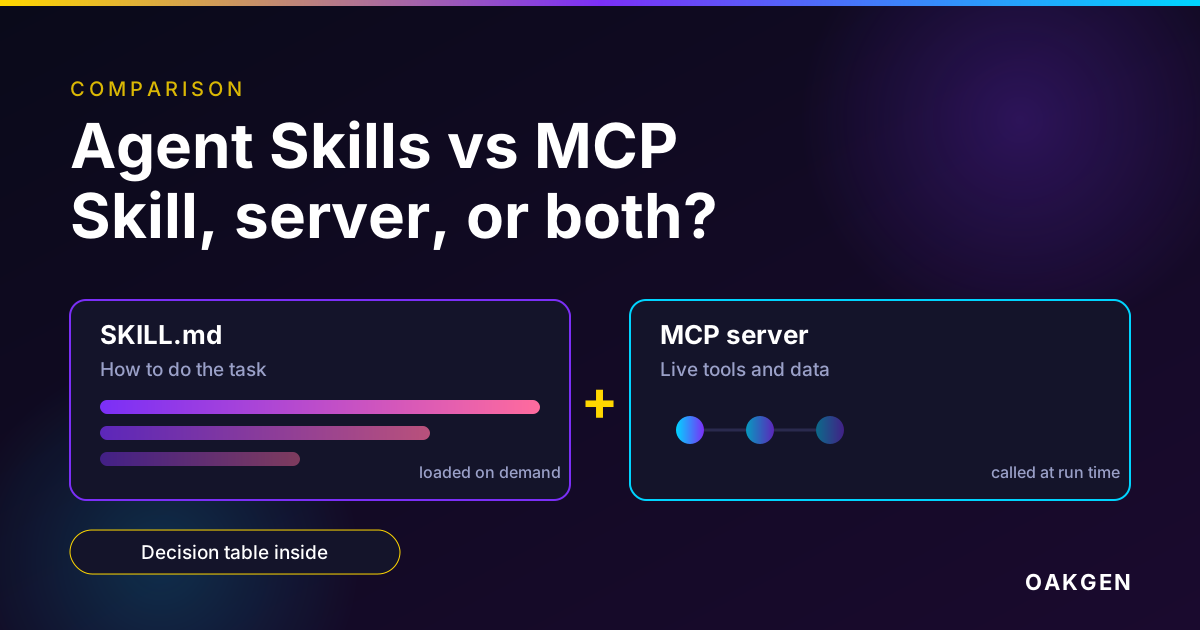
Agent Skills vs MCP is not a choice between rivals. A Skill is a folder with a SKILL.md file that teaches an agent how to do a task, and the agent loads it only when the task needs it. An MCP server exposes live tools and data that the agent calls at run time. Ship a Skill when the missing piece is know-how, a server when the missing piece is a live capability, and both when an agent must use your tools the way your team does.
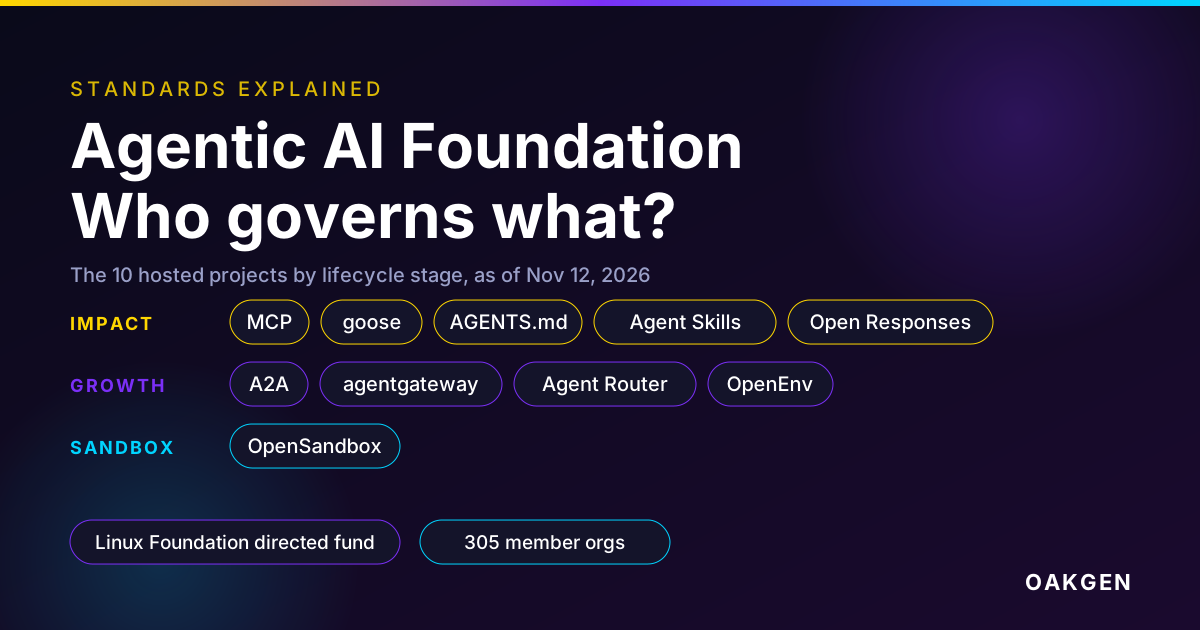
As of November 12, 2026, both standards sit under the Linux Foundation's Agentic AI Foundation (AAIF). We checked the donation claim against primary sources below, and it holds, with two caveats.
See an MCP server built for creative work
Oakgen MCP lets an agent search image, video and voice models, check a price, start a job and track it. Read what it exposes before you decide what an agent should be taught.
The short version
| Question | Skill | MCP server | Both |
|---|---|---|---|
| What it carries | Procedure, conventions, reference text, scripts | Tools, data, live actions | A procedure that calls live tools |
| How it reaches context | Name and description at startup, body when triggered, files when read | Tool definitions listed by the client, results returned per call | Skill picks the steps, server runs them |
| Changes without a release | No, it is a file you ship | Yes, the server can return new data every call | Mixed |
| Best for | Team conventions, checklists, deterministic helper scripts | Databases, SaaS APIs, paid generation jobs | Regulated or expensive workflows |
| Fails when | The job needs a live system or exact, fresh data | The agent has the tool but not your rules for using it | Nobody owns the pair, so they drift apart |
Disclosure: Oakgen is our product. This is an infrastructure comparison, not a pitch. Oakgen appears in one short section and in the call-to-action boxes.
Who this is for
You build or buy agent tooling and keep hearing "just write a Skill" and "just add an MCP server" as if one replaced the other. You might be shipping an integration or leading a creative team whose agents misuse a tool they can technically call.
Still choosing a protocol layer? Read the MCP versus API comparison first. For governance, see our AAIF explainer.
How we checked this
On November 12, 2026 we opened every page listed under sources, including Anthropic's announcement, the Linux Foundation press release, the specification and its repository, the MCP Skills extension and the Google Open Source Blog interview of November 11, 2026.
Every number here comes from one of those pages and carries its publisher and date. Where a figure is a vendor's own claim we say so. We did not benchmark Skills against MCP, so we make no claim about which is faster or more accurate. We ran no Skill or server for this post, and checked the example below against the specification by reading, not by running the skills-ref validator.
What each one actually does
Both standards fix the same problem, a capable model that still lacks context, from different sides.
A Skill is know-how that loads in stages
The Agent Skills specification defines a skill as a directory with a required SKILL.md, optionally with scripts/, references/ and assets/ folders. The file starts with YAML frontmatter and continues in Markdown.
Agents load it in three stages, which both the specification and Anthropic's documentation call progressive disclosure.
| Stage | When it loads | Cost per Anthropic's docs and the spec |
|---|---|---|
| Metadata | At startup, for every installed skill | About 100 tokens per skill, the name and description only |
| Instructions | When a task matches the description | The SKILL.md body, under 5,000 tokens recommended |
| Resources | Only when the instructions point to them | Nothing until read. Scripts run and only their output enters context |
The specification adds two limits. Keep SKILL.md under 500 lines, and keep file references one level deep. Anthropic's best-practices page explains that Claude may only preview deeply nested files.
Google's Kurtis Van Gent, in the Google Open Source Blog interview of November 11, 2026, says Skills "commoditized context the same way MCP commoditized tools". Installed skills cost little, because only the descriptions are always present.
An MCP server is live capability
The MCP tools specification (revision 2026-07-28) lets a server list tools with a name, a description and an input schema, and lets a client call them. Tools are model-controlled, and the specification says there SHOULD always be a human in the loop with the ability to deny a call.
The tradeoff is context. Anthropic's engineering post of November 4, 2025 notes that most clients load every tool definition up front, and gives one example where code execution cut usage from 150,000 tokens to 2,000, a 98.7 percent saving. That is Anthropic's own illustrative example, not an independent test. Our post on code execution with MCP covers it.
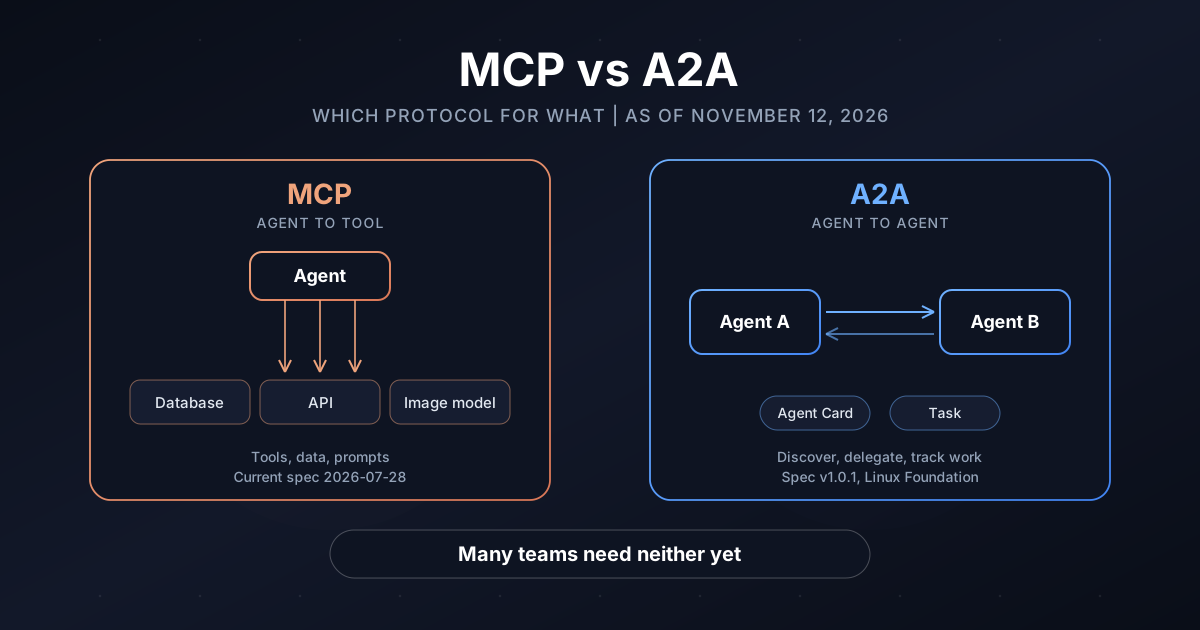
Anthropic's Claude Code docs draw the same line. MCP provides tools and data access, and Skills provide knowledge and workflows. They "solve different problems and work well together", with the skill holding database schema notes and query patterns and the server holding the connection and authentication.
Was Agent Skills really donated to the AAIF?
The claim comes from the Google Open Source Blog of November 11, 2026, which says Anthropic donated the Agent Skills specification to the AAIF "alongside MCP". We checked it against the sources closer to the event.
- Anthropic, October 22, 2026. Anthropic says it is donating the standard to the AAIF under the Linux Foundation, and lists what moves. That is the Agent Skills name and logo, the GitHub organization and the agentskills.io domain.
- Linux Foundation, October 22, 2026. The press release lists Agent Skills, contributed by Anthropic, as one of four new AAIF projects, alongside Open Responses, OpenEnv and OpenSandbox, and says the AAIF now hosts 10 projects.
- The repository, November 4, 2026. A governance file was adopted that day, and the repository's recent commit is titled as part of the AAIF donation.
So the donation is real and dated. Two caveats matter for accuracy.
First, "alongside MCP" is loose wording. MCP joined the AAIF at its December 2025 launch, and Agent Skills joined on October 22, 2026, ten months later. They are siblings under one foundation, not a joint donation.
Second, the governance file's first paragraph says Agent Skills "will be established as" a Series of LF Projects, LLC. That is future tense on the date it was adopted, so the legal setup was described as in progress. The same file gives Lead Maintainers final decision authority, including a veto over Core Maintainer votes. Maintainers serve as individuals, and Anthropic names David Soria Parra and Mahesh Murag as Lead Maintainers.
What the donation does not settle matters more for your plans.
- The format is unchanged. Existing skills keep working.
- No tagged releases yet. The repository showed zero tags when we read it. Anthropic calls versioned releases, a proposal process and security guidance a proposed roadmap.
- Packaging and discovery are open. Van Gent says the specification does not yet standardize bundling collections, how harnesses find skills, or name conflicts.
- Adoption figures are Anthropic's. Its announcement cites more than 70 platforms, one million skills published and nearly 280 million installs. We found no independent count.
The decision table
Here is the asset to bookmark. Each row is a concrete job, with what to ship and what breaks if you pick the other option.
| Job | Ship | Why | What goes wrong otherwise |
|---|---|---|---|
| Team commit-message and branch conventions | Skill | Pure procedure, no live system | A server adds auth and hosting for text |
| Create a ticket, post to Slack, send an email | MCP server | A live, credentialed action | A Skill can only describe the action |
| Read current stock, prices or account balance | MCP server | The data changes faster than any file you ship | A Skill goes stale between releases |
| Fill a PDF form with a tested script | Skill with scripts/ | Deterministic code, only output enters context | Generating the code each run is slower and less repeatable |
| Brand voice and ad-copy review checklist | Skill | Stable guidance, loaded only for copy tasks | Putting it in always-on instructions costs context every session |
| Query a customer database safely | Both | Server exposes approved actions, Skill carries schema notes and query patterns | Server alone gets used badly, Skill alone cannot reach the data |
| Paid media generation with a quote and approval step | Both | Server searches, prices and runs jobs, Skill holds thresholds and the brief template | Server alone lets an agent skip the approval habit |
| Integration you sell to many customers | Server first, Skill second | Any MCP client can use the tools, the Skill makes them usable well | A Skill-only integration needs every customer's agent to run its own code |
| A rule that must run on every edit | Neither, use a hook | Claude Code's docs say a hook fires without Claude deciding, while a Skill is interpreted and can vary | A Skill may be skipped |
Seven questions to ask in order
- Does the job need a live call to a system you do not control? If yes, you need a server or another tool. A Skill alone cannot do it.
- Does it need credentials? Keep them in the server, never in a Skill.
- Does the data change faster than you ship? A server. Otherwise a file is fine.
- Is the know-how stable text and scripts? A Skill.
- Must it run the same way every time? Use code or a hook. Skills are instructions the model interprets.
- Who installs it? A team inside one repository can commit a Skill. Strangers on many clients can connect to a server.
- Does your host support the format? Skills over MCP is Final, but host support is still being implemented per the MCP site, so test your client.
Let an agent quote the job before it spends credits
A server that prices a request before running it is the part a Skill cannot replace. Oakgen Agent Chat lets you test a creative brief, plan and cost before you generate.
A worked example of a SKILL.md layout
Take the media-generation row. The server does the work, and a Skill teaches the agent your team's approval habit. Here is the folder.
media-job-approval/
├── SKILL.md
├── references/
│   └── approval-thresholds.md
├── scripts/
│   └── check_quote.py
└── assets/
    └── brief-template.md
Here is the SKILL.md. The frontmatter uses only fields the Agent Skills specification defines.
---
name: media-job-approval
description: Walks an agent through briefing, pricing, approving and tracking a paid image, video or audio generation job when a media generation server is connected. Use when the user asks to generate media, asks what a generation will cost, or asks to retry a failed job.
license: Apache-2.0
compatibility: Needs a connected MCP server that can search models, quote a price and report job status. The bundled script needs no network access.
metadata:
  author: example-team
  version: "1.0"
---

# Media job approval

## Steps

1. Restate the brief in one sentence using assets/brief-template.md.
2. Search the server's models for the job and shortlist at most three.
3. Read the chosen model's input schema. Never invent fields.
4. Ask the server for a price on the exact inputs you will send.
5. Run scripts/check_quote.py with the quote and the user's budget.
   It prints APPROVE, ASK or STOP.
6. On ASK, show the price and wait for a yes. On STOP, say why and offer a cheaper option.
7. Start one job. Poll its status. Never start a second job to retry the first.

## Edge cases

- If no price is available, do not guess. Ask the user.
- If the inputs change after the quote, price again.

Team limits live in references/approval-thresholds.md.
Checked against the specification as read on November 12, 2026.
nameis 18 characters, lowercase with single hyphens, and matches the folder name. Anthropic's platform also bans the wordsanthropicandclaudein names.descriptionsays what the skill does and when to use it, is far under 1,024 characters, and is in third person, as Anthropic's best-practices page advises.license,compatibilityandmetadataare optional.metadatais a map of strings, so the version is quoted.- We left out
allowed-tools, which the specification marks experimental.
Notice what the Skill leaves out. It names no tool, endpoint or credential. Those belong to the server, which can change them without touching the Skill.
To serve the same folder over MCP, the server lists it through skills/list. This shape follows the MCP documentation's own example, with a placeholder digest.
{
  "uri": "skill://media-job-approval/SKILL.md",
  "frontmatter": {
    "name": "media-job-approval",
    "description": "Walks an agent through briefing, pricing, approving and tracking a paid image, video or audio generation job."
  },
  "resources": [
    {
      "uri": "skill://media-job-approval/SKILL.md",
      "digest": "sha256:<digest of the bytes served>",
      "size": 1024
    }
  ]
}
Per the MCP page, the final path segment must match the skill name, hosts verify each file's size and SHA-256 digest before use, and servers should stay under 512 files or 16 MiB per skill.
Three ways to ship both
| Route | How it works | Status on November 12, 2026 | Watch out for |
|---|---|---|---|
| Two separate installs | A server in one place, a Skill folder in another | Works today in clients that support both | The pair drifts apart, because nothing links them |
| A plugin bundle | Claude Code plugins bundle skills, hooks, subagents and MCP servers into one installable unit. Google says its Cloud Databases team pairs MCP and Skills in Agent Plugins | Works today in the products that ship plugins | Plugin formats are product-specific, not part of either standard |
| Skills over MCP | The server serves the Skill through skills/list and skills/get | SEP-2640 is Final, but SDK and host support is still being implemented | Test your client. Hosts must approval-gate skill content |
One discrepancy. The Google post calls serving Skills over MCP "proposals", but the MCP project's own pages list SEP-2640 as Final. Trust the MCP site, then confirm your client implements it.
Van Gent also says developers finish complex database tasks "much more quickly and reliably" with MCP tools paired with Skills, citing Google's own benchmarks. The post gives no numbers, so treat it as direction, not evidence.
How a creative team would apply this
Oakgen is our product, so weigh this accordingly. Oakgen MCP exposes tools for model search, input schemas, pricing, starting a generation, checking its status and listing past work. That is a clear server job, because the prices and jobs are live.
The Skill is the part a creative team writes itself. It holds the brief template, the spend ceiling and the rule that a changed input needs a fresh quote, mirroring the six-step flow in our guide to an AI image generation MCP server. We have not verified or announced Skills-over-MCP support for Oakgen, so keep the Skill on your side. For an agency example, see creative MCP workflows for marketing agencies.
Turn the brief into finished creative
Once the plan and the price are approved, take the brief into Oakgen's AI product creative studio and generate the images and video it calls for.
Where each one breaks
Skills. Instructions are advice. Claude Code's documentation says a Skill is interpreted, so outcomes can vary. Custom Skills uploaded to claude.ai, to the API and in Claude Code do not sync, per Anthropic's docs. On the Claude API they run with no network access, while Claude Code gives them the user's own. Agent Skills is not covered by zero data retention arrangements. And a Skill is code and instructions, so audit every file.
MCP servers. Definitions cost context when a client loads them all up front, per Anthropic's November 2025 post. A human SHOULD be able to deny any call. Our posts on the 2026-07-28 spec, supply chain security and the security checklist for creative teams cover the rest.
Skills over MCP. Hosts must approval-gate skill code execution and treat skill content as untrusted. A digest only proves the bytes match the server's manifest.
Common mistakes
- Writing a Skill when the job needs a live call. A Skill that says "fetch the price" with no tool for it makes the agent guess.
- Shipping a server when the job is a checklist. You pay for hosting and auth to deliver text.
- Putting secrets in a Skill. Credentials belong in the server's auth.
- A vague description. Anthropic's best-practices page says Claude uses it to choose among potentially 100 or more skills, so "helps with documents" will not trigger reliably.
- A 900-line SKILL.md. Keep it under 500 lines and split the rest into files one level deep.
- Relying on a Skill for a rule that must always run. Use a hook or a server-side check.
- Assuming portability. Claude Code adds its own frontmatter fields that other agents may ignore, and Van Gent says packaging, discovery and versioning are still unstandardized.
Decision framework
Match the shipping choice to what is missing.
- Know-how only. Ship a Skill. Start with one job you have explained to an agent three times.
- A live capability only. Ship a server with a short tool list and descriptions a model can act on.
- The agent has the tool and uses it badly. Add a Skill. This is the common case for paid or regulated actions.
- The agent has the knowledge and cannot reach the system. Add a server.
- Many customers, many agents. Server first, Skill second, then Skills over MCP once clients support it.
- A rule that must never be skipped. Enforce it in code, a hook or the server, and use the Skill only to explain it.
What I would do
I would write the Skill second. Build or connect the server first, run the workflow by hand, and note where the agent hesitates or improvises. Those spots are your SKILL.md.
I would keep the first Skill under 100 lines, name the trigger in the description in plain words, and test it with every model I plan to use, as Anthropic's best-practices page recommends.
I would not wait for Skills over MCP to mature. A separate install or a plugin bundle works today. When your clients implement SEP-2640, move the Skill onto the server so the pair versions together.
The AAIF news is a reason to relax about lock-in, not to skip the work. Versioning and packaging are still being designed.
Run an agent against real creative tools
Give an agent a brief in Oakgen Agent Chat, compare models and prices, then generate image, video and audio from one workspace. Oakgen is our product.
For the other standards under the same foundation, see AGENTS.md, Open Responses and other agent standards. To see agents chain tools in production, read agentic creative pipelines, or browse the Oakgen model library.
Frequently asked questions
What is the difference between Agent Skills and MCP?
A Skill is a folder with a SKILL.md file that teaches an agent how to do a task, plus optional scripts and reference files. The agent loads it on demand. An MCP server exposes live tools and data that the agent calls at run time. A Skill carries know-how, a server carries capability. Google's Kurtis Van Gent described them in a November 11, 2026 interview as complementary, with Skills teaching an agent how to approach a problem and MCP providing the live execution interface to carry it out.
Do Agent Skills replace MCP servers?
No. A Skill cannot reach a system that needs credentials or a live call unless the agent already has a tool for it. Anthropic's documentation says Skills on the Claude API run in a sandbox with no network access, so live data on that surface has to come from a tool such as an MCP server. A server cannot teach your team's conventions either. Most real workflows need both.
Was Agent Skills donated to the Agentic AI Foundation?
Yes. Anthropic's announcement of October 22, 2026 says it is donating the Agent Skills standard, the name and logo, the GitHub organization and the agentskills.io domain to the AAIF, and the Linux Foundation's press release of the same day lists Agent Skills among four new AAIF projects. The format did not change. As of November 12, 2026 the spec repository shows no tagged releases, and versioned releases and a proposal process are stated plans.
Can an MCP server serve Agent Skills?
Yes, through the Skills extension, SEP-2640, which the MCP project lists as Final. A server declares the io.modelcontextprotocol/skills extension, implements skills/list and skills/get, and serves each skill file as a resource, conventionally under a skill:// URI. The MCP page says SDK and host support is still being implemented, so check your client before you depend on it.
How many tokens does a Skill cost?
Anthropic's documentation says each installed Skill costs about 100 tokens at startup for its name and description, under 5,000 tokens for the SKILL.md body once triggered, and nothing for bundled files until they are read. Scripts run through bash and only their output enters context. These are Anthropic's own figures for its products, not an independent measurement.
Is it safe to install a Skill from the internet?
Treat it like installing software. Anthropic's documentation warns that a malicious Skill can direct Claude to call tools or run code in ways that do not match its stated purpose, and recommends installing Skills only from trusted sources and auditing every bundled file. The MCP Skills extension adds file digests so a host can detect a changed file, but its own documentation says a digest shows consistency with the server's manifest, not that the content is trustworthy.
Does Oakgen support Agent Skills?
Oakgen is our product. Its MCP server exposes tools for searching models, reading input schemas, pricing, starting generations, checking status and listing past generations. We have not verified or announced Skills-over-MCP support for it, so treat it as MCP tools only. A team can still write its own Skill for brand rules and approval thresholds and use it alongside the server.
Sources
- Anthropic, Donating Agent Skills to the Agentic AI Foundation, Oct 22 2026 (read 2026-11-12)
- Linux Foundation, Agentic AI Foundation Announces Four New Projects, Oct 22 2026 (read 2026-11-12)
- Google Open Source Blog, Scaling AI agents with open standards, Nov 11 2026 (read 2026-11-12)
- Agent Skills, Specification (read 2026-11-12)
- agentskills/agentskills repository, README and file list (read 2026-11-12)
- agentskills/agentskills, GOVERNANCE.md, adopted Nov 4 2026 (read 2026-11-12)
- Anthropic, Agent Skills overview, Claude Platform docs (read 2026-11-12)
- Anthropic, Skill authoring best practices, Claude Platform docs (read 2026-11-12)
- Anthropic, Equipping agents for the real world with Agent Skills, Oct 16 2025 (read 2026-11-12)
- Claude Code docs, Extend Claude with skills (read 2026-11-12)
- Claude Code docs, Extend Claude Code, MCP vs Skill and Hook vs Skill (read 2026-11-12)
- Model Context Protocol, Skills extension overview (read 2026-11-12)
- Model Context Protocol, SEP-2640 Skills Extension, status Final (read 2026-11-12)
- Model Context Protocol, Tools, specification 2026-07-28 (read 2026-11-12)
- Anthropic Engineering, Code execution with MCP, Nov 4 2025 (read 2026-11-12)