ChatGPT
 Claude
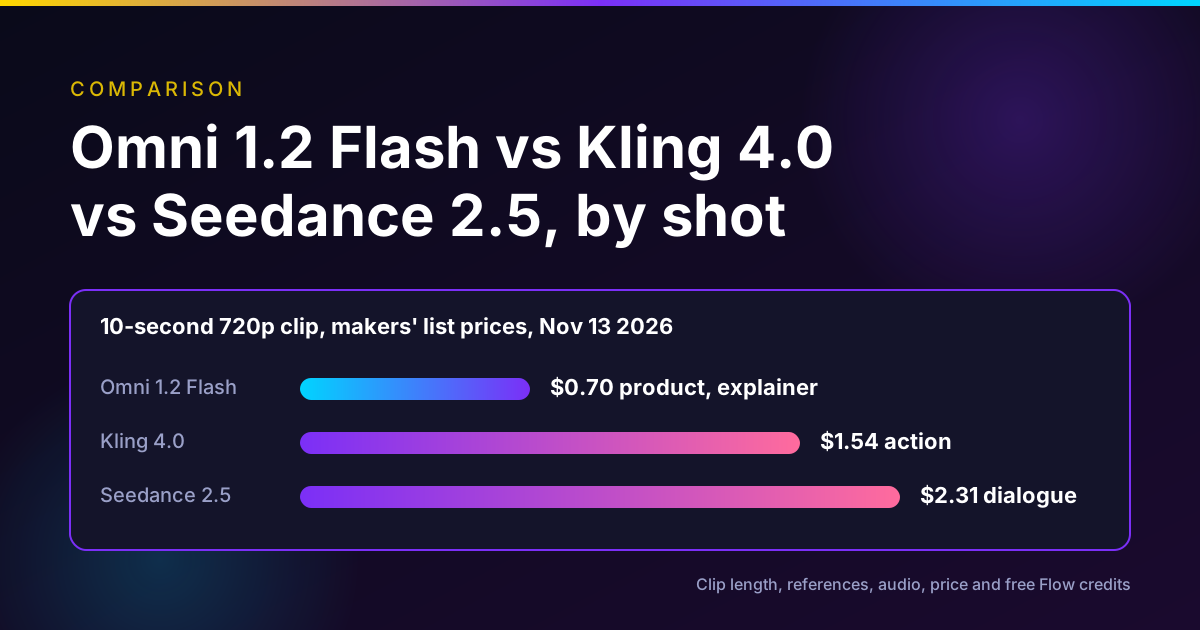
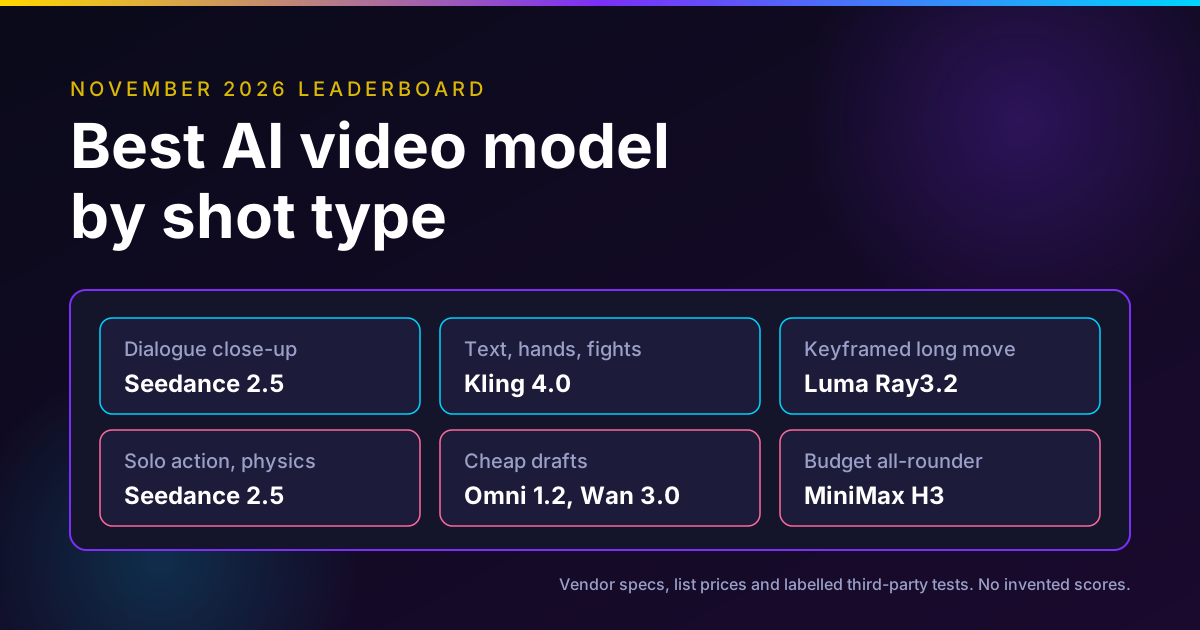
Gemini Omni 1.2 Flash vs Kling 4.0 vs Seedance 2.5 is not a contest with one winner. Pick by the shot. For dialogue longer than 15 seconds, use Seedance 2.5, which makes picture and sound together in clips up to 30 seconds. For fast action and complex camera moves, use Kling 4.0. For product shots you expect to revise, and for cheap drafts, use Gemini Omni 1.2 Flash, which is the cheapest of the three on its maker's list price and edits a clip by conversation. For long takes, use Kling 4.0 or Seedance 2.5, since Omni stops at 15 seconds.
The free route is Omni. As of November 13, 2026, Google Flow gives every account 50 credits a day, and a 10-second 720p Omni clip costs 30 of them.
We already compared Kling 4.0 vs Seedance 2.5 for UGC ads and micro drama. This post adds Omni 1.2 Flash, which Google made generally available on November 5.
Disclosure: Oakgen is our product. It runs Kling 4.0 and Seedance 2.5, and we say below where Google Flow or the vendors' own apps do more.
Test two models on the same shot
Run one prompt through Kling 4.0 and Seedance 2.5 in Oakgen's video generator and compare before you commit a budget.
The three models at a glance
Specs come from Google's launch post and release notes, Kuaishou's Kling 4.0 user guide and ByteDance's Seedance 2.5 launch post. Prices come from each maker's own pricing page. All were read on November 13, 2026.
| Gemini Omni 1.2 Flash | Kling 4.0 | Seedance 2.5 | |
|---|---|---|---|
| Maker and date | Google, GA November 5, 2026 | Kuaishou, launched October 15, 2026 | ByteDance, July 31, 2026 |
| Clip length, one pass | 3 to 15 s | 3 to 30 s | Up to 30 s |
| Longer than one pass | Extension up to 30 s total | Two-minute extension "coming soon" | Multi-round extension |
| Resolution | 360p or 720p, upscaled to 1080p or 4K | 720p, 1080p, 4K | 480p, 720p, 1080p on BytePlus |
| Audio | Native audio (Google model page) | Two-channel stereo | Joint audio and video |
| References | Up to 6 images | Up to 15 total (10 images, 5 videos, 7 elements) | Up to 30 images, 10 videos, 10 audio clips |
| Signature control | Multi-turn conversational editing | Up to 10 keyframes | Timestamp-level edits, big reference packs |
| List price, 720p | $0.07 per second | About $0.154 per second | $0.231 per second |
| Free access | 50 Flow credits a day | Not verified | Not verified |
| Best shot type | Product, explainer, quick drafts | Action, camera moves, keyframed beats | Dialogue, ensemble scenes, long takes |
The Kling price is our arithmetic. Kling's developer page bills Kling 4.0 at 1.0 unit per second at 720p and 1.5 at 1080p, and its smallest Kling 4.0 pack is $500 for 3,250 units. The Seedance price is BytePlus's own example for a 5-second 16:9 clip with no video input.
Who this is for
You make short video for ads, social or story work, and you have heard three model names this month. You want to know which one to open for the shot in front of you, what it costs, and what you can try for free. If you already chose between Kling and Seedance, the new question is whether Omni changes that. For some shots, it does.
How we checked
On November 13, 2026 we opened every primary page in the sources list: Google's launch post, Cloud post, release notes, pricing page and Flow plan and credit pages, Kling's user guide, investor release and developer pricing page, and ByteDance's launch post and BytePlus pricing page. We used Firecrawl, Exa, Perplexity, Parallel Search and the built-in search together, and treated news and reseller pages as pointers only.
We did not run our own generations for this post, so nothing here says one model looks better in a test we ran. Where we describe quality, it is the vendor's claim, labelled as such, or one creator's opinion, labelled as opinion. Oakgen credit prices come from Oakgen's price quotes on the same day.
Dialogue: Seedance 2.5 first, Omni for short lines
A dialogue shot needs three things: lips that match the words, voices that stay distinct, and enough length for an exchange. Seedance 2.5 was built for the third. ByteDance's launch post (July 31, 2026) says it makes 30-second audio and video clips in one pass and can preserve "the appearances and voices of multiple characters." It also takes up to 10 audio clips as references, which matters when a voice must stay the same across episodes.
Omni 1.2 Flash is now a real option for short lines. Google's launch post (November 5, 2026) says 1.2 brings "more fluid, natural-sounding dialogue, clearer lip-sync, and distinct multi-speaker conditioning." That is a vendor claim. The hard limit is 15 seconds per pass, which fits one line or a short back-and-forth, not a full scene.
Kling 4.0 also does dialogue in Kling's own app. The Kling 4.0 user guide (November 4, 2026) lists two-channel stereo, nine languages and voice references. On Oakgen, though, Kling 4.0 returns silent video, so we would not pick it there for talking shots.
What I would do. Draft a dialogue scene at 480p in Seedance 2.5 to check timing, then render the keeper. Use Omni for a single spoken product line or a 10-second explainer, where its lower price adds up over many takes.
Action and camera moves: Kling 4.0
Kuaishou's launch release (October 16, 2026) says Kling 4.0 was "designed for video creation scenarios featuring intense motion and complex camera movements," with steadier large-scale motion in high-speed action. That is Kuaishou's description of its own model.
Two features back it up for action. First, up to 10 keyframes, placed anywhere on the timeline, so you can say a character jumps at 3 seconds and lands at 5. Second, 30 seconds in one pass with multi-shot on by default, so a chase can cut between angles without you stitching clips.
Google is candid that Omni is not there yet. Its launch post says development is ongoing "to further improve things like fast sports action, rapid script changes and complex physics." Seedance 2.5 handles motion too, and its clay-render reference lets you block a move with a rough 3D model, but its launch post leads with storytelling and references, not speed.
What I would do. For a stunt, a sports beat or a fast drone pass, start with Kling 4.0 and pin the key poses with keyframes.
Product shots: Omni 1.2 Flash for drafts and revisions
Product video is mostly revision. The client wants the bottle in blue, the light warmer, the angle lower. Omni 1.2 Flash is built around that loop. Google Cloud's post (November 5, 2026) says you can refine the same clip, "such as swapping a product, changing lighting, or changing camera angle, instead of starting over." It also claims stronger adherence to references, so packaging and brand details stay consistent shot to shot. Both are Google's claims.
The price helps. At $0.07 per second for 720p on the Gemini API pricing page, you can draft many variants before spending on a final. Google suggests drafting at 360p or 720p and upscaling only the keepers, at about $0.104 per second for 1080p and $0.209 for 4K.
Where Omni falls short for product work: six reference images is fewer than the others accept, and 15 seconds will not hold a full 30-second spot. For a hero product film in native 4K with exact timing, Kling 4.0's 4K output and keyframes fit better.
What I would do. Iterate the look in Omni, then rebuild the approved version in Kling 4.0 if the final needs 4K or 30 seconds.
Long takes: Kling 4.0 or Seedance 2.5
A long take means one continuous shot, or a sequence that must hold its look for 20 to 30 seconds. Both Kling 4.0 and Seedance 2.5 make up to 30 seconds in one pass. Omni makes 15, and extends to 30 in total through the API.
Choose by what fills the take. If it is people talking and reacting, Seedance 2.5, because sound and picture come from the same pass. If it is a moving camera through a space, Kling 4.0, because keyframes let you place each beat. Kling's user guide includes a 20-second single-take street escape as a worked example.
The price per shot
Here is a 10-second clip on each maker's own price list, as of November 13, 2026. These are list prices, not reseller prices, and they will change.
| 10-second clip | Gemini Omni 1.2 Flash | Kling 4.0 | Seedance 2.5 |
|---|---|---|---|
| 480p or 360p | About $0.23 (360p) | Not offered | About $1.03 (480p) |
| 720p | About $0.70 | About $1.54 | About $2.31 |
| 1080p | About $1.04 (upscaled) | About $2.31 | About $5.69 |
| Where the price comes from | Gemini API pricing page | Kling developer API, $500 pack | BytePlus ModelArk examples |
Two cautions. Kling's API sells prepaid packs from $500, valid 180 days, so the per-second rate assumes you buy one. BytePlus bills Seedance by tokens, and the per-second figure comes from its 5-second 16:9 example, so other shapes and lengths differ slightly.
On Oakgen, as of November 13, 2026, a 10-second 720p clip quoted 531 credits on Kling 4.0 and 1,599 credits on Seedance 2.5, with 746 at 480p and 3,935 at 1080p.
Compare cost per usable clip, not per second
Run the same shot through Kling 4.0 and Seedance 2.5 on Oakgen and count how many takes you keep.
Free access: Google Flow's 50 daily credits
Omni is the only one of the three with a clear free route from its maker. The Flow plans page lists, for users without a Google AI subscription, 50 daily Flow credits and "Omni 1.2 Flash (≤10s)". Flow's credit help page gives the costs:
| Omni 1.2 Flash in Flow | 360p | 720p | Who can use it |
|---|---|---|---|
| Seconds 1 to 10 | 1 credit per second | 3 credits per second | Everyone |
| Seconds 11 to 15 | 2 credits per second | 6 credits per second | Plus, Pro, Ultra |
| Extension | 1 credit per second added | 3 credits per second added | Subscribers |
So 50 free credits buy one 10-second 720p clip with 20 credits left, or five 10-second 360p drafts. Daily credits do not roll over. Flow also says non-subscribers may be unable to generate video between roughly 2 pm and 5 pm UTC. Paid plans add monthly credits: 200 on Google AI Plus, 1,000 on Pro, and 10,000 or 25,000 on the two Ultra tiers, per the Flow plans page.
Google Vids is a second free door. Google says (November 5, 2026) anyone with a Google account can make up to three 15-second Omni videos a month there at no cost.
We did not verify a current free tier for Kling 4.0 or Seedance 2.5 from their makers' pages, so we make no claim about one. Be careful with videos promising "free unlimited" Seedance. Several we saw link to paid platforms through referral links.
What creators are saying
One YouTube creator, AI Frame Lab (November 8, 2026), put the three side by side on price and reached a per-shot verdict: "Kling to direct, Seedance to act, Omni to explain." That is the creator's opinion. The video says only its Omni leg was the creator's own test, and the Kling and Seedance quality data came from third parties. Its list prices match the ones we read on the vendors' pages. Our own reading of the documentation lands in a similar place, but we did not test it either.
A decision framework
Ask four questions, in this order.
- Does the shot need people speaking for more than 15 seconds? Use Seedance 2.5.
- Is it fast motion, a stunt, or a camera move with exact beats? Use Kling 4.0.
- Will the client ask for changes to the same clip? Draft in Omni 1.2 Flash and edit by conversation.
- Does it need native 4K or 30 seconds in one pass? Kling 4.0 for 4K, Kling 4.0 or Seedance 2.5 for length.
If none of these apply and you want the cheapest decent draft, start with Omni. The mistake is choosing the model before choosing the shot.
Common mistakes
Comparing reseller prices. A reseller's markup can make one model look three times dearer than its list price. Compare list to list, or cost per usable clip on your own platform.
Treating 15 seconds as enough. Omni's jump from 10 to 15 seconds is real, but a 30-second spot still needs Kling or Seedance, or Omni's extension, which costs more and is subscriber-only in Flow.
Planning a dialogue scene on a silent model. Kling 4.0 has stereo audio in Kling's app but returns silent video on Oakgen. Check the platform, not just the model.
Counting on free credits for a deadline. Flow's free tier can block video in the afternoon UTC peak, and daily credits expire.
Repeating vendor quality claims as test results. "Clearer lip-sync" and "steadier motion" are the makers' words. Run your own shot before you promise a client anything.
Where Oakgen fits
Oakgen is useful when you want to move between models on one balance and one workspace. On Oakgen as of November 13, 2026, Kling 4.0 makes 3 to 30 second silent clips at 720p or 1080p and Seedance 2.5 makes clips with sound at 480p, 720p or 1080p.
Here is where others are stronger. For Gemini Omni 1.2 Flash, use Google Flow or the Gemini API, which give you 15-second clips and upscaling to 1080p or 4K. Kling's own app has audio, 4K and keyframes that Oakgen's Kling 4.0 does not expose. For a reference guide to Seedance, see how to use Seedance 2.5, and for Kling, how to use Kling 4.
For more picks by shot type across other models, read our best AI video generator by shot type. For the full week of launches, see the AI creative news roundup for November 9.
Make the shot, then the next one
Oakgen is our product. Draft in one model, finish in another, and keep every take in one workspace.
Frequently asked questions
Is Omni 1.2 Flash better than Kling 4.0 and Seedance 2.5? It is cheaper and edits by conversation, but it stops at 15 seconds and Google says fast action is still a weak spot.
Which model for dialogue? Seedance 2.5 for longer scenes, Omni for short lines.
Which model for action? Kling 4.0, by its maker's positioning.
Can I use Omni for free? Yes, up to 10-second clips with Flow's 50 daily credits.
What does a 10-second clip cost? About $0.70, $1.54 and $2.31 at 720p on the three makers' list prices.
Which takes the most references? Seedance 2.5.
Does Oakgen support all three? It lists all three names, with the limits above.
Did Oakgen test them? No. This post is built from vendor pages, not our own generations.
Frequently asked questions
Is Gemini Omni 1.2 Flash better than Kling 4.0 and Seedance 2.5?
Not across the board. It is the cheapest of the three on its maker's list price, about $0.07 per second at 720p against roughly $0.15 for Kling 4.0 on Kling's own API and $0.231 for Seedance 2.5 on BytePlus, and it is the only one built around editing a clip in conversation. But it stops at 15 seconds, and Google itself says fast sports action and complex physics are still being worked on. Kling 4.0 and Seedance 2.5 both make 30-second clips.
Which model should I use for dialogue scenes?
Seedance 2.5 is our default for longer dialogue, because ByteDance built it around joint audio and video generation in clips up to 30 seconds and it accepts up to 10 audio references. Gemini Omni 1.2 Flash is the cheaper pick for a single talking shot of 15 seconds or less, and Google says 1.2 improved lip-sync and multi-speaker dialogue. Kling 4.0 also outputs stereo audio in Kling's own app, but on Oakgen it returns silent video.
Which model is best for fast action shots?
Kling 4.0. Kuaishou designed it for intense motion and complex camera moves, it supports up to 10 keyframes to pin action beats, and it makes 30 seconds in one pass. Google's own launch post for Omni 1.2 Flash says fast sports action is still under development. Treat this as a vendor-positioning call, since we did not run an action test.
Can I use Gemini Omni 1.2 Flash for free?
Yes, within limits. As of November 13, 2026, Google Flow gives every account 50 credits a day, and Omni 1.2 Flash clips of up to 10 seconds are available without a subscription. Flow's help page lists 1 credit per second at 360p and 3 credits per second at 720p, so one 10-second 720p clip uses 30 credits. Clips of 11 to 15 seconds need a Google AI plan, and non-subscribers may not be able to generate video between about 2 pm and 5 pm UTC.
How much does a 10-second clip cost on each model?
On the makers' own list prices as of November 13, 2026, a 10-second 720p clip is about $0.70 on Gemini Omni 1.2 Flash through the Gemini API, about $1.54 on Kling 4.0 through Kling's developer API at the $500 pack's unit price, and about $2.31 on Seedance 2.5 through BytePlus ModelArk. The Kling and Seedance figures are our arithmetic from the vendors' per-second rates and examples. Prices change, so check each pricing page before you budget.
Which model takes the most reference material?
Seedance 2.5, with up to 30 images, 10 video clips and 10 audio clips in one request, according to ByteDance. Kling 4.0 takes up to 15 references in total, including up to 10 images, 5 videos and 7 elements. Gemini Omni 1.2 Flash works from up to 6 reference images, according to Google's release notes.
Does Oakgen support all three models?
Oakgen offers Kling 4.0 and Seedance 2.5. On Oakgen, Kling 4.0 returns silent video at 720p or 1080p and Seedance 2.5 makes sound at 480p to 1080p. For Gemini Omni 1.2 Flash, including 15-second clips and 1080p or 4K upscaling, use Google Flow or the Gemini API. Oakgen is our product.
Did Oakgen test these three models for this article?
No. We did not generate clips for this comparison. Specs and prices come from Google, Kuaishou and ByteDance pages read on November 13, 2026. Oakgen credit prices come from Oakgen's own price quotes on the same day. The shot-type verdicts are our reading of the vendor documentation, plus one creator video we cite as opinion.
Sources
- Google, Gemini Omni 1.2 Flash: Fast and cost-effective with longer clips, Nov 5 2026 (read 2026-11-13)
- Google Cloud Blog, Gemini Omni 1.2 Flash now generally available, Nov 5 2026 (read 2026-11-13)
- Google AI Studio, Gemini API release notes, entry of Nov 5 2026 (read 2026-11-13)
- Google AI Studio, Gemini API pricing, Gemini Omni 1.2 Flash, undated page (read 2026-11-13)
- Google Flow, plans and features, undated page (read 2026-11-13)
- Google Flow Help, credit costs per generation, undated page (read 2026-11-13)
- Google, Generate longer AI videos with Omni 1.2 Flash in Google Vids, Nov 5 2026 (read 2026-11-13)
- Kling AI, Kling 4.0 User Guide, Nov 4 2026 (read 2026-11-13)
- Kuaishou Technology, Kling AI Officially Launches Kling 4.0, Oct 16 2026 (read 2026-11-13)
- Kling AI, Developer API pricing, undated page (read 2026-11-13)
- ByteDance Seed, Introducing Seedance 2.5, Jul 31 2026 (read 2026-11-13)
- BytePlus, ModelArk model pricing, undated page (read 2026-11-13)
- AI Frame Lab on YouTube, Omni 1.2 vs Kling 4.0 vs Seedance 2.5, Nov 8 2026 (read 2026-11-13)