ChatGPT
 Claude
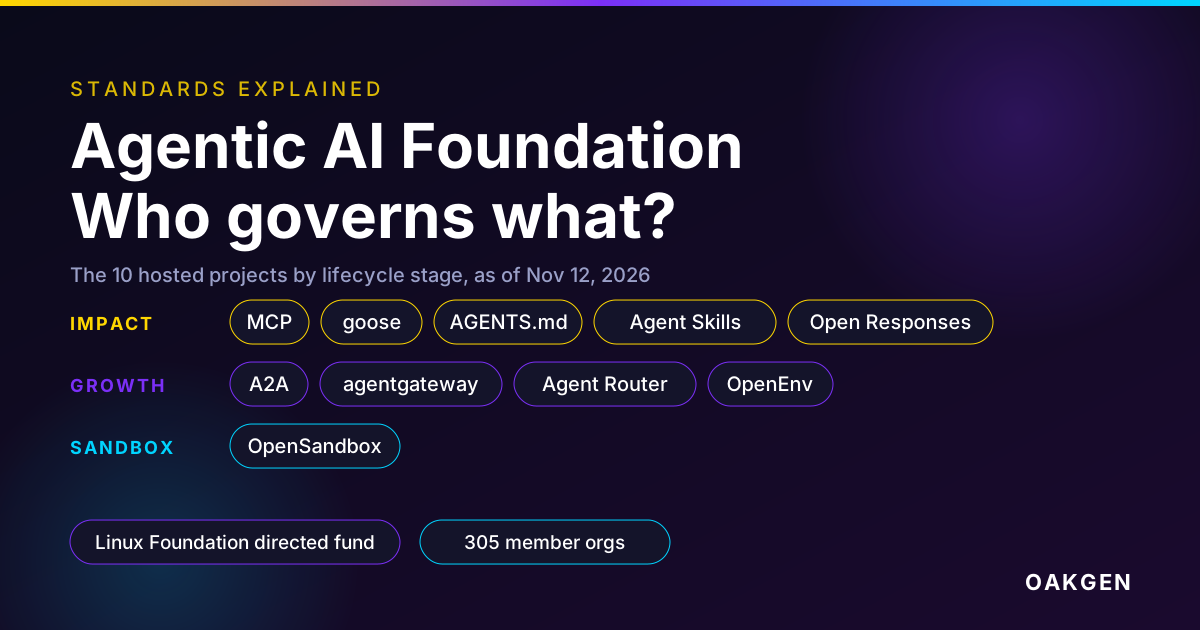
The Agentic AI Foundation (AAIF) is a directed fund inside the Linux Foundation. It holds the funds, trademarks and neutral hosting for agent standards. It does not write their specifications. The Linux Foundation announced it on December 9, 2025 with three projects, MCP, goose and AGENTS.md. As of November 12, 2026 it hosts ten, adding A2A, agentgateway, Agent Router, Agent Skills, Open Responses, OpenEnv and OpenSandbox.
A board of nine voting seats approves projects and budget. Each project's own maintainers still decide the technical content. The foundation reported 305 member organizations on October 22, 2026. What it cannot do is promise stability, security, or that two hosted projects will fit together.
See what an MCP server looks like in a creative tool
Oakgen's remote MCP server lets an MCP client discover models, check pricing and start image, video and audio jobs. MCP is one of the ten projects covered below.
The short version
| Question | Short answer | Where it comes from |
|---|---|---|
| What is it | A directed fund under the Linux Foundation, formed December 9, 2025 | Linux Foundation press release |
| Founding projects | MCP (Anthropic), goose (Block), AGENTS.md (OpenAI) | Linux Foundation press release |
| Projects today | 10, with 5 at Impact, 4 at Growth and 1 at Sandbox stage | AAIF GitHub profile, TC repository |
| Who decides | Board (8 Platinum seats and 1 Gold seat) approves projects and budget. Technical Committee (8 seats) reviews them. Maintainers run each spec | Charter, AAIF pages, MCP blog |
| Members | 305 organizations, reported by the AAIF on October 22, 2026 | AAIF press release |
| What it does not settle | Spec stability, security quality, overlap between projects | Our reading, see below |
Disclosure: Oakgen is our product. Nothing in this post depends on Oakgen holding a role in the AAIF, and we do not claim one.
Who this is for
You build or buy agent tools and keep seeing "now under the Linux Foundation" without knowing what changed. Or you run a platform team deciding whether a hosted project is safe to build on. Or you work on a creative team and want to know whether the protocol behind your AI tools can be changed under you.
For the protocol layers themselves, read our MCP versus A2A guide. For AGENTS.md, Open Responses and the other formats, see the other agent standards explained.
How we checked this
On November 12, 2026 we opened the Linux Foundation and AAIF press releases, the AAIF charter PDF, the Technical Committee repository and lifecycle policy, the AAIF projects and board pages, the A2A proposal issue on GitHub and each project announcement. Every date and number below comes from one of those pages.
Where sources disagree, we say so.
- The AAIF About page still names five hosted projects. The projects page, GitHub profile and the Linux Foundation's October 22 release all list ten.
- The A2A announcement is dated August 17, 2026 on aaif.io. A2A's own post carries August 27 in its URL.
- The LFX "first commit" dates shown on aaif.io project pages, for example July 11, 2019 for MCP and December 6, 2018 for agentgateway, do not match the projects' launch histories. We did not use them, except in the two table rows where the release gives no date, and we label those.
We did not read private board minutes, and the charter does not list membership fees.
How the AAIF is built
The charter, amended July 29, 2026, says the fund exists to raise, budget and spend money for projects the Governing Board approves, and that each project's governance is set by that project's own charter. Here is who holds which power.
| Body | Seats | What it decides | Source |
|---|---|---|---|
| Governing Board | One per Platinum member (capped at eight) plus one Gold representative the board selects from nominees. Silver and Associate members have no seat | Approves projects, budget, officers, policies and member benefits | Charter sections 2 and 3 |
| Technical Committee | One per Platinum member, eight in all, appointed by the board for March 1 to December 31, 2026. Chair is David Soria Parra of Anthropic | Reviews proposals, maintains the project lifecycle policy, votes projects into stages | Technical Committee repository, aaif.io |
| Project maintainers | Set by each project | Technical direction, releases and spec changes | Charter section 4, MCP blog |
| Working groups | Seven plus one cross-group taxonomy workstream, open to participation | Send proposals to the board and the committee | AAIF blog, GitHub |
| Linux Foundation | Not a seat | Holds the funds and trademarks, and takes an administrative fee of 9% of the first $1,000,000 a year and 6% above it | Charter sections 8 and 11 |
The board page lists David Nalley of AWS as chair and April Kyle Nassi of Google as treasurer. The other voting seats go to Microsoft, OpenAI, Cloudflare, Anthropic, Bloomberg and Block, plus Zhong Wu of Shopify for the Gold tier. The page also lists Matt Vasey of the Gates Foundation. The charter provides a non-voting seat for a charitable funding Associate Member, and we did not verify whether that is his. Mazin Gilbert is executive director and announced on April 2, 2026 that he was joining.
Two rules in the charter matter for outsiders. Charter amendments, new policies, a higher Platinum cap and additional top-level projects each need two-thirds of the entire board. For three years from the charter's effective date they also need approval from every Platinum member that has contributed a top-level project. The charter does not name those members.
Board meetings are private by default. On the Technical Committee, two sources differ. The board chair's February 24 post says its biweekly meetings are recorded and open to observe. The committee's README says it is still formalizing its governance and that meetings will open to the public once it is established.
Every hosted project, with origin, join date and stage
This table covers all ten projects as of November 12, 2026. Stage comes from the AAIF GitHub profile and the Technical Committee README, which agree. "Created or launched" is the date the contributing organization or Linux Foundation gave. "Joined" is the date the AAIF announced it.
| Project | Origin and contributor | Created or launched | Joined the AAIF | Stage |
|---|---|---|---|---|
| Model Context Protocol (MCP) | Anthropic | Open sourced November 2024, per Anthropic's Mike Krieger in the Linux Foundation release | December 9, 2025 (founding) | Impact |
| goose | Block | Released early 2025, per the Linux Foundation release | December 9, 2025 (founding) | Impact |
| AGENTS.md | OpenAI | Released August 2025, per the Linux Foundation release | December 9, 2025 (founding) | Impact |
| agentgateway | Created by Solo.io | Accepted by the Linux Foundation August 25, 2025 | June 4, 2026, the fourth hosted project | Growth |
| Agent2Agent (A2A) | Created by Google | Launched April 2025. Became a Linux Foundation project June 23, 2025 | August 17, 2026 | Growth |
| Agent Router | Started by Bloomberg and Tetrate engineers as Envoy AI Gateway | Public development from October 2024 | September 9, 2026 | Growth |
| Agent Skills | Anthropic | Launched October 2025. Published as an open standard December 2025 | October 22, 2026 | Impact |
| Open Responses | OpenAI, based on its Responses API | January 15, 2026 | October 22, 2026 | Impact |
| OpenEnv | Hugging Face | Not given in the release. The AAIF page shows a first commit on October 1, 2025 | October 22, 2026 | Growth |
| OpenSandbox | Alibaba | Not given in the release. The AAIF page shows a first commit on November 13, 2025 | October 22, 2026 | Sandbox |
Stage counts are five Impact, four Growth and one Sandbox. The lifecycle policy lets a project enter at any of the three stages if it meets that stage's bar, which is how Agent Skills and Open Responses can be listed at Impact less than a year after launch. We did not see the committee's reasoning for those two.
Browse the models an MCP client can call
MCP connects an agent to tools. The generation models behind those tools are what produce the media. Compare the image, video and audio models in Oakgen's library.
Membership, as the AAIF reports it
All three counts are organization numbers published by the foundation. Nobody outside it has audited them.
| Date | Total members | What the release said | Source |
|---|---|---|---|
| December 9, 2025 | Not stated | Eight Platinum members, 18 named Gold and 23 named Silver | Linux Foundation release |
| February 24, 2026 | 146 | 18 new Gold and 79 new Silver members | AAIF release |
| May 18, 2026 | Not read | Headline says 43 new members | AAIF news index |
| August 12, 2026 | 247 | 57 new in the quarter, 3 Gold, 33 Silver, 21 Associate | AAIF release |
| October 22, 2026 | 305 | 60 new, 7 Gold, 33 Silver, 18 Associate | AAIF release |
The increments do not sum exactly. For example 247 plus 60 is 307, not 305, and we cannot say why. Treat the totals as the foundation's headline figures, and read membership as a sign of interest, not of adoption. New members include banks, a philanthropy and universities, which says who is paying attention. It says nothing about who has shipped anything.
Platinum is capped at eight, and the About page still lists the same eight founding members, Amazon Web Services, Anthropic, Block, Bloomberg, Cloudflare, Google, Microsoft and OpenAI. Silver and Associate members get no vote. Every member must also belong to the Linux Foundation.
How a project joins, with A2A as the worked example
The lifecycle policy, first created March 18, 2026 and updated October 15, requires four things. The project needs an OSI-approved permissive license, its host must transfer trademarks and assets to the Linux Foundation, it must adopt a Linux Foundation technical charter, and it needs an absolute majority of the Technical Committee followed by Governing Board approval.
There are four stages.
- Sandbox. An entry point that is not an endorsement. No mentorship, funding or security scanning, a checkpoint at six months, and an expectation to apply for Growth within twelve.
- Growth. Needs documented production use by two unaffiliated organizations and a growth plan. Reviewed quarterly and expected to leave Growth within two years.
- Impact. Needs significant adoption, maintainers from multiple organizations and a public roadmap. Eligible for ongoing foundation funding.
- Emeritus. For projects that have reached end of life.
A2A shows the real pace. Google's open source office opened the proposal on June 18, 2026. It reached Technical Committee voting on June 29. The committee's approval as a Growth project was recorded on July 9 and confirmed in a GitHub comment on July 15. The Governing Board approved it on August 4, and the issue closed the same day. The AAIF announced it on August 17. Because A2A was already a Linux Foundation project, that comment said no further paperwork was needed.
That is 47 days from proposal to board approval, and 60 days to the announcement. Plan for a similar timeline if you ever donate a project.
What governance does not settle
This is the part most explainers skip. A neutral home changes who owns the name. It does not change much else.
Specifications stay with maintainers. The MCP blog said that the Linux Foundation "will not dictate the technical direction of MCP". MCP's own schedule shows it. The maintainers announced a six-month release cycle on November 11, 2026, with the next version targeted for March 30, 2027. The foundation was not part of that announcement. Read what to plan for that cycle if you maintain a server or SDK.
Neutral is not the same as equal. Eight Platinum members hold the Technical Committee seats and all but one of the board's voting seats. Several of them wrote the projects with the largest installed bases. The committee chair is also MCP's lead maintainer. That is a reasonable arrangement for a young foundation. It is also a concentration of influence, and you should know it exists.
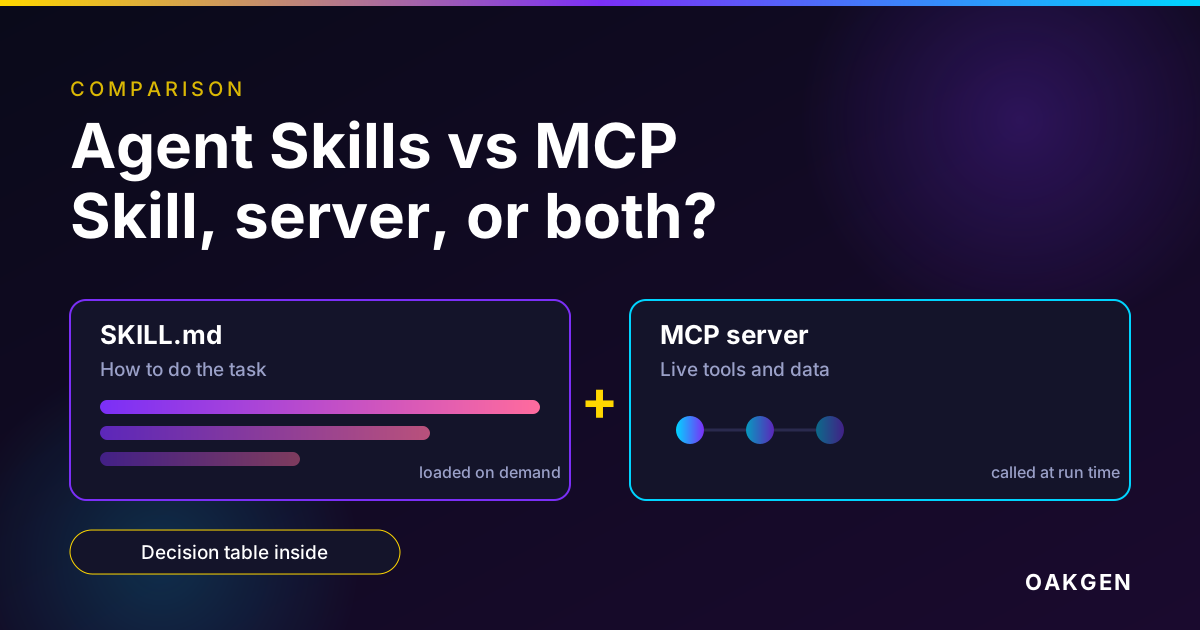
Hosted does not mean combined. Two projects are gateways, agentgateway and Agent Router. Agent Skills and MCP both extend what an agent can do. Open Responses and A2A each define their own message formats. Nothing in the sources says the foundation will reconcile them. Our Agent Skills versus MCP comparison covers one overlap.
Stage is maturity, not safety. Sandbox projects get no security scanning under the policy. Even Impact only makes a project eligible for audits. Neither promises that a server built on the protocol is safe, which is why our MCP security checklist for creative teams still applies.
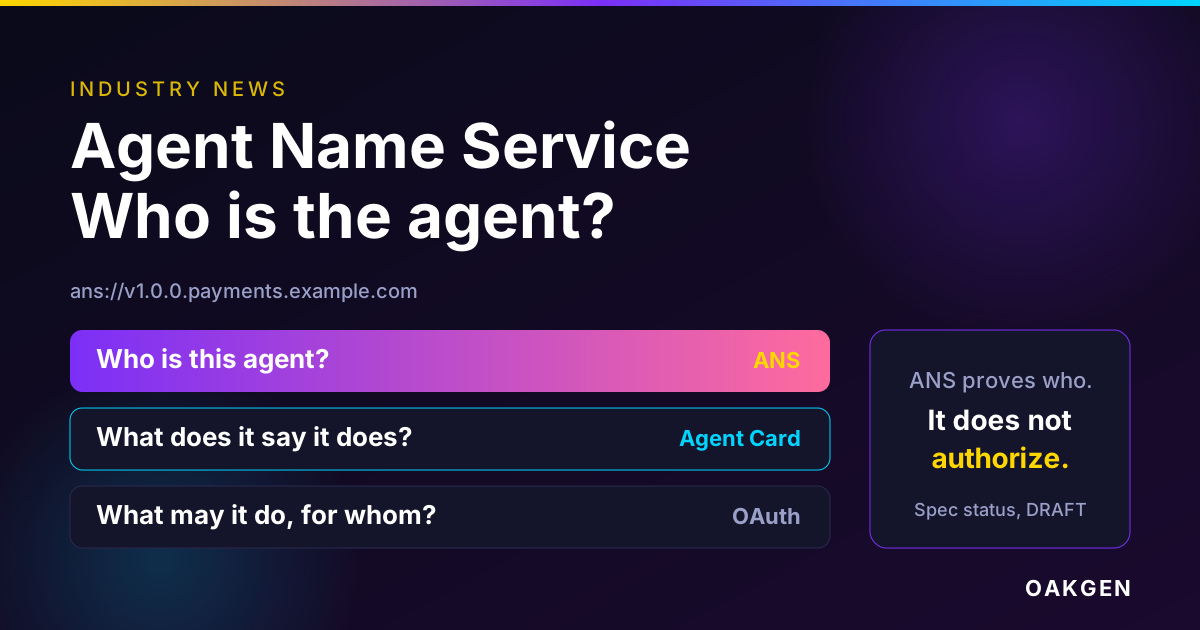
The AAIF is not the whole field. Agent Name Service launched on November 10, 2026 as a Linux Foundation project. The release does not call it an AAIF project. The AGNTCY Agent Directory Service is described there as another Linux Foundation project. Read our ANS explainer for the identity gap.
Adoption claims are claims. The Linux Foundation's December 2025 release said more than 60,000 open source projects had adopted AGENTS.md. That is the foundation's figure, from launch day.
Many articles still describe the AAIF as MCP, goose and AGENTS.md. That was true on December 9, 2025. It has been ten projects since October 22, 2026, and the foundation's own About page is out of date.
Timeline
| Date | Event |
|---|---|
| November 2024 | Anthropic open sources MCP |
| June 23, 2025 | A2A becomes a Linux Foundation project |
| August 25, 2025 | Linux Foundation accepts agentgateway |
| December 9, 2025 | AAIF formed with MCP, goose and AGENTS.md |
| February 24, 2026 | 146 members. David Nalley named chair. Technical Committee and seven working groups in place |
| April 2, 2026 | Mazin Gilbert joins as executive director |
| June 4, 2026 | agentgateway joins |
| August 4 and 17, 2026 | A2A approved by the board, then announced |
| September 9, 2026 | Agent Router joins |
| October 22, 2026 | Four projects join, ten in total. 305 members |
| November 11, 2026 | MCP announces a six-month release cycle |
Decision framework, and what I would do
Use the project's stage as a risk filter, not the foundation's name.
| Stage | What the policy says | How I would treat it |
|---|---|---|
| Impact | Significant adoption, maintainers from two or more organizations, public roadmap | Fine to build on. Still pin versions |
| Growth | At least two unaffiliated production users, mentorship, quarterly review | Fine for production with a fallback plan |
| Sandbox | Not an endorsement, no security scanning, apply to Growth within twelve months | Prototype only |
The table's third column is my opinion, not the foundation's.
- If you ship an MCP server. Ignore the AAIF day to day. Track the MCP specification, your SDK's tier and the March 2027 target. Foundation news will not break your server. A spec revision can.
- If you run a platform team. Choose between the two gateways by your data plane and your team's skills, not by the shared logo. Treat any Sandbox project as a prototype and ask what happens if it is archived.
- If you are a creative team. You do not need to do anything because of the AAIF. Ask each AI tool vendor which MCP revision it supports, what it logs, and how it asks you to approve spend. Our guide to human approval for creative AI agents covers that last question.
- If you want a vote. Platinum is capped, so look at Gold, which has one board seat shared by every Gold member. Working groups are open to all tiers.
One honest Oakgen note. Oakgen's remote MCP server is an MCP server, and MCP is the spec now hosted by the AAIF. We have not verified which spec revision it implements for this post, and we do not claim AAIF membership. For a plain-language view of what such a server exposes, see our guide to AI image generation MCP servers.
Brief an agent and review the plan before anything is generated
Agent Chat lets you describe a campaign, review the plan and then generate the images, video and audio it calls for. It is the creative-team side of the protocols covered here.
Common mistakes
- Reading "hosted by the AAIF" as one specification. There are ten projects, each with its own spec, maintainers and release process.
- Using membership as an adoption number. A university joining as an Associate Member is not a production deployment.
- Treating Impact as a security rating. It describes maturity and adoption.
- Quoting old numbers. The 146 and 247 member counts are superseded by 305. The three-project story is superseded by ten.
- Assuming a foundation fixes versioning. A2A has been a Linux Foundation project since June 2025, and its releases still come from its maintainers.
- Forgetting the exits. The policy has an Emeritus stage, and Sandbox projects are expected to move up or be discussed for archival.
For these protocols applied to image and video work, see our post on agentic creative pipelines.
What I would do
I would treat the AAIF as good news for durability and neutral trademarks, and as silent on everything else. I would pin spec versions, read the lifecycle stage of every project I depend on, and watch the MCP schedule, since that is where change actually arrives.
Over the next year I would watch whether the two gateway projects converge, and whether the Technical Committee opens its meetings as its README promises. Outsiders cannot judge neutrality without seeing how decisions are made.
Connect an MCP client to your creative toolkit
Set up Oakgen's remote MCP server with a supported client, then inspect models, check pricing and run image, video and audio jobs from your agent.
Frequently asked questions
What is the Agentic AI Foundation (AAIF)?
The Agentic AI Foundation is a directed fund inside the Linux Foundation. The Linux Foundation announced it on December 9, 2025, with three founding projects, Anthropic's Model Context Protocol, Block's goose and OpenAI's AGENTS.md. Its charter says it exists to raise, budget and spend funds in support of agentic AI projects that its Governing Board approves. As of November 12, 2026 it hosts 10 projects and reports 305 member organizations.
Which projects does the Agentic AI Foundation host?
As of November 12, 2026 the AAIF projects page and GitHub profile list ten. They are Model Context Protocol, goose, AGENTS.md, agentgateway, Agent2Agent (A2A), Agent Router, Agent Skills, Open Responses, OpenEnv and OpenSandbox. Five are at Impact stage, four at Growth stage and one, OpenSandbox, at Sandbox stage. The About page on aaif.io still names only five, so use the projects page for the current list.
Who controls MCP now that it is under the AAIF?
MCP's own maintainers still decide the protocol. The MCP blog said on December 9, 2025 that the AAIF Governing Board decides strategic investment, budget, member recruitment and approval of new projects, while each project keeps full autonomy over technical direction. The Linux Foundation, it said, will not dictate MCP's technical direction. The AAIF Technical Committee chair, David Soria Parra of Anthropic, is also MCP's lead maintainer, so the two groups overlap.
How many members does the AAIF have, and what does membership cost?
The AAIF reported 146 members on February 24, 2026, 247 on August 12, 2026 and 305 on October 22, 2026. These are organization counts reported by the foundation, not audited figures, and the quarterly increments do not sum exactly. We did not find a public fee schedule in the sources we read. The charter only says every member must also be a corporate member of the Linux Foundation, so ask the foundation for current pricing.
Is the AAIF a formal standards body?
Not in the way that name suggests. The charter describes a directed fund that supports technical projects, and it says each project's governance is set by that project's own charter. Specification decisions stay with project maintainers. The AAIF supplies funding, trademarks, neutral hosting and a process for admitting projects, but it does not publish one combined specification.
Do I need to join the AAIF to use or contribute to MCP, A2A or Agent Skills?
Not for Agent Skills. Anthropic's October 22, 2026 post says you can use or contribute to the standard without joining the AAIF. The AAIF lifecycle policy also requires every hosted project to use an OSI-approved permissive license. We did not check the contribution rules of each of the ten projects, so read the CONTRIBUTING file in the one you care about. Membership is for organizations that want a vote or a seat in working groups.
Does the AAIF matter for a creative team using AI image and video tools?
Indirectly. If your tools connect through MCP, the protocol you depend on is now hosted by a neutral foundation and follows a published release schedule, which lowers the chance of a single vendor changing it overnight. It does not tell you which spec revision a given tool supports or whether its servers are safe. Ask each vendor which MCP revision it implements and how it handles approvals before spend.
Sources
- Linux Foundation, Formation of the Agentic AI Foundation, Dec 9 2025 (read 2026-11-12)
- Anthropic, Donating MCP and establishing the Agentic AI Foundation, Dec 9 2025 (read 2026-11-12)
- Model Context Protocol blog, MCP joins the Agentic AI Foundation, Dec 9 2025 (read 2026-11-12)
- AAIF, Foundation charter, amended July 29 2026 (read 2026-11-12)
- AAIF, About and Governing Board pages (read 2026-11-12)
- AAIF, Technical Committee page (read 2026-11-12)
- AAIF Technical Committee repository, members and project stages (read 2026-11-12)
- AAIF Technical Committee, Project Lifecycle Policy, updated Oct 15 2026 (read 2026-11-12)
- AAIF on GitHub, project list and stages (read 2026-11-12)
- AAIF, Welcomes 97 New Members, Feb 24 2026 (read 2026-11-12)
- AAIF, First Quarter update from board chair David Nalley, Feb 24 2026 (read 2026-11-12)
- AAIF, Welcomes 57 New Members, Aug 12 2026 (read 2026-11-12)
- AAIF, Surpasses 300 Members, Oct 22 2026 (read 2026-11-12)
- AAIF news index, including the May 18 2026 member announcement (read 2026-11-12)
- AAIF, Executive Director Mazin Gilbert, Apr 2 2026 (read 2026-11-12)
- AAIF, agentgateway joins AAIF, Jun 4 2026 (read 2026-11-12)
- Linux Foundation, Welcomes agentgateway project, Aug 25 2025 (read 2026-11-12)
- AAIF, A2A joins AAIF's open agentic stack, Aug 17 2026 (read 2026-11-12)
- A2A project, A New Chapter for A2A, post dated Aug 27 2026 (read 2026-11-12)
- AAIF project proposals, A2A proposal issue #37, Jun 18 to Aug 4 2026 (read 2026-11-12)
- Linux Foundation, Launches the Agent2Agent Protocol Project, Jun 23 2025 (read 2026-11-12)
- AAIF, Envoy AI Gateway becomes Agent Router and joins AAIF, Sep 9 2026 (read 2026-11-12)
- Linux Foundation, AAIF announces four new projects, Oct 22 2026 (read 2026-11-12)
- Anthropic, Donating Agent Skills to the AAIF, Oct 22 2026 (read 2026-11-12)
- Open Responses, specification changelog (read 2026-11-12)
- AAIF project pages for OpenEnv and OpenSandbox (read 2026-11-12)
- Model Context Protocol blog, A More Predictable Release Cycle for MCP, Nov 11 2026 (read 2026-11-12)
- Linux Foundation, Welcomes Agent Name Service, Nov 10 2026 (read 2026-11-12)