ChatGPT
 Claude
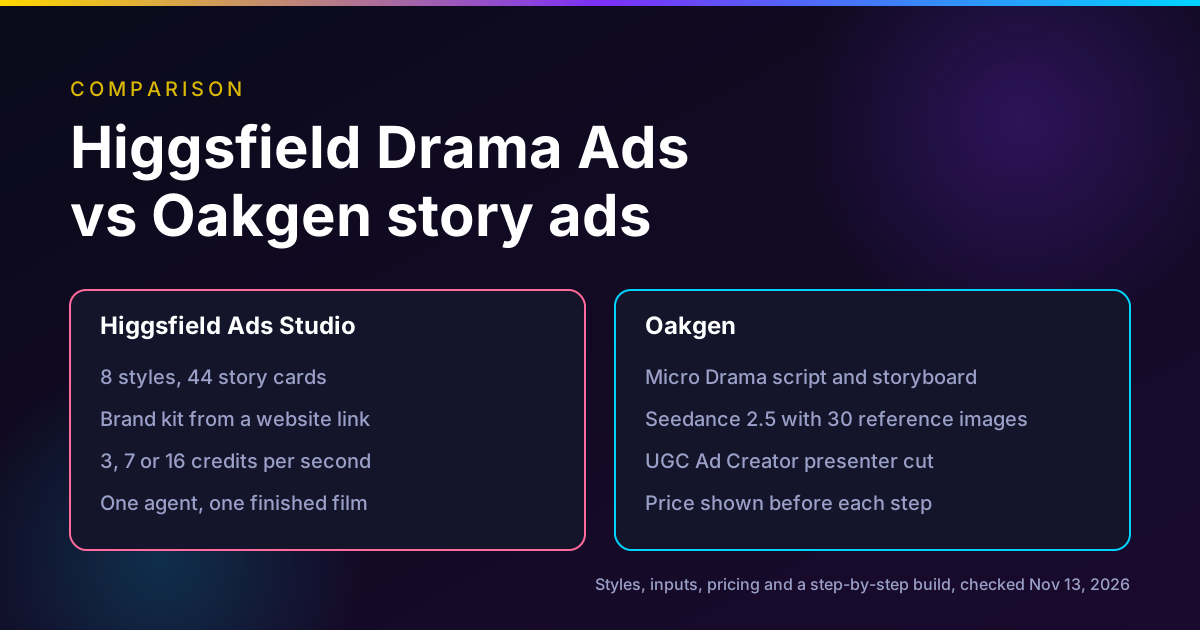
Higgsfield Drama Ads (called Micro Drama Ads in Higgsfield's own blog) turn a product into a short story video: a hero, a problem, often a rival, and your product at the turning point. You chat with an agent in Ads Studio, choose one of eight styles or one of 44 story cards, add a product and an avatar, and it makes the film for 3 to 16 credits per second, according to Higgsfield's November 6, 2026 launch post. Oakgen has no equivalent one-click feature. In Oakgen you build the same kind of ad from Micro Drama (script, cast, storyboard), Seedance 2.5 Reference (your real product photo in the scene) and the UGC Ad Creator (a talking presenter cut).
Short version: if you want a finished story ad with the least setup, Higgsfield is the faster path and is cheaper per second at listed rates. Oakgen fits when you want to control each shot, keep a cast across many ads, and choose the video model yourself.
Disclosure: Oakgen is our product. We include it because it is relevant to this workflow, but the comparison also covers where Higgsfield is stronger. All Higgsfield facts come from Higgsfield's own pages, read on November 13, 2026. We did not run the same brief through both tools, so this post makes no claim about which output looks better.
Higgsfield Drama Ads vs Oakgen at a glance
| Higgsfield Ads Studio (Micro Drama Ads) | Oakgen (Micro Drama + Seedance 2.5 + UGC Ad Creator) | |
|---|---|---|
| What you get | A finished story ad from one chat | The parts of a story ad, which you assemble |
| Starting point | A story card, an idea or a pasted script | A ready-made story, your own script, or one line (Micro Drama) |
| Styles | 8 video styles, 44 story cards (Nov 6 count) | Any look you prompt. No style catalog for ads |
| Product input | Product from a brand kit, filled from a website link | Product photo as a reference image (Seedance 2.5 Reference, UGC Ad Creator) |
| Cast | One avatar reused across your ads | Characters library with up to 16 reference images and a voice |
| Review before video | Ask before generating, optional | Storyboard frames before filming (Micro Drama) |
| Shape | 9:16 cards on the web. 16:9, 1:1, 4:3, 3:4, 21:9 via MCP | Micro Drama 9:16. Seedance 2.5 from 21:9 to 9:16. UGC Ad Creator 9:16, 4:5, 1:1 |
| Length | No set limit, per Higgsfield | Seedance 2.5 clips 4 to 30 s. Micro Drama episodes up to 90 s |
| Captions | Not by default in Claude and ChatGPT, on request | Burned in on Micro Drama episodes |
| Video price | 3, 7 or 16 credits per second (480p, 720p, 1080p) | Seedance 2.5: 373 credits for 5 s at 480p, 800 for 5 s at 720p (quotes of Nov 13) |
| Plan price | Plus $35, Ultra $65 a month billed yearly during a sale ending Nov 15 | Basic $9 a month (1,500 credits), Pro $19 (4,000) |
Sources for each row are in the sections below. Prices are as of November 13, 2026 and both companies change them often.
Plan a story ad shot by shot
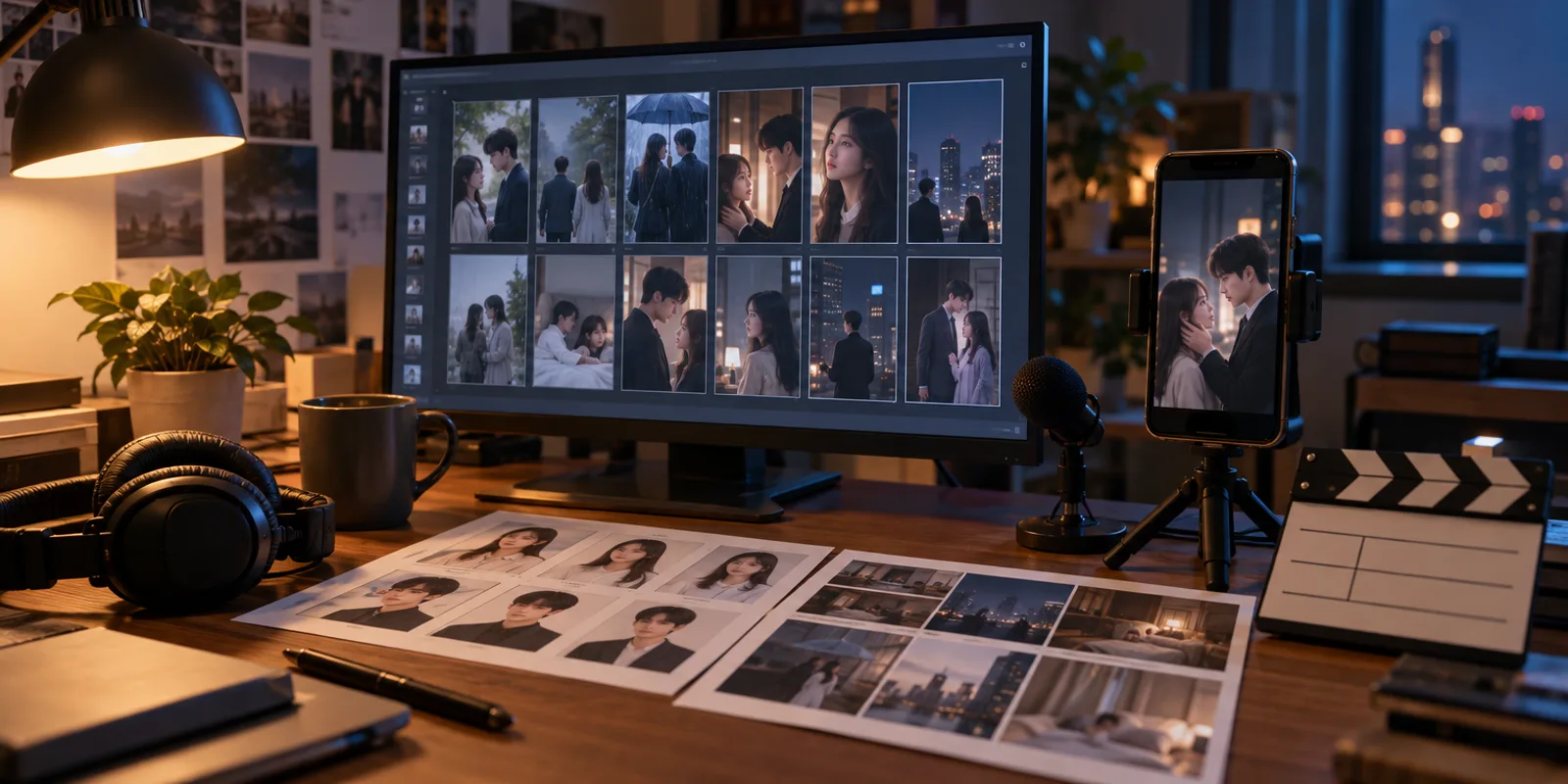
Start from one line or your own script, lock the cast, and check the storyboard before any clip is filmed.
What Higgsfield Micro Drama Ads actually do
Higgsfield's November 6 post describes the format plainly: "There's a main character, something goes wrong, and the product helps turn things around." The main live-action style is described as "a live-action mini drama shot like a film," and the post notes that a rival often makes the trouble worse before the product enters.
The feature sits inside Ads Studio. Higgsfield's changelog shows Ads Studio launching on September 30, 2026 for static ads, "up to 20 ads per product per batch," and adding video ads with an agent on November 9. The same day, Higgsfield's X account announced "Higgsfield Drama Ads" with four lines: turn any product into a drama, organic product placement, editing, captions and sound included, and ready to post in one click.
So "Drama Ads" and "Micro Drama Ads" are the same feature under two names. The landing page at higgsfield.ai/drama-ads-intro uses the shorter name and lists the formats as "short drama, singing ads, talking objects, 3D cartoon, crochet and felt, and cinematic ads."
The eight styles and 44 story cards
Higgsfield's post counts styles and cards as of November 6, 2026:
| Style | Look | How the story is told | Story cards |
|---|---|---|---|
| Micro drama | Live action, shot like a film | Characters act it out | 18 |
| Cartoon story | 3D cartoon | Hero voiceover | 7 |
| Cinematic story | Cinematic scenes | Hero voiceover | 3 |
| Claymation story | Stop-motion clay | Hero tells it | 4 |
| Talking object | Your product as a character | The product talks | 3 |
| Inside the body | Cells and organs | Inside the body | 3 |
| Doll story | A doll world | Hero tells it | 3 |
| Crochet story | A knitted world | Hero tells it | 3 |
A story card is a template with a finished example ad. Recreate makes a similar ad with your product. Higgsfield's examples include "Public failure," where a rival sabotages the hero and the product beats the sabotage, and "Frizzilla," where a vain talking product fixes a flaw until the flaw lands on the rival.
This catalog is where Higgsfield is clearly stronger. Writing a good 30-second conflict with a product turn is the hard part of a story ad, and 44 tested story shapes save that work. Oakgen has nothing comparable for ads today.
Inputs
Per the landing page FAQ, you need "a product image, a reference or a link to your website." A brand kit can be filled from a website link, which sets colors, selling points and products, or set up by hand, per the changelog. You then pick a style, a product and an avatar ("ready-made, from AI Influencer or new"), and the post says the avatar "stays the same person across all your ads."
You can also batch: the landing page says you can add several products, choose how many ads each, and Ads Studio makes them in one batch.
Two ways to run it
On the web, the Ads Studio agent makes the film. By default it starts generations without asking. You can switch to "Ask before generating."
In Claude or ChatGPT, the /microdrama-ads command in the Higgsfield MCP connector opens the same catalog. Higgsfield says your assistant writes the script, makes references and clips, and joins them into one film. That route adds options the web composer lacks: 16:9, 1:1, 4:3, 3:4 or 21:9 instead of 9:16, and a choice of 480p, 720p or 1080p. Captions are not added by default there; you ask for them.
What it costs
Higgsfield lists video at 3 credits per second at 480p, 7 at 720p and 16 at 1080p, with "character and location images, voiceover and music" adding "a small amount on top." Using its own basis of $49 for 1,000 credits, that is $8.82 a minute at 480p, $20.58 at 720p and $47.04 at 1080p. On the web, each agent request also uses credits "unless the model is Auto (free)." In Claude and ChatGPT, only the generations use Higgsfield credits.
The pricing page on November 13 showed an 11.11 sale ending November 15: Starter $19, Plus $35 (struck from $59) and Ultra $65 (struck from $129) a month billed yearly, with 270, 1,200 and 3,000 credits a month. Those are sale prices for annual billing; check the page before you buy.
How you would make a story-style ad in Oakgen
Oakgen does not have a Drama Ads button. What it has, as of November 13, 2026, are three tools that cover the parts of a story ad. Here is how they fit.
1. Write and storyboard the story in Micro Drama
Micro Drama is built for vertical series, not ads, but a 30 to 45 second episode is the same shape as a story ad. You can start from a ready-made story, paste your own script (up to 12,000 characters), or write one line. The app writes the script, and you get:
- Up to 4 characters, each with a reference sheet, outfit images and a voice you choose.
- An establishing image for each place.
- A storyboard of frames before any clip is filmed, with a redraw per frame.
- Episode presets of 30, 45, 60 or 90 seconds, 9:16, with captions burned into the downloaded MP4.
- Dialogue in English, Spanish, Hindi, Portuguese or French.
- A price shown before each paid step, and "Redo shot N" for one bad shot.
The limit for ads: Micro Drama has no product photo or brand kit input. You can name the product in the script and describe it, but the model draws its own version of it. For a real bottle, box or label, move to step 2.
We compared Micro Drama with another drama tool in OpenArt Director vs Oakgen Micro Drama, so we will not repeat that here.
2. Put the real product in the key shots with Seedance 2.5 Reference
The product turn is the shot that matters. In the AI Video Generator, Seedance 2.5 Reference accepts up to 30 reference images, 10 reference videos and 10 audio clips in one request, per Oakgen's model schema read on November 13. Clips run 4 to 30 seconds at 480p, 720p or 1080p, in 21:9, 16:9, 4:3, 1:1, 3:4 or 9:16, with native audio on by default.
A practical setup for the hero shot:
- Product photo on a plain background as Image 1.
- Your lead's front and full-body references as Images 2 and 3 (from the Characters library, which keeps up to 16 reference images and a voice per character).
- The storyboard frame from Micro Drama as Image 4, so the scene matches the rest of the story.
- A prompt in three beats: problem, product enters, result. Name each image's role in words.
Oakgen quoted 800 credits for a 5-second 720p Seedance 2.5 clip and 4,797 credits for 30 seconds at 720p on November 13. Our Seedance 2.5 guide covers the reference modes and prompt shape in detail.
3. Add a talking presenter cut with the UGC Ad Creator
Many story ads end with a person to camera. The UGC Ad Creator composites an avatar with your product image, lip-syncs a script of up to 60 seconds of audio, and can make B-roll from a prompt and a product image. It outputs 9:16, 4:5 or 1:1. That gives you a direct-response tag to cut onto the end of the story.
4. Or ask Agent Chat to plan it
If you would rather describe the ad than drive three tools, Agent Chat has a starter flow called "Create UGC Style Content." Its prompt asks for the product, offer, audience and creator style, then makes the video in the chat. It does not have Higgsfield's story catalog, so bring the story beats yourself.
Put your real product in the scene
Seedance 2.5 Reference takes up to 30 images, so the product, the cast and the storyboard frame go into one clip.
Where Higgsfield is stronger
Be clear about this before choosing:
- Story writing is done for you. 44 story cards across 8 styles is a real head start. Oakgen has no ad story catalog.
- One workflow, one film. The agent writes, casts, generates and joins the film. In Oakgen you move between up to three tools and edit the final cut yourself if you mix them.
- Brand kit from a URL. Higgsfield fills colors, selling points and products from your site. Oakgen has no brand kit.
- Stylized looks out of the box. Claymation, crochet, doll and inside-the-body styles are presets. In Oakgen you would have to prompt and test those looks yourself.
- Lower listed video cost. At 7 credits a second at 720p, 30 seconds of Higgsfield video is 210 credits, about $10.29 on Higgsfield's own credit basis before images, voice and music. One 30-second 720p Seedance 2.5 clip on Oakgen was quoted at 4,797 credits, about $29 at Basic plan value (1,500 credits for $9) or about $23 at Pro value (4,000 for $19). That is our arithmetic on list prices, not a test. The two tools use different models and do different amounts of work per credit.
- Batching. Several products and several ads per product in one run.
Where Oakgen fits better
- Control before you pay for video. Micro Drama shows storyboard frames before filming and prices each step. Higgsfield's web agent generates without asking by default, though you can turn on approval.
- Exact product appearance. Up to 30 reference images in one Seedance 2.5 clip lets you show the real packaging, not a drawn version.
- A cast you reuse beyond ads. A saved character opens in Create as an @Name mention for a photo, a video or a talking clip, with its references and voice attached.
- Model choice. In the AI Video Generator you pick the video model for each shot yourself, so one shot can use Seedance 2.5 and another a cheaper model.
- Lower entry plan. Oakgen's Basic plan is $9 a month, per Oakgen's pricing page on November 13. Higgsfield's lowest paid plan was $19 a month billed yearly.
How we checked
- Higgsfield: we read the Micro Drama Ads launch post (dated November 6, 2026), the Drama Ads landing page, the November 9 X post, the changelog and the pricing page on November 13, 2026. Every Higgsfield number above is Higgsfield's own claim. We did not generate an ad on Higgsfield.
- Oakgen: we read Oakgen's code for Micro Drama, Characters and the UGC Ad Creator, its model schema for Seedance 2.5 Reference, and its live pricing page on November 13, 2026. Credit costs are price quotes from Oakgen's own pricing system that day, not generated clips.
- Not tested: output quality, speed, retake rates and how often a story card produces a usable ad. Dollar figures are our arithmetic on published prices.
If you are comparing Higgsfield's other ad tools, see Higgsfield Marketing Studio vs Runway Ads.
Which should you use?
Use Higgsfield Ads Studio if:
- You sell a consumer product and want a finished story ad today with minimal setup.
- You want a stylized look (clay, crochet, talking product) without prompt work.
- You are testing many products and want batches.
Use Oakgen if:
- The product's exact look matters and you want it in the key shot from a real photo.
- You want to review a storyboard and price before each paid step.
- You plan to reuse the same characters across ads, series and social posts.
- You already write your own ad scripts and want shot-level control.
The mistake is choosing the tool before choosing the job. If the job is "ten quick story ad tests this week," a catalog and an agent win. If the job is "one story ad where the product, cast and pacing must be right," control wins.
Common mistakes with story-style ads
- Letting the story bury the product. The product should solve the problem on screen, not appear in the last second. Plan the turn shot first.
- Using text to describe packaging. A model will invent a label. Use a product photo as a reference for any shot where the product is readable.
- Changing the actor between ads. Higgsfield reuses one avatar; in Oakgen, save the lead in Characters before you start.
- Skipping captions. Most feed viewing is muted. Higgsfield's MCP route adds captions only on request; Micro Drama burns them in.
- Comparing per-second prices only. Retakes, images, voice and music add up. Count the cost of an ad you would actually post.
FAQ
What are Higgsfield Drama Ads?
Drama Ads is the name Higgsfield used on X on November 9, 2026 for the Micro Drama Ads feature inside its Ads Studio, which its blog introduced on November 6. It turns a product into a short story video with a main character, a problem and the product at the turning point. You chat with an agent, pick a style, a product and an avatar, and it generates the film.
How much do Higgsfield Micro Drama Ads cost?
Higgsfield's November 6 post lists 3 credits per second of film at 480p, 7 at 720p and 16 at 1080p, with character and location images, voiceover and music adding a small amount on top. On its own basis of $49 for 1,000 credits, that is about $8.82 a minute at 480p and $47.04 a minute at 1080p. On the web, agent requests also use credits unless the model is set to Auto.
How many styles and story cards does Higgsfield Ads Studio have?
Eight video styles and 44 ready-made story cards, as checked by Higgsfield on November 6, 2026. Micro drama has 18 cards, Cartoon story 7, Claymation story 4, and Cinematic story, Talking object, Inside the body, Doll story and Crochet story have 3 each. Story cards are vertical 9:16.
Does Oakgen have a Drama Ads feature?
No. As of November 13, 2026, Oakgen has no story-card catalog, brand kit or product-placement agent like Higgsfield's. You can build a story-style ad from three Oakgen tools: Micro Drama for the script, cast and storyboard, Seedance 2.5 Reference in the AI Video Generator to put a real product photo into the scene, and the UGC Ad Creator for a talking presenter cut.
Can I put my real product into an Oakgen Micro Drama?
Not as an image. Micro Drama takes a story, a script or one line of text, and it has no product photo or brand kit input as of November 13, 2026. You can write the product into the script, but for the exact packaging use Seedance 2.5 Reference, which accepts up to 30 reference images in one clip, or composite the product with an avatar in the UGC Ad Creator.
Which is cheaper for a 30-second story ad?
At listed rates, Higgsfield. Its video rate is 210 credits for 30 seconds at 720p, about $10.29 on its $49 per 1,000 credits basis, plus images, voice and music. One 30-second 720p Seedance 2.5 clip on Oakgen was quoted at 4,797 credits on November 13, which is about $29 on the Basic plan's 1,500 credits for $9. The tools do different amounts of the work, so compare total cost after retakes.
Can I run Higgsfield Micro Drama Ads from Claude or ChatGPT?
Yes. Higgsfield says the /microdrama-ads command in its MCP connector opens the same story catalog in Claude and ChatGPT, and that only the generations use Higgsfield credits there, while the chat runs on your assistant. In that route you can ask for 16:9, 1:1, 4:3, 3:4 or 21:9 instead of 9:16, and pick 480p, 720p or 1080p.
Build a story ad your way
Script and storyboard in Micro Drama, product shots with Seedance 2.5, and a presenter tag from the UGC Ad Creator.
Sources
- Higgsfield, Introducing Micro Drama Ads in Higgsfield Ads Studio, 2026-11-06 (read 2026-11-13)
- Higgsfield on X, Introducing Higgsfield Drama Ads, 2026-11-09 (read 2026-11-13)
- Higgsfield, Drama Ads landing page and FAQ, undated (read 2026-11-13)
- Higgsfield, What's new changelog, entries of 2026-09-30 and 2026-11-09 (read 2026-11-13)
- Higgsfield, Pricing page, 11.11 sale ending Nov 15 (read 2026-11-13)
- Oakgen, Pricing page (read 2026-11-13)
- Oakgen, AI Micro Drama Generator page (read 2026-11-13)