ChatGPT
 Claude
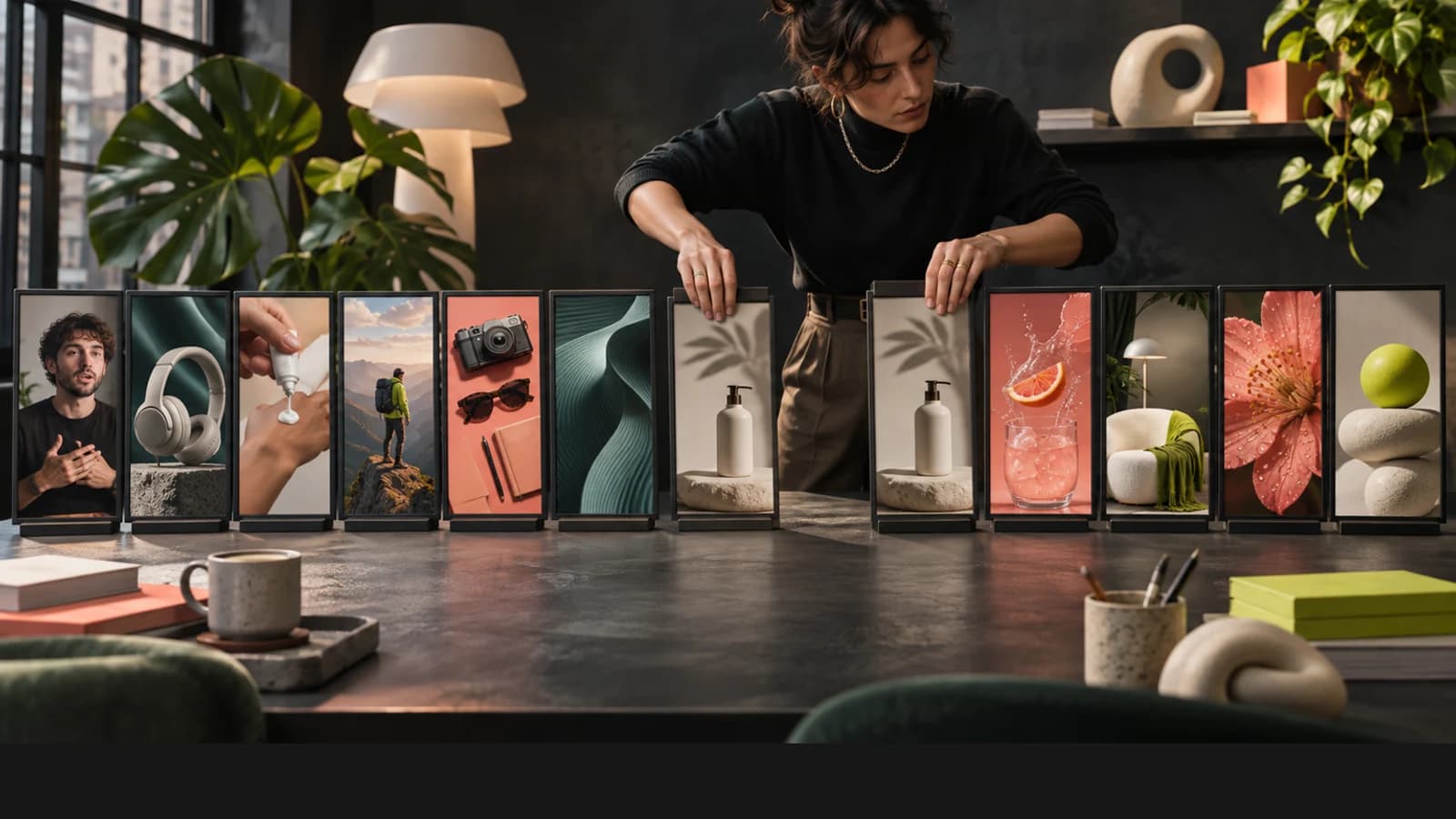
The Meta creative diversity score is a High, Medium or Low label that Ads Manager gives each ad set. According to Meta's Help Center, it is "calculated by comparing the images and video thumbnails in your ad set to each other to determine similarity." A Low rating means your ads look alike. It does not mean you have too few of them. You fix it with new concepts that look different, and new headlines on the same picture will not move it.
This guide explains what the column reads, why a busy ad set can still score Low, and how to rebuild one with a six-lever concept grid. The levers are format, hook, angle, person, setting and offer. There is a worked example of a Low ad set rebuilt asset by asset. Oakgen makes AI creative tools, including the AI UGC ad generator we recommend below, so we have a stake in this topic.
Plan new ad concepts, not more variants
Start from product facts, pick an angle, then draft a script and the talking-presenter or B-roll assets for it.
What is the Meta creative diversity score?
It is a reporting column, not a delivery setting. To add it, open Ads Manager and choose Columns, then Customize columns, then search for Creative diversity. Search Engine Land gave that path on August 26, 2026, in a piece saying Meta had rolled the metric out "earlier this month." Several agencies, including Common Thread Collective, date the launch to August 26. Meta made no launch announcement that we could find, and advertisers reported the column reaching accounts in waves.
Meta's own definition is short. The column is a "diversity label for ad creative diversity score given an adset or account ID." It is used "to determine if more varied images and videos need to be added to an ad set to help prevent creative fatigue and improve performance." Meta converts the similarity into a score and applies thresholds to get High, Medium or Low. Meta also marks the metric as estimated and in development, and it has not published the thresholds.
Here is how common edits should affect the rating, judged against that definition. The right-hand columns are our reading of Meta's wording, not Meta's published rules.
| What you change | Does the image or thumbnail change? | Likely effect on the rating | Counts as a new concept? |
|---|---|---|---|
| Headline, primary text or CTA button | No | None | No, it is an iteration |
| Same photo, new background color | Slightly | Little or none | No |
| Same video, new crop for 9:16 and 4:5 | Barely | None | No, it is a placement fit |
| Same script, new opening frame | Yes | Some | Partly, if the hook changes too |
| New person on screen in a new setting | Yes | Strong | Yes |
| Static product shot replaced by a creator video | Yes | Strong | Yes, if the angle changes as well |
| Carousel of use cases next to a single packshot | Yes | Strong | Yes |
Anything that leaves the picture the same should leave the rating the same.
Who this guide is for
This is for the person who has to answer "why does Ads Manager say Low?" on a client call. That is usually an agency paid social manager, an ecommerce founder on Advantage+ who uploads new ads weekly, or a creative strategist briefing designers and UGC creators. If you have one ad set with two ads, the score will tell you little. Fix your offer and tracking first.
How we checked
We read every source in the list at the end of this post on November 4, 2026. Most are Meta's own pages, including the Creative diversity Help Center entry, the December 16, 2025 diversification post and the October 28, 2026 Andromeda engineering post. The rest are the Search Engine Land article that first described the column and two agency write-ups.
We did not run our own ad tests for this post, and we have no access to Meta's thresholds. Where we say what should move the score, that is an inference from Meta's definition, and we label it. The worked example later in the post is illustrative. It is not a client result.
Why is my creative diversity low on Meta?
There are four usual causes. All of them come from the same fact, which is that the column reads pictures.
- Your ads share a hero image. Five ads built on the same product photo with different headlines are one image to this comparison.
- Your videos open on the same frame. Meta compares video thumbnails. Three videos with different hooks that all start on the same packshot or the same creator in the same room look alike before anyone presses play.
- Your "different formats" are the same picture. A carousel whose first card is the same packshot as your static ad adds format variety on paper and little visual variety.
- The metric is strict, or still settling. In the Search Engine Land piece, Akvile DeFazio wrote that several client accounts she considered highly diverse were rated Low. Those accounts used statics, video, varied hooks and people, UGC, partnership ads and carousels. She suggested the metric's early stage, strict thresholds or undisclosed signals as possible reasons.
So tell clients that Low is a reason to look at the ad set, not proof the creative is bad. Meta has not said the label itself changes delivery.
What Meta has said is more useful. In its December 2025 guidance, Meta wrote that its system "groups together ads that share key visual and thematic attributes. When multiple ads look or feel alike, these are seen as variations of the same creative, meaning learnings and delivery optimizations are shared at the creative level." That is the real reason to care. Ten look-alike ads give the system one idea to work with.
How Andromeda creative diversification works
Andromeda is the retrieval stage of Meta's ad system. Before ranking and the auction, retrieval picks a shortlist of candidate ads for each person. Meta's December 2025 post says it "quickly scans tens of millions of ads and selects a few thousand strong candidates so only the most relevant and distinct creatives move forward."
On October 28, 2026, Meta's engineering team described the next generation of the system. The post says retrieval now runs at over one billion ads per second while "scoring every eligible ad across Facebook and Instagram." It also says that since 2025, Andromeda "has delivered a 2.4% increase in conversions on Facebook." It gives the reason for the rebuild as well. Generative AI creative tools "have helped advertisers rapidly create hundreds of millions of new ads."
Read together, the two posts point one way. Meta groups ads that look alike, so near-copies add volume without adding options.
Meta draws the line between two habits in plain words:
- Iteration "might produce two ads with identical visuals, but different text CTAs."
- Diversification "would generate two distinctly different pieces of creative," and Meta's example is "a Reels ad tailored for GenZ and a separate partnership ad featuring a creator who connects with new moms."
Meta's best-practice line is to make ads "truly different in look, feel, storyline, and message." Iteration still finds the best version of a concept. It cannot stand in for new concepts.
Two Meta delivery statuses tell you when look-alike creative is already costing money. Per Meta's creative fatigue page, Creative limited appears when cost per result is above your past ads but less than twice as high. Creative fatigue appears at twice or more. Meta's creative differentiation page links the two problems directly. When creative is too similar, the system "could deliver it to the same sets of audiences," which "limits your reach and ultimately leads to Creative limited or Creative fatigue status." For the refresh side of that problem, see our guide to diagnosing and refreshing ad creative fatigue.
The six-lever concept grid
A concept is a distinct reason to buy, shown in a distinct way. Six levers do most of the work. If you change three or more of them together, you have a new concept. If you change one cosmetic detail, you have a variant. D2C Prominence published a similar six-lever table in October 2026, and the grid below is our version, written for briefing.
| Lever | What it is | Changes the picture? | New concept examples | Only a variant |
|---|---|---|---|---|
| Format | How the ad is built | Yes | Static, creator video, carousel, motion graphic, talking photo | Same video in 9:16 and 4:5 |
| Hook | The first two seconds or headline idea | Only if the first frame changes | Problem callout, result shown first, reaction shot, myth bust | Same hook, new wording |
| Angle | The reason to buy | Usually, through what you show | Gift, value, durability, ingredient, routine | Same angle, new adjective |
| Person | Who is on screen or speaking | Yes | Founder, customer, expert, creator, no person | Same creator, new shirt |
| Setting | Where and when it happens | Yes | Gym bag, office desk, school run, hiking trail | Same room, new lighting |
| Offer | What the deal is | Only if shown visually | Bundle, gift with purchase, free shipping, no offer | 20% off vs 25% off |
Format, person and setting always change the picture, so they move the Meta creative diversity score most directly. Hook, angle and offer only move it when you show them visually, for example with a different opening frame.
A one-line-per-concept brief template
Paste this into your brief and fill one row per concept. If two rows match on four or more levers, merge them into one concept with variants.
| # | Concept name | Format | Hook | Angle | Person | Setting | Offer |
|---|---|---|---|---|---|---|---|
| 1 | |||||||
| 2 | |||||||
| 3 | |||||||
| 4 | |||||||
| 5 | |||||||
| 6 |
The same discipline runs through our agency workflow from client brief to 50 ad variations. The concepts come first and the variants come after.
Worked example of a Low ad set rebuilt to High
This example is illustrative. The brand, the ads and the rating change are invented to show the method. We did not run this ad set, and we cannot promise any rating, because Meta does not publish its thresholds.
The brand. A company selling a stainless steel insulated water bottle. One Advantage+ ad set has eight ads and reads Low.
The ad set before.
| Ad | What it is | Why it looks alike |
|---|---|---|
| 1 to 5 | Bottle on a white background, five different headlines | Same image five times |
| 6 and 7 | Same shot, bottle in sage and in black | Same composition, new color |
| 8 | 20-second video that opens on the same white packshot | Same thumbnail as ads 1 to 5 |
By the grid, this is one concept with seven variants. The format is static, the hook is a product feature, the angle is "keeps drinks cold," there is no person, the setting is a studio and the offer is 15% off.
The ad set after. We keep the best of ads 1 to 5 as concept 1 and pause the rest. Then we add five concepts. Each one changes at least three levers from concept 1.
| # | Concept | Format | Hook | Angle | Person | Setting | Offer |
|---|---|---|---|---|---|---|---|
| 1 | Studio packshot (kept) | Static | Feature callout | Cold for 24 hours | None | Studio | 15% off |
| 2 | Ice still there at 5 pm | Creator video | Result shown first | Durability | Office worker | Desk at end of day | None |
| 3 | School run kit | Carousel, four cards | "What's in my bag" | Family routine | Parent | Car and school gate | Bundle with kids' bottle |
| 4 | Trail test | UGC-style video | Reaction shot | Toughness | Hiker | Mountain trail | Free shipping |
| 5 | Gift for the gym friend | Static, flat lay | Gift idea | Gifting | None, hands only | Gym bag contents | Gift wrap |
| 6 | Founder on the steel | Talking-head video | Myth bust about cheap bottles | Materials and safety | Founder | Workshop | None |
Each thumbnail now shows a different place, a different person or no person, and a different composition. That is what Meta's comparison reads. The headlines from ads 2 to 5 become copy variants inside concept 1.
What to watch after the rebuild. Read the Creative diversity column once the new ads have delivered for a few days, then the Delivery column, then cost per result by ad. If concept 4 wins, iterate on it with new hooks and crops.
Make concept 2, 4 and 6 without a shoot
Draft the script, cast a presenter and build talking-presenter and B-roll assets for each concept in one studio.
How to improve creative diversity in Meta ads, step by step
- Add the column and write down today's rating for every active ad set. Meta calls the metric in development, so today's reading is your baseline.
- List every ad in each Low ad set with its format, first frame, person and setting. Most Low ad sets turn out to be one or two concepts.
- Group the ads into concepts with the grid. Keep the best performer in each group, and treat the rest as variants.
- Fill the template to four to six concepts, each changing three or more levers. Lead with person, setting and format, because those change the picture.
- Give every video its own first frame. The thumbnail is what Meta compares. A new hook spoken over the same opening shot does not count visually.
- Produce the concepts. Use real creators where you have them. Where you do not, AI production covers people and settings you could not shoot this week.
- Launch the new concepts together, then read the column, the Delivery status and cost per result by ad.
- Iterate on winners inside their concept. New headlines, CTAs and crops go here.
For the counting question in step 4, our sibling guide on how many ad creatives to test on Meta goes further into budget per concept and how long to wait for a read.
Where Oakgen fits in step 6
Step 6 is where most teams stall, because each new person and setting used to mean a new shoot.
In Oakgen, the AI UGC ad generator starts with product facts and an angle, builds a variation matrix and an editable script, then opens talking-presenter and B-roll workflows. The studio writes three alternative opening lines for a script and makes presenter ads in 9:16, 4:5 and 1:1. The person lever is the one AI changes most cheaply. You can create a consistent AI presenter once and reuse their face and voice across concepts, then cast a different one for the next concept. For the format lever, Oakgen also makes carousels and motion graphics.
Here is where this breaks. AI presenters are good enough for testing new concepts. They are not a replacement for a real customer's testimonial, and you should not present them as one. For Meta's rules on AI labels and its AI feature terms, read our guide to Meta AI features terms for agencies before you launch.
What does it cost to produce six concepts?
Real creators charge per video and per usage right, so six concepts can mean six briefs and six invoices. AI production costs credits per generation, plus review time. We will not quote a per-concept figure, because it depends on length, model and takes. For numbers on both sides, see the AI UGC rate card, and the live Oakgen pricing page for plan credits. The cheaper move in most accounts is to stop paying for variants. Five headline swaps on one photo add nothing to the score and little to what Meta can learn from the ad set. That budget is better spent on two new concepts.
Our older post on how agencies produce more creative variations with AI covers the production side. The variations it describes still have to be concepts.
Cast a new presenter for every concept
Create an AI influencer once, then bring the same face and voice into any image, video or voiceover by typing their name.
Common mistakes
- Treating the label as a target. Meta says the score is estimated and in development. Optimizing purely for High can push you toward visually loud ads that do not sell. Cost per result still decides what stays.
- Counting ads instead of concepts. Thirty ads can be one concept. Count rows in the grid.
- Swapping copy and expecting a change. Per Meta's definition, text is not part of the comparison.
- Pausing the winner to make room. Keep your best ad as concept 1. Diversity sits next to the winner. It does not replace it.
- Repeating vendor numbers as Meta rules. Similarity percentages and "exactly N concepts" rules come from agencies and tools, not from Meta.
When another tool or approach fits better
Oakgen is not the right answer for every Low ad set. Here is when we would use something else.
- You only have product photos and need motion fast. Meta's own training tells advertisers to use the generative AI tools in Advantage+ creative to turn one concept into more assets, such as a video, a static image or a Reel. Our comparison of Meta Advantage+ video generation vs AI UGC covers where Meta's built-in tools win and where they look generic.
- You need cinematic product video for a hero concept. A dedicated video studio may give you more camera control. See Higgsfield Marketing Studio vs Runway Ads for that comparison.
- The same concepts must also run on TikTok. TikTok has its own creative tools. Our guide to TikTok Symphony alternatives compares the options.
- You have a real customer base willing to film. Real UGC from real customers is still the strongest proof for many products. Use AI for the concepts you cannot film, not for testimonials.
- Your best concept is a still image. Then the question is static versus video, and our guide on choosing static vs video ads by product proof is the better starting point.
Put the thumbnails of every ad in a Low ad set side by side on one screen. If a stranger would say "those are the same ad," Meta's comparison probably says the same thing. Rebuild before you add more.
Start with the grid, then make the concepts
The Meta creative diversity score is a blunt instrument, and Meta says it is still in development. It does point at a real problem, though. Ads that look alike share learnings and delivery, so a busy ad set can be one idea in Meta's eyes. Fill the six-lever grid, lead with person, setting and format, give every video its own first frame, and keep your winner.
If producing new people and settings is the bottleneck, plan your next concepts in the AI UGC ad generator and build the presenter and B-roll assets from there.
Rebuild your Low ad set this week
Turn one product into four to six distinct concepts with scripts, presenters and B-roll you review before launch.
Frequently asked questions
Where do I find the creative diversity score in Meta Ads Manager?
Open Ads Manager, go to the ad set view, then choose Columns, Customize columns and search for Creative diversity. Each ad set shows High, Medium or Low. Meta labels the metric estimated and in development, and advertisers reported it rolling out in waves through August and September 2026, so some accounts may not see it yet.
Why is my creative diversity low on Meta when I run lots of ads?
Meta's Help Center says the score compares the images and video thumbnails in an ad set for similarity. Ad count does not enter into it. Ten ads built on the same product shot, or ten videos that open on the same frame, look alike to that comparison and pull the rating down.
Does changing the headline or primary text improve creative diversity?
Meta's definition mentions only images and video thumbnails, so new copy on the same visual should not move the rating. Copy changes are still worth testing inside a concept. They just do not count as a new concept.
Does a Low creative diversity score hurt ad delivery?
Meta has not said the label itself changes delivery. What Meta has said, in its December 2025 guidance, is that ads which look or feel alike are treated as variations of the same creative and share learnings and delivery. Treat Low as a warning that your ads may be competing for the same people, not as a penalty.
What is Andromeda creative diversification?
Andromeda is Meta's ad retrieval system, which picks a shortlist of candidate ads for each person before ranking. Meta's advice is to feed it distinct concepts made for different personas or use cases, rather than many iterations of one ad, so retrieval has different ads to match to different people.
How many different concepts should an ad set have for a High rating?
Meta does not publish a number or the thresholds behind High, Medium and Low. A practical starting point is four to six concepts per ad set that each change at least three of these levers, format, hook, angle, person, setting and offer. Then read the column again after the new ads have been live for a few days.
Can AI-generated ads raise creative diversity?
They can if each one is a different concept. AI tools make it cheap to produce new people, settings and formats, which are the levers that change what an image or thumbnail looks like. They lower the score again if you use them to produce near-copies of one winning ad.
Sources
- Meta Business Help Center, Creative diversity (read 2026-11-04)
- Meta for Business, Demystifying Creative Diversification, December 16, 2025 (read 2026-11-04)
- Meta Business Help Center, About creative fatigue recommendations in Meta Ads Manager (read 2026-11-04)
- Meta for Business, Creative differentiation guidance (read 2026-11-04)
- Meta for Business, Creating Diverse Meta Advertising Campaigns lesson (read 2026-11-04)
- Engineering at Meta, Meta Andromeda: Powering the Next Generation of Ads Retrieval Through Model-System Co-Design, October 28, 2026 (read 2026-11-04)
- Search Engine Land, Meta Ads: Why creative variation matters more than volume, August 26, 2026 (read 2026-11-04)
- Common Thread Collective, Meta's New Creative Diversity Score Is Live in Ads Manager, September 9, 2026 (read 2026-11-04)
- D2C Prominence, Meta's Andromeda update and Q4 creative, October 8, 2026 (read 2026-11-04)