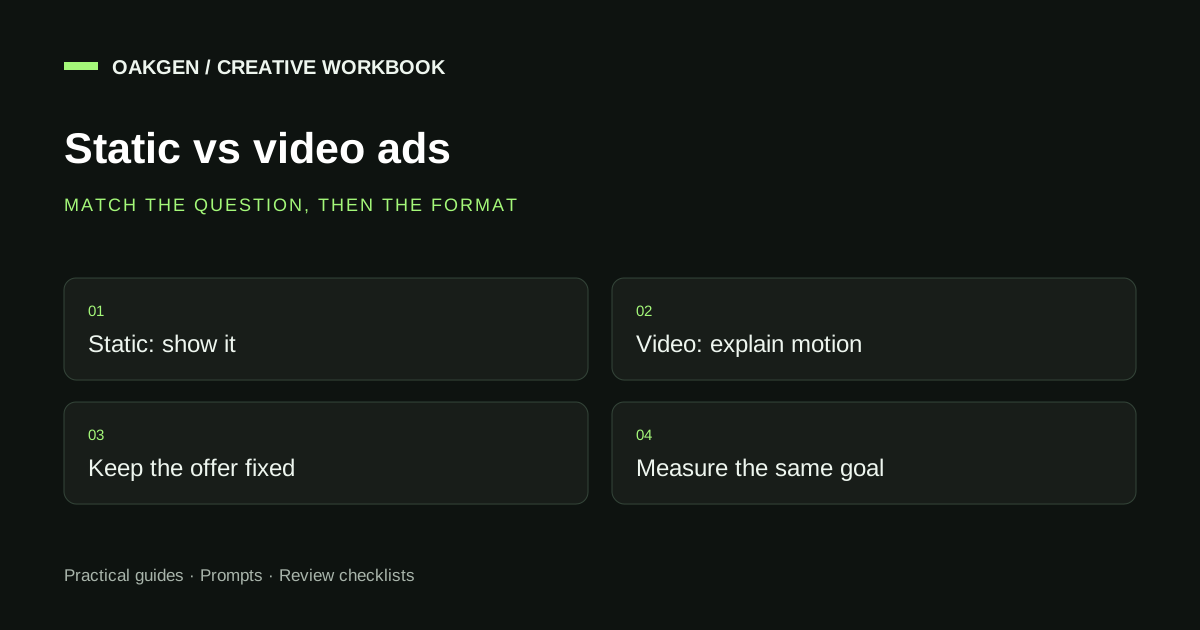
Static vs video ads is a decision about what a shopper needs to understand. Use an image when one composition can show the product and the relevant proof. Use video when movement or a sequence adds information, such as how a clasp opens or how several parts fit together. Neither format guarantees lower costs or more purchases.
If the choice is uncertain, make a paired brief with the same product promise and evidence, then compare the resulting assets in an appropriate test. Oakgen can help plan the brief and create individual image or video assets in separate workflows. Your team still assembles, approves, publishes, and measures the ads.
Plan a paired image and video brief in Oakgen before deciding that every campaign needs both.
Choose by the information job
| What the viewer needs to understand | Start with | Why | Watch for |
|---|---|---|---|
| Exact bundle contents | Static image | Viewer can inspect the full set at once | Missing or ambiguous items |
| An opening mechanism | Video or real demonstration | Sequence explains the action | Generated motion invents behavior |
| A simple approved offer | Static image | Wording can remain visible | Small qualifiers and expired terms |
| Material or finish | High-quality still or close-up | Detail can carry the proof | Lighting changes perceived material |
| Several steps in use | Video | Order matters | Too much setup before product clarity |
| Relative size | Measured still or verified footage | Needs accurate scale evidence | Unsupported generated comparisons |
| A complex choice between variants | Structured image series or longer explanation | One fast clip may not allow inspection | Overloading a single ad |
These recommendations describe production fit, not performance rankings. A format that explains the product well still needs the right message, destination, and delivery context.
Build the shared product brief with the same facts for both formats. That planning utility organizes your inputs; it doesn't generate an image or a video.
Who should use this comparison
This guide is for ecommerce teams deciding where to spend their next production effort, particularly when a designer wants a cleaner image and a media buyer wants another video. It is not a platform buying guide or a forecast of return on ad spend.
Research reviewed September 13, 2026. The comparison framework and numerical example are editorial tools, not Oakgen campaign results. We do not repeat broad claims that video always wins prospecting or that static always wins retargeting. Those claims ignore the product, message, placement, audience, and experiment.
Disclosure: Oakgen is our product. We discuss its role in creating separate assets, not as evidence that either ad format performs better. A real product shoot or an existing approved photograph may provide stronger evidence than a newly generated asset for a particular job.
Ask what disappears when the video stops
Pause the planned clip on its most informative frame. If that frame communicates everything useful, you may have an image concept wearing a video wrapper. Motion can still affect presentation, but don't confuse a slow zoom with additional product proof.
Consider a fictional travel kit containing a pouch and two empty bottles. An all-contents image can explain the offer immediately. A video that moves the camera around the same arrangement adds visual movement but may not resolve another buying question.
Now consider a verified demonstration of how the pouch opens and how the real bottles sit inside. The order of actions conveys information a single photograph cannot fully show. Video has a clearer reason to exist, provided you can represent the behavior accurately.
The same distinction applies to furniture assembly, a folding object, or a device interface. If the feature depends on a sequence, capture or source the sequence. A model's plausible reconstruction is not proof of real product performance.
Static imagery has its own demands. An image must communicate without a later frame coming to its rescue. Weak hierarchy, a hidden accessory, or unreadable wording can leave the viewer with the wrong idea. A still is not automatically the easier creative task just because the file doesn't move.
Separate a format test from a campaign-package test
There are two legitimate comparisons, but they answer different questions.
A format-focused comparison holds the central promise and evidence as stable as practical. For example, both assets explain the same kit contents; one uses an all-items image and the other a brief reveal. You still need to account for differences in duration and presentation.
A campaign-package comparison gives each format its strongest suitable treatment and delivery context. The video might use a real demonstration while the image uses a clear offer. This can help choose a practical campaign package, but any difference cannot be attributed solely to format.
Write which comparison you are running before production. Otherwise, a video with a stronger offer can “beat” an image and turn into an unsupported declaration that video is better. The result may simply reflect the offer.
Placement availability complicates matters further. If one format reaches different inventory, your comparison includes delivery conditions. Ask the media owner to record the actual setup and explain what the test can isolate. Do not force unlike placements into a supposedly pure format comparison.
A same-brief worksheet for an ecommerce product
Use this fictional travel-kit example as a planning pattern. Replace its facts with the merchant's current source material.
| Shared field | Both versions must use |
|---|---|
| Product | One pouch and two empty refillable bottles |
| Communication question | What exactly comes in the kit? |
| Evidence | Approved photograph of the assembled set |
| Main wording | Merchant-approved contents statement |
| Offer | Same current offer, or no offer in either asset |
| Destination | Same reviewed product selection |
| Unsupported claims | No airline approval, leak claim, or environmental savings |
The static treatment shows the complete group with enough separation to count the items. Add approved explanatory text outside generation. The video treatment begins on the same group, then uses a controlled view that makes each item identifiable before returning to a clear complete-set hold.
Keep the product scale and quantity identical. Use the bundle photography manifest to check that a new format didn't quietly advertise a different kit.
If you want a second video that demonstrates packing, label it a separate concept. That video tests more than the presentation of the contents statement. It may be a useful candidate, but it shouldn't inherit the same hypothesis simply because it shows the same product.
Prepare the static treatment with Oakgen's photo prompt builder. Add your source in the destination workflow and approve the result before deriving other assets from it.
Proposed production directions for the pair
These are original brief examples, not generated outputs or proven ad templates.
Static direction
Use the approved assembled-kit photograph as the authority. Keep exactly one pouch and two empty bottles with their real proportions, materials, and closures. Compose the set so every item is easy to count. Leave space for a separately added contents statement. No extra props, generated typography, liquid, or packaging. Prioritize product clarity over decorative styling.
Video direction
Start from the approved complete-kit view in a workflow that supports an appropriate image input. Use modest movement that keeps the item count and product identities stable. Each object remains visible; no objects enter, disappear, or change size. Finish with a stable full-set view for the reviewed contents statement added during editing. Do not demonstrate unverified product behavior.
For a script-driven treatment, draft the timed explanation in Oakgen. Review the draft before separately creating voice, presenter, or B-roll assets. A script is not an assembled ad.
Choose the opening shot deliberately. The first-frame hook guide helps you make the product and question visible before introducing motion. A branded intro that hides the item consumes attention without helping this particular contents brief.
Count production effort honestly
Generation cost is only one part of making a usable ad. Include source preparation, rejected attempts, review, editing, exports, and any paid production work. A cheap candidate that requires extensive correction can cost more to use than an existing approved photograph.
Use a planning equation:
Cost per accepted asset = total production expenditure divided by the number of assets approved for the intended use.
If you want an internal estimate that includes staff time, choose your own hourly cost basis and record it. Do not mix cash spending in one format with fully loaded staff cost in the other.
For an explicitly hypothetical example, suppose a static batch costs 60 currency units and produces four accepted assets. Its recorded average is 15 per accepted asset. Suppose a video batch costs 150 units and produces five accepted clips; its average is 30. These figures are made-up arithmetic, not Oakgen prices or expected production costs.
The calculation does not tell you which batch creates more business value. It tells you the production difference you need the test to justify. A more expensive video might still be the appropriate choice when it proves a feature the image cannot explain.
Record reuse too. An approved product still might serve a landing page and several ad layouts. A clean demonstration clip might support multiple edits. Don't credit all future reuse as guaranteed savings; note the actual reuse when it happens.
Compare results at the level of the decision
Define the outcome before launch. If your goal is qualified product consideration, a click can be an intermediate signal, but it may not answer a sales question. If your goal is purchases, inspect the later outcome and the conversion context rather than selecting the file with more video views.
Do not compare video-only metrics with a static ad as though they were shared outcomes. Watch time is useful for understanding a clip; a still image does not have an equivalent viewing sequence. Use common business measures for the comparison and format-specific measures for diagnosis.
Where a suitable controlled experiment is available, ask the media specialist to use it and explain the limitations. Google's experiment guidance recommends focusing on a variable and deciding a metric in advance. The principle helps structure the question; the correct implementation depends on the actual platform and campaign. Google experiment guide.
Avoid changing copy and offer halfway through, then reporting the entire period as one clean test. When a necessary commercial correction occurs, record it and reconsider the comparison. An inaccurate control does not deserve to stay live for methodological convenience.
Read four possible outcomes
If video produces stronger business results in the tested context and its added production cost is acceptable, use that treatment there. Keep the scope in the conclusion: that product, promise, audience, and period. You haven't established a universal format ranking.
If the image performs adequately and costs less to maintain, it may be the better operational choice. You can reserve video effort for products whose behavior needs demonstration rather than animating every catalog item.
If the formats look similar within the available evidence, choose based on practical needs and keep the uncertainty visible. “No clear difference observed” is more honest than picking a winner from a tiny numerical gap.
If both fail, revisit the promise, evidence, offer, destination, and delivery setup. Switching format again may not address the problem. Use the creative fatigue and decline worksheet when the issue appears after previously acceptable performance.
Common comparison mistakes
Using a weak image as the control against an elaborate new video makes the test a comparison of effort as much as format. Give both versions a clear communication job and a credible execution.
Another mistake is burying the useful video information behind an introduction. TikTok's current guidance recommends introducing the proposition early and designing around its vertical interface. Apply those recommendations as a starting point, then inspect the actual placement. They are not proof that video beats images. TikTok creative guidance.
Don't mistake visual polish for product accuracy. A soft fabric may become stiff in a generated still; a clasp may operate incorrectly in a generated clip. Review the type of error each format introduces rather than judging both only by how attractive they look.
Finally, count the revisions your team actually makes. A changing offer may be simple to update in an image but require a new voiceover in a video. That maintenance burden belongs in the decision if your promotions change frequently.
Frequently asked questions
Are static or video ads better for ecommerce?
Neither is universally better. Start with the information the product needs to communicate, then evaluate a relevant treatment in your own context. A still can explain a complete offer; a sequence can explain behavior that one frame cannot.
Are static ads cheaper to produce?
They can require less assembly, but use your actual production record. Include rejected attempts, review, editing, and accepted outputs. A complex image may cost more than reusing an already approved demonstration clip.
Should I turn every product image into a video?
No. Define what motion adds before generating it. If movement doesn't reveal a useful detail or sequence, a strong still may already answer the shopper's question. Test visual presentation deliberately rather than treating animation as automatic improvement.
Can I run a fair comparison with different placements?
You can compare the practical packages, but the result includes placement and delivery differences. Do not describe that as an isolated format effect. Have the media owner document what stayed constant and what changed.
What metric should decide the winner?
Use the outcome that matches the business decision and define it beforehand. Format-specific metrics help explain behavior but don't replace shared business measures. More video views alone cannot establish better sales performance than a static ad.
Can Oakgen create and test both ads automatically?
Oakgen helps plan the shared brief and opens separate generation workflows for the assets you choose. It does not run the advertising comparison through this workflow. Final review, assembly, publishing, and measurement remain separate.
Choose the proof before the format
Build a product creative plan in Oakgen with one shopper question and the evidence that answers it. Create the image or video that serves that job, and compare both only when you have a decision worth testing.