ChatGPT
 Claude
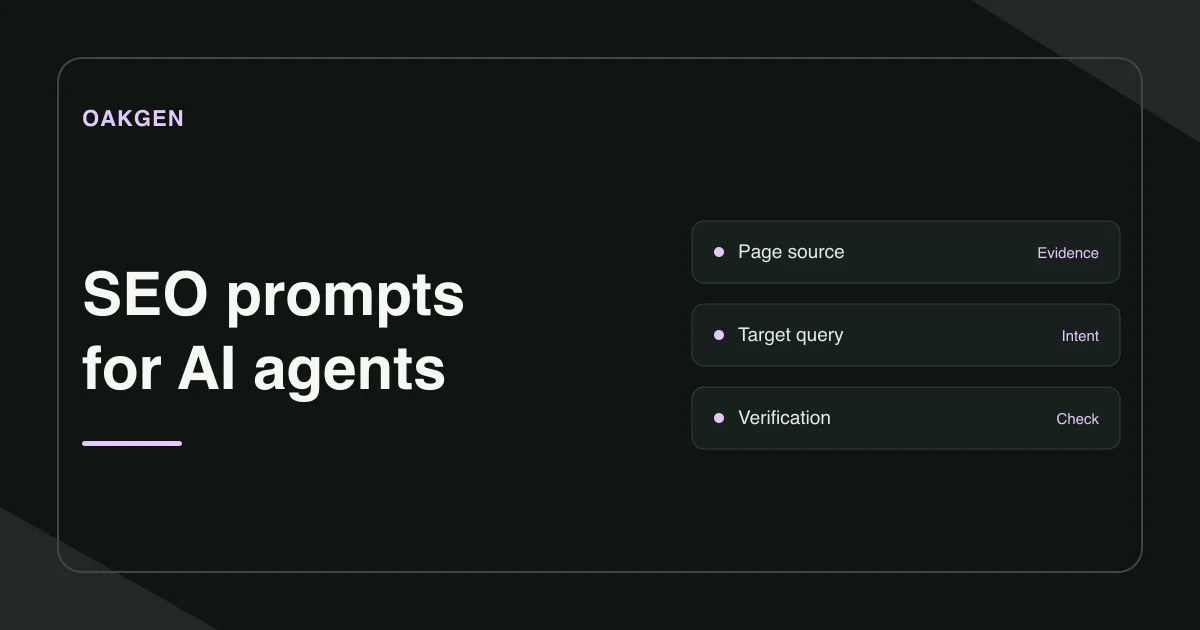
A useful SEO prompt gives the assistant one page, one job and enough evidence to show its work. For a page review, paste the metadata and headings it should inspect and ask for the exact field behind each finding. When an answer depends on data you haven't supplied, ask the agent to mark it unknown.
How do you ask an agent to review one page?
Give it a short assignment and a clear boundary. Say you're reviewing the live page after a launch. Include the target query, the page's title, main heading, canonical and robots tag. Copy those fields from the on-page SEO audit or paste the relevant HTML.
Try this instruction with the source attached.
Review this page for the query "ceramic product photography." For each issue, give the exact field and its current value, the reader or indexing problem, a proposed fix and how I can verify it. Use the supplied HTML as your source. Mark Search Console or crawler checks as unknown unless I supply those reports. Make no site changes.
Suppose the title says "Studio Notes," while the main heading says "Photograph glossy ceramics by a window." A reasonable edit clarifies the title so the reader knows what to expect. If an assistant also claims the page is unindexed, ask what evidence supports that finding. The title and heading are visible in the source. Index status needs its own check.
How do you draft a title or description from limited facts?
List what the page actually delivers. A ceramic shoot guide might show a single-window setup, one white board, and examples of where to put the cup. Ask for three titles that emphasize those concrete angles, then select the one that matches the query best.
Write three title and meta description pairs for this page. Use only these facts: one window, one white board and three cup angles. Give each pair a different angle and say which reader it suits. Leave out claims about professional results, rankings or outcomes that the guide does not show.
Place the result in a Google SERP preview to check readability on a phone. Open the page again before publishing and make sure it actually includes the example that appears in the description.
What should an internal-link prompt return?
Ask for a source sentence, a specific destination and a reason someone would follow the link. Supply the set of allowed destinations. If you give the agent only a sitemap with hundreds of URLs, it can recommend plausible pages that still lead nowhere useful.
For example, if an article says a stale share image may come from caching, the natural link is to instructions for diagnosing that preview. A generic link to the homepage would send the reader away from the problem. Ask the assistant to skip any proposed link it cannot support with a source sentence.
When is a manual check faster?
Open Search Console when the question is whether Google indexed a URL or selected a different canonical. Open the source or compare two URLs when you need a quick technical diff. Use an assistant after you have the facts, particularly if you want someone to turn a list of observations into an ordered set of fixes.
The AI agent prompts library has copyable versions for these tasks. Replace the bracketed fields with real inputs before running them. Keep customer data and private access tokens out of prompts.
How we checked this
We reviewed the Oakgen prompt templates, OpenAI's prompt guidance, and Google's title and URL Inspection documentation on November 21, 2026. The ceramic example is illustrative. It does not describe an actual client, audit or ranking result.
Frequently asked questions
What makes a good prompt for an SEO audit?
Name the exact page and query, supply the source HTML or inspection results, and ask for the evidence and a verification step for each recommendation.
Can an AI agent tell me which page Google indexed?
Give the agent a URL Inspection export or other verified evidence to summarize. Use Google Search Console to check indexing directly.
Should I let an agent publish SEO changes automatically?
Review page titles, canonicals, robots directives and internal links before publishing. Start with an agent that proposes changes in a draft.
Can prompts generate reliable search volume?
A prompt can organize supplied keyword metrics. Use a source such as Keyword Planner or DataForSEO for the actual estimates.