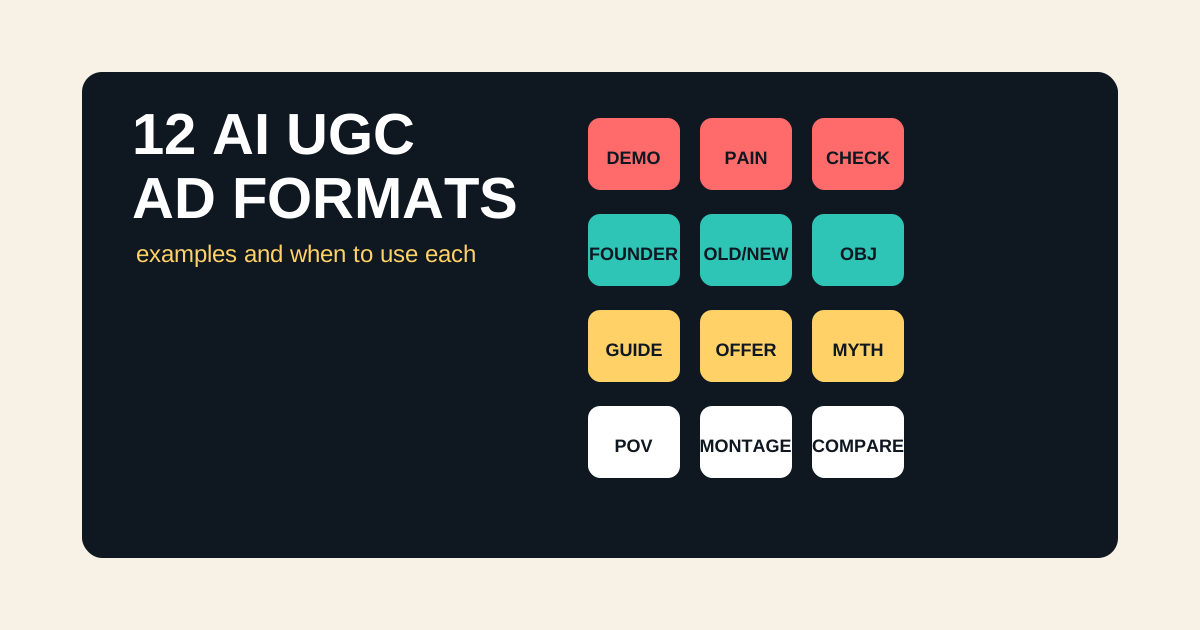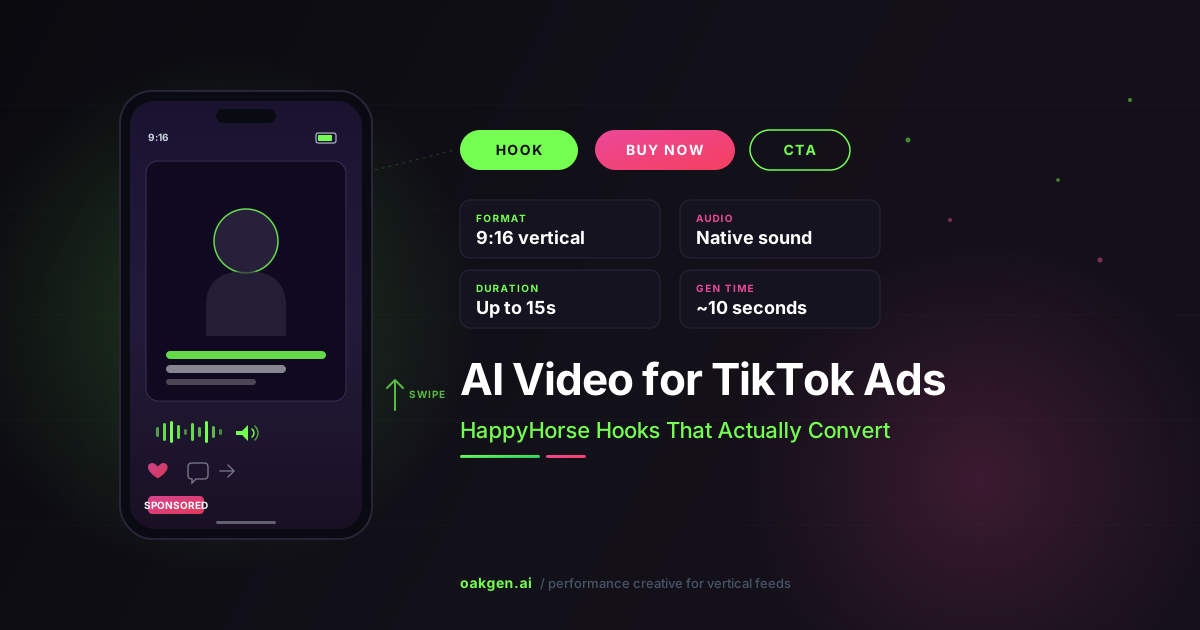
A useful Seedance 2.5 UGC ad should feel like a person showing something worth knowing, not a synthetic customer reading brand copy. Build it around one hook, one verified product fact, one visible demonstration, and one next action. Lock the creator and product with references, keep live dialogue physically simple, and add exact claims, prices, captions, disclosures, and CTA text during editing.
Seedance 2.5 is coming soon on Oakgen. The model cannot be generated through Oakgen today. You can build current campaigns with Oakgen UGC ads and the AI video generator, then test the same controlled brief when 2.5 arrives.
Build The Current UGC Ad
Create the presenter, voice, product scenes, and working variations with Oakgen now, then preserve the brief for a Seedance 2.5 launch test.
What The Reported 2.5 Capabilities Mean For UGC
Product materials report continuous generation up to 30 seconds, up to 50 multimodal references, synchronized audio, local editing, and output up to 4K. Oakgen has not verified these as exposed 2.5 controls, limits, pricing, or guarantees.
For UGC production, the possible value is practical:
| Reported capability | Possible UGC job | Production caution |
|---|---|---|
| Up to 30 seconds | Keep hook, explanation, demo, and payoff connected | Longer scenes create more drift opportunities |
| Up to 50 multimodal references | Carry creator, product, room, motion, and audio direction | More references can conflict |
| Synchronized audio | Generate action-linked dialogue and product sounds | Speech should not compete with complex movement |
| Local editing | Repair one hand, face, label, or background region | Final Oakgen repair controls remain unverified |
| Up to 4K output | Preserve more finishing detail | Resolution does not prove product or claim accuracy |
Pick A Truthful UGC Structure
| Structure | Hook example | Evidence basis | Avoid |
|---|---|---|---|
| Demonstration | “Watch what happens when I close this latch” | Visible product action | Hidden cuts that fake performance |
| Buying checklist | “Check these four details before buying a travel bag” | Honest category criteria | Pretending the presenter owns the product |
| Product explainer | “This control changes the light in two steps” | Current specification and demonstration | Turning a feature into a guaranteed outcome |
| Founder explanation | “We designed the lid around one common spill point” | Documented brand or founder fact | Invented founder identity or history |
| Objection answer | “Does it fit under an airline seat?” | Verified dimensions and scenario | Universal claim across every airline |
| Clearly fictional scene | Obvious dramatization of a problem | Approved product role | Presenting fiction as customer testimony |
Do not use a synthetic presenter to say “I have used this every day for six months” when nobody had that experience. The AI UGC social-proof guide covers truthful evidence and testimonial boundaries.
The UGC Production Packet
Creator reference
Creator ID:
Age range and presentation:
Hair, face, and distinguishing details:
Wardrobe:
Camera relationship: selfie / tripod / friend filming
Speaking energy:
Actions allowed during speech:
Actions reserved for voiceover:
Identity details that cannot change:
Use a small set of agreeing views. Do not mix different hairstyles, ages, wardrobe, or lighting unless the ad explicitly changes them.
Product reference
Exact product and SKU:
Front, side, three-quarter, and in-use references:
Shape, material, color, cap/control details:
Logo and label position:
Approved claims:
Claims blocked from the script:
Price / offer source and expiry:
Product action shown:
Keep final label text under editor control. A correct-looking generated package can still contain the wrong claim.
Setting reference
Choose one room or environment with a believable reason for the creator and product to be there. A bathroom works for a skincare routine; a parked car may work for a travel accessory demonstration. Avoid a generic luxury apartment that says nothing about the use case.
30-Second Creator-Led Beat Sheet
Use less time if the job is simple. Product materials report up to 30 seconds; Oakgen has not confirmed the final duration setting.
| Time | Job | Performance | Product visibility |
|---|---|---|---|
| 0–3s | Earn attention | One direct line or visual problem | Product may enter frame |
| 3–8s | Establish context | Creator names the buying problem | Product visible and stable |
| 8–19s | Demonstrate | One action, broken into clear physical beats | Product unobstructed at proof moment |
| 19–25s | Explain why it matters | Plain approved fact or criterion | Cut between creator and detail |
| 25–28s | Give next action | Short spoken CTA or voiceover | Product held naturally |
| 28–30s | Delivery frame | Stable expression or product plate | Space for real caption and CTA |
Do not force a creator to speak while opening packaging, pouring liquid, walking, pointing, and changing camera angle. Put the explanation over product b-roll when the action needs attention.
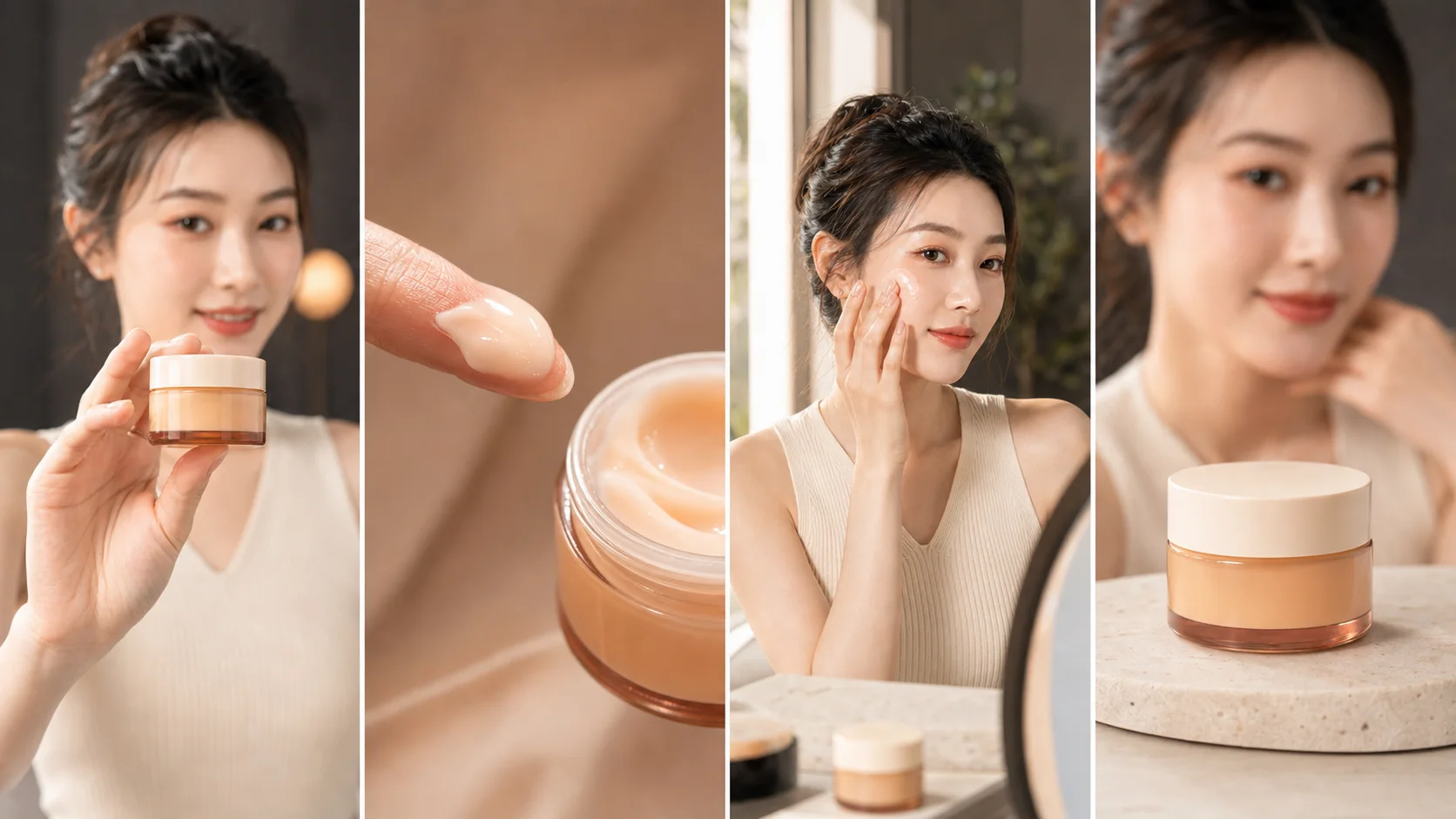
Keep the presenter, product, setting, and direction stable while each beat performs a different job.
Copyable Seedance 2.5 UGC Prompt Template
GOAL: [duration] vertical creator-led ad for [buyer]. Explain and demonstrate [one approved product fact].

CREATOR LOCK: same person from @CreatorFront and @CreatorProfile; preserve face, hair, age, wardrobe, voice character, and natural skin detail.

PRODUCT LOCK: same [SKU] from @ProductFront, @ProductSide, and @ProductUse; preserve shape, proportions, material, exact color, closure, controls, and logo position. Do not rewrite packaging.

SETTING: same [room/location] from @Environment; natural available light; believable phone-camera framing.

0–3s HOOK: [one line or visible problem]. Creator looks toward the lens without exaggerated reaction.
3–8s CONTEXT: [one sentence identifying the buying problem]. Product enters frame once.
8–19s DEMO: [one physical product action with clear start and end]. Use voiceover during any movement that obscures the face.
19–25s EXPLANATION: [one verified fact or selection criterion]. Cut to one product detail.
25–28s NEXT ACTION: [short CTA].
28–30s DELIVERY: stable product or creator frame with clear space for approved text.

AUDIO: [room ambience], [one action-linked product sound], [dialogue or voiceover]. Keep words natural and paced for the action.

CONSTRAINTS: one creator, one product, one setting, no customer testimonial, invented result, generated price, rating, review, subtitle, logo, legal claim, duplicate object, face drift, hand distortion, or product redesign.
For deeper prompt construction, read the Seedance 2.5 prompt guide. If a generation fails, use the Seedance 2.5 troubleshooting table.
Three Ready-To-Adapt Script Patterns
The buying check
Hook: Before you buy a [category], check [specific detail].
Context: Most product pages hide it in [location or spec area].
Demo: [Show the relevant mechanism or measurement.]
Fact: This [product] lists [verified specification].
CTA: Compare the full details on the product page.
The one-action demonstration
Hook: This is the part I would test first.
Demo: [Perform one action once, clearly.]
Explanation: The [verified design feature] is what controls [approved practical function].
CTA: Watch the full product demo.
The objection answer
Hook: Will it [specific buyer concern]?
Setup: The listed [dimension/material/specification] is [verified value].
Demo: [Show a realistic scenario without faking the result.]
CTA: Check the exact fit or compatibility before ordering.
These patterns keep the presenter useful without assigning them a customer history.
Audio Direction For Natural Performance
Write for breath and thought, not a perfect paragraph.
Line 1: quick recognition, slight pause after the problem.
Line 2: slower while product enters frame.
Demo: no live speech during the most complex hand action; use room sound.
Explanation: calm voiceover over the product detail.
CTA: one short sentence, no forced excitement.
Reported synchronized audio could keep product clicks, pours, sprays, or closures tied to action. Treat that as a launch test, not a verified Oakgen behavior today.
Build Variations That Teach You Something
Hold the creator, product, proof, offer, setting, and CTA fixed. Change one variable:
- problem hook versus buying-check hook
- dialogue opening versus visual opening
- selfie framing versus friend-filmed framing
- product demonstration versus product-detail insert
- creator delivery frame versus clean product delivery frame
Name every version by hypothesis:
product_audience_hook_proof_format_version
travel-bag_weekend-traveler_fit-check_dimensions_selfie_v01
For a larger campaign matrix, connect the result to the AI ad creative testing framework.
UGC QA Scorecard
Score each item 0, 1, or 2: reject, repair, pass.
| Check | Pass standard |
|---|---|
| Hook | Buyer understands the problem or question within three seconds |
| Creator identity | Face, age, hair, wardrobe, and voice remain stable |
| Product fidelity | Correct SKU, shape, color, controls, and packaging |
| Physical action | Hands, grip, contact, weight, and timing make sense |
| Script truth | Every fact has an approved source; no invented experience |
| Audio | Speech and product sounds align with visible action |
| Disclosure | Required ad or synthetic-media treatment survives the edit |
| CTA | Action and destination match the current offer |
| Delivery frame | Real typography can be added without covering the proof |
Any zero in product identity, false testimony, unsupported claims, or misleading offer blocks publication.
Common Mistakes
- Writing a polished commercial, then asking the presenter to pretend it is casual.
- Giving the creator five actions during one sentence.
- Using a mood-board person, not a controlled identity packet.
- Asking the model to invent reviews, stars, discounts, or before-and-after results.
- Treating reported up-to-4K output as proof that labels and hands are correct.
- Generating every variant before approving one master.
- Saying Seedance 2.5 is available on Oakgen before launch.
Use Oakgen Now, Keep The 2.5 Brief
Build the current version with Oakgen UGC ads, generate supporting product shots in the AI video generator, and save the production packet beside the outputs. Seedance 2.5 is coming soon on Oakgen; the saved brief gives you a fair launch-day test instead of another random prompt.