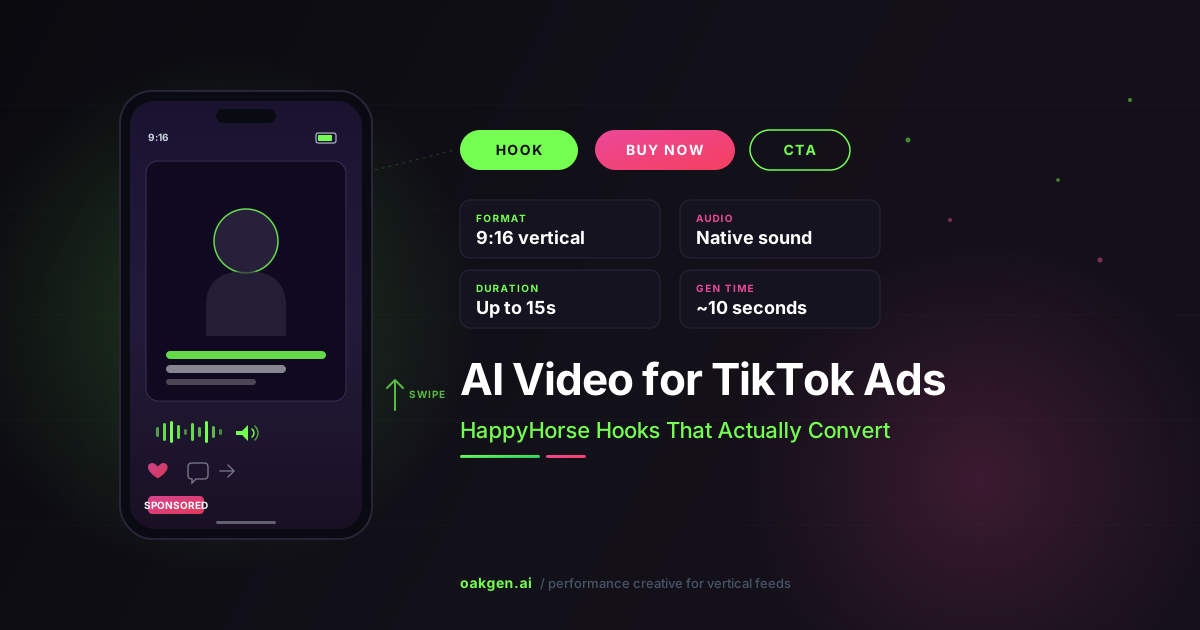
TikTok performance ads obey a brutal format: 9:16, first 3 seconds decide the impression, and sound-on creative is the norm. On Oakgen, the models that fit are Seedance 2.0 Fast, Kling v3 Pro, MiniMax H3 Max, Seedance 2.5 and Grok Imagine Video. All five render 9:16, generate audio with the video, and run 15 seconds or longer per clip. As of 2026-10-25, a 15-second 9:16 clip costs about 357 credits on Grok Imagine Video at 720p and about 853 credits on Kling v3 Pro with audio.
This guide first recommended HappyHorse 1.0 as the default TikTok ad model. Oakgen retired HappyHorse on 2026-09-27, so the guide now uses the video models Oakgen runs today. For what happened to HappyHorse and what replaces it, see the best HappyHorse alternatives.
What does a TikTok ad model need?
TikTok ads want four things from a video model, and Oakgen's model settings (read on 2026-10-25) show which models have them:
- Vertical 9:16. Every model in the table below offers a 9:16 aspect ratio.
- A full ad in one clip. Spark Ads run 15 seconds or under. Kling v3 Pro, Seedance 2.0, Seedance 2.0 Fast, MiniMax H3 Max and Grok Imagine Video go up to 15 seconds. Seedance 2.5 goes up to 30.
- Audio in the same generation. Silent clips with TTS layered on later sound fake. Kling v3 Pro, Seedance 2.0 Fast, Seedance 2.5, MiniMax H3 Max and Grok Imagine Video can generate audio with the video.
- A low price per test. Hook testing means dozens of variations, so credits per second matter more than peak quality.
Which Oakgen models fit TikTok ads?
Credit prices are from Oakgen's pricing table on 2026-10-25. The generator shows the price before you run.
| Model | 9:16 | Max clip | Audio | Resolution | Credits per second |
|---|---|---|---|---|---|
| Grok Imagine Video | Yes | 15s | Yes | 480p, 720p | 17 (480p), 24 (720p) |
| MiniMax H3 Max | Yes | 15s | Yes | 480P, 768P, 1080P | 17, 28, 55 |
| Seedance 2.0 Fast | Yes | 15s | Yes | 480p, 720p | 37 (480p), 82 (720p) |
| Kling v3 Pro | Yes | 15s | On or off | 1080p | 57 with audio, 38 without |
| Seedance 2.5 | Yes | 30s | Yes | 480p, 720p, 1080p | 75, 160, 394 |
We did not run these models head to head for this article, so the table holds settings and prices, not quality scores. The practical split is simple. Run volume hook tests on the cheapest model that looks right for your product, often Grok Imagine Video or MiniMax H3 Max at a low resolution. Move winning concepts to Kling v3 Pro or Seedance 2.5 for the final ad. Seedance 2.0 and 2.5 also accept reference images, video and audio, which helps when a brand look must hold across a campaign.
Outside Oakgen, Google's Veo 3.1 is still available on Vertex AI (its Gemini API preview shut down on 2026-10-22) and Alibaba's Wan models run on other platforms. Oakgen offers neither.
Prompt Library: Hooks That Actually Convert
The TikTok algorithm rewards three things in the first 3 seconds: pattern interrupt, implied stakes, and human face. Ad-grade prompts are about behavior, surprise, and a clean first frame.
3-Second Hook Prompts (Pattern Interrupt)
For the opening 3 seconds. The goal is to stop the scroll, not tell a story yet.
Vertical 9:16 close-up, woman aged 25 holding her phone with visible
frustration, soft window light from the left, kitchen background out
of focus, she sighs and looks directly into the lens, ambient kitchen
sounds and faint refrigerator hum, 3 seconds, handheld
Vertical 9:16, hands unboxing a small white product box on a wooden
desk, top-down, natural daylight, the lid pulls off with audible
cardboard friction and a soft tissue paper rustle, 3 seconds, no
music, real foley, slight handshake
Vertical 9:16 medium shot, man aged 30 in his bathroom mirror wearing
a plain gray t-shirt, holding a product up to the mirror with a
confused expression, fluorescent overhead lighting, ambient bathroom
echo, he opens his mouth to speak but the clip cuts at 3 seconds
These work because they leave a question unanswered at 3s, and the audio pass gives you the kitchen hum or bathroom echo that signals "real" rather than "rendered."
UGC-Style "Person Talking to Camera" Prompts
The dominant TikTok ad format is a person speaking directly to the lens. These prompts produce the look.
Vertical 9:16 selfie-style, woman aged 28 walking a sunny urban
sidewalk holding her phone at arm's length, late-afternoon golden
light on half her face, mid-sentence saying "okay so I have to tell
you about this" with a slight laugh, ambient city traffic, warm
timbre, 8 seconds, natural camera shake, motion blur on background
Vertical 9:16 close-up, man aged 35 in the driver seat, seatbelt
visible, dashboard in frame, selfie-style, tired, venting in casual
tone "I've been trying everything for like three months", ambient
car interior with faint engine and road noise outside, warm
afternoon light through the windshield, 10 seconds
Vertical 9:16, woman aged 24 cross-legged on her unmade bed, soft
pastel bedroom light, fairy lights blurred in background, mid-rant
to the phone camera saying "I'm not even kidding this changed my
whole skincare routine", warm intimate audio with slight room
reverb, no music, casual handheld, 12 seconds
Key patterns: casual hand-held framing, ambient audio bed (car, bedroom, sidewalk), half-spoken first line, natural light. A model that generates audio with the video handles the voice and room tone in the same pass, which helps the output read as UGC instead of stock.
Multilingual Hooks for Global Campaigns
Models with native audio can speak a prompted line in other languages, which lets you test the same hook in several markets without a dubbing pipeline. Oakgen's model settings do not list supported speech languages, so check pronunciation and lip-sync in every language before you spend on it. More in the multilingual AI video lip-sync guide.
Vertical 9:16, woman aged 26 in a bright Tokyo apartment with sunlight
through sheer curtains, sitting at a small desk holding her phone selfie-
style, speaking in natural conversational Japanese saying "ちょっと聞いて
ほしいんだけど" with warm tone and a slight smile, ambient room sound,
casual UGC framing, 8 seconds
Vertical 9:16, man aged 32 in a Berlin kitchen with morning light,
holding a coffee mug and his phone, speaking in natural German saying
"Also Leute, ich muss euch was zeigen" with friendly delivery, ambient
kitchen sounds and faint coffee machine hiss, 10 seconds
Vertical 9:16, woman aged 29 walking through a Parisian café entrance,
speaking in natural French saying "Vous allez pas me croire" with
expressive gestures, ambient café chatter and clinking cups, golden
hour window light, handheld phone selfie style, 12 seconds
Compared to re-shooting or hiring a native-language creator per market, the unit economics on multi-region testing collapse.
Full 15-Second Ad-Ready Prompts
For a complete ad in one shot, use a 15-second clip. Structure: hook (0-3s), problem framing (3-8s), product reveal (8-13s), CTA frame (13-15s).
Vertical 9:16, 15-second narrative, opens on woman aged 27 looking
frustrated at her cluttered bathroom counter with multiple skincare
products, ambient morning bathroom sounds, she sighs; at 6 seconds
she picks up a single sleek white product bottle and her expression
shifts to curious surprise; by 12 seconds she is smiling at the mirror
with the product visible on the counter, soft window daylight, no
music, ambient room tone and product handling foley only, UGC handheld
Vertical 9:16, 15 seconds, man aged 34 in a modern home office, opens
mid-task looking stressed at his laptop, ambient typing and faint
office hum; at 4 seconds he turns to camera saying "okay this is
going to sound dramatic but"; at 8 seconds he holds up a small
gadget to the lens; at 11 seconds he is back at his laptop visibly
calmer; final frame at 14 seconds shows the gadget on the desk, warm
afternoon window light throughout
Vertical 9:16, 15-second product demo, top-down on a marble kitchen
counter, hands enter at 1 second placing a small jar; at 3 seconds
the lid opens with a soft clink; at 5 seconds a finger swipes the
contents; at 8 seconds it is applied to the back of the other hand;
at 12 seconds the hand pulls away revealing smooth absorbed product,
no voiceover, only foley audio, soft natural daylight
Each runs as one generation. As of 2026-10-25, a 15-second 9:16 clip costs about 357 credits on Grok Imagine Video at 720p, about 408 on MiniMax H3 Max at 768P and about 853 on Kling v3 Pro with audio.
Generate TikTok Ad Videos on Oakgen
The Workflow: From Concept to A/B Test in One Afternoon
Cheap, short test clips are what make this a daily workflow rather than a once-a-week project.
Step 1: Write 5 hook concepts. Five distinct angles for the same product -- different problem framing, demographic, setting, opening line. One paragraph each.
Step 2: Generate 10 variations of each concept. Prompt your test model 10 times per concept with small variations -- actor age, lighting, ambient setting, half-line. That's 50 generations. At 5 seconds each on Grok Imagine Video at 480p (17 credits per second as of 2026-10-25), that is about 4,250 credits.
Step 3: Review and pick winners. Scrub through all 50 clips. Expect to reject most of them even with strong prompts. Pick the top 1-2 per concept; you should end with 5-10 ad-ready clips.
Step 4: Stack into a TikTok creative test. Upload your top clips as separate ads in the same ad set. Equal initial budget for 24-48 hours and let TikTok's auction surface the winner. This is "creative-as-the-targeting" -- TikTok's algorithm matches creative to user better than interest-based audiences match it.
Step 5: Iterate the winner. Regenerate 10 more variations of the winning concept. AI compounds here: a winning hook iterates 10x in an hour, where a UGC re-shoot is days out.
Full loop: concept (1h), generation, selection (30 min), test (48h) and iteration. A complete creative cycle fits in about 3 days.
When AI Ads Actually Underperform Real UGC
AI-generated TikTok ads do not always beat shot UGC. Pretending otherwise burns budget. Where shot creative still wins:
- Food and beverage close-ups. Real food has texture, condensation, and steam patterns AI still gets uncanny on. AI-generated food often has a slightly plasticky surface. If the viewer needs to want to eat it, shoot it real.
- Beauty and skincare on actual faces. Pore-level detail, makeup application, and "did this product actually work" demos are still where AI fails high-trust verticals. AI before/after is especially risky.
- Physical product mechanics. If a viewer needs to understand a mechanism (folding stroller, pour-spout, fitness movement), AI fudges the physics. The clip looks plausible but the motion is wrong, and the viewer notices.
- Influencer trust transfer. When the value is "this real human you trust uses this," there's no shortcut. AI faces don't carry parasocial trust in lifestyle and wellness.
- AI-skeptical niches. Some audiences (artists, parts of fitness, certain craft communities) spot AI and skip on principle. Test before scaling.
AI video is the right call for volume hook testing, multi-region localization, atmospheric demos (apps, software, services, accessories), and early-funnel awareness. Wrong call for food, skincare, physical-mechanism products, and trust-driven niches. Use the right tool per brief.
Where Each Model Wins in the Mix
Different shots want different generators. These roles follow from each model's settings and price on Oakgen, not from our own tests:
- Grok Imagine Video -- the cheapest per second at 480p and 720p, so it suits brute-force hook testing.
- MiniMax H3 Max -- low cost at 480P and 768P with a 1080P option, and it takes start and end frames or image, video and audio references.
- Seedance 2.0 Fast -- native audio at 480p or 720p for UGC-style talking-to-camera tests.
- Kling v3 Pro -- 1080p with audio on or off, for the final version of a winning hook.
- Seedance 2.0 and 2.5 -- when you have a brand reference video or image and need consistency across a campaign. Seedance 2.5 also runs up to 30 seconds.
Don't pick a model -- pick the right model per shot. Oakgen runs all of these on one credit balance, so you switch generators per ad without re-subscribing.
Earn 30% for 12 months on every referral.
Share Oakgen, get paid every month they stay.
Conclusion
For performance marketers running TikTok, Reels, or Shorts, the model needs are 9:16, a 15-second clip, audio in the same pass and a low price per test. On Oakgen, test on Grok Imagine Video or MiniMax H3 Max, then finish winners on Kling v3 Pro or Seedance 2.5. HappyHorse 1.0, which this guide first recommended, is no longer on Oakgen.
Honest caveat: real UGC still wins for food, beauty, physical-product mechanics, and influencer-trust niches. For the broad center of paid social -- lifestyle, software, services, accessories, awareness -- a hook-testing workflow on Oakgen produces test clips in the time it takes to write the brief.
How we checked this
Model settings (aspect ratios, durations, resolutions, audio) come from Oakgen's video model configs, and credit prices come from Oakgen's pricing table, both read on 2026-10-25. We did not run the models side by side for this article, so there are no speed or quality scores here.