ChatGPT
 Claude
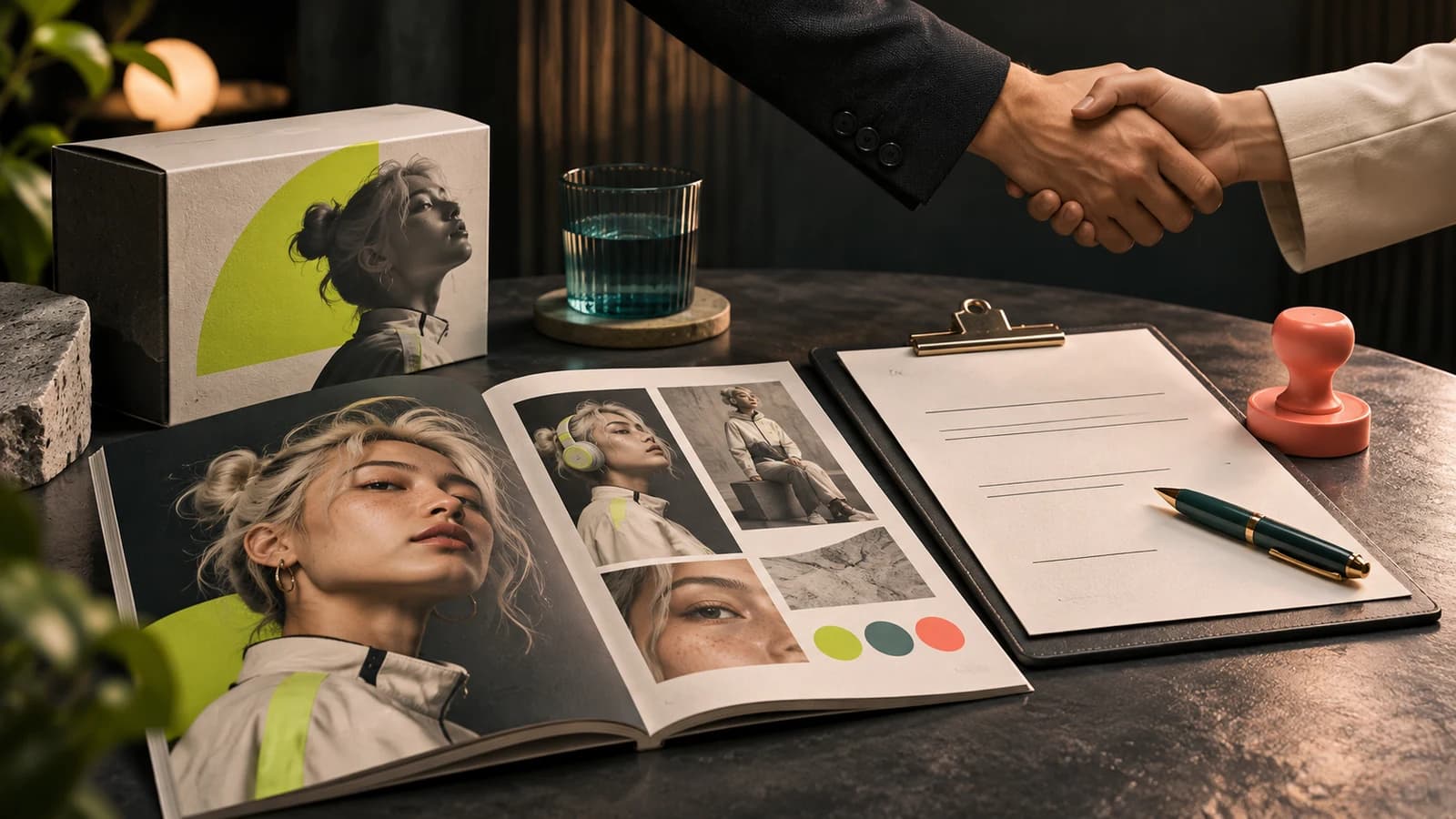
AI influencer brand deals work like human creator deals with three extra checks. The brand has to see that the persona is labelled as AI, it has to trust that the archive is clean when its vetting software scans it, and the contract has to settle who controls the persona's face. To land a first deal, label the account, build a media kit that opens with the AI disclosure, pitch one concrete post idea to a brand that fits the niche, price it from reach rather than novelty, and sign a contract that licenses the posts but not the persona.
Brands pay real money for this. Aitana Lopez's creators told Euronews she earns just over 1,000 euros per advert. That is their own claim, and it comes from one of the best-known AI influencers there is, so treat it as a ceiling to aim at, not a starting rate.
Oakgen has a stake here. Our AI Influencers studio is where you would build the persona, and we say below where you need other tools.
Build a persona brands can book
Create your AI influencer once, then bring the same face and voice into every sponsored image, video and voiceover by typing @ and their name.
What does a first AI influencer brand deal involve?
A first deal has five stages, and the AI part changes something in each one. This table is the short version. Every rule in it is checked against the source named in the last column on November 4, 2026.
| Stage | What the brand checks | What you prepare | Source for the rule |
|---|---|---|---|
| Discovery | Niche and audience fit, often through AI search tools | A consistent niche and a profile that says it is AI | TikTok One Creator AI Search, CreatorIQ |
| Vetting | Brand safety across the archive and the open web | A clean, labelled archive with no stolen faces | CreatorIQ SafeIQ |
| Pitch | Reach, engagement, audience, price | Media kit, one post idea, price with usage terms | Your own analytics |
| Contract | Usage, exclusivity, approvals, disclosure | Clauses that keep the persona yours | Your lawyer |
| Posting | Ad disclosure and AI labels on the post | Paid partnership tag, AI label, synthetic performer line where needed | FTC, Meta, New York, California |
The rest of this guide takes each stage in order.
Who this guide is for
- A solo creator whose AI persona has an audience and keeps getting "collab?" messages, with no idea what to charge.
- A small agency that wants a repeatable deal process. Our hub on running an AI influencer agency covers the roster and team. This post covers the deal.
- A brand marketer who wants to know what a fair AI persona deal looks like before signing one.
If the persona does not exist yet, start with the AI influencer monetization guide for the revenue options, then come back when you have posts to show.
How we checked this
On November 4, 2026 we read the primary sources listed at the end of this post: the FTC's endorsement and testimonial rules, Meta's Branded Content Policies, Instagram's label announcement, the New York and California synthetic performer laws, the US Copyright Office's 2025 AI report, CreatorIQ's October announcements and Net Influencer's report on TikTok's October 7 summit.
We did not run a brand deal for this article and we have no private rate data. The pitch template and the worked price example are illustrative.
The contract and disclosure sections describe what the public rules say and what operators commonly negotiate. They are general information, not legal advice. Have a lawyer in your jurisdiction review any contract before you sign it, especially for health, finance or alcohol brands.
How to get brand deals as an AI influencer
Get the account into a state a brand can approve, then pitch narrowly. Most first deals fail at vetting, not at the pitch.
- Label first. Turn on Instagram's AI-generated profile label and the AI label on each realistic post. A brand that later learns its creator was an unlabelled AI has a PR problem.
- Hold one niche for 60 days. AI search tools match on niche and past performance. A persona that posts fitness on Monday and crypto on Thursday matches nothing.
- Keep the face stable. Brands buy a recognisable person. Run the AI influencer consistency drift test before you pitch, because a brand will scroll your grid looking for the same person in every post.
- Clean the archive. Archive posts with real people who did not consent, copyrighted characters, or jokes you would not want quoted next to a brand name.
- Build the media kit (template below).
- Pitch ten brands that already sell to your audience, with one post idea each. A specific idea beats "open to collabs".
- Say yes to a small paid test first. One post at a fair price gives you a case study for the next pitch.
How brands now vet creators with AI tools
Brand-side vetting got faster and wider in autumn 2026, and it changes what a brand sees before it replies to you.
TikTok. At its TikTok World Canada summit on October 7, 2026, TikTok announced a Creator AI Search tool in TikTok One, its creator and agency hub, which "interprets campaign briefs and analyzes creator profiles to surface recommended talent," as Net Influencer reported. A brand types a brief, and the tool proposes creators. If your persona's niche is muddled, the brief will not match it.
CreatorIQ. On October 13, 2026 CreatorIQ announced enhanced SafeIQ, its brand safety product. The company says it "can reduce manual review from 40 minutes to about one minute per video," and new web monitoring "surfaces what has been said about a creator anywhere on the web, not just in their own content." Its October release notes add a keyword scan that covers "up to three years of content from the creator profile," with categories such as Politics, Substances and Profanity.
So assume a brand can scan your persona's whole history in minutes, plus what others say about it online. A story calling the account a fake human is what web monitoring finds. Labelling from day one is the defence.
What goes in an AI influencer media kit?
An AI influencer media kit is a human creator's media kit with the AI questions answered before the brand asks them. Keep it to two pages or one short PDF.
| Section | What to put in it | Why it matters for an AI persona |
|---|---|---|
| Disclosure line | "Maya is an AI-generated persona created and operated by [studio name]." | The brand needs to know before it reads anything else |
| Operator | Legal entity, country, one named contact | Brands contract with a business, not a character |
| Audience | Followers, average reach and engagement per format, from native analytics, dated | AI accounts are suspected of inflated numbers, so show the source |
| Audience detail | Top countries, age bands, gender split | This is what AI search tools match on |
| Label status | Which labels are on, per platform, with a screenshot | Shows you will not create a disclosure problem for the brand |
| Recommendation status | Screenshot of Instagram Account Status | Shows the account is not restricted |
| Past work | Three to five posts, with results if you have them | Proves the face is consistent across settings |
| Formats offered | Photo post, carousel, reel, talking clip, story set | Lets the brand pick without a call |
| Prices and usage | Price per format, organic usage included, paid usage priced separately | Avoids the usage fight later |
| Limits | Categories you will not promote | Brands trust a persona that turns some deals down |
We have a separate guide to making a media kit for a blog or brand if you need help with layout. The carousel maker can turn your past posts into a clean deck page.
A pitch email template
Copy this and fill in the brackets. Keep it under 150 words.
Subject: [Persona name] x [Brand]: one reel idea for [product]
Hi [first name],
I run [persona name], an AI-generated [niche] creator on Instagram and TikTok ([followers] followers, [average reach] average reel reach in the last 30 days). The account carries Instagram's AI-generated profile label, and every sponsored post gets the paid partnership tag.
Idea: [one sentence describing the post, built around what the product does].
Price: [amount] for one reel with 30 days of organic use. Paid usage is quoted separately.
Media kit attached. Happy to send two concept frames before you commit.
[Your name], [studio name]
Concept frames are an AI persona's advantage. You can show the brand the actual post before it pays. On Oakgen you make those frames from the saved persona in the character library, so the face matches the media kit.
Send concept frames with every pitch
Make two on-brand frames of your persona with the product before the brand signs, using the same saved face as your feed.
How much do brands pay AI influencers?
Nobody publishes reliable rate data for AI influencers. The figures that circulate trace back to a handful of press stories about famous accounts, and most are the operator's own claims.
The one we can trace to a named source is Aitana Lopez. Her creators at the Barcelona agency The Clueless told Euronews in a November 2023 story that she "can earn up to 10,000 euros a month, according to her creators, but the average is usually around 3,000 euros," and that she "earns just over 1,000 euros per advert." She had more than 343,000 Instagram followers by the article's December 2024 update. None of that is audited. Treat it as a ceiling for a well-known account, not a benchmark for a new one.
What we would do instead:
- Price from reach, not novelty. Charge what a human creator with the same average reach and engagement in your niche charges. Being AI is not a premium on its own, and some brands will expect a discount.
- Price usage separately. The fee covers posting on your account. If the brand wants to run the post as a paid ad from its account or yours, that is a separate line, priced per month. Our AI UGC rate card sets out how to price usage, whitelisting and variants.
- Check your floor. Work out what the post costs you to make, from generation credits and team time, with the AI influencer cost per post guide. Never quote below it.
Worked example, illustrative only. A persona averages 20,000 views per reel. A human creator in the same niche with similar reach charges, say, $400 per reel, so you quote $400 with 30 days of organic use. The brand asks to run it as a Spark Ad or partnership ad for a month, and you add a usage fee on top. Your cost to make the reel is $40, so the deal clears your floor easily. Swap in rates from your own niche.
Know your cost before you quote
Every image, video and voiceover shows its credit price before you generate, so your floor price is a real number.
Which contract clauses matter for an AI persona?
Most of the contract looks like any creator agreement. A few clauses need more attention for an AI persona. Use this deal sheet before you sign. It is a checklist, not a contract.
| Clause | What to ask for | Red flag in the brand's draft |
|---|---|---|
| Persona ownership | You own the persona, its name, face and voice. The brand gets a licence to the specific posts only | "All IP in the creator's likeness vests in Brand" |
| No new generation | The brand may not create new images, video or audio of the persona, or use the posts to train AI models | "Brand may create derivative works featuring the talent" |
| Usage term | Organic use for a set period, for example 30 or 90 days, on named channels | "Perpetual, worldwide, all media" for one fee |
| Paid usage | Paid ads with the content priced per month, ended in writing | Paid usage folded into the base fee |
| Exclusivity | Short, category-specific, paid | Broad competitor ban with no fee |
| Originality warranty | You warrant you have the rights you use and that no real person's likeness is used without consent | You warrant the content is protected by copyright |
| Script claims | Brand supplies and stands behind product claims | You are liable for any claim the brand wrote |
| Disclosure | Who applies the paid partnership tag, the AI labels and any synthetic performer line | Brand asks you to drop or hide the AI label |
| Termination | Kill fee if the brand cancels after concept approval | No payment if the brand changes its mind |
IP and originality warranties
The US Copyright Office's January 2025 report says "copyright does not extend to purely AI-generated material," and that prompts alone do not give enough human control to make the user the author. So be careful with a clause where you warrant that the content is copyrighted or that you can assign full copyright. You may not hold it. Warrant what you can control: that you have rights to your inputs, and that no real person's face or voice is in the content without consent. Oakgen's Terms of Service, section 4.4, likewise says Oakgen does not claim ownership of eligible outputs but does not guarantee any output is "protectable by intellectual property law, or cleared for a particular use."
Script claims
The FTC's Endorsement Guides give an example of a fake review as deceptive because it "was not written by a bona fide user of the product." The FTC's 2024 rule on reviews and testimonials, 16 CFR 465.2, bans testimonials that misrepresent "that the testimonialist used or otherwise had experience with the product." An AI persona has not used the serum. Write scripts around what the product does and what the brand claims, and have the brand stand behind those claims in the contract. "This serum has 10% niacinamide" is fine. "My skin cleared up in two weeks" is a problem.
How should an AI influencer disclose a sponsored post?
A sponsored post by an AI persona usually needs two kinds of disclosure: that it is an ad, and that the person is not real. These are the rules we read on November 4, 2026.
- Ad disclosure, FTC. The Endorsement Guides say the endorser "could be or appear to be an individual, group, or institution," so a virtual persona is covered. A paid connection must be disclosed "clearly and conspicuously," and on social media the disclosure "should be unavoidable." A disclosure only on the profile page does not count.
- Paid partnership tag, Meta. Meta's Branded Content Policies say "creators must use the branded content tool to tag the featured third party product, brand, or business partner with their prior permission" when there is an exchange of value, including free gifts. The policy also says creators "cannot accept anything of value to post content that does not feature themselves or that they were not involved in creating." Our reading is that the persona's own operator creating the post meets that test, but posting a finished ad the brand made does not.
- Synthetic performer, New York. New York's law, in effect since June 9, 2026, requires advertisers to disclose when an ad includes a synthetic performer, defined in the bill as a digital asset made to look like a human performer "who is not recognizable as any identifiable natural performer." The duty sits with whoever produces or creates the ad, which can include you.
- Synthetic performer, California. SB 1050, signed September 16, 2026, takes effect January 1, 2027, according to Mayer Brown's analysis. It requires a clear disclosure with wording substantially similar to "this performance features a synthetic performer" or "no human performer is depicted" when an ad prominently features one.
- AI labels on the platforms. These apply whether or not the post is paid. The full table is in our post on AI influencer disclosure rules by platform.
A safe default for every sponsored post is the paid partnership tag, the platform AI label, and a first caption line such as "Ad. [Persona] is an AI-generated character." Put the disclosure duty in the contract so the brand cannot ask you to drop it later.
How does the Instagram AI-generated profile label change a pitch?
It moves the AI question from a risk to a checkbox. On August 31, 2026 Instagram renamed its "AI creator" label to "AI-generated profile" and said it "will also limit the reach of profiles that feature an AI-generated person and do not add this label." It also said creators who add the label themselves "will not see a change to their profile's reach."
A brand's first worry about an AI persona used to be "what if people find out?" With the label on, people already know, and Instagram says it costs no reach. An unlabelled persona, by contrast, can lose recommendations, which cuts the non-follower reach a brand pays for. Put the label screenshot and an Account Status screenshot in your media kit. Our guide to the Instagram AI-generated profile label covers how to turn it on, hybrid accounts and appeals.
Common mistakes in a first AI influencer brand deal
- Hiding that the persona is AI until the contract stage. The brand finds out in vetting and walks away.
- Signing a perpetual likeness grant. One fee should not buy the persona forever.
- First-person product results in the script. The persona did not use the product, and the FTC rules on testimonials apply.
- Promising copyright you may not have. Warrant your inputs and consent, not copyright in AI output.
- Leaving disclosure to "we'll sort it out." Write who applies which label into the contract.
When does another route fit better?
An AI persona with its own audience suits brands that want reach and a recurring face. It is the wrong product for some briefs.
- The brand wants ads, not posts on your account. Sell AI UGC instead. Our guide to selling AI UGC ads to brands covers that model, and the AI UGC ad generator is the better tool for it.
- The brand needs a real person's testimony, for example in skincare results or supplements. Hire a human creator who used the product.
- The brand wants matching and payments handled for it. Marketplaces such as TikTok One handle discovery, briefs and payment inside the platform. Oakgen does not run deals, contracts or payouts. It makes the content.
If you are ready to pitch, set up the persona in the AI Influencers studio, make two concept frames for your first target brand, and send them with the media kit above.
Land your first AI influencer brand deal
Build the persona, make concept frames for the brand's product, and pitch with a face that stays the same in every post.
Frequently asked questions
How do I get brand deals as an AI influencer?
Turn on the platform AI labels first, keep the persona's face and niche consistent, and build a media kit that says up front the persona is AI-generated. Then pitch brands whose products fit the persona's niche with one specific post idea, a price and the usage terms. Brands now scan creators with AI vetting tools, so a clean, labelled archive matters as much as follower count.
What should an AI influencer media kit include?
A one-line AI disclosure, who operates the persona, audience size and engagement from native analytics with the date, audience location and age, the label status on each platform, three to five past posts, the formats you offer, prices with usage terms, and a contact. Add a screenshot of Instagram Account Status showing the profile is eligible for recommendations.
Does a sponsored post by an AI influencer need disclosure?
Yes. The FTC Endorsement Guides say an endorser can be or appear to be an individual, so a paid post by a virtual persona needs a clear ad disclosure. Meta's Branded Content Policies require the paid partnership tool when there is an exchange of value. New York has required advertisers to disclose synthetic performers in ads since June 9, 2026, and a similar California law takes effect January 1, 2027. This is general information, not legal advice.
Can an AI influencer say it uses the product it promotes?
Be careful. The FTC treats an endorsement that claims use of a product as deceptive if the endorser was not a bona fide user, and its 2024 rule bans testimonials that misrepresent that the testimonialist used the product. A persona cannot try a serum. Write scripts around what the product does and what the brand claims, not first-person results. Ask a lawyer to review scripts for regulated categories.
Who owns the AI influencer's face in a brand deal?
You should, and the contract should say so. Grant the brand a licence to use the specific posts for a set term and set channels, and do not let the brand generate new content with the persona's face or train models on it. Also note that the US Copyright Office says purely AI-generated material is not protected by copyright, so do not promise IP rights you may not hold.
Sources
- Euronews, Meet the Spanish AI model earning up to 10,000 euros a month, updated December 27, 2024 (read 2026-11-04)
- CreatorIQ, CreatorIQ Unveils Q, an Enterprise Agentic System for Creator Marketing, Alongside MeasureIQ and Enhanced SafeIQ, October 13, 2026 (read 2026-11-04)
- CreatorIQ, October 2026 release roundup (read 2026-11-04)
- Net Influencer, TikTok Unveils AI-Powered Ad and Creator Tools at Canada Summit, October 9, 2026 (read 2026-11-04)
- eCFR, 16 CFR Part 255, Guides Concerning Use of Endorsements and Testimonials in Advertising (read 2026-11-04)
- eCFR, 16 CFR Part 465, Rule on the Use of Consumer Reviews and Testimonials (read 2026-11-04)
- Meta Business Help Center, Branded Content Policies (read 2026-11-04)
- Instagram for Creators, Bringing More Transparency to AI-Generated Profiles on Instagram, August 31, 2026 (read 2026-11-04)
- Governor of New York, synthetic performer advertising disclosure law is in effect, June 9, 2026 (read 2026-11-04)
- New York Senate, Bill S8420-A text (read 2026-11-04)
- Governor of California, Governor Newsom signs SB 1050, September 16, 2026 (read 2026-11-04)
- Mayer Brown, California Joins New York in Requiring Disclosures in Advertisements Featuring Synthetic Performers, October 15, 2026 (read 2026-11-04)
- U.S. Copyright Office, Copyright and Artificial Intelligence, Part 2 Copyrightability, January 2025 (read 2026-11-04)