ChatGPT
 Claude

Most of the agent standards people confuse with MCP and A2A solve a different problem each. AGENTS.md tells a coding agent how your repo works. Open Responses gives applications one request format across model providers. Agent Skills packages procedures an agent loads on demand. AI Catalog and Agentic Resource Discovery are competing drafts for finding agents and tools. WebMCP lets a web page hand tools to a browser agent.
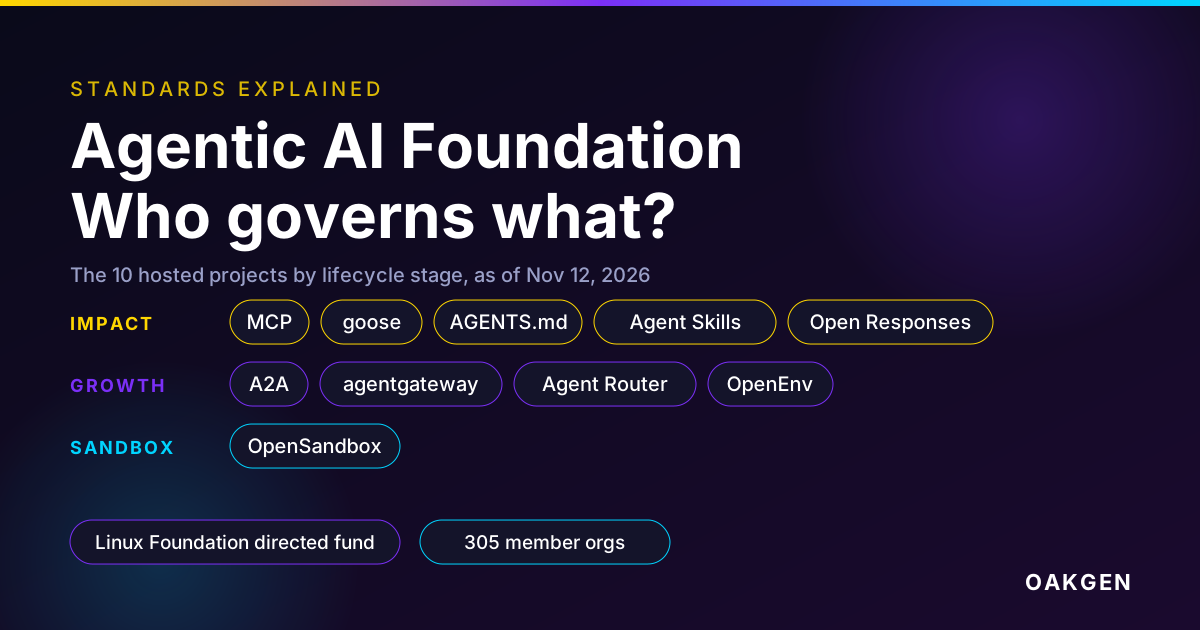
The Agentic AI Foundation (AAIF) hosts three of these, AGENTS.md, Open Responses and Agent Skills, among 10 projects as of November 12, 2026. The discovery drafts and WebMCP sit outside it. Only AGENTS.md is simple and stable enough to adopt today without a caveat. The rest are young, loosely versioned or still drafts.
See an MCP server built for creative work
Oakgen MCP lets an agent search image, video and voice models, read their inputs, check a price and start a job. Read what it exposes before you decide what else your stack needs.
The short version
| Standard | Problem it solves | Home and maintainers | Status on 2026-11-12 | Still draft or unsettled |
|---|---|---|---|---|
| AGENTS.md | Project instructions for coding agents | AAIF project, repo agentsmd/agents.md | In use, no versions or releases | No spec versioning at all |
| Open Responses | One LLM API format across providers | AAIF project, joined Oct 22 2026, TSC of maintainers | Dated spec releases (2026-01-15, 2026-04-24 listed), no tagged releases | Anthropic and Google endpoints not covered |
| Agent Skills | Reusable procedures loaded on demand | AAIF project, contributed by Anthropic | Spec published, repo has no tagged releases | Governance files added Nov 4 2026 |
| AI Catalog | Discovering MCP servers, agents, plugins | Temporary Linux Foundation working repo | Draft, no published version | Permanent home and governance undecided |
| Agentic Resource Discovery | Federated search for agentic resources | ards-project, authors include Google and Hugging Face | v0.91, status Proposal | Competing path and media types |
| WebMCP | Web page exposes tools to browser agents | W3C Web Machine Learning Community Group | Draft Community Group Report | Not a W3C Standard, Chrome origin trial |
| OpenAPI Overlay | Repeatable edits to an OpenAPI description | OpenAPI Initiative | v1.2.0 released 2026-09-22 | Not agent specific |
| MCP and A2A | Agent to tool and agent to agent | AAIF projects | Covered in our MCP vs A2A post | See that post |
Disclosure: Oakgen is our product. These are infrastructure standards, not Oakgen features, so Oakgen appears in one short section and in the call-to-action boxes.
Who this is for
You lead a small product or creative team that uses coding agents and perhaps an agent platform. You keep seeing a new acronym in a launch post and need to know whether it is a protocol, a file format or a draft. You want to know what to do this quarter, not what to read for fun.
If you still need the transport layers, start with the MCP 2026-07-28 spec explainer and the AAIF explainer.
How we checked this
On November 12, 2026 we opened each project's own spec page and repository, the foundation's pages, and the vendor docs for the claims about Claude Code, Codex, Chrome and Stripe. We read the GitHub release and tag lists to say whether a version exists.
We ran no agent, spec validator or compliance test, and we did not benchmark anything. Where a number is a vendor's or a project's own claim, the sentence says so. Several of these repositories changed within the last week, so treat every status as a snapshot.
AGENTS.md, the README for coding agents
AGENTS.md is plain Markdown at the root of a repository. The project's own FAQ says there are no required fields and the agent simply reads the text. Nested files are allowed, the nearest file to the edited code wins, and an explicit chat prompt overrides everything.
It began as a collaboration that agents.md credits to OpenAI Codex, Amp, Jules from Google, Cursor and Factory. AAIF now stewards it, and it was one of AAIF's three launch projects in December 2025. The repository has no tags or releases. There is no version to pin, which is both its strength and its limit.
agents.md says the format is used by over 60,000 open-source projects. That is the project's own claim, and we did not count.
Support is real but uneven in the details. Codex reads AGENTS.md files from the root down to your working directory, one file per directory, and stops adding files at 32 KiB by default, per OpenAI's documentation. Claude Code reads AGENTS.md directly from version 2.1.277, according to its docs. If a CLAUDE.md also exists, Claude Code reads the CLAUDE.md only, so import the AGENTS.md from it if you keep both.
Claude Code's documentation says it treats CLAUDE.md and auto memory as context, not enforced configuration, and points to a PreToolUse hook to block an action regardless of what the model decides. The same logic applies to AGENTS.md. Never put a rule there that must hold, such as "do not touch production credentials", and expect it to be followed every time.
Does it pay off? An AAIF blog post dated November 11, 2026, by Ana Jiménez Santamaria, tested a roughly 50-line AGENTS.md on todogroup.org. Across 18 runs of Claude Code with Opus 5.5, correct runs rose from 7 of 9 to 9 of 9, tokens fell 36%, time fell 32% and estimated cost fell 26%. The author says it covered three tasks on one site with one agent setup and may not carry over. The post sits on the foundation's own blog, so read it as a promising single test.
Open Responses, one API shape for many model providers
Open Responses standardizes the model API layer, not tools. Its spec says LLM systems have converged on similar primitives (messages, function calls, tool use, multimodal input) but encode them differently, and it defines one shared schema plus semantic streaming events such as response.output_text.delta and response.completed.
Three ideas carry the design. Items are the atomic unit of context and are valid as input or output. Streaming is a series of meaningful events, not raw text deltas. Tools are either externally hosted, where the developer runs a function, or internally hosted, where the provider runs the tool. The spec names MCP as an example of an externally hosted tool, so it sits beside MCP, not against it.
The history is short and the labels matter.
- 2026-01-15. The project launched, initiated by OpenAI, per its changelog and the Hugging Face post of the same day.
- 2026-04-24. A changelog entry added a WebSocket transport, a
/v1/responses/compactendpoint and an optional assistantphasefield. - 2026-10-21. The Technical Charter was adopted. A technical steering committee, initially made up of the project's maintainers, holds technical oversight. Code is Apache-2.0 and documentation CC BY 4.0.
- 2026-10-22. The Linux Foundation announced that OpenAI contributed it to AAIF.
The repository has no tagged releases. Versions are dated spec snapshots under public/openapi/, which the README calls immutable once released.
Who uses it? The New Stack reported on October 22, 2026 that AWS Bedrock, Databricks, LM Studio, Ollama, Hugging Face, Nvidia, OpenRouter, Red Hat, Vercel, vLLM and OGC support it. An OpenAI spokesperson told The New Stack that Vercel AI Gateway and Databricks Model Serving already implement it. That second claim is OpenAI's, relayed by a publication.
The same article names the gap. Anthropic uses its own Messages API and Google uses its Interactions API, and neither was listed. The New Stack also notes the project's own contributor guide says the core schema files were copied from OpenAI's API. Open Responses is vendor-neutral in governance and still OpenAI-shaped in lineage.
The project ships a compliance suite at openresponses.org/compliance. Its browser tester lists 10 tests, including streaming, tool calling and image input. Use it on any endpoint a vendor says is compatible.
Agent Skills, procedures an agent loads on demand
A skill is a directory with a SKILL.md file. The spec requires frontmatter with a name (up to 64 characters, lowercase letters, numbers and hyphens, matching the directory name) and a description (up to 1,024 characters). Optional fields are license, compatibility, metadata and an experimental allowed-tools.
The repository describes progressive disclosure in three stages. Agents load only the name and description at startup, read the full instructions when a task matches, and open bundled scripts or files as needed.
Anthropic originally developed the format. The Linux Foundation announced its contribution to AAIF on October 22, 2026, together with Open Responses, OpenEnv and OpenSandbox. The repository's latest commit on November 4 adds governance and maintainers, and it still has no tagged releases. For when to ship a Skill instead of a server, read our Agent Skills vs MCP comparison.
Let an agent quote the job before it spends credits
A standard can describe how an agent behaves, but only a server can price a request and run it. Try a creative brief in Oakgen Agent Chat and see the plan and cost before you generate.
AI Catalog and ARD, two drafts for discovery
Both try to answer one question. How does an agent find the MCP servers, agents and skills a domain offers, without someone installing each by hand?
AI Catalog is a JSON format for discovering heterogeneous AI artifacts. Each entry declares its type with a media type and either points to or embeds the native metadata. A document uses the media type application/ai-catalog+json, and hosts may serve one at /.well-known/ai-catalog.json. It defines three conformance levels, Minimal, Discoverable and Trusted, and optional signed Trust Manifests.
Its status is plain in its own words. The spec page is a draft dated November 11, 2026 and shows no latest published version. The repository says it is a temporary working repo maintained by the Linux Foundation, that it will move to a permanent location with a permanent governance model, and that the A2A and MCP steering committees will vote on adoption once it is finalized. That is a plan, not a decision.
Agentic Resource Discovery (ARD) covers the same ground differently. Its version 0.91 is dated August 26, 2026, lists authors from Google and Hugging Face, and carries the status Proposal. It publishes manifests at /.well-known/ard.json, adds searchable registries, and says its media types are still tracking toward formal IANA registration. A repository README note says v0.91 dropped the claim that ARD builds on AI Catalog, and the spec calls the AI Catalog path its predecessor.
An individual IETF Internet-Draft, draft-bu-dawn-ard-discovery-00, was published October 30, 2026 and expires May 3, 2027. An Internet-Draft is a work in progress by definition and expires after six months, which this one does on May 3, 2027.
The AI Catalog repository still describes itself as the common standard that MCP and A2A may adopt. The ARD repository says it has separated from AI Catalog. We found no source that says which one will win, or that any major agent client resolves either file today.
WebMCP, tools from inside a web page
WebMCP is a browser API, not a wire protocol. The draft says it lets web applications provide JavaScript-based tools to AI agents, so a page behaves like an MCP server whose tools run in client-side script.
The specification is a Draft Community Group Report dated November 11, 2026, published by the W3C Web Machine Learning Community Group. Editors are from Microsoft and Google. It states that it is not a W3C Standard and is not on the Standards Track. Chrome's documentation calls it an evolving draft, offers an origin trial from Chrome 149, and notes that local testing needs Chromium 146.0.7672.0 or newer with a flag enabled.
Chrome's guide is explicit about the difference from MCP. WebMCP runs in the tab, uses no HTTP, Server-Sent Events or stdio, and supports Tools only, not Resources or Prompts.
Is it worth trying? Stripe's own engineering blog of September 22, 2026 says it enabled WebMCP on Stripe Checkout UIs and measured, over 60 tests on six models on a fictional retailer, 42% fewer tokens, 38% fewer tool calls and 39% faster checkouts. All runs completed. That is a vendor-run test on one flow. It does show why a team that owns a web app might care, because the baseline Stripe reports was about 1.8 million tokens and 38.83 tool calls per checkout.
OpenAPI Overlay and Arazzo, the API-description neighbors
These are not agent standards, and we include them only because they come up in the same conversations. The OpenAPI Initiative, a Linux Foundation collaborative project, maintains three specs that fit together.
- OpenAPI describes individual HTTP APIs.
- Arazzo describes workflows across those APIs. Version 1.1.0 dated May 17, 2026 added AsyncAPI support. The OpenAPI Initiative's June 2026 newsletter says its roadmap targets MCP and A2A step types. That is a roadmap, not a release.
- Overlay applies repeatable changes to an OpenAPI description. Version 1.2.0 is dated September 22, 2026 and adds reusable actions. Version 1.1.0 came on January 14, 2026.
The Overlay spec lists use cases such as updating descriptions and adding metadata for another tool. Our inference, not the spec's claim, is that an Overlay is a clean way to rewrite verbose human API descriptions into short agent-friendly ones before you generate tools from an OpenAPI file, without editing the source document.
The decision table
This is the map to keep. Pick your problem, then read the standard and the caveat.
| If your problem is | Use | What you must still check |
|---|---|---|
| Agents misrun builds and tests in your repo | AGENTS.md | Keep it under a few hundred lines, nothing in it is enforced |
| A repeatable review or brand procedure agents skip | Agent Skill | Install only skills you have audited |
| An agent needs live data or a paid action | An MCP server | Auth, spend limits, approval steps |
| You switch model vendors and fear API lock-in | Open Responses at your gateway | Whether each provider you use really implements it, run the compliance tests |
| You own a web app and want browser agents to act in it | WebMCP, as an experiment | Chrome flag or origin trial, spec still draft |
| You want agents to discover your tools by domain | Wait, or publish a plain docs page | Two drafts, no verified client support |
| You feed OpenAPI files to a tool generator | Overlay | Tool support, not agent support |
A creative team's take
A small creative team rarely needs all of this. What helps is a short rule file and one checked procedure. Put the build and test commands for your asset pipeline in AGENTS.md so a coding agent stops guessing. Put the brand review checklist and the credit-spend limit in a Skill, and let a tool that can quote a price do the quoting.
Oakgen's MCP server is one such tool. It exposes calls to search models, read a model's input schema, check a price, start a generation and check its status. We checked our own application code on November 12, 2026 and found no WebMCP, AI Catalog or ARD implementation, so nothing here is a claim that Oakgen speaks these standards. For approval design, see our human approval post and the creative MCP security checklist.
Try an agent workflow with a price check built in
Brief an agent in Oakgen Agent Chat, review the plan and the quoted cost, then generate image, video and audio from one workspace. Oakgen is our product.
Adoption order for a small team
This is the order I would go in, with a reason for each step.
- AGENTS.md this week. It costs an hour, needs no tools and works across agents. Write what a new teammate would need, then trim it.
- One Agent Skill for your most repeated procedure. Pick the checklist people forget. Keep the description specific, because that sentence decides when it loads.
- MCP servers when an agent needs a live system. Add them one at a time with the narrowest permissions. See the MCP security checklist.
- Open Responses only at the gateway. If you run multiple model vendors behind one layer, ask each for Open Responses support and run the compliance suite. If you call one vendor directly, skip it.
- WebMCP only for a web app you own. Prototype behind the Chrome flag and measure tokens and tool calls like Stripe did, on your own flow.
- AI Catalog and ARD, watch only. Do not build on a spec that has no published version or no verified consumer.
- Overlay, only if you already generate tools from OpenAPI.
For each step, run the same five tasks with and without the standard and count tokens, tool calls and failures. The AAIF AGENTS.md test and Stripe's WebMCP test both used that method, and both are small enough for a team of three to repeat.
Common mistakes
- Treating "open standard" as "finished standard". Of the seven items here, only OpenAPI Overlay and Arazzo carry numbered releases on a standards body's own site. The rest are young, loosely versioned or drafts.
- Assuming Open Responses means every provider speaks it. The New Stack's list on October 22, 2026 did not include Anthropic or Google.
- Confusing WebMCP with MCP. One runs in a browser tab with Tools only. The other is a client-server protocol.
- Letting AGENTS.md rot. The AAIF post warns that agents with a good file check little else, so a stale file is followed confidently.
- Writing rules that need enforcement into a context file. Use hooks or permissions.
- Publishing an AI Catalog and expecting traffic. We found no verified client that reads it.
- Installing third-party skills unread. A skill can bundle scripts, so audit every file.
Decision framework
Ask four questions in order.
- Is the problem about what the agent knows? Use AGENTS.md or a Skill.
- Is it about what the agent can reach? Use an MCP server, or WebMCP when the target is a page you own.
- Is it about which model answers? Open Responses at the gateway, and only where providers support it.
- Is it about finding things? Wait. Both discovery drafts can change under you.
What I would do
I would write the AGENTS.md today and measure it, then ship one Skill. I would not touch Open Responses until a gateway I already pay for lists it. I would prototype WebMCP only if checkout or a similar flow already costs me agent tokens. I would not publish an AI Catalog or an ARD manifest yet.
I would also re-check this page's table in 60 days. Four of these repositories changed within the past two weeks, and the discovery fight is not settled.
Start with the part that is stable
Use the standards that are settled, then give your agent real creative tools. Oakgen MCP connects an agent to image, video and audio models with prices you can check first.
Frequently asked questions
What is the difference between AGENTS.md and Agent Skills?
AGENTS.md is one plain Markdown file of project instructions that a coding agent reads at the start of a session. Its own FAQ says there are no required fields. An Agent Skill is a folder with a SKILL.md file whose frontmatter requires a name of up to 64 characters and a description of up to 1,024 characters. Agents load only the name and description at startup and read the rest when a task matches. Use AGENTS.md for facts every session needs, such as build and test commands. Use a Skill for a procedure that only some tasks need.
Is Open Responses the same as the OpenAI Responses API?
No. Open Responses is an open specification based on the OpenAI Responses API. It defines a shared schema, semantic streaming events and tool patterns so that a request can run across providers with minimal translation. Any API that implements the spec directly, or is a proper superset of it, counts as compliant. The project's contributor guide says its core schema files were copied from OpenAI's API, as The New Stack reported on October 22, 2026. OpenAI donated it to the Agentic AI Foundation, announced the same day.
Does Anthropic or Google support Open Responses?
Not as of The New Stack's report of October 22, 2026. It listed AWS Bedrock, Databricks, LM Studio, Ollama, Hugging Face, Nvidia, OpenRouter, Red Hat, Vercel, vLLM and OGC as supporters, and noted that Anthropic uses its own Messages API and Google uses its Interactions API. Anthropic is an AAIF member. We did not find a later announcement of support, so check the provider's current docs before you plan around it.
Is WebMCP the same thing as MCP?
No. WebMCP is a browser API from the W3C Web Machine Learning Community Group that lets a web page register JavaScript tools for agents. Chrome's documentation says it runs entirely client-side in the browser tab, does not use HTTP, Server-Sent Events or stdio, and supports Tools only, not the Resources or Prompts of backend MCP. The specification is a Draft Community Group Report dated November 11, 2026 and says it is not a W3C Standard and not on the W3C Standards Track.
What is the AI Catalog and is it final?
AI Catalog is a JSON format for discovering heterogeneous AI artifacts such as MCP servers, A2A agent cards and plugins, optionally served at /.well-known/ai-catalog.json. As of November 12, 2026 the specification is a draft with no latest published version, and its repository calls itself a temporary working repo maintained by the Linux Foundation. A separate effort, Agentic Resource Discovery, is at version 0.91 with status Proposal and uses /.well-known/ard.json. Neither is final, so do not build a product on either yet.
Which of these standards should a small team adopt first?
Start with AGENTS.md, because it is one Markdown file, needs no tooling and is read by Codex and, in Claude Code v2.1.277 or later, by Claude Code. Add Agent Skills when you have a repeatable procedure. Add MCP servers when an agent needs live tools. Treat Open Responses, WebMCP, AI Catalog and Agentic Resource Discovery as things to adopt only when a specific need appears, because each is either a provider-side concern or still a draft.
Does AGENTS.md actually make agents cheaper or better?
One small test says it helped. An Agentic AI Foundation blog post of November 11, 2026 reports 18 runs of Claude Code with Opus 5.5 on the TODO Group website. With a roughly 50-line AGENTS.md, 9 of 9 runs were fully correct instead of 7 of 9, with 36% fewer tokens, 32% less time and an estimated 26% lower cost. The author says it covered three tasks on one site with one agent setup and may not generalize. Treat it as one data point, not a benchmark.
Does Oakgen support these standards?
Oakgen is our product. It offers an MCP server and an Agent Chat. We checked our own application code on November 12, 2026 and found no WebMCP, AI Catalog or Agentic Resource Discovery implementation. We have not verified Open Responses or Agent Skills support either, so treat Oakgen as an MCP server plus an agent chat and nothing more where these standards are concerned.
Sources
- Linux Foundation, Agentic AI Foundation Announces Four New Projects, Oct 22 2026 (read 2026-11-12)
- Agentic AI Foundation, Projects page, 10 listed projects (read 2026-11-12)
- AGENTS.md, project website and FAQ (read 2026-11-12)
- agentsmd/agents.md repository, README, charter and release list (read 2026-11-12)
- AAIF, AGENTS.md project page (read 2026-11-12)
- AAIF blog, DevEx for your agents, How AGENTS.md cut token usage and cost, Nov 11 2026 (read 2026-11-12)
- Claude Code docs, How Claude remembers your project, AGENTS.md section (read 2026-11-12)
- OpenAI Codex docs, Custom instructions with AGENTS.md (read 2026-11-12)
- Open Responses, project website and specification (read 2026-11-12)
- Open Responses, changelog (read 2026-11-12)
- Open Responses, Technical Charter adopted Oct 21 2026 (read 2026-11-12)
- openresponses/openresponses repository (read 2026-11-12)
- The New Stack, OpenAI donates Open Responses to the Agentic AI Foundation, Oct 22 2026 (read 2026-11-12)
- Hugging Face, Open Responses What you need to know, Jan 15 2026 (read 2026-11-12)
- Agent Skills, Specification (read 2026-11-12)
- agentskills/agentskills repository, README and release list (read 2026-11-12)
- AI Catalog, specification draft dated Nov 11 2026 (read 2026-11-12)
- Agent-Card/ai-catalog repository, README and governance note (read 2026-11-12)
- Agentic Resource Discovery specification v0.91, status Proposal, Aug 26 2026 (read 2026-11-12)
- ards-project/ard-spec repository, README and status (read 2026-11-12)
- IETF, draft-bu-dawn-ard-discovery-00, Oct 30 2026 (read 2026-11-12)
- W3C Web Machine Learning Community Group, WebMCP draft report, Nov 11 2026 (read 2026-11-12)
- Chrome for Developers, WebMCP overview and origin trial (read 2026-11-12)
- Chrome for Developers, WebMCP implementation status guide (read 2026-11-12)
- Stripe, How Stripe is designing Checkout for AI agents, Sep 22 2026 (read 2026-11-12)
- OpenAPI Initiative, Overlay Specification v1.2.0, Sep 22 2026 (read 2026-11-12)
- OpenAPI Initiative, Overlay Specification v1.1.0, Jan 14 2026 (read 2026-11-12)
- OpenAPI Initiative, Arazzo Specification overview, v1.1.0 (read 2026-11-12)
- OpenAPI Initiative, Newsletter June 2026, Arazzo roadmap (read 2026-11-12)