The AI creative tools landscape in 2026 looks nothing like it did 12 months ago. DALL-E has been retired. Sora is winding down. Midjourney finally launched a web app. The AI video market has exploded from $788 million to a projected $3.44 billion. ElevenLabs hit an $11 billion valuation. Suno crossed $300 million in annual recurring revenue.
This is not a trend piece or a predictions article. This is a snapshot of where every major AI creative tool stands right now -- what shipped, what failed, what the numbers say, and what it means for creators choosing their tools in Q2 2026.
The Image Generation Landscape
The Fall of DALL-E, The Rise of GPT Image
The biggest story in AI image generation this year is not a new model -- it is the retirement of an old one. OpenAI officially deprecated DALL-E 3 in early 2026, folding image generation entirely into the GPT family. GPT Image 1.5 is now the company's image offering, integrated directly into ChatGPT rather than existing as a standalone model.
GPT Image 1.5 is good. It handles creative prompts well and benefits from ChatGPT's conversational interface. But it is no longer positioned as a best-in-class image generator -- it is a feature of a chatbot. For professional creators who need fine control over aspect ratios, styles, and output settings, dedicated image generation platforms offer significantly more flexibility.
Google's Nano Banana 2 Dominates
Google's Nano Banana 2 launched in February 2026 and immediately became the most-used AI image model in the world. 200 million images in its first week. Native 4K output, 14 reference images for character consistency, and dramatically improved text rendering -- all at roughly half the cost of its predecessor, Nano Banana Pro.
The model's success is partly about quality and partly about distribution. Nano Banana 2 is built into Gemini, Google's AI assistant, which puts it in front of hundreds of millions of users. But standalone access through platforms like Oakgen unlocks its full potential with proper settings control and integration with other creative tools.
Midjourney V8 and the Web App
After years as a Discord-only tool, Midjourney finally launched a proper web application in 2026 alongside Midjourney V8. The new model produces stunning results with Midjourney's signature aesthetic -- painterly, atmospheric, and immediately recognizable.
But Midjourney remains a single-model platform. If you want to compare V8 against Flux 2 Pro, Nano Banana 2, or Ideogram V3, you need separate subscriptions and separate workflows. The walled-garden approach works for users who are deeply committed to the Midjourney look, but it is a limitation for professionals who need flexibility.
The Emerging Players
Several other models have carved out significant niches:
- Flux 2 Pro from Black Forest Labs remains the gold standard for photorealism
- Ideogram V3 continues to lead in text-rendering accuracy
- Recraft V3 has become the go-to for illustration and icon generation
- Seedream V4.5 is gaining traction for artistic and stylized outputs
- Imagen 4 from Google offers another high-quality option
In 2024, a creator might have had access to 3-4 competitive image models. In 2026, there are over 40 production-quality models available. Platforms like Oakgen.ai that aggregate multiple models under one interface have become increasingly valuable as the model landscape fragments.
The AI Video Revolution
The Market Numbers
The AI video generation market has been the fastest-growing segment of AI creative tools. Industry analysts project the market to grow from $788 million in 2025 to $3.44 billion in 2026 -- a more than 4x increase driven by enterprise adoption, social media content creation, and advertising use cases.
This is not just research hype. The growth is visible in real usage numbers across platforms, including Oakgen, where video generation now accounts for a growing share of total credit usage.
Kling 3.0: The New Benchmark
Kuaishou's Kling 3.0 set a new standard for AI video. 4K resolution at 60fps, native audio generation with lip sync, multi-shot capability with up to 6 cuts, and character tracking for 3 people. It is the first AI video model that can produce footage genuinely competitive with professional camera work for certain types of content.
The multi-shot feature is particularly significant. Previous models could only generate a single continuous shot. Kling 3.0 can create a sequence with establishing shots, close-ups, and reaction shots -- the building blocks of actual filmmaking.
Sora's Decline
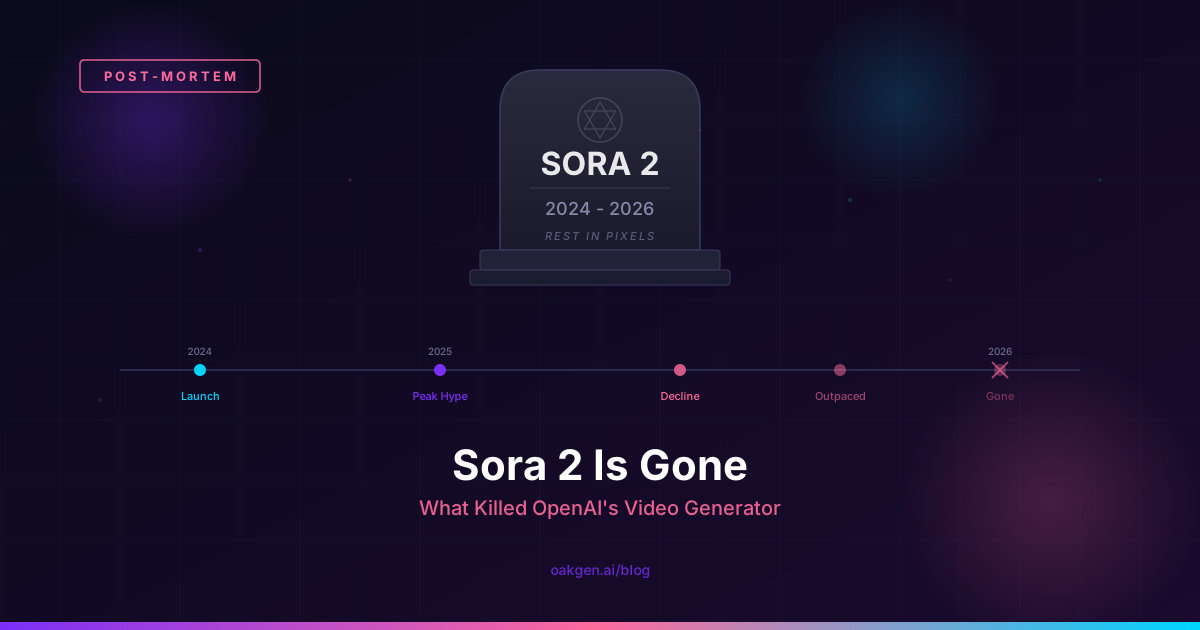
OpenAI's Sora launched with enormous hype but has struggled to maintain momentum. Sora 2 improved on the original's quality, but the model faces stiff competition from Kling, Veo, and Wan on both quality and pricing. Reports suggest OpenAI may be shifting resources away from Sora development, with some industry observers speculating the product could be sunset by the end of 2026.
The Sora story is a cautionary tale about hype cycles. Being first does not guarantee being best, especially in a market moving this fast.
Veo 3.1 and Google's Video Play
Google's Veo 3.1 has established itself as a strong contender in the cinematic AI video space. Its native audio generation and consistent visual quality make it a favorite for commercial and narrative content. Combined with Nano Banana 2 for image generation, Google now has a compelling end-to-end creative pipeline.
The Full 2026 Video Landscape
| Model | Creator | Resolution | Audio | Key Strength |
|---|---|---|---|---|
| Kling 3.0 | Kuaishou | 4K 60fps | Yes | Best overall quality |
| Veo 3.1 | 1080p | Yes | Cinematic style | |
| Sora 2 | OpenAI | 1080p | No | Creative storytelling |
| Runway Gen-4.5 | Runway | 4K | No | Temporal consistency |
| Wan 2.6 | Alibaba | 1080p | No | Multi-shot, budget |
| Hailuo 2.3 | MiniMax | 1080p | No | Reliable quality |
| LTX-2 | Lightricks | 4K upscale | Yes | Speed |
The Audio and Music Explosion
ElevenLabs at $11 Billion
ElevenLabs reached an $11 billion valuation in early 2026, making it one of the most valuable AI startups globally. Their text-to-speech technology has become the industry standard for AI voiceovers, audiobook narration, and content localization. The quality gap between ElevenLabs voices and real human speech has narrowed to the point where most listeners cannot tell the difference in controlled tests.
Suno's $300M ARR
Suno, the AI music generation startup, crossed $300 million in annual recurring revenue -- a staggering number for a company that barely existed two years ago. Their models can now generate full songs with vocals, instrumentation, and production quality that rivals indie releases.
The music industry's response has been mixed. Major labels are pursuing legal action while simultaneously licensing AI tools for their own use. The tension between copyright concerns and commercial opportunity defines the AI music space in 2026.
The Audio Tool Stack
The audio landscape in 2026 includes:
- ElevenLabs -- Premium text-to-speech and voice cloning
- MiniMax Speech HD -- High-quality TTS alternative
- Minimax Music V2 -- Versatile music generation
- Sonauto v2 -- Music from text prompts
- CassetteAI -- Lo-fi and retro music styles
- YuE -- Chinese music generation (expanding globally)
- Lyria 2 -- Google's music model
On Oakgen, you can access ElevenLabs and MiniMax Speech HD for voice generation, plus Lyria 3 Pro and Eleven Music through the Music Generator -- all under the same credit system.
The real power of 2026 AI tools is not any single model -- it is combining them. Generate an image, animate it into video, add a voiceover, and score it with AI music. Platforms that unify these tools under one roof, like Oakgen.ai, reduce the friction that makes multi-modal creation practical.
Enterprise Adoption: The Tipping Point
Advertising and Marketing
The advertising industry has become the largest enterprise consumer of AI creative tools. Agencies use AI for:
- Rapid concept prototyping (10 variations in minutes instead of days)
- Localized ad creative at scale (same concept, dozens of markets)
- UGC-style content generation (authentic-feeling ads without production crews)
- Product visualization for e-commerce catalogs
Oakgen's UGC Ads tool and Photo Studio are built specifically for these workflows.
Content Creation at Scale
Social media managers, YouTube creators, and newsletter authors are generating visual content at unprecedented volumes. The economics are compelling: a single $19/month subscription to a platform like Oakgen replaces what used to require stock photo subscriptions ($29-199/month), freelance designers ($50-500/project), and hours of manual creation time.
Film and Animation
The film industry's adoption has been more cautious but is accelerating. AI video is being used for:
- Previsualization and storyboarding
- Background plate generation
- Concept development
- Short-form content for social campaigns
Kling 3.0's multi-shot capability and character tracking bring AI video closer to production-ready quality for certain types of content.
Key Trends Shaping the Rest of 2026
Model Convergence
Image, video, audio, and 3D generation are converging. Models that started as text-to-image tools are adding video. Video models are adding audio. The trajectory points toward unified multi-modal models that generate entire scenes -- visuals, motion, sound, and music -- from a single prompt.
Resolution Race
4K is becoming table stakes for image models. Nano Banana 2 ships native 4K. Kling 3.0 does 4K video. The next frontier is 8K for image models and consistent 4K at 60fps for video.
Reference and Control
The most significant capability improvement is not raw quality but control. Nano Banana 2's 14 reference images, Kling 3.0's character tracking, and style-transfer capabilities across models all point toward AI tools that produce consistent, brand-aligned output rather than random beautiful images.
What This Means for Creators
If you are a creator in 2026, the landscape has never been more favorable:
- Quality is solved -- Multiple models produce professional-grade output across image, video, and audio
- Cost is plummeting -- What cost $1 per image in 2024 now costs $0.02-0.05
- Variety is exploding -- 40+ image models, 17+ video models, multiple audio and music options
- Integration is improving -- Multi-tool workflows that combine image, video, audio, and music are becoming practical
The challenge is no longer "can AI produce good creative content?" -- it can. The challenge is choosing the right tools and building efficient workflows. Platforms that simplify this choice by offering access to the best models in one place, with a unified credit system and seamless tool-to-tool handoffs, will define how most creators interact with AI in the coming years.