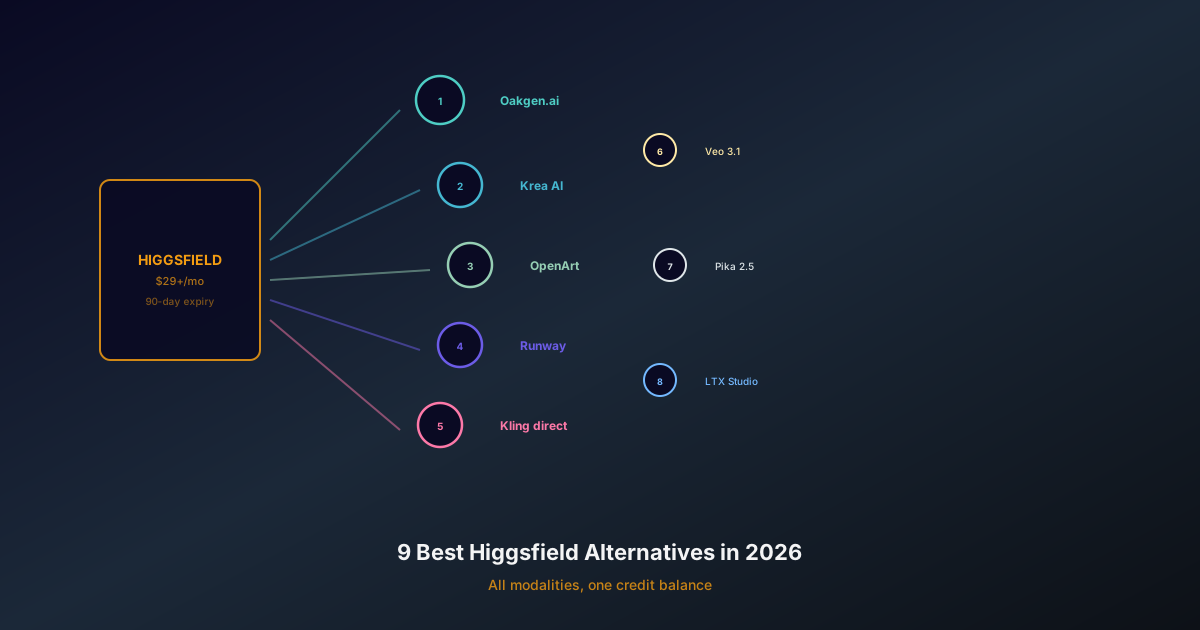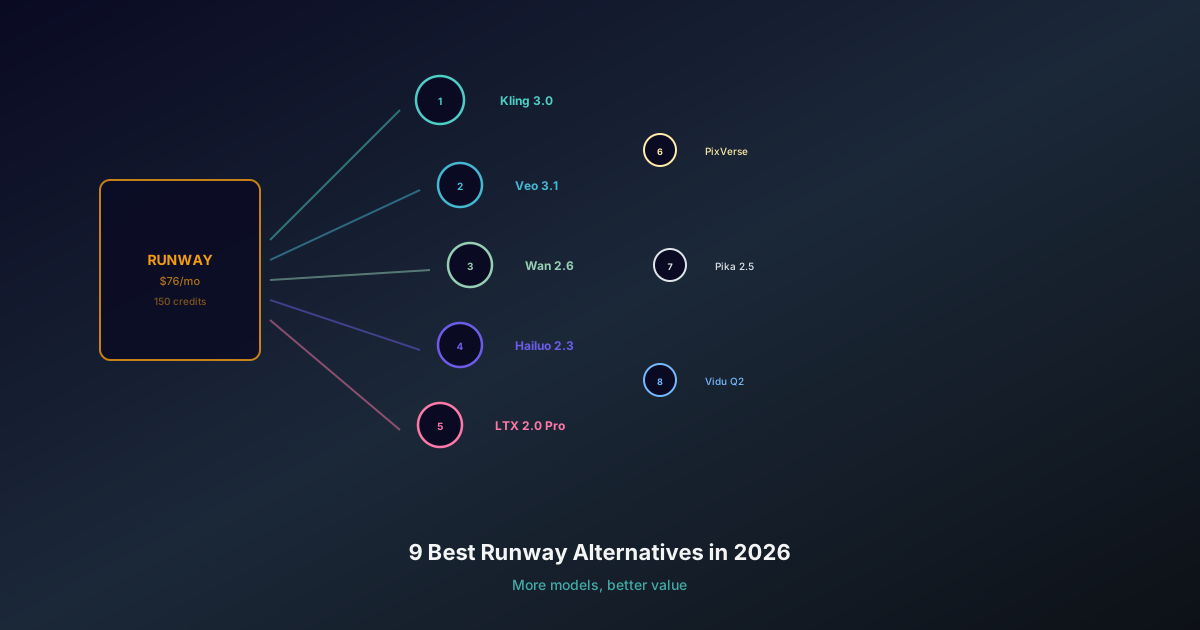
Choose Oakgen when the job needs several video models plus image references, voice, or music under one subscription. Choose Higgsfield for recurring-character campaigns and directed camera work. Choose Runway when Aleph 2.0, Final Cut, or Runway's proprietary Gen models are required.
Oakgen is our product. We checked official Higgsfield and Runway product and pricing pages on August 10, 2026. This is a workflow comparison, not a controlled output test, and promotional prices can change.
Run the Video Brief on Oakgen First
Compare model families, build image references, and add voice or music without buying two specialist production suites.
Quick verdict
| Job | Better starting point | Reason |
|---|---|---|
| Mixed-model video plus image, voice, or music | Oakgen | One credit balance covers the full campaign stack |
| Comparing model families before committing | Oakgen | The buyer is choosing output, not a specialist interface |
| Persistent spokesperson or recurring character | Higgsfield | Soul ID is built around identity reuse across production |
| Camera-led campaign clips | Higgsfield | Cinema Studio and campaign tools reduce setup |
| URL-to-ad and guided campaign production | Higgsfield | Marketing Studio covers more of the brief-to-asset path |
| Proprietary cinematic model access | Runway | Gen-4.5 and Gen-4 Turbo are Runway products |
| Targeted editing and clip assembly | Runway | Edit Studio, Aleph 2.0, and Final Cut cover revisions and short-form assembly |
| Shared third-party model access | Oakgen | Run the models without paying for both specialist layers |
How we compared them
We evaluated six production stages: brief, subject consistency, generation, camera control, editing, and delivery. We used official product descriptions and plan details rather than claiming hands-on results we did not collect for this update.
The shared-model issue matters. Higgsfield's official July comparison says both services carry Seedance 2.0, Kling 3.0, WAN 2.6, Veo 3.1, and Gemini Omni Flash. Model availability changes, but the pattern is stable: a buyer often chooses the surrounding product, not exclusive access to a third-party model.
Where Higgsfield is stronger
Persistent identity
Higgsfield describes Soul ID as a reusable character identity that works across supported models and sessions. That can save a campaign team from rebuilding a spokesperson with fresh references for every shot.
The value depends on the job. One-off product b-roll does not need a trained identity. A 20-asset campaign with the same person may.
Campaign production
Marketing Studio is aimed at turning a product URL or brief into formatted campaign assets. This sits earlier in the process than a traditional video editor. It helps answer what to make, not only how to alter the finished clip.
Camera intent
Cinema Studio brings camera language and production controls into generation. That is useful for a team that thinks in shots: orbit, dolly, tracking, crane, close-up, and reveal.
Guided execution
Higgsfield's Supercomputer product is positioned as an agent-style production layer that plans steps, selects tools, and shows cost before execution. A creator who wants guidance may value this more than a deep manual timeline.
Where Runway is stronger
Proprietary Gen models
Runway owns Gen-4.5 and Gen-4 Turbo. If one of those models is required by the creative director, a competing host cannot replace it with the exact same model.
Runway's current pricing page lists Gen-4.5 at 60 credits for five seconds and translates plan credits into estimated generation time. That makes the model cost easier to forecast than a generic “videos per month” promise.
Editing and targeted changes
Runway's clearest separation is after the first generation. Its current Edit Studio uses Aleph 2.0 to change products, characters, backgrounds, objects, lighting, or style across clips up to 30 seconds. Final Cut can split, trim, arrange, and export clips, either manually or with Runway Agent. A team that expects local revisions and short-form assembly may prefer those controls.
Motion Brush should not be part of a current buying decision. Runway says it belonged to the retired Gen-2 model and is unavailable on newer models.
Audio tools on higher plans
Runway Pro lists custom voices for lip sync and text to speech. Runway's current product has moved beyond the old “video only” description found in many comparison articles.
Transparent plan examples
Runway currently publishes concrete examples: Standard's 625 monthly credits equal 52 seconds of Gen-4.5 or 104 seconds of Gen-4 Turbo, according to its pricing page. These are generation-time equivalents, not approved deliverables, but they help forecasting.
Pricing compared
| Platform and tier | Displayed price checked | Allowance | Important rule |
|---|---|---|---|
| Higgsfield Basic | $9/month in its July comparison | 120 credits | Live promotions and checkout can vary |
| Higgsfield Plus | $49/month | 1,000 credits | Model cost changes output count |
| Higgsfield Ultra | $129/month | 3,000 credits | Best suited to steady volume |
| Runway Standard | $15 monthly; $12/month annual | 625 credits/month | Monthly credits do not roll over |
| Runway Pro | $35 monthly; $28/month annual | 2,250 credits/month | Adds custom voice tools and more storage |
| Runway Max | $95 monthly; $76/month annual | 9,500 credits/month | Up to one month of unused credits rolls over |
Runway says purchased extra credits do not expire. Confirm Higgsfield's current rules for plan credits, top-ups, and promotions at checkout.
For a deeper model-attempt worksheet, use the Higgsfield pricing guide.
The production-stage matrix
| Stage | Higgsfield | Runway | Buying question |
|---|---|---|---|
| Brief | Marketing Studio and guided production | Manual setup or agent/editor workflow | Do you need help deciding the asset set? |
| Character | Soul ID persistence | References and character tools | Must identity survive across sessions and models? |
| Generation | Shared models plus Higgsfield tools | Shared models plus proprietary Gen models | Is an exclusive model required? |
| Camera | Cinema Studio and camera-aware generation | Director controls and motion tools | Is control needed during generation or after it? |
| Editing | Useful creative tools, less timeline-centered | Stronger post-generation and targeted editing | How many local revisions happen before approval? |
| Delivery | Campaign-oriented outputs | Editing, upscaling, storage, export | Where does the finished asset actually leave the workflow? |
This table is the most useful way to choose. A production that begins with a recurring character has a different bottleneck from one that begins with a finished clip needing frame-level repair.
Which one is better for AI ads?
Higgsfield has the clearer starting point for short-form ad production because it combines character identity, camera direction, lip sync, and campaign tooling. That can reduce the time between product brief and first batch of hooks.
Runway becomes more attractive when the ad depends on targeted clip changes, timeline assembly, or a proprietary Gen model. It may also be the better home for a team that already edits inside Runway.
For high-volume UGC-style production, compare both against a purpose-built AI UGC ad generator. The right test is ten variations of one real offer, not one polished demo.
Which one is better for filmmakers?
Runway is a strong choice for filmmakers who value Gen-4.5, targeted changes, and a familiar edit-oriented surface. Higgsfield is attractive for previsualization, recurring identities, camera-led generation, and a guided path across many shots.
Neither replaces every part of a professional post-production stack. Check codec, resolution, frame rate, color workflow, audio handoff, and timeline export before treating either as the only production tool.
When Oakgen fits
Oakgen is not a clone of Cinema Studio or Runway's editor. It fits when the bottleneck is access to several model families and creative formats under one account.
A team may use Oakgen for image references, compare video models, generate voice or music, and finish in a dedicated editor. That can cost less than paying for two overlapping generation suites when their specialist features are not needed.
The broader decision is covered in Oakgen vs Higgsfield vs Krea. Compare Oakgen pricing only after estimating attempts per approved clip.
One Credit Balance for the Campaign
Use Oakgen for product images, video variations, voiceover, and music, then finish in the editor your team already uses.
A 45-minute pre-purchase test
Use one reference image, one product, and one short script. Keep the desired output to five or ten seconds so the test stays affordable.
Run these tasks on both platforms:
- Generate a shot with a named camera move and one subject action.
- Ask for a second shot with the same subject and a different location.
- Change one part of the first clip without changing the rest of the composition.
- Add or generate spoken audio if that is part of the real workflow.
- Export the clip in the ratio and resolution used by your delivery channel.
Record the following rather than relying on first impressions:
| Measure | Higgsfield | Runway |
|---|---|---|
| Setup minutes | ||
| Generation attempts | ||
| Credits spent | ||
| Character/reference failures | ||
| Local edits completed without regeneration | ||
| External tools needed | ||
| Minutes to an approved export |
The winner is the service with the lower cost and time per approved export for your repeated job. A beautiful first generation can still lose if every revision requires starting again. A feature-rich editor can also lose if the team never uses its post-production controls.
Common comparison mistakes
Calling Higgsfield a preset tool
Its 2026 product includes identity, campaign, canvas, audio, MCP/CLI, and agent-style production features.
Calling Runway video-only
Runway now lists image and audio tools alongside video, and Pro includes custom voice features.
Comparing credits directly
One Runway credit and one Higgsfield credit are not equivalent. Compare the cost of the exact model and setting.
Ignoring the editor
If most production time happens after generation, the editing surface can matter more than a cheaper attempt.
Using one lucky output as a benchmark
Record attempts, failures, revisions, and approval rate across the same brief.
Sources
- Higgsfield AI vs Runway: official July 2026 comparison
- Higgsfield pricing
- Runway pricing
- Runway Edit Studio and Aleph 2.0 guide
- Runway Final Cut trimming and assembly guide
- Runway custom voice guide
- Runway Gen-2 and Motion Brush deprecation
Choose the stage that saves the most work
Oakgen wins when subscription overlap and model choice are the repeated burden. Higgsfield earns its place when identity and campaign setup save real time. Runway earns its place when proprietary generation and post-production controls are required.
If neither specialist layer is central, run the same shot through Oakgen's AI video generator and keep the editor your team already trusts.
Start with Oakgen, Add a Specialist Only If Needed
Plans start at $9 with image, video, voice, and music tools under one account.