Oakgen.ai
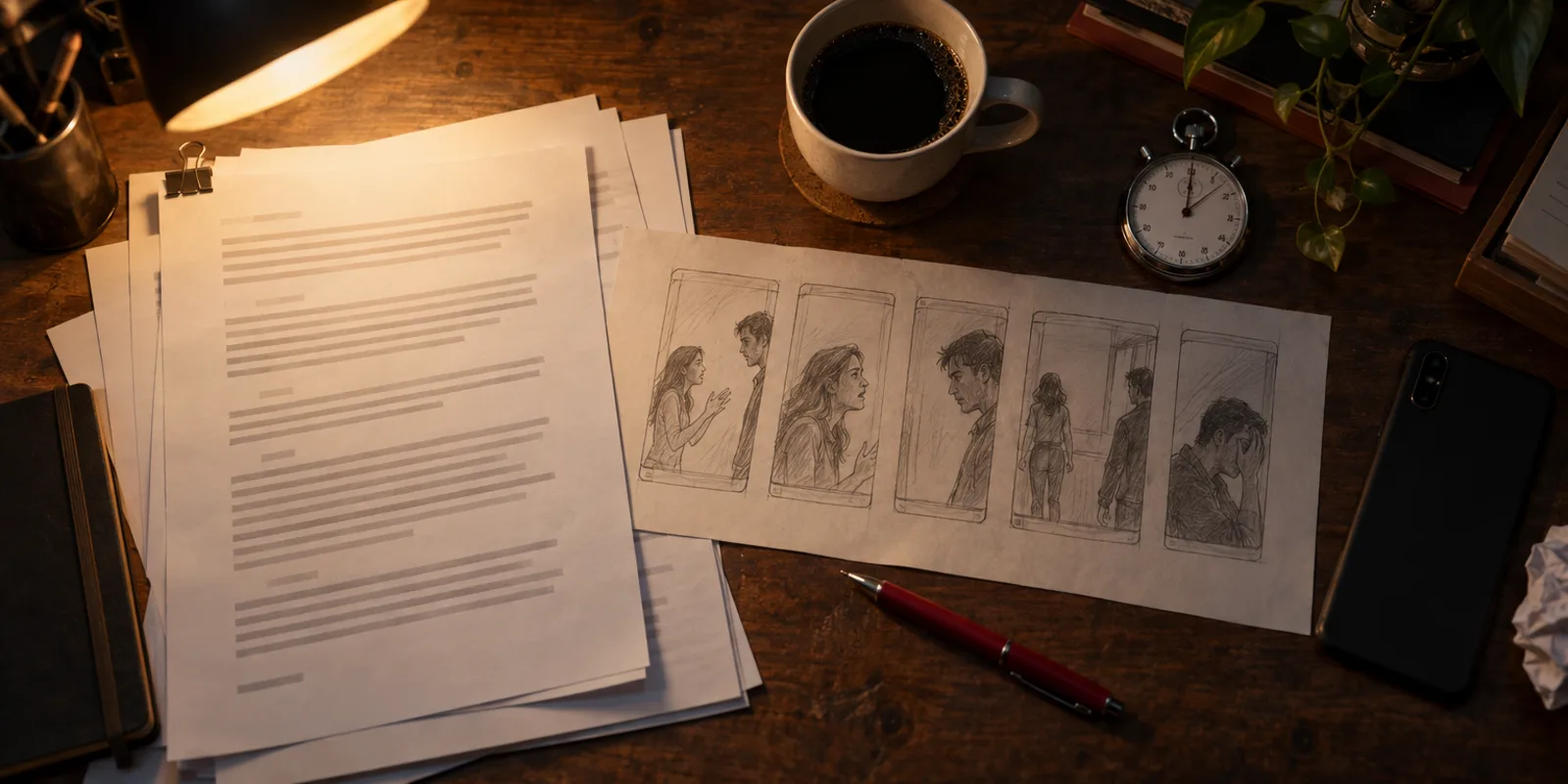
A micro drama episode of 60 to 90 seconds needs five beats: a hook in the first 3 seconds, a short setup, one escalation, a turn, and a cliffhanger in the last few seconds. Budget about 90 to 130 words of dialogue per 60 seconds, end every episode except the last on an open question, and write the season arc before episode 1.
The word budget is our rule of thumb, built from a measured speaking rate cited below. The rest of this guide gives a beat sheet with timings, how to write the hook and the cliffhanger, a season arc, a copyable template, and how Oakgen Micro Drama turns an idea or a finished script into a shot-by-shot script you then edit. If you are new to the format, start with what a micro drama is.
How much script fits in one episode?
Less than most first drafts. Researchers at the University of Pennsylvania measured conversational English at an average of 152 to nearly 170 words per minute, depending on the topic, with silences removed (Yuan, Liberman and Cieri, 2006). A drama is not wall-to-wall talk. It needs a beat of silence before a reveal, a reaction shot and action with no line. So we plan for someone to be speaking 60 to 75 percent of the time, which gives the budgets below.
| Episode length | Dialogue budget (our rule of thumb) | 15-second shots |
|---|---|---|
| 30 seconds | 45 to 65 words | 2 |
| 45 seconds | 70 to 95 words | 3 |
| 60 seconds | 90 to 130 words | 4 |
| 90 seconds | 135 to 195 words | 6 |
The shot column is how Oakgen Micro Drama plans an episode as of 2026-10-30. Its writer makes every shot 15 seconds long, plus one shorter shot of 5 or 10 seconds when the length is not a multiple of 15. Its instructions say a 15-second shot "can carry a short sequence of action and a line or two of dialogue". That is a useful rule for any AI video tool, because a video model makes one clip per prompt, and even Seedance 2.5 and Kling V4 on Oakgen stop at 30 seconds per clip as of 2026-10-30.
Check every scene by reading it aloud against a stopwatch. If you run over, cut words before you cut beats.
What is the beat sheet for a 60 to 90 second episode?
Five beats, each with one job. The timings below are for a 60-second episode, with the 90-second version in brackets.
- Hook, 0 to 3 seconds. The conflict in one image or one line. A slap, a ring thrown on the floor, "You were never my husband."
- Setup, 3 to 15 seconds (3 to 20). Who these people are to each other and what one of them wants, in as few words as you can. On episode 2 onward, this is where you pay off the last cliffhanger.
- Escalation, 15 to 40 seconds (20 to 55). The want meets resistance and the pressure rises. One complication, not three.
- Turn, 40 to 52 seconds (55 to 80). Something flips: a secret comes out, an ally betrays, the plan works too well.
- Cliffhanger, the last 5 to 8 seconds. A new question the viewer needs answered, ending on a face or an object, not on a resolved line.
In a 90-second episode, use the extra time for a second escalation or a longer reaction, not for a second plot.
How do you write the 3-second hook?
Open on the conflict itself. TikTok's ad guidance, last updated June 2025, says to "Introduce your content proposition in the first 3 seconds" and to "Prioritize your hook in the first 6 seconds". That page is written for ads, but a drama episode in a vertical feed faces the same swipe.
Hooks that work in this format usually take one of four forms:
- Mid-action. Start after the fight has begun. Cut the walk to the door.
- A line that states the stakes. "Sign the divorce papers or lose the baby." The viewer knows the problem before they know the names.
- A visual reveal. The poor waitress takes off her apron and the room bows.
- The last episode's cliffhanger, replayed. Two or three seconds of the moment the viewer already wants resolved.
Avoid openings that set a scene: a skyline, an alarm clock, a character walking into a building. They spend your three seconds on information the viewer does not need yet. For hook lines grouped by trope, see micro drama tropes and hooks.
How do you write a cliffhanger that earns the next episode?
End on a question, not a statement. Wikipedia's Microdrama article describes cliffhangers "engineered to appear at the end of nearly every episode", and in a pay-per-episode app that is the moment a viewer decides to unlock the next one.
Five types are worth rotating so the series does not feel repetitive:
- Reveal. A fact lands that changes who someone is. "She's his sister."
- Arrival. Someone walks in who should not be there.
- Threat. A deadline or a weapon. "You have until midnight."
- Decision. A character must choose, and we cut before they do.
- Interrupted line. The confession starts and the door opens.
Cut on the reaction, not after it. Hold the last shot on a face for a beat, then end. The final episode of a season is the exception. It answers the main question, and it can open one new one if you plan a second season.
How do you plan a season arc?
Write the whole arc on one page before you write episode 1. App series often run 20 to 100 episodes (Wikipedia), and MIT Technology Review reports viewers can finish one "in as little as 30 minutes to an hour", so the series has to hold together when it is binged.
For a short season of 6 to 8 episodes, this shape works:
| Episode | Job |
|---|---|
| 1 | The premise in full: who is wronged, what they want, the first cliffhanger |
| 2 | First move. The protagonist acts, and it costs them |
| 3 | A new obstacle, often a rival or a secret |
| Middle | The reversal. What we believed about someone is wrong |
| Second to last | The lowest point. Everything the protagonist built is taken |
| Last | The payoff the premise promised, and the main question answered |
Then keep a series bible next to the arc: each character's name, age, look, wardrobe and way of speaking, the places, and the rules that never change. In AI video the bible is also the reference sheet, so a vague bible produces drifting faces. Keeping the same characters across episodes covers the visual side.
What does a micro drama script template look like?
One block for the series, then one block per episode with a line per shot. Copy it and fill the brackets. The shot lines are written so that each one can become a 15-second clip in any AI video tool.
SERIES Title: [title] Logline: [who wants what, and what stands in the way, in one sentence] Genre: [one to three, e.g. Revenge, Romance] Episodes: [number] x [seconds] seconds Ending: [how the main question is answered in the last episode]
CHARACTERS (keep to four or fewer) [Name], [age], [role]. Looks: [face, hair, build, marks]. Wears: [fixed outfit]. Speaks: [how they talk] [Name], ...
PLACES [Place name]: [what it looks like, time of day]
ALWAYS TRUE
- [a rule that never changes, e.g. Mara never takes off the silver ring]
EPISODE [n]: [title] Hook (0-3s): [the image or line that states the conflict] Ends on: [the open question]
SHOT 1 (15s) | [place] | [camera, e.g. close-up, slow push in] Action: [who is in frame and what they do, beat by beat] [NAME]: [line]
SHOT 2 (15s) | [place] | [camera] Action: [...] [NAME]: [line] [NAME]: [line]
SHOT 3 (15s) | ... SHOT 4 (15s) | ... [last shot holds on the cliffhanger]
Here is episode 1 of an invented series written in that template, at 60 seconds and 94 words of dialogue.
EPISODE 1: The Wrong Bride Hook (0-3s): A bride in white is pushed out of the church door into the rain. Ends on: The groom's mother recognises the bride's ring and knows her dead mother.
SHOT 1 (15s) | Church steps, night, rain | Wide, then fast push in Action: Lena, 26, in a soaked wedding dress, stumbles down the steps. Behind her the doors slam. Her new husband, Adrian, 30, stands at the top. ADRIAN: You signed the contract. One year as my wife. Then you disappear. LENA: You told me this was to save your company. Not to humiliate me.
SHOT 2 (15s) | Church steps | Two-shot, Adrian walks down to her Action: Adrian hands her an umbrella without looking at her. ADRIAN: It is. Don't confuse kindness with anything else. LENA: I won't. I need the money for my brother's surgery. That's all this is.
SHOT 3 (15s) | Mansion hall, night | Medium, Lena enters dripping Action: A row of staff turns to stare. Adrian's mother, Celia, 58, in pearls, walks toward Lena slowly. CELIA: So this is the girl from nowhere. Adrian, she's dripping on my floor. LENA: My name is Lena. And I'll be gone in a year, so don't learn it.
SHOT 4 (15s) | Mansion hall | Close-up on the ring, then on Celia's face Action: Celia grabs Lena's hand. She stares at the silver ring on Lena's finger. Her face goes white. CELIA: Where did you get this ring? LENA: It was my mother's. CELIA: Your mother died twenty years ago. In this house. Hold on Lena's face. Cut.
The hook is visible before anyone speaks. The setup is done by shot 2. The turn is the ring, and the episode ends on a question the next episode must answer.
How does Oakgen Micro Drama turn an idea into a script?
It writes the whole series in one pass, then lets you change it before anything is filmed. These are the steps as of 2026-10-30.
- Give it an idea or your script. Open /app/drama and type an idea in the box, which takes up to 12,000 characters. That is enough for the filled template above for a short season. Pick 1 to 3 genres from Romance, Mystery, Thriller, Revenge, Drama, Medical, Comedy and Fantasy, then 1 to 8 episodes at 30, 45, 60 or 90 seconds each. The writer's instructions say that if the brief "contains a finished script", it should "adapt it faithfully: keep its plot, characters and dialogue, and only structure, time and describe it". It is an AI writer, so read the result rather than assume it.
- Read what comes back. Press "Write my series". The writer returns a title, a cast of up to 4 characters, the places, a list headed "Always true in this series", and every episode's script split into scenes and shots of up to 15 seconds, each with an action description, a camera note and its spoken lines. The cast and world page shows the cast, places, rules and episode titles. You read each episode shot by shot on its storyboard, after you approve that episode and before anything is filmed.
- Rewrite before you lock. On the cast and world page, "Rewrite the story" takes a note such as "Make Leo the one who calls the police" and rewrites the series. The button shows the credit price before you confirm. On the same page you can edit a character's description, add or change outfits and ask for a new face, then lock the cast and world.
- Review the storyboard. When you approve an episode, Oakgen draws a storyboard frame for each shot with its first line under it, and waits for your review unless you ticked "Skip my storyboard review when every check passes". Open a frame to read its action, who is in it, where it happens and its spoken lines, and ask for a redraw with a note such as "hold on her face longer". The redraw price comes out of the episode's limit.
- Edit lines and fix after filming. Once the episode is filmed, open a shot to change what a character says. Saving a line is free and changes the script at once. The shot keeps its old voice until you redo it, which costs credits shown on the button. You can also redo a shot with a director's note, use an earlier take, cut a shot, or fix a caption. Caption fixes are free and change only the on-screen words.
The limits shape what you should write for it. A series is capped at 300 seconds, so the longest options are 5 episodes of 60 seconds or 3 of 90. The writer works in English only. A series has at most 4 characters, a shot has at most 3 speakers, and episodes play in the app with no downloadable file yet. Filming needs a paid plan. The full production flow, from cast to finished episode, is in how to make an AI micro drama, and what filming costs per episode is in AI micro drama cost per episode.
When is another way of writing the better choice?
When the series is longer, in another language, or has a bigger cast than Oakgen Micro Drama holds today. A 40-episode season, a Hindi script or a five-person family feud should be written in a plain document or a screenwriting app using the template above, then produced shot by shot in an image, video and voice workflow. Our Seedance 2.5 short film guide shows that route, and fixing two-person dialogue covers the most common failure when two characters talk in one AI shot.
If you post AI episodes on TikTok, YouTube or Instagram, label them where the platform asks. The rules are in do you have to label AI videos.
How we checked this
We read the Yuan, Liberman and Cieri speaking-rate paper, TikTok's creative best practices page, Wikipedia's Microdrama article and the MIT Technology Review report on 2026-10-30. The dialogue budget is our own calculation from the measured rate, not a published standard. The beat timings and hook and cliffhanger types are our editorial advice, not measured results. The example episode is invented for this guide and was not filmed. Oakgen facts come from the Micro Drama code and its writer instructions on the release that went live on oakgen.ai on 2026-10-30. We did not test how faithfully the writer keeps a pasted script, and limits can change.
Turn your script into a series
Paste an idea or a finished script, pick genres and episodes, and review each episode's storyboard before anything is filmed.
Frequently asked questions
How long is a micro drama script?
One page or less per episode. A 60-second episode carries about 90 to 130 words of dialogue and four to six short action lines. That budget is our rule of thumb, derived from measured conversational English of 152 to about 170 words per minute (Yuan, Liberman and Cieri, 2006), with time left for silences, reactions and action.
How many words of dialogue fit in a 60-second episode?
About 90 to 130 words if the episode is dialogue-led. Measured conversational English runs at 152 to about 170 words per minute without pauses, and a drama needs pauses, so plan for someone to be speaking 60 to 75 percent of the runtime. Read every line aloud against a stopwatch to check.
What is the 3-second hook in a micro drama?
The first image or line, which has to tell the viewer what is at stake before they swipe. TikTok's ad guidance, last updated June 2025, says to introduce your proposition in the first 3 seconds and to put the hook in the first 6. For a drama that means opening on the conflict itself, not on a location or a character waking up.
Should every micro drama episode end on a cliffhanger?
Every episode except the last. Wikipedia's Microdrama article describes cliffhangers at the end of nearly every episode, because each episode has to earn the next tap. The final episode resolves the main question.
Can I paste my own script into Oakgen Micro Drama?
Yes. The idea box takes up to 12,000 characters, and Oakgen's series writer is instructed to adapt a finished script faithfully, keeping its plot, characters and dialogue and only splitting, timing and describing it. It is an AI writer, so check the result before you lock the cast. As of 2026-10-30 the writer works in English, a series holds up to 4 characters, and a series is capped at 300 seconds.
How many episodes should a micro drama season have?
App series usually run 20 to 100 episodes, per Wikipedia's Microdrama article. For a first series you post yourself, write a short season of 3 to 8 episodes that resolves, so you can test whether viewers follow it before writing more.
Sources
- Yuan, Liberman and Cieri, Towards an Integrated Understanding of Speaking Rate in Conversation (Interspeech 2006)
- TikTok Ads Help, Creative best practices for performance ads (last updated June 2025, read 2026-10-30)
- Wikipedia, Microdrama (read 2026-10-30)
- MIT Technology Review, How Chinese short dramas became AI content machines (2026-05-15)