Oakgen.ai
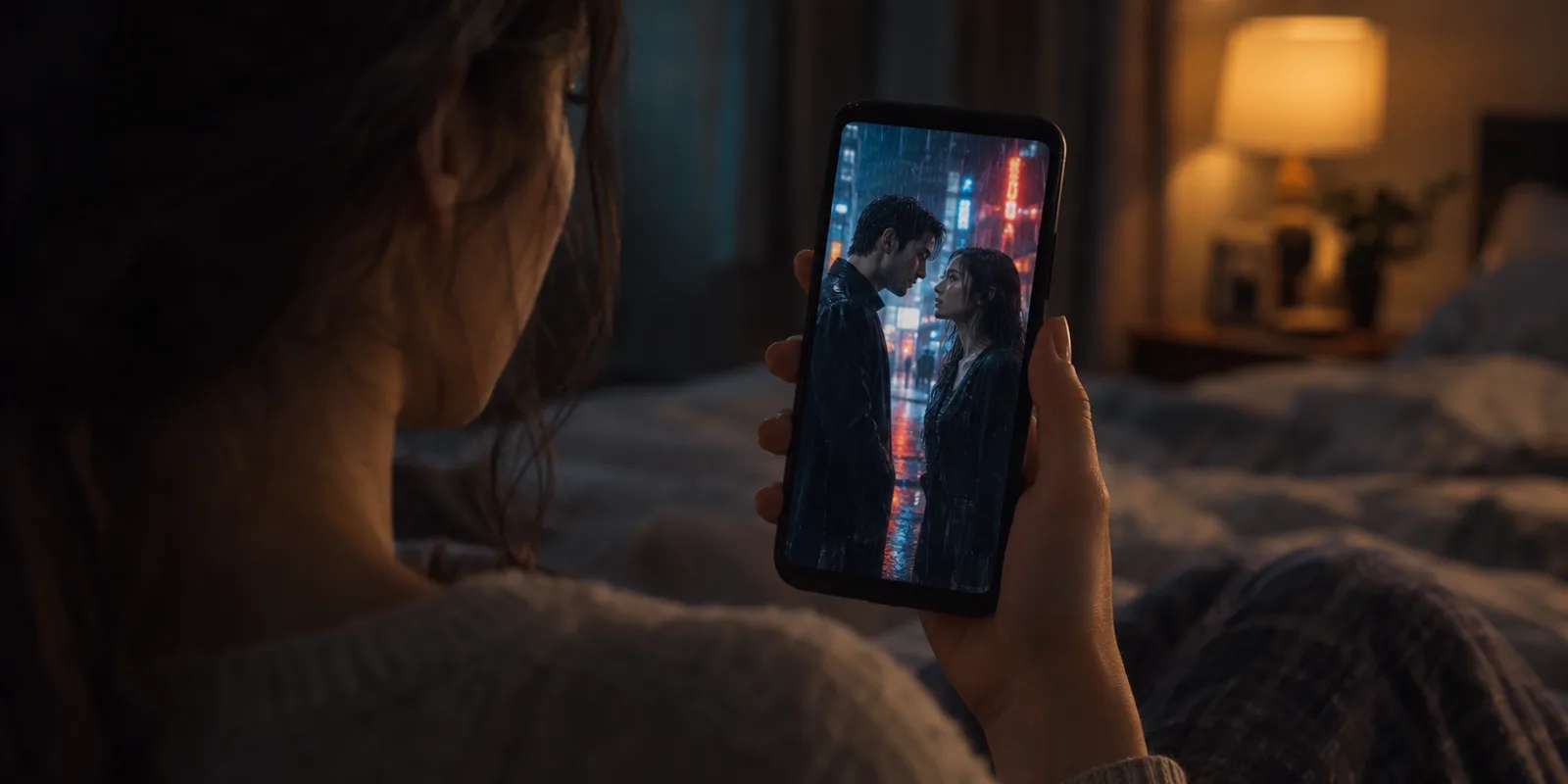
A micro drama is a scripted fiction series made for phones. Episodes usually run 1 to 2 minutes, are shot vertically at 9:16, and almost all of them end on a cliffhanger. A series can run 20 to 100 episodes. Apps such as ReelShort and DramaBox give the first episodes away and charge to unlock the rest.
The same format goes by several names: vertical drama, short drama, mini drama, and duanju in China, where it started. This guide covers what defines the format, how the apps earn from it, how it differs from a web series or a YouTube Short, and what AI changes about making one. Every outside fact links to its source, read on 2026-10-30.
What makes a series a micro drama?
Five traits together define it. Any one alone also describes plenty of other video, so check all five.
| Trait | Micro drama | Source |
|---|---|---|
| Episode length | 1 to 2 minutes | Wikipedia, Microdrama; MIT Technology Review |
| Episodes per series | 20 to 100 | Wikipedia, Microdrama |
| Frame | Vertical, 9:16 | Wikipedia, Microdrama |
| Episode ending | A cliffhanger at the end of "nearly every episode" | Wikipedia, Microdrama |
| How viewers pay | Free opening episodes, then coins, ads or a subscription per series or per app | ReelShort and DramaBox App Store listings |
The stories lean on fast, high-emotion premises. Sensor Tower's 2026 report says the format "typically centers on high-emotion genres". Common premises include revenge, hidden heirs, contract marriages, billionaires, werewolves and second chances. We list 30 of them, each with an episode-1 hook, in micro drama tropes and hooks.
Watched in a row, a whole series is about the length of a film. MIT Technology Review's May 2026 report says viewers "can finish an entire series in as little as 30 minutes to an hour".
Where did micro dramas come from?
They started in China. Wikipedia's Microdrama article traces the duanju format to comedy sketches and serialized short videos on Douyin and Kuaishou around 2018, and its stories to Chinese web fiction. China's National Radio and Television Administration "formally recognized the duanju as a distinct genre of online audiovisual content" in 2020, according to the same article.
Apps then took the format abroad. Wikipedia credits ReelShort with being "among the most widely downloaded microdrama apps globally". DramaBox, introduced in April 2023, "initially purchased the rights to Chinese short dramas and translated them for international distribution" and "later also produced a large number of original short dramas", according to its Wikipedia article.
How do micro drama apps make money?
They sell access to episodes. Wikipedia describes three models: pay per episode, fully ad-supported, and a hybrid of free episodes, a paywall, rewarded ads and optional subscriptions. ReelShort and DramaBox show the hybrid in their store pages:
- ReelShort. Its App Store listing, read on 2026-10-30, sells a subscription that is "valid for 7 days" and says that "While your subscription is active, you can watch all tv mini series for free." One-time purchases are listed from $4.99 to $29.99.
- DramaBox. Its listing sells memberships from $5.99 to $19.99. In replies to reviews, the developer says viewers "can unlock dramas for free by collecting free coins through completing tasks or simply by watching ads."
The money is large and it goes to the apps. Sensor Tower estimates short drama apps took "roughly US$750M in Q1 2026, up 20% year-on-year" in in-app revenue, with DramaBox and ReelShort "each generating close to US$140M". Downloads passed 850 million in that quarter. Those figures are app-store estimates and leave out ad revenue. For where independent creators fit, read how micro drama makes money.
Why did the format spread so fast?
Two measured trends and one feature of the model point to why. No source we read proves the cause.
- Viewers spend real time in the apps. Sensor Tower measured average daily time in short drama apps at 25 minutes globally by April 2026, up 85% from January 2025, while time in streaming video apps stayed "broadly flat at around 35 minutes".
- New markets grew fastest. In Q1 2026 Southeast Asia took 32% of downloads, Latin America 23% and India 22%, "all three markets posting triple-digit year-on-year growth", per Sensor Tower.
- The episodes fit the paywall. A one-minute episode that ends on a cliffhanger asks for one small payment at the moment the viewer most wants the next scene. That is our reading of the model, not a measured finding.
How is a micro drama different from a web series or a YouTube Short?
It differs from each on a different axis. A Short is one standalone video. A web series is serialized, but its episodes are usually longer and its framing is usually horizontal. A micro drama is serialized, vertical and cut into 1 to 2 minute pieces that each end on a hook.
| Micro drama | Web series | YouTube Short | |
|---|---|---|---|
| Unit | One episode of a 20 to 100 part series | One episode of a series | One standalone video |
| Length | 1 to 2 minutes | No standard length | Up to 3 minutes (uploads on or after 2024-10-15) |
| Frame | 9:16 | Usually horizontal | Square or vertical |
| Story shape | A cliffhanger nearly every episode | Varies | Self-contained |
| Typical home | ReelShort, DramaBox and other drama apps | YouTube and streaming platforms | YouTube |
The Shorts length and frame come from YouTube Help, read on 2026-10-30. The web series column describes common practice, not a rule.
Many creators post micro drama episodes as Shorts, TikToks or Reels, so one video can be both an episode and a Short. Each platform's series and playlist features are covered in how to post a micro drama series.
What does AI change about making a micro drama?
It cuts the cost and time of production, by the producers' own figures. AI does not remove the need for a script that works.
- Cost. A FlexTV executive told MIT Technology Review that a North American short drama "once cost roughly $200,000" and that "AI can cut that cost by 80% to 90%".
- Time. The same report says development "used to take three to four months" and "can now take less than a month". A Caixin photo caption from March 2026 says an AI short drama "takes less than five days and costs about 10% of a traditional live-action project", against 15 to 30 days for live action.
- Volume. MIT Technology Review, citing the analytics firm DataEye, reports that "An average of 470 AI-generated short dramas were released every day in January" in China.
Those are company claims reported by journalists, not audited numbers. The work that does not get cheaper is the writing and the fixing. AI video still drifts on faces, voices and outfits between shots, so a series needs locked character references and someone who watches every shot. Keeping the same characters across episodes covers that problem, and AI micro drama cost per episode works out what an episode costs in credits.
If you post AI-made episodes, platforms ask you to label realistic AI content. The rules by platform are in do you have to label AI videos.
Can you make a micro drama on Oakgen?
Yes, a short series. Oakgen Micro Drama, at /app/drama (sign-in required), went live on 2026-10-30. It does the steps below, as of that date.
- Write. Type an idea of up to 12,000 characters, pick 1 to 3 genres, 1 to 8 episodes and 30, 45, 60 or 90 seconds per episode. The writer returns the cast, the series rules and every episode's script.
- Cast and lock. Oakgen draws each character's face and outfits and the places, then you lock the cast and world so every episode uses the same faces. Characters do not get a fixed voice yet, so the video model voices each shot.
- Film each episode. You approve each episode under a credit limit that you see first, review its storyboard, then let it film shot by shot with spoken lines and captions.
- Fix. Redraw a frame, redo a shot with a director's note, pick an earlier take, or fix a caption for free.
The limits matter for this format. A series is capped at 300 seconds in total and 8 episodes, so Oakgen makes a pilot or a short season, not a 60-episode app series. Video is 9:16 at 768p, the writer works in English only, and a series has at most 4 characters. Episodes play in the app, and there is no downloadable episode file yet. Filming needs a paid plan, and the live price range shows before you start. The full method, tool by tool, is in how to make an AI micro drama, and the writing side is in how to write a micro drama script.
If you need dozens of episodes, a 1080p file to upload, or a language other than English, Oakgen Micro Drama cannot do that today. Use an image, video and voice stack with an editor instead. Our Seedance 2.5 short film guide shows that route.
How we checked this
We read the Wikipedia Microdrama article, the Sensor Tower 2026 report, the MIT Technology Review and Caixin articles, the ReelShort and DramaBox App Store listings and the YouTube Shorts help page on 2026-10-30. Caixin's full article is paywalled, so we quote only its public photo caption. We did not install the apps or pay to unlock episodes, so the pricing above is what the store listings show, and in-app prices may differ by region. Oakgen facts come from the Micro Drama code and its documentation on the release that went live on oakgen.ai on 2026-10-30. Limits can change.
Write your first micro drama series
Type an idea, pick genres and episodes, and review each episode's storyboard before anything is filmed.
Frequently asked questions
What does micro drama mean?
A micro drama is a scripted fiction series made for phones. Episodes are usually 1 to 2 minutes long, filmed vertically at 9:16, and nearly every episode ends on a cliffhanger. A series can run from 20 to 100 episodes. The same format is also called vertical drama, short drama or, in China where it started, duanju.
Is a micro drama the same as a vertical drama or a short drama?
Yes. Micro drama, vertical drama, short drama, mini drama and duanju all name the same format. Apps tend to say short drama or drama shorts in their store listings, and press coverage in the US often says vertical drama or microdrama.
How long is a micro drama episode?
Usually 1 to 2 minutes. Wikipedia's Microdrama article gives 1 to 2 minute episodes and 20 to 100 episodes per series. ReelShort's App Store listing, read on 2026-10-30, describes "one-minute short movie episodes".
Are micro dramas free to watch?
Partly. The usual model gives away the opening episodes, then asks you to unlock the rest with coins, by watching ads, or with a subscription. ReelShort's App Store listing, read on 2026-10-30, sells a 7-day subscription that unlocks all series, and DramaBox's developer replies say coins can be earned by completing tasks or watching ads.
Are micro dramas made with AI?
A growing share is. MIT Technology Review reported on 2026-05-15 that an average of 470 AI-generated short dramas were released every day in January 2026 in China, citing DataEye. Most of the big app catalogues still carry live-action series with real actors.
Can I make a micro drama on Oakgen?
Yes, a short one. Oakgen Micro Drama, at /app/drama, writes a series from your idea, locks the cast and world, then films each episode shot by shot at 9:16. As of 2026-10-30 a series is capped at 8 episodes and 300 seconds in total, English only, with up to 4 characters, and episodes play in the app with no downloadable file yet. Filming needs a paid plan.
Sources
- Wikipedia, Microdrama (read 2026-10-30)
- Sensor Tower, State of Short Drama Apps 2026 (June 2026)
- MIT Technology Review, How Chinese short dramas became AI content machines (2026-05-15)
- Caixin Global, China's Short-Drama Makers Rush to Ride AI Boom as Production Costs Plunge (2026-03-17)
- Wikipedia, DramaBox (read 2026-10-30)
- ReelShort on the Apple App Store (read 2026-10-30)
- DramaBox on the Apple App Store (read 2026-10-30)
- YouTube Help, YouTube Shorts length (read 2026-10-30)