A pet portrait is one of the few gifts that is almost always personal, and almost never returned. The risk is not that the person dislikes the idea; it is that the portrait does not look like their pet, does not suit their home, or arrives as a small blurry print that ends up in a drawer.
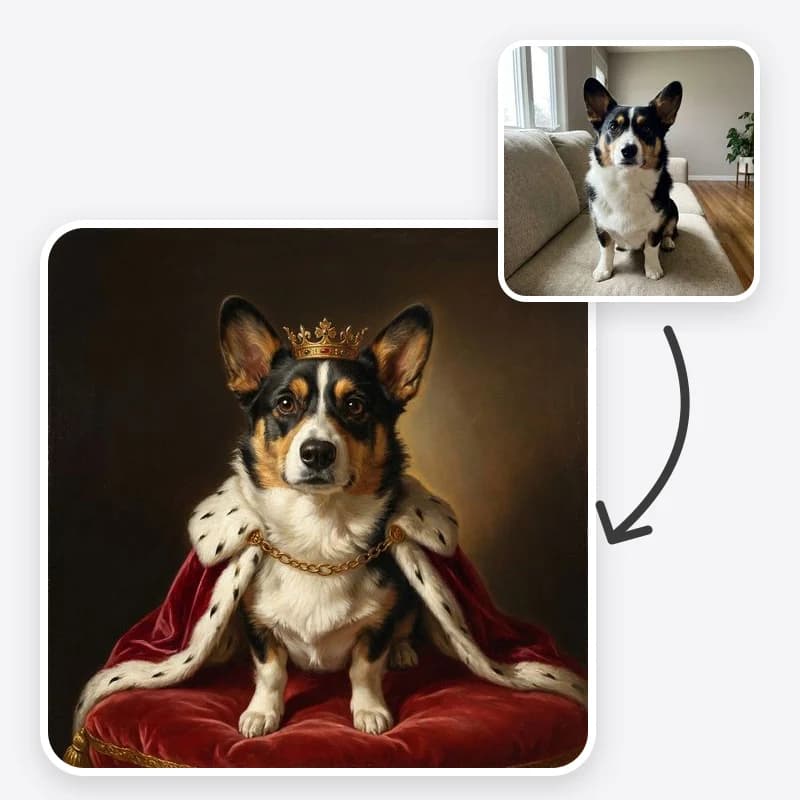
This guide covers the decisions around the portrait: choosing a style for both the pet and the person, getting a usable photo without giving the surprise away, sizing, printing, framing and presentation. For the step-by-step of making the portrait itself, see how to make a royal pet portrait from a photo. The examples here use Oakgen's Royal Pet Portrait tool, which repaints a pet photo as a royal, Renaissance, military or Victorian oil-style portrait.
Start with the person, not the pet
The pet will look good in any style. The question is what the owner will want on their wall. A few quick reads:
- They love a joke. Royal, with a crown and ermine cape, or General, with medals and epaulettes. These are the portraits people show every guest.
- Their home is calm and traditional. Renaissance or Victorian, with the dark museum backdrop. Funny when you look closely, elegant from across the room.
- Their home is modern and minimal. Renaissance on a dark backdrop with no frame, printed on paper in a thin black frame. The contrast between old painting and modern frame works well.
- They are grieving a pet. Treat this differently; see the memorial section below.
- You are not sure. Make two or three versions and choose the one you would be happy to receive yourself.
Getting the photo without spoiling the surprise
You need one sharp photo of the pet, ideally at eye level, with its face, ears and chest visible and its markings easy to see. Some quiet ways to get it:
- Look at what they have already shared. Group chats, family albums and social posts often hold a good candidate. Download the largest version you can.
- Ask a partner, housemate or family member. They can send a few recent photos, or take one on a walk.
- Take it yourself on a visit. Crouch down, use window light, and get the pet's attention with a treat or a sound just above the camera.
Avoid photos from above, photos with flash, and photos where the pet is small in the frame. If the pet has a distinctive marking on one side, make sure that side is visible. The how-to guide has a full photo checklist.
One more check: make sure it is a current-looking photo. An owner will notice if a grey-muzzled dog has been painted as a puppy.
Make the portrait first
Upload a photo of the pet, choose a style, background and frame, and check every marking before you order the print.
Choosing style, background and frame for a gift
Style. Match it to the pet's personality and the owner's humour, as above. If the pet has a nickname that fits, such as "the Duchess" or "the Colonel", that settles it.
Background. The dark museum backdrop is the safest for printing: it suits every room and every frame, and it keeps attention on the face. The palace hall is grander and suits large prints. The library suits a study or office.
Painted frame or not. For a physical gift, choose No Frame in the tool and buy a real frame. A painted gold frame inside a real frame looks like a mistake. Keep the painted gold frame for digital gifts: a phone wallpaper, a card or a message on the morning of their birthday.
Check the likeness before anything else. Compare eyes, ears, muzzle, coat colour and markings with the original. The owner knows every patch. If one is missing, regenerate with the marking named in the instructions; do not order until it is right.
Print sizes and resolution
Choose the size for the wall it will hang on, then check that your image has enough pixels. A common guide for sharp prints is about 300 pixels per inch; canvas, viewed from further away, can usually manage with somewhat less.
| Print size | Where it suits | Pixels at 300 PPI |
|---|---|---|
| 5x7 inches | Desk, bedside, card | about 1500 x 2100 |
| 8x10 inches | Shelf, small wall | about 2400 x 3000 |
| 11x14 inches | Hallway, above a desk | about 3300 x 4200 |
| 16x20 inches | Main wall, above a sofa | about 4800 x 6000 |
If your image is smaller than the size you want, enlarge it with an upscaling tool and then inspect the fur and eyes at full size again; upscaling sharpens edges but cannot add real detail that was never there. Our guide to upscaling AI images for print explains how far you can push it.
Also check the shape. An 8x10 print has the same 4:5 shape as a 4x5 image, but a square or 3:4 image will not fit it exactly, so the printer may crop or add borders. Keep the ears and the crown away from the top edge.
Canvas or paper
Canvas suits the oil-painting look. Gallery-wrapped canvas needs no frame and no glass, so there is no glare, and it is easy to hang. Ask the printer how they handle the edges: wrapping the image around the sides cuts off part of it, so a coloured or mirrored edge is safer for a portrait.
Paper in a frame with a white or cream mat looks more like a museum piece and usually costs less. Matte or lustre paper reduces glare and suits the painted texture better than gloss.
Either way, order a small proof first if you can. Warm painted tones on a screen can print darker or redder on paper.
Framing
- Gold or ornate frames suit Royal and Renaissance, and lean into the joke.
- Dark wood frames suit Victorian and the library background.
- Thin black or natural frames suit modern homes and make a Renaissance portrait feel like contemporary art.
- A mat gives a small print more presence and keeps the image away from the glass.
If you are not sure about their taste, give the print in a simple frame that matches most homes, or give it unframed with a note that you will frame it together.
Memorial portraits
A portrait of a pet that has died can mean a great deal, and it needs a little more care.
- Choose a calm style. Renaissance with the dark museum backdrop is dignified. Save the crown and the medals for a pet that is still around, unless you know the owner would smile at them.
- Use their favourite photo. Ask someone close what that photo is. It may not be the sharpest one.
- Check likeness extra carefully. A small change, such as eye colour or a missing patch, feels much bigger to someone who is grieving.
- Give it privately. Not everyone wants to open a memorial gift in front of others.
Presentation and timing
- Leave time. Printing and framing take time, and printers get busy in December. Make the portrait well before you need it.
- Wrap it flat and padded. Corners of canvases and frames dent easily.
- Add a short note naming the style: "Her Majesty, Queen Biscuit" makes the joke land the moment the paper comes off.
- Consider a digital extra. Send the framed-style version as a phone wallpaper the same day.
Other ideas from the same photo
- A cute animated version with the 3D cartoon style tool, or read the Pixar-style pet portrait guide for that look.
- An uncostumed painting with the oil painting effect.
- A festive card with the pet by the tree, from our Christmas card photo ideas.
Give a portrait they will hang
Choose a style that fits the pet and the person, check every marking, then print, frame and wrap.
Frequently asked questions
How do I get a good photo of someone else's pet without spoiling the surprise?
Look through photos they have already shared with you, or ask a family member to send a few. Choose one that is sharp, taken at the pet's eye level and shows its face and markings clearly.
What size should I print a pet portrait?
8x10 inches suits a shelf or small wall, 11x14 a hallway or above a desk, and 16x20 a main wall. At about 300 pixels per inch, 8x10 needs roughly 2400 by 3000 pixels, so check your file and upscale if needed.
Is a royal portrait appropriate for a pet that has died?
It can be, but choose a calm style such as Renaissance with a dark backdrop rather than the comic crown, and think about whether the person would enjoy humour right now. When in doubt, ask someone close to them.
Should I choose a canvas or a paper print?
Canvas suits the oil-painting look and needs no glass. A paper print in a frame with a mat looks more like a gallery piece and is usually cheaper. Both work; match it to the person's home.