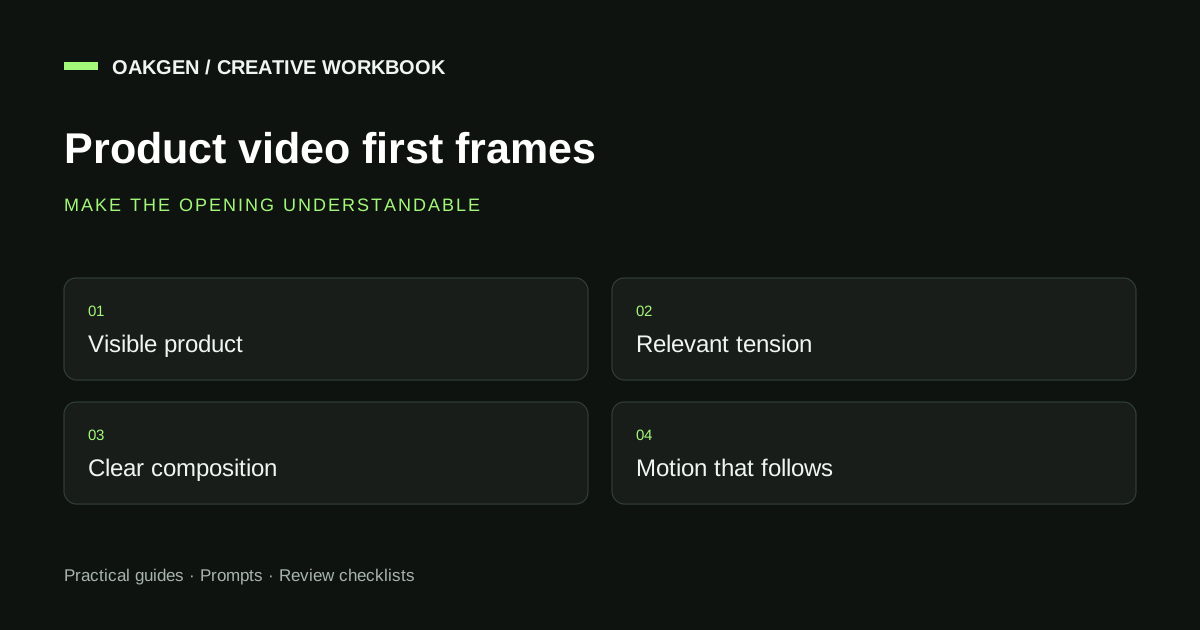
First-frame hooks give a product video a useful opening image: the viewer can recognize an object, a question, or a relevant action before a spoken line finishes. Start with the product already visible and choose a composition that leads naturally into the proof. A surprise that has nothing to do with the product may earn attention without earning interest in buying it.
For ecommerce creative, I would plan the first visible frame as a still before requesting motion. Oakgen can help prepare the photo direction and create a candidate in a separate asset workflow; you then inspect the product and develop the video. That does not guarantee an exact first frame or a successful ad.
Plan your opening shot in Oakgen using one of the communication jobs below.
Pick an opening by what it reveals
| Opening type | What is visible immediately | Useful for | Main risk |
|---|---|---|---|
| Complete set | All included items, clearly separated | Bundles and kits | Wrong quantity |
| Action already underway | Real mechanism in a readable state | Products whose operation matters | Invented functionality |
| Scale reference | Product beside an accurate reference | Size uncertainty | False size or compatibility claim |
| Detail with context | Important feature plus enough of the product to identify it | Material or construction explanation | Anonymous macro shot |
| Two real states | Clearly distinguished closed/open or folded/unfolded views | Physical transformation | Unsupported before/after implication |
| In-use arrangement | Product where its job is apparent | Simple use cases | Styling implies performance |
| Objection card | Product and one concise question | Consideration-stage ads | Text too dense to read |
| Offer with product | Recognizable item plus approved offer layer | Time-bound promotions | Expired or unclear conditions |
This library is a set of editorial proposals, not a ranking of hook performance. Choose one that the source material can support.
Prepare a source-led opening composition. The planner creates a treatment before upload; add the actual product image in the destination workflow.
A first frame is not just the first line
A script that begins “Here is what fits inside” can still open on a logo, a closed bag, or an empty room. The line promises information, but the image delays it. Planning the visible state forces you to decide whether the viewer can understand the subject immediately.
Think of the first frame as the first useful visible composition rather than a claim that a single encoded frame determines performance. Playback, transitions, and interface behavior affect what someone actually sees. Review the exported opening in motion, not only the poster frame or thumbnail.
The spoken hook and image should help each other. “Check the dimensions before choosing” can accompany a measured product view. It should not accompany an unrelated lifestyle montage while the measurement arrives much later.
For this article, the audience is ecommerce marketers and small agency teams planning short product ads. Research reviewed September 13, 2026. The shot library and prompts are original planning examples, not generated outputs or tested campaigns.
TikTok recommends introducing the content proposition in the first three seconds and prioritizing the hook early. Treat that as a reason to make the beginning legible, not a promise that a particular opening will convert. TikTok creative guidance.
Write a first-frame brief in plain visual terms
Start with the object and its state: “open pouch, both bottles visible” is more useful than “attention-grabbing travel aesthetic.” Then define the camera view and the single thing the viewer should notice.
Add the source requirement. If the opening shows an interior, the reference packet needs an interior. If it shows a folded state, you need evidence of the actual folded product. Don't ask a model to invent the information that carries the ad's promise.
Describe the next beat too. An opening shot of a bottle cap should lead into an explanation of that closure, not cut to an unrelated claim about price. Continuity gives the viewer a reason to keep watching without making the ad feel like a trick.
Finally, record exclusions. For a fictional travel kit, these might be no liquid, no extra bottle, no airline approval badge, and no unverified leak demonstration. Negative instructions help state the review criteria; they do not guarantee the generator will obey them.
Eight first-frame storyboard proposals
The following treatments use hypothetical products. Replace their facts and visible states with approved material before production.
1. The complete-set opening
Show a pouch and its two empty bottles in a shallow arrangement, with enough spacing to count them. The next beat identifies each included item. The final beat returns to the whole set so the viewer leaves with a correct picture of the offer.
This is appropriate when shoppers ask what comes in the box. A busy unboxing can hide the answer. Use the bundle photography checklist before animating the set, because an attractive extra accessory changes the offer.
2. The mechanism already visible
For a real folding stand, start with its hinge and supported position visible. The next beat shows a verified movement or cuts between actual supported states. Use real demonstration footage when the movement itself proves a product feature.
Avoid a long shot of someone reaching for the stand before anything happens. You can enter the explanation later in the action, provided the edit still accurately represents how the object works.
3. The measured scale opening
Place the product beside an accurate scale reference and add approved dimensions during editing. The next beat can explain which dimension matters to the purchase. Keep the comparison visually honest and avoid distortion from mismatched perspective.
A generated laptop entering a sleeve can imply compatibility even if the text only says “compact bag.” If fit is the promise, use measurements and source material that support that exact fit. Don't rely on an attractive approximation.
4. The identifiable detail
Frame the actual closure or seam while leaving enough of the product visible to identify it. The next beat pulls back or cuts to the complete object. This lets a small detail lead the explanation without turning the opening into a guessing game.
An extreme macro of anonymous fabric may look good but reveal nothing about the product. Keep the feature connected to the item, and compare generated texture with the real source before making it the hero.
5. The two-state comparison
Show real closed and open states in a clear side-by-side layout. The next beat focuses on the relationship that matters: how a real object folds, opens, or stores. Label views accurately if the layout could otherwise imply two included products.
This is a physical-state comparison, not permission to invent transformation claims. A cosmetic, medical, or other outcome-based before-and-after has different evidentiary demands and should not borrow this treatment without appropriate review.
6. The job-ready arrangement
Show a desk organizer with the actual supported items arranged around it. The next beat explains a concrete part of its layout. Keep props distinguishable from included contents and avoid pretending a stylized setup is a tested capacity demonstration.
This works as a planning idea when the product's purpose is difficult to read on a blank background. Remove any prop that makes the offer unclear, even if the set looks less elaborate without it.
7. The question beside the object
Place a concise question next to a clear product view: “What comes in the kit?” or “How big is it?” The next beat answers that exact question with verified evidence. Add the text in editing so it stays readable and editable.
Avoid fake personalization such as telling an individual why they left a cart. A question about the product can be relevant without implying surveillance or pretending to know a private motivation.
8. The approved offer opening
Show the product and the current, merchant-approved offer together. The next beat supplies one reason to care about the item, followed by clear conditions and destination. Keep the terms separate from generated imagery so updates remain manageable.
Use the Black Friday release checklist for expiry and replacement ownership. A strong opening becomes an inaccurate ad as soon as its offer no longer applies.
Draft the opening and next beat in Oakgen's script planner after you select a supported idea. The result remains an editable script; it does not automatically create or assemble the shots.
A prompt that defines the frame before the movement
Here is a proposed still-image direction for the fictional kit:
Use the approved photograph of one pouch and two empty bottles. Compose an opening view where all included items are recognizable immediately, with both bottles separated and the pouch behind them. Preserve their real shapes, materials, closures, and relative sizes. Leave a clear area for a short question added later. No generated words, extra products, decorative packaging, liquids, or performance claims. Use a camera angle supported by the source.
After reviewing the still, a separate motion direction might read:
Begin with the approved complete-kit composition in a workflow that supports the chosen source input. Keep the product arrangement stable while making a modest camera move. Do not introduce a hand or reveal an unseen interior. Preserve the item count throughout. End on a readable complete view that connects to the planned explanatory text.
Choose a model and workflow whose available controls fit the task; do not assume every video generator accepts an exact first frame. Even with a suitable source input, inspect the output for early drift. A correct first still does not guarantee the next frames preserve it.
Open the video workflow for your reviewed shot only after the opening composition passes the product check. Keep generation, editing, and advertising review as separate approval steps.
The opening review card
Use this pass/fail card before judging a shot's taste or novelty. A single failed product claim can outweigh an otherwise attractive opening.
| Check | Pass condition | Revision if it fails |
|---|---|---|
| Product recognition | Viewer can identify the relevant object | Widen the view or remove unrelated setup |
| Promise clarity | Image and first line concern the same question | Rewrite one or change the shot |
| Source fidelity | Product, count, and visible feature match evidence | Repair with approved source or reject |
| Readability | Text is legible in the intended placement | Reduce wording and revise layout |
| Continuity | Next beat delivers what the opening suggests | Change the sequence, not just the transition |
| Claims | No unsupported function or outcome appears | Replace the demonstration or obtain evidence |
Preview the actual exported beginning on a phone. A fade from black, a late text animation, or an interface overlay can hide the composition you approved in the editor. Check sound on and off, while remembering that this is a practical clarity review rather than proof of ad performance.
Ask someone unfamiliar with the brief what they think the product is and what the video is about. Their answer can reveal ambiguity. Don't turn one person's reaction into a conversion prediction; use it to catch a communication problem before spending on delivery.
Compare openings while keeping the body useful
A same-body test changes the opening while retaining the main explanation, offer, and destination where practical. For example, compare a complete-kit opening with a question-led complete-kit opening. Both can connect to the same contents explanation.
Not every opening belongs on the same body. A hook about size followed by a body about materials breaks the promise. If a new hook needs a different proof sequence, label it as a new concept comparison rather than forcing it into a nominally controlled test.
Record the changed element and the shared elements before production. Give each file a name that describes the difference, such as KIT-CONTENTS and KIT-QUESTION. Have the media owner select a suitable experiment and decide how much evidence supports a conclusion.
Google's experiment guidance recommends focusing on one variable and choosing the decision metric in advance. Apply that discipline to the question; the ad platform and account determine the suitable test implementation. Google experiment guide.
Early-view metrics can help diagnose an opening, but they are not interchangeable with purchases. A dramatic scene may draw attention from people with no interest in the product. Read later outcomes before declaring the opening a business winner.
Fix the common opening failures
If viewers cannot identify the product, remove the setup or widen the close-up. Adding faster cuts may make the ambiguity worse. Clarity often requires changing the first composition, not accelerating it.
If the opening promises a result the body cannot support, narrow the promise. You don't need a bigger claim to rescue the hook. A truthful explanation of a specific feature gives the next beat something real to deliver.
If the product morphs during the first move, simplify the motion or keep the source view more stable. Avoid adding a hand interaction, a rotation, and a new background at the same time when you cannot tell which demand caused the error.
If the whole idea still reads better as a single image, use one. The static-versus-video decision guide helps you recognize when motion contributes little. A readable product image is preferable to a video whose only achievement is moving.
Frequently asked questions
What is a first-frame hook in a product ad?
It is the opening visual composition that makes the product or communication question apparent. It works with the spoken line and next beat; it is not merely a slogan or a claim that one encoded frame determines performance.
Should every product appear immediately?
Immediate product clarity is a useful starting point for the workflows here, especially contents or feature explanations. Other concepts may use a relevant problem first, but the delay should have a reason and lead honestly to the product.
How many opening versions should I test?
Choose a small set of genuinely different, supportable ideas that your team can produce and evaluate. There is no universal number in this guide. More files do not help if they repeat the same visual idea or lack meaningful delivery.
Can I generate the first frame and then animate it?
Yes, in a workflow with suitable image-input support. Review the still first and inspect the generated beginning for changes. A source image and prompt do not guarantee exact product preservation across every frame.
Is hook rate the same as ad performance?
No. Early attention is one diagnostic signal. Interpret it alongside later outcomes that match the business goal, using consistent definitions. A hook that attracts curiosity may not attract people interested in buying the product.
Should I replace a hook whenever performance drops?
Investigate first. Delivery, the offer, inventory, checkout, and reporting changes can affect results. Use the creative fatigue worksheet before assuming the opening is responsible, then revise the component tied to your evidence.
Give the opening a job
Plan your next product-video opening in Oakgen with a visible product state, an honest question, and the proof that follows. If an existing ad is declining, pair the shot plan with the creative refresh diagnosis before replacing its opening.