You have probably seen one by now: an athlete sprints up a wall that is far too tall and far too steep, flips off the top, and a stadium full of people goes wild. The captions say things like "gravity never stood a chance". The short answer to the question everyone asks in the comments is no, the clips that have been checked are not real. They are AI. This article covers what the fact-check found, how to tell for yourself, and how Oakgen's Wall Run template lets you make one that does not pretend to be real. If you already know and just want to make yours, go to the step-by-step guide.
Run up the wall, openly AI
Add one photo, review your credit quote and make the 15-second Wall Run: the dam, the flip, the splash landing and the crowd.
What the fact-check found
On 9 October 2026 the fact-checking site Lead Stories published a prebunk called "Stunt Running Videos Took An Off-Ramp From Reality -- Don't Jump To Gravity-Defying Conclusions", updated on 12 October. It describes a wave of clips with the same shape: a sporting event or a contest held next to a well-known landmark, a main character who runs to the top of a tall ramp or a "giant curved wall", and a crowd and an announcer greeting them.
The clips travel under hashtags such as #WallRun, #FlipWall, #Parkour, #freerunning, #CityStunt and #SpectatorFootage, on TikTok, YouTube, X and Facebook. The accounts named include the TikTok account @stuntversehq, whose captions place the wall in Singapore and in Cairo, and a YouTube Shorts channel called FlipWall, with titles like "Insane Wall Run Stunt!". The conclusion is plain: what the clips show "are not real people's stunts".
That is why this trend is called the Wall Run: it is the name the wave already goes by. Where the AI stunt running clips come from goes deeper into the accounts and the timeline.
Is any of it real?
The move is. A wall run is a real parkour technique: a few fast steps up a vertical wall to grab a ledge, and real athletes film them. The update to the fact-check quotes David Belle, one of the practitioners who shaped modern parkour, who says the big giveaway in the AI clips is the gravity and the flight path, and that real athletes do not hover. The real parkour wall run vs the AI trend covers the real move, its history and record heights.
What is not real is the scale. Nobody runs the full height of a stadium wall or a dam and flips off the top. We found no real event where anyone ran up a dam, and no public name for a dam version of the trend.
How to spot an AI wall run
These are the signs the fact-check describes, in the order we would check them:
- Gravity and flight path. The runner keeps full speed as the wall turns vertical, hangs in the air too long, or lands from a huge height and keeps going.
- Bodies that do not hold together. In one checked clip an arm disappeared between the shoulder and the hand and a foot looked distorted. Pause during fast moves.
- Crowds that do not react. Spectators turned away from the action, or holding phones at angles no one holds a phone.
- Phones that film nothing. In one clip the athlete did not appear on the screens of the phones filming her.
- Things that change over time. AI video struggles to keep objects and people consistent from one second to the next: count the people at the start and at the end.
- Watermarks and labels. One clip carried an AI app's watermark; in another the watermark looked cut off or removed. Some TikTok and YouTube posts carried platform AI labels.
- Detectors, last. The fact-check ran one clip through two AI detectors, which rated it 92% and 93% likely AI. A detector score is one more signal, not proof either way.
The dam reel, checked the same way
Oakgen's template is based on one reel: posted on Instagram on 23 October 2026 by @jacksonzhangai, an AI creator who appears as the runner. It had 87,506 likes and 319 comments when we fetched it.
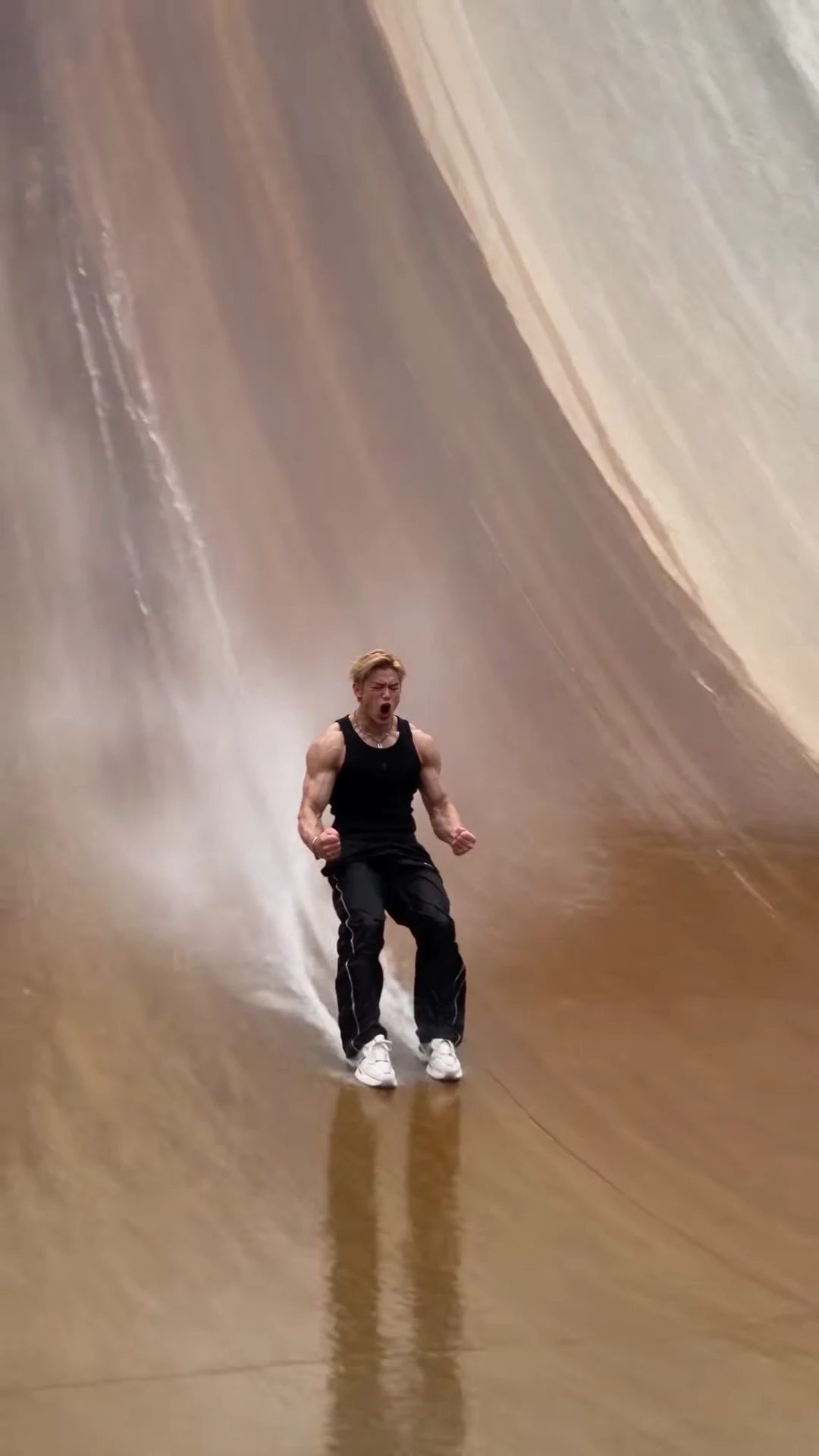
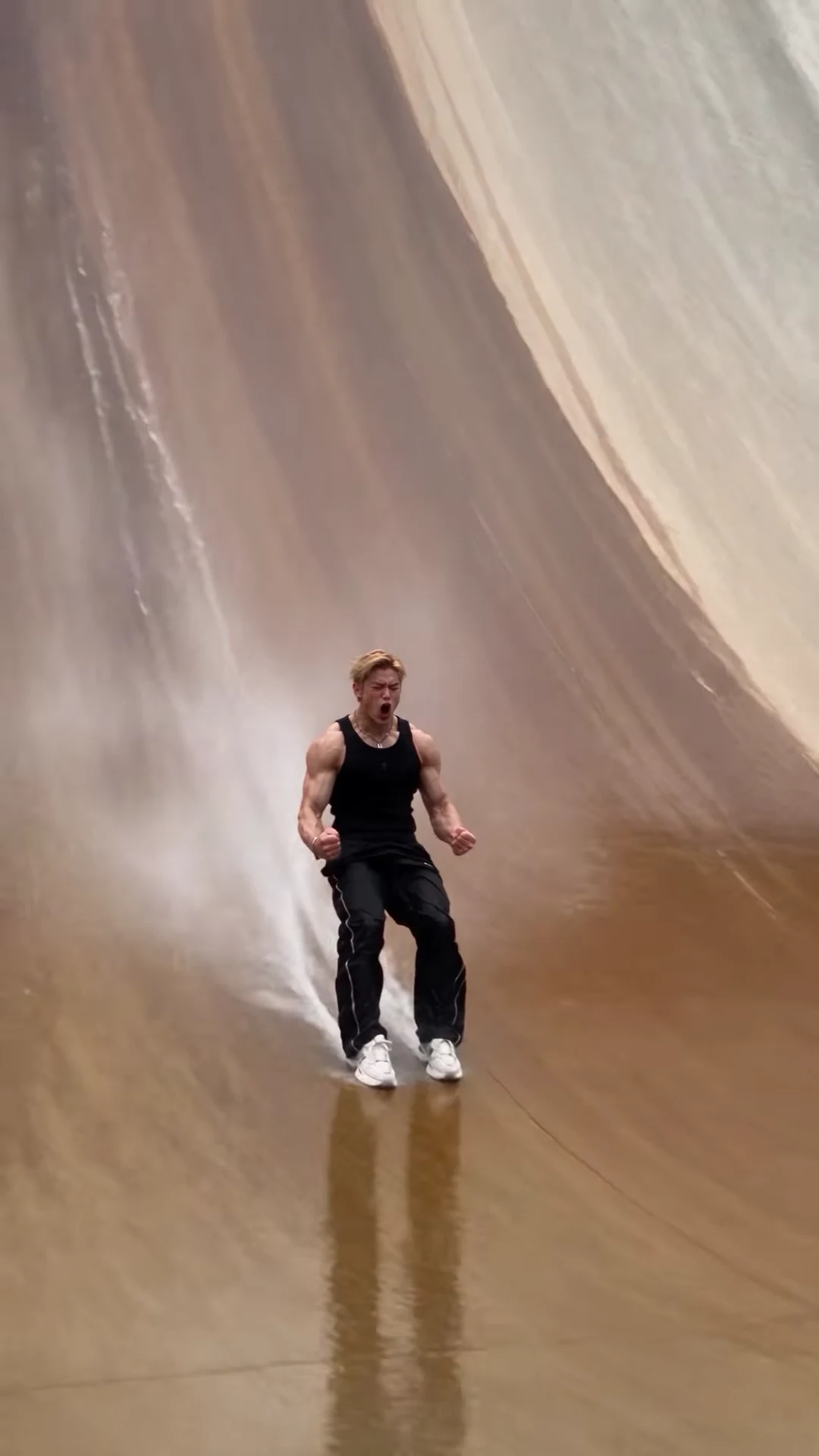
The slide after the splash landing, from the reference AI reel by @jacksonzhangai. This is not an Oakgen output.
Run the list and the first point settles it. The runner sprints up a wet concrete face that bends toward vertical, flips above the railing at the top, falls back down the wall and lands feet first in a burst of spray, then slides down standing up. Notice what is missing, too: the reel has no watermark and no on-screen label, so the absence of a watermark tells you nothing. The account and the physics do.
The sound is its own original audio, with no song: footsteps, a splash, a crowd roar and a scream. No one speaks. The dam wall run scene guide covers everything in the frame besides the runner.
How Oakgen's version differs
Oakgen's Wall Run template is a recreation of that one reel with you as the runner, made to be shared as AI rather than passed off as real:
- One photo, required. The runner in the reel is a real person's likeness, so that face is never kept. Your face, hair and build come from your photo. Casting yourself as the runner explains what the photo controls.
- The outfit stays. The black ribbed tank top, silver chain, black track pants with white piping and white sneakers are the look of the trend, so you wear them whatever your photo shows.
- The scene and stunt stay. The dam, the grandstand, the guards, the handheld camera, the sprint, flip and splash landing, and the original sound. The video is 15 seconds in portrait 9:16, made with Seedance 2.5.
- The price is quoted first. The studio shows the credit quote before anything is generated.
We have not published an Oakgen result for this template yet. The preview on the trend page is the credited reference reel, not something we made.
Post it as AI
The whole problem the fact-check describes is realistic clips presented as real footage. Yours does not have to be one of them: put "AI video" in the caption, use the app's AI label where there is one, and skip tags that imply real spectator footage. Captioning and labelling a gravity-defying stunt video has caption ideas and the tags people already use.
Ready to make it? How to make the Wall Run AI trend from one photo goes from choosing the photo to checking the finished clip. For another one-photo stunt in front of a roaring crowd, see how to make the Forever Dunk AI trend. To choose between the Wall Run and the other sports trends, see sports and stunt AI video trends compared.
Frequently asked questions
Are the viral wall run videos real?
The ones fact-checked so far are not. A Lead Stories prebunk from 9 October 2026 found that many of the stunt-running clips, where an athlete sprints up a tall ramp or a giant curved wall in front of a crowd, were made with AI, and that what they show "are not real people's stunts".
Is the dam wall run real?
No. It is an AI reel posted by the AI creator @jacksonzhangai on 23 October 2026. Nobody can sprint up a near-vertical wet wall, flip off the top and land feet first on the same wall. We found no real event where anyone ran up a dam.
Is wall running a real thing?
Yes. A wall run is a real parkour move: a few running steps up a vertical wall to reach a ledge. The AI clips take that move and make it impossible.
How do I spot an AI stunt video?
Watch the physics first: athletes who float, hang in the air or keep full speed up a vertical surface. Then look for limbs that vanish or bend, crowds facing the wrong way, spectators whose phone screens do not show the athlete, cut-off watermarks and platform AI labels.
Can I make my own wall run video?
Yes, as an openly AI video. Oakgen's Wall Run template puts your face on the runner from one photo and keeps the dam, the crowd, the stunt and the original sound. Label it as AI when you post it.