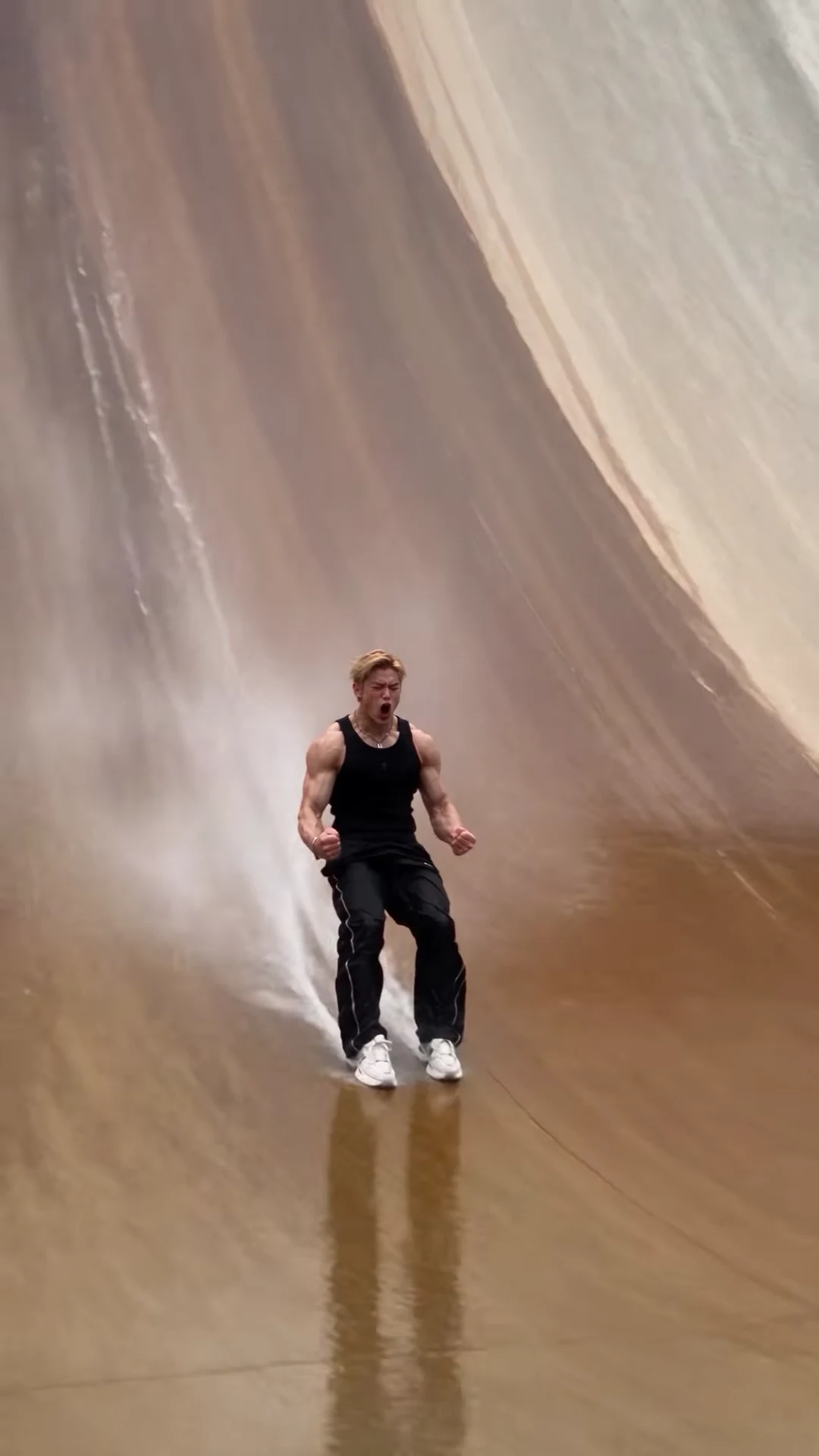
The viral wall run clips borrow their name from a real move. Parkour athletes really do run at walls and use them to climb, and some of the best-known spots in the sport are walls. What they do not do is sprint up a stadium wall or a dam, flip off the top and land on the same wall. This article is about the real wall run: what the move is, how it works, where it comes from, what real wall runs look like and how people learn it safely. Then it sets the AI clips beside it, so you can see exactly where they leave reality. If you mainly want to know whether a clip you saw is real, start with the AI wall run trend explained.
Keep the impossible version on screen
Add one photo, review your credit quote and make the 15-second Wall Run: the dam, the flip, the splash landing and the crowd, openly AI.
What a wall run is
In parkour, a wall run means running toward a high wall, jumping and pushing off the wall with a foot to reach the top. The point is to get over an obstacle that is too tall to jump: the push off the wall turns forward speed into height.
The name also gets used for famous walls that athletes travel across rather than straight up, such as Brighton's Big Wall, below. Either way, the real thing is measured in metres, not in stadium heights: the record listed further down is four metres.
How it works, at a high level
The clearest description of the mechanics comes from a 2019 study in the Journal of Experimental Biology by James Croft, Ryan Schroeder and John Bertram. They filmed parkour athletes running up a 3-metre plywood wall with force plates in the wall and the floor, and recorded 67 successful ascents.
Three findings stand out:
- The athlete is still moving almost horizontally when the foot meets the wall. The wall run converts a run into a climb at that one moment of contact.
- The foot lands below hip height, which lets the athlete keep much of the run-up's momentum while pushing upward, and the other leg swings forward to help lift the body.
- More speed is not better. The researchers' simulation found an intermediate run-up speed the most efficient: too slow needs more effort at the push, and a flat-out charge makes the leg absorb a shock that wastes energy.
That last point is the opposite of what the AI clips show. Real athletes manage their speed into the wall; the AI runners accelerate up it.
This is a description of the physics, not a lesson. If you want to learn the move, see the safety section further down.
Where the move comes from
Parkour grew out of a much older idea of practical training. Georges Hébert, who joined the French Navy in 1896, developed a training system called "la méthode naturelle" built on practical movement. Lead Stories' fact-check on the AI clips sums up the lineage the same way: the discipline originated from Hébert's teachings, but it did not take its current form until the late 1980s, through practitioners such as David Belle.
Belle's father, Raymond Belle, born in 1939 in French Indochina, trained in a French military orphanage and later became a firefighter in Paris. David Belle grew up with that training. After he moved to Lisses, other young men who shared the interest joined him, and together they developed a new way of moving through the town. The group performed under the name Yamakasi at a Paris firefighters' show in 1997; the members later split, and a feature film called Yamakasi, with members of the original group, came out in 2001.
Freerunning is the sibling name. The word was first used in Mike Christie's 2003 documentary Jump London, which showed Sébastien Foucan, Jérôme Ben Aoues and Johann Vigroux moving across London landmarks.
Real wall runs worth knowing
The record height. Guinness World Records lists the highest vertical, unassisted wall run at 4.00 metres, set by Erwan Suquet in Paris on 28 September 2009, on the set of the TV show Le Monde des Records. Two rival runners on the same day could not clear the previous record of 3.85 metres. Four metres is a little more than twice the height of a tall adult. Hold that number in mind when you watch a clip of someone running up a dam.
Brighton's Big Wall. In Brighton, on the south coast of England, is a wall built in the early 19th century to stabilise a cliff about 20 metres tall. Parkour athletes adopted it; the writer Reuben J. Brown describes them finding ever more daring ways of navigating its "eighty-degree surface over a 13-foot drop to the concrete stairway below", and says the nickname "Suicide Wall Run" comes from fishermen who fell while trying to run along it. On 18 September 2022 the UK parkour team Storror, founded in 2010 by Max Cave, Benj Cave and Drew Taylor, hosted a Big Wall Open there, with athletes travelling from as far as Australia. The final stunt was a jump off the end of a 7-metre wall run into a shopping trolley.
The "most famous" wall run. The phrase has its own video: YouTuber Emil Abrahamsson's "I Tried World's Most Famous Wall Run With No Experience", made with Storror. We have not confirmed which wall it shows, so we only point to the title as evidence of how the parkour world talks about famous walls.
What these have in common is scale and traceability. A record is four metres. A famous wall run is a few metres of steep wall. Each comes with a named athlete or team, a place and a date you can check.
Real wall run vs AI wall run
| Real parkour wall run | AI wall run clip | |
|---|---|---|
| Height | A few metres; the listed record is 4.00 m | The full height of a stadium wall or a dam |
| On the wall | A push off the wall with a foot to reach the top | A full sprint up a surface that turns vertical |
| Speed | Controlled into the wall; flat out is less efficient | Full speed or faster all the way up |
| Flight path | Rises and falls under gravity | Hangs, hovers or floats |
| Ending | The athlete reaches the top of the wall | A flip off the top and a landing back on the wall |
| Evidence | A named athlete or team, a place and a date | Viral stunt accounts; the fact-checked clips were made with AI |
David Belle, quoted in the Lead Stories update of 12 October 2026, gives the shortest test: "Usually the big giveaway is the gravity (or lack thereof) and flight path." He also points out that for an ordinary unsupported jump, gravity pulls the athlete down the whole time. A real jump slows while rising, passes its highest point and then accelerates down. A runner who hovers at the top for too long, rises again after starting to fall, or changes direction in mid-air without touching anything is not obeying it.
Belle's bigger complaint is about labelling, not imagination. "A clearly labelled AI video is entertainment," he told Lead Stories, but an unlabelled one presents a fantasy as a real physical achievement. He warns that "someone might see a fake AI jump as evidence that a distance, a drop or a landing is achievable and try to copy it and put themselves in danger."
The Oakgen template is based on one of those clips: an AI reel by @jacksonzhangai in which the runner sprints up the wet face of a curved dam, flips above the railing at the top, lands feet first on the wall in a burst of spray and slides down. Every row of the table above lands on the AI side. The sprint, flip and splash landing, beat by beat walks through each impossible moment.
Learn the real move safely
A wall run looks simple and is not, and a miss means falling from a height onto whatever is below. Do not try to copy an AI clip, and do not learn on a tall wall alone.
Learn in a class with a qualified coach, on walls and landings chosen for your level, and build height over time. Real coaching includes safety checks, which Belle notes "are completely ignored in AI videos." In the UK, Parkour UK is the national governing body: it runs coaching qualifications from Level 1 up to Master Coach and has a "Find Parkour Near You" search for local classes. Elsewhere, look for your country's parkour federation or a club with qualified coaches.
Make the impossible one, openly
The AI version is fun precisely because nobody could do it. That is also why it should be posted as AI. If you want to star in one, Oakgen's Wall Run template puts your face on the runner from one photo and keeps the dam, the crowd, the stunt and the original sound. We have not published an Oakgen result for it yet; the preview on the trend page is the credited reference reel.
- How to make the Wall Run AI trend from one photo goes from the photo to the checked clip.
- Where the AI stunt running clips come from traces the accounts and hashtags behind the wave.
- Captioning and labelling a gravity-defying stunt video helps you post it without fooling anyone.
- Sports and stunt AI video trends compared puts the Wall Run next to the dunk and football trends if you are still choosing.
Frequently asked questions
What is a wall run in parkour?
A wall run is a real parkour move: you run toward a high wall, jump and push off it with a foot to reach the top. It turns a run into a climb over an obstacle too tall to jump.
How high can a person wall run?
Far less than the AI clips suggest. Guinness World Records lists the highest vertical, unassisted wall run as 4.00 metres, set by Erwan Suquet in Paris on 28 September 2009.
Who started parkour?
Parkour grew out of Georges Hébert's "méthode naturelle" training. It took its current form in Lisses, France, from the late 1980s, through practitioners such as David Belle and the group that became the Yamakasi.
Are the viral wall run videos real?
The ones fact-checked so far are not. Lead Stories found that many were made with AI and that what they show "are not real people's stunts". The move is real; the scale is not.
How do I learn a real wall run safely?
Learn it in a class with a qualified parkour coach, on walls and heights chosen for your level. In the UK, Parkour UK, the national governing body, runs coaching qualifications and lists local classes.
Sources
- Lead Stories: Prebunk: Stunt Running Videos Took An Off-Ramp From Reality
- Wikipedia: Parkour
- Parkour UK: A brief history of parkour
- Parkour UK, the national governing body of parkour
- Inside JEB: How parkour enthusiasts scramble up walls (Journal of Experimental Biology)
- Guinness World Records: Highest wall run (vertically and unassisted)
- Reuben J. Brown: Big Wall (on Brighton's Big Wall and Storror's Big Wall Open)
- Wikipedia: Storror
- Emil Abrahamsson on YouTube: I Tried World's Most Famous Wall Run With No Experience (ft. STORROR)