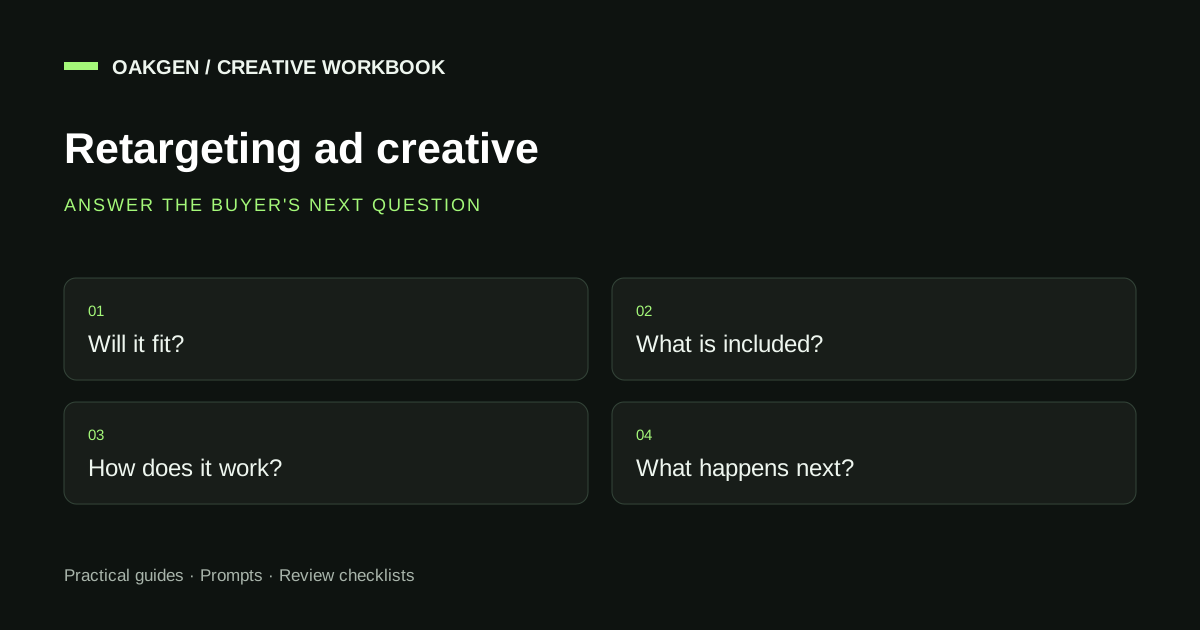
AI retargeting ads can help an ecommerce team produce different creative responses to product questions: what fits, what comes in the box, how something works, or what an offer includes. Start with evidence for those questions, create a small set of messages, and have your media buyer decide how to deliver and evaluate them.
Oakgen supports the creative side through brief, angle, script, and separate asset workflows. It does not identify your site visitors, build retargeting audiences, connect this workflow to Ads Manager, or run an advertising experiment. Buying retargeting software and making retargeting creative are different jobs.
Plan an objection-led creative set in Oakgen if you already have product facts and need assets your media team can review.
Turn a signal into a question, not a claim
| Available signal | Possible question to investigate | Useful creative direction | What the signal does not prove |
|---|---|---|---|
| Product page visit | Does this item suit my use case? | Clear context or dimensions | The visitor found the price too high |
| Cart addition without purchase | What will I receive or pay? | Contents and approved purchase conditions | The shopper abandoned because of shipping |
| Repeated sizing questions in support | Which version fits? | Measured comparison using real products | Every visitor needs the same size |
| Questions about a feature | How does it work? | Verified demonstration | The product solves every related problem |
| Prior purchase, where appropriately usable | What complements this item? | Relevant accessory explanation | The customer wants another identical item now |
The distinction matters. An event tells you that something happened; it doesn't contain the shopper's private explanation. Treat each objection as a hypothesis unless you have direct evidence.
Organize the supplied facts in a product brief, including what remains unknown. The brief utility won't crawl a product URL or infer missing proof.
The scope of this guide
This is for ecommerce operators and agency teams whose ad delivery already has an owner. It covers message planning and asset production, not audience eligibility, consent implementation, or bid strategy. Have the responsible specialists review those parts separately.
Research note, September 13, 2026: examples below are fictional planning exercises, not customer records or measured campaigns. Google describes dynamic remarketing as advertising viewed products or services to previous visitors, using feeds and related setup. A manually created product ad is not a dynamic retargeting system merely because AI helped make its image. Google's dynamic remarketing overview.
That boundary is useful when choosing a workflow. If the missing piece is accurate catalog delivery, another batch of scripts won't solve it. If the delivery setup works but every ad repeats the same vague reminder, the creative brief deserves attention.
Find objections in material you actually own
Start with product questions that already reach your team. Read support categories, on-page questions, return reasons that you can appropriately use, and interviews the customer agreed to provide. Summarize recurring themes instead of uploading identifiable customer histories into a prompt.
A theme might read, “Buyers ask whether the bag's sleeve fits a specific laptop size.” Keep the evidence separate from the inference: five similar questions, if you genuinely counted five, justify investigating fit information. They do not prove that fit causes a particular share of abandoned carts.
Check whether the store answers the question adequately before creating an ad. A useful size visual belongs on the product page as well. Sending interested visitors back to the same missing information wastes the work you put into the reminder.
Create a short evidence record: question, source type, date reviewed, approved answer, and asset that can demonstrate it. The answer may be a dimension, a component list, or a policy supplied by the merchant. Keep unsupported claims out of the creative brief rather than asking the model to soften them into believable language.
For example, “waterproof” and “water-resistant” aren't decorative synonyms. If your source only supports a particular material description, use that description. An AI-generated rain scene may imply performance beyond the words, so review the picture as a claim too.
Build the objection-to-proof matrix
Suppose a fictional shop sells a commuter bag. The merchant supplies a real photograph, exterior measurements, a verified compartment list, and the current returns policy. No evidence supports weatherproofing or a claim that all laptops fit.
| Hypothesis | Evidence to request | Ad message direction | Visual requirement | Reject if |
|---|---|---|---|---|
| Size feels uncertain | Actual dimensions and supported fit examples | Show the bag's size clearly | Real scale reference or reviewed dimension graphic | A generated device falsely implies compatibility |
| Interior layout is unclear | Open-bag source photo | Show where the supplied compartments sit | Correct count and arrangement | Model adds a pocket |
| Purchase conditions are unclear | Current merchant policy | Explain the relevant condition plainly | Legible approved wording | Qualification disappears in the crop |
| Value is hard to judge | Specific material and construction facts | Explain a real detail | Accurate close-up | Texture or stitching changes |
Each row creates a different creative job. A different background behind the same product isn't a new answer to the shopper's question.
Use this matrix to reject weak ideas before generation. If the proposed promise is “a bag that does everything” and the evidence column contains only a front photo, the concept isn't ready. Narrow it to something you can show.
Draft distinct message directions with the ad angle generator. Its angle matrix is planning material, not a prediction of which message will perform.
Four retargeting script proposals
These are original script outlines for the fictional bag. They are not testimonials, verified product claims, or generated videos. Replace every statement with the actual merchant-approved fact before use.
1. The fit explanation
Open on the real bag beside a measured reference. Spoken direction: “Check the size before you choose your everyday bag.” Follow with the approved dimensions and a close-up of the relevant compartment. End by inviting the viewer to review the sizing details on the product page.
Avoid “your laptop fits” unless the merchant can support that exact compatibility statement. Even a model-generated laptop slipping into the sleeve communicates a claim. If fit is the reason for the ad, use real footage or an approved still comparison that demonstrates it honestly.
2. The interior view
Open with the bag already unzipped so the compartments are visible. Explain the actual pocket arrangement using the merchant's terms. Finish with the product name and a destination that shows the same interior photograph.
Do not make the AI invent the inside from a closed-bag reference. Request an open-bag photograph or choose another concept. Hidden surfaces are missing evidence, not an invitation for creative interpretation.
3. The purchase-condition clarification
Use a simple product image and the exact relevant policy wording. A voiceover can explain it if the conditions remain clear, but a text-led static may be easier to inspect and update. Keep the destination close to the policy explanation.
If the policy varies by country, product state, or sale status, those conditions need a review. Don't turn a qualified returns policy into “risk-free” just because the phrase reads better in a short script.
4. The material detail
Begin with an approved close-up that shows a real construction detail. Explain what the material is, without inventing durability tests. Then pull back to identify the whole product so the viewer knows what the detail belongs to.
A generated macro can make ordinary fabric look thicker or softer. Compare the output against the reference under similar lighting. If the detail carries the purchase argument, preserve real pixels or capture it directly rather than accepting an attractive approximation.
Prepare an editable timed script in Oakgen after you select a supported concept. The script planner does not create a presenter, a voice track, or an assembled video; those are separate production steps.
Write the production brief without customer data
A creative brief can describe the intended communication without listing individual shoppers or their browsing histories. “Explain the bag's measured size to people considering it” gives the creative team a usable job. “Tell Maya we saw her add the charcoal bag last night” does not belong in a generation prompt.
Use this proposed instruction:
Plan a product-consideration ad for the supplied commuter bag. The communication task is to explain the verified interior layout. Use only the supplied open-bag reference and compartment facts. Keep the product name, construction, and colors consistent. Do not refer to an individual's browsing, cart, location, or purchase history. Do not add a discount or customer review. List any missing source material before proposing shots.
This instruction doesn't configure targeting. It keeps production focused on a reasonable shopper question while the media owner handles delivery separately.
Choose the format that proves the answer with the least ambiguity. A measured still may explain dimensions more clearly than a fast montage. A real opening mechanism may need motion. Consult the static-versus-video comparison worksheet if the team is defaulting to video without a specific reason.
Keep synthetic presenters out of fake testimony
A narrator can explain supplied facts without pretending to have bought or used the item. Write “The main compartment contains…” rather than “I've used this every day for six months” unless that is a real, authorized person's accurate statement and your team has reviewed how it will appear.
Do not invent star ratings, customer names, reviews, or before-and-after experiences. The US FTC's rule addresses false reviews and testimonials, including fabricated experiences. A synthetic presenter does not make a false story acceptable. Review the rules for your market and platform before publication. FTC rule announcement.
When the concept depends on a genuine experience, commission or obtain authorized source material. AI can help with production planning, but it cannot supply a missing customer history. A plainly presented product explainer is a better choice than a pretend customer endorsement.
Review the message and the destination together
Open the ad and the landing page side by side. If the ad answers a fit question, can someone find the same fit evidence after clicking? If it promises a particular bundle, does the page show that exact bundle rather than a collection that requires more searching?
Check product variants. An ad for a charcoal bag that lands on a beige variant may still look superficially correct to the reviewer, but the mismatch creates unnecessary uncertainty. Record the intended variant in the handoff.
Offer-based retargeting needs an expiry owner. The creative does not stop being misleading simply because it once matched a promotion. Our Black Friday creative release workflow includes a replacement-asset record that also works for short promotions during the year.
Ask the media buyer to confirm exclusions, audience overlap, platform rules, and destination tracking using the appropriate account tools. These are delivery checks; don't mark them complete in a creative review because the script reads well.
Measure the objection hypothesis without overclaiming
Give each asset an ID tied to its question: FIT-A, INTERIOR-A, POLICY-A, or MATERIAL-A. Keep the exact approved message and evidence record alongside it. Later, someone should be able to identify what the creative actually tested without watching dozens of exports.
Before launch, agree on a business decision. Are you choosing between two ways to explain the interior, or deciding whether an interior explanation deserves production at all? Those questions may need different tests. Let the media specialist design the comparison and decide what data volume can support.
A high attributed return from a warm audience doesn't prove the ad caused all those purchases. Some shoppers may have bought anyway. Report attributed results as attributed results; use a suitable experiment when the business needs evidence of additional sales caused by advertising.
If performance declines, don't assume the objection disappeared or that the model produced a bad image. Check destination changes, available stock, audience delivery, and measurement first. The creative fatigue diagnosis guide gives you a way to separate these possibilities before ordering another batch.
A weekly creative review that stays small
Bring one unresolved product question, the current supporting evidence, and the latest media context to the review. Choose one message to improve or retire. That is more actionable than demanding a fixed number of new ads every week.
Keep a rejected-claim list too. If “fits every laptop” repeatedly returns in brainstorms, record why it is unsupported and which fit statement the merchant does approve. This saves the next writer from making the same mistake.
Only expand the set when you can explain the difference between its members. Five versions with different opening colors may be useful visual candidates, but they still belong to the same message family. Name them accordingly.
Frequently asked questions
Can Oakgen run AI retargeting campaigns?
Not through this creative workflow. It helps prepare briefs and scripts and opens separate asset-generation workflows. Audience setup, catalog delivery, ad-account operation, spending, and performance measurement remain outside this workflow.
What should an abandoned-cart ad say?
Answer a supported product or purchase question instead of claiming to know why someone left. Clear contents, dimensions, or approved purchase conditions can be useful hypotheses. A cart event alone does not prove price sensitivity.
Do retargeting ads always need a discount?
No. They can clarify a feature, show a real detail, or explain purchase conditions. Only use a discount when the merchant supplies and approves the offer. Test the message in context rather than assuming discounting is necessary.
Is an AI product ad the same as a dynamic product ad?
No. AI describes how an asset may have been created. Dynamic product advertising involves delivery that draws on catalog and audience-related inputs. Producing an image does not set up that system.
Can an AI avatar read a customer testimonial?
Do not invent or casually reattribute customer experiences. Genuine testimonials need permission, accuracy, and review of the representation. A fact-based narrator is a different creative choice from someone claiming personal use.
How often should I replace retargeting creative?
Review it when product facts change, an offer expires, or comparable performance suggests a problem. Avoid a universal expiry schedule. A stale claim needs immediate attention even if an asset still receives clicks.
Make the next ad answer something
Build your retargeting creative plan in Oakgen using one verified product question. Prepare the message, create the required assets separately, and hand the reviewed set to the person responsible for campaign delivery.