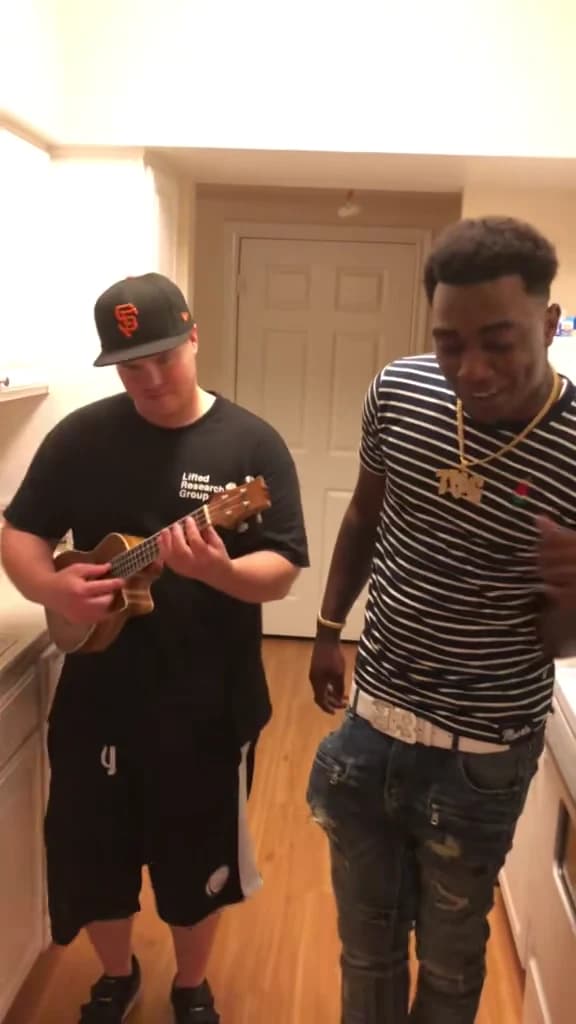
The Fredo Bang Oouuh AI trend comes from a kitchen performance with Einer Bankz playing ukulele on the left and Fredo Bang singing on the right. The reference audio was identified as Oouuh (Acoustic Bang). The Tony Montana and Elvira version supplied on Instagram is a later AI character remake of that performance.
To follow the same duet, open the reference in Oakgen. This guide explains which recording and scene you are hearing, then maps the 15-second excerpt's musical and visual changes. For upload instructions, use the complete recreation walkthrough.
Identify the performance before choosing a sound
A song title, a video excerpt and an AI remake can circulate together while referring to different objects. Start with the two people and what they are doing. The creator-posted kitchen performance supplies the underlying scene: steady strumming beside an expressive lead vocal.
| Reference you find | What it establishes | How to recognize it |
|---|---|---|
| Einer Bankz's kitchen performance with Fredo Bang | The performers, setting and division of roles | Left player with a small brown ukulele; right singer in the same continuous shot |
| Oouuh (Acoustic Bang) catalogue listing | The acoustic recording's title and artist | Fredo Bang is named on the released track |
| The supplied Tony Montana and Elvira Reel | A particular AI reinterpretation | Fictional character likenesses occupy the familiar duet roles |
| Oakgen's Oouuh preview | The excerpt used by this fixed template | A 15-second portrait segment from the real performance |
The public trend page shows that excerpt. Its original-performance preview is different from the @ausar.ai character remake. Neither preview is presented as a paid Oakgen output.
What the original audio is
Apple Music lists Oouuh (Acoustic Bang) by Fredo Bang. That title distinguishes the acoustic reference from other releases carrying the shorter song name. Naming the song alone does not tell an editor which performance, arrangement or excerpt to align.
For this trend, the useful reference is the combination of a lead vocal and audible ukulele from the kitchen take. A different release can share the composition while placing phrases, breaths or accompaniment differently. Start by listening to the actual preview instead of assuming any search result bearing the title will match it.
The performers' own material supports the connection. Einer Bankz's GIPHY post tags Fredo Bang and Oouuh. In a first-person Flaunt interview, Fredo discusses making a video with Bankz and his ukulele. These sources support the collaboration without making a character remake the original performance.
You do not need a full lyric transcription to identify this clip. Artist, acoustic title, kitchen setting and left/right performance roles provide a much more useful reference note than an uncertain transcription of a short social-video sound.
Keep repost and release dates separate
The retrieved creator post is dated April 27, 2022. The Apple Music acoustic listing is dated July 8, 2022. One dates that TikTok publication; the other dates the catalogue release. They answer different questions.
Neither date alone establishes when the people stood in the kitchen or when the performance first appeared online. We have not established the earliest upload or filming date, so this guide does not turn a repost timestamp into an origin claim.
The downloaded creator-posted video runs longer than the excerpt used here. Oakgen's reference takes its opening 15 seconds. When comparing versions, begin at the start of that excerpt rather than matching the ending of a longer upload to the ending of a shorter template.
This distinction matters in a practical edit: the end of the template is an excerpt boundary, not proof that the performers finished the complete song at that moment.
A listening map for the 15-second duet
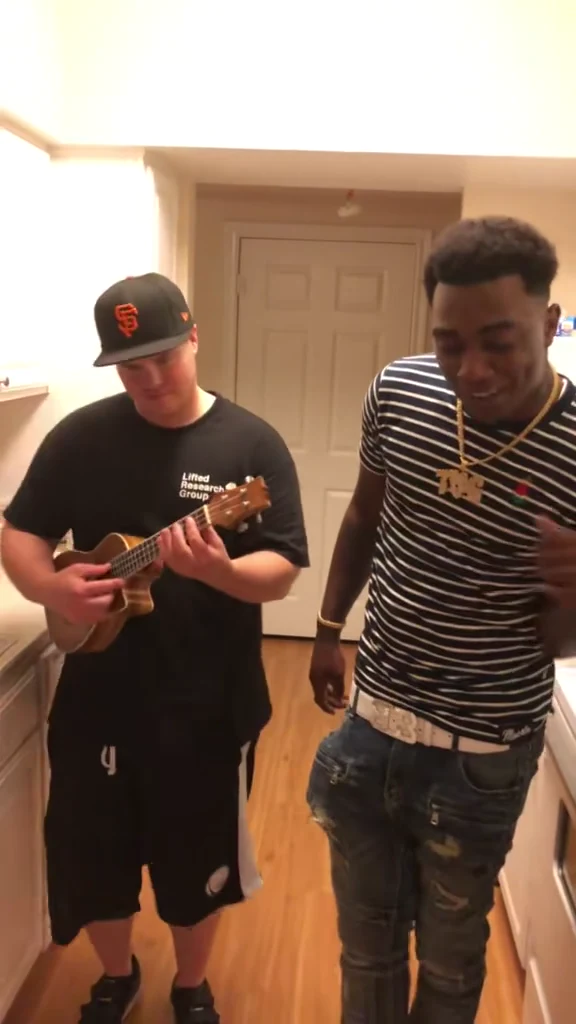
The table below combines the inspected excerpt's visible gestures with broad listening cues. Boundaries are approximate and describe sections, not individual lyric syllables or an official musical transcription.
| Approximate time | What to listen for | What the reference shows | What gives the section its character |
|---|---|---|---|
| 0–4 seconds | Lead vocal phrases over continuing ukulele | Player mostly looks down; singer faces forward and gestures near chin or chest | The two distinct performance jobs are established immediately |
| 4–7 seconds | Vocal phrasing continues against the steady accompaniment | Singer looks down, smiles and turns toward the player; player briefly looks up | A shared human moment inside the same performance |
| 7–12 seconds | More accented delivery and changes within the vocal line | Singer raises a hand near the head, returns toward the lens and lowers the gestures | The singer's energy varies while the player anchors the scene |
| 12–15 seconds | A held vocal near the excerpt's end, with strumming underneath | Singer lifts the chin and narrows or closes the eyes; player continues | The contrast between sustained expression and steady accompaniment becomes strongest |
The instrument does not change hands. The camera does not cut to a new performance. Keeping that continuous two-person relationship is central to recognizing the kitchen duet, even when a remake changes both faces and outfits.
Listen once, watch once, then combine them
First, listen without trying to read every mouth shape. Notice the continuing strum and where the vocal energy rises or settles. This gives you a musical outline that does not depend on recognizing a celebrity.
Next, watch the scene without sound. The player's repeated instrument motion contrasts with the singer's shifting attention, hand gestures and head lift. The brief glance between them is part of the performance; it does not introduce a different singer or a new scene.
Finally, watch with sound and connect the held vocal to the final head lift. This is a way to understand the reference's timing. It is not a claim that every generated mouth movement or instrument contact will reproduce it exactly.
Worked example: plan attention across the duet
Imagine a recreation featuring Morgan as the calm instrumentalist and Kei as the expressive vocalist. The planning question is where the viewer should look over time, not whether both people can make large gestures throughout.
For the first four seconds, let the scene establish two different jobs: Morgan's repeated strum and Kei's lead delivery. Around the shared look in the middle, keep both people in the composition so the interaction can register. Treat the larger hand gesture later as an accent inside the vocal performance, rather than a cue to insert a new shot.
Save room for the last section. If you choose an external excerpt that ends around eleven seconds, you remove the chin lift and sustained expression that make the ending distinctive. If your caption covers the singer's face during the last few seconds, it competes with the very gesture that explains the musical peak.
Write a short editing note: “Both people visible; steady player throughout; shared look retained; final vocal hold gets space.” This is an original planning example, not a tested generated result or a new prompt required by the fixed template.
You can watch the duet in Oakgen while following that note. The useful question is whether your chosen presentation preserves the contrast between the two performers, even before you consider a particular cast.
Choose the matching excerpt when comparing remakes
Use three anchors: the opening arrangement of the pair, the shared look during the middle section and the late chin lift. Together they identify the performance more reliably than a single expressive screenshot. A different sound edit may begin midway through the same take and reach those gestures at different elapsed times.
Keep your time notes tied to one version. The map above starts at the first frame of Oakgen's 15-second reference. It should not be treated as a universal timestamp list for every full-length repost, loop or remix.
The supplied fictional-character version can help you recognize the format, but use the credited real performance to distinguish the two original jobs. A character's dramatic reputation does not determine who plays the instrument; the visible action does.
Take that timing into your version
Oakgen uses two required photos for this fixed portrait duet, one for the left player and one for the right singer. It retains the reference soundtrack. Uploading a photo does not record that person's singing or replace the acoustic performance with a new song.
For the creation process, continue with the two-photo Oouuh walkthrough. For choosing inputs and reviewing appearance, use the player and singer photo guide. The listening map here is for identifying and planning the performance, rather than diagnosing a particular generated face or hand.
For a contrasting format, the Bills scene explainer follows changing conversational attention across three people. The Stop Sign walkthrough follows speaking and listening around an offscreen voice.
Frequently asked questions
What song is used in the Fredo Bang Oouuh AI trend?
The reference audio was identified as Oouuh (Acoustic Bang) by Fredo Bang. The kitchen clip pairs his vocal with Einer Bankz's ukulele performance, and Oakgen retains the reference soundtrack rather than recording the uploaded person's voice.
Who are the original performers in the kitchen duet?
Einer Bankz plays the ukulele on the left, while Fredo Bang sings and gestures on the right. The inspected excerpt keeps those roles together in one continuous kitchen shot.
Is the Tony Montana and Elvira version a Scarface scene?
No. The supplied @ausar.ai Reel is an AI character remake of the Fredo Bang and Einer Bankz duet. It is not an original Scarface scene or a verified Oakgen result.
Does the creator repost date establish when the duet was filmed?
No. The retrieved Einer Bankz TikTok post is dated April 27, 2022, while Apple Music dates the acoustic release July 8, 2022. Those are separate publication events; neither alone establishes the kitchen performance's filming date.
Which moment defines the end of the 15-second excerpt?
Around the final 12 to 15 seconds, the singer lifts his chin into a held vocal while the player continues strumming. Preserve that contrast when planning a recreation; this excerpt ends before the complete creator-posted performance does.
Sources and review scope
Reviewed October 18, 2026. The listening map and worked example come from inspecting the reference and current product. The cover shows the real performance reference, not an Oakgen generation. No paid generation was produced for this article.
- Einer Bankz creator-posted performance: the retrieved kitchen source and its publication metadata.
- Oouuh (Acoustic Bang) on Apple Music: acoustic title, artist and catalogue date.
- Einer Bankz's Oouuh GIPHY post: creator-associated naming evidence.
- Fredo Bang's Flaunt interview: his first-person account of the ukulele collaboration.
- Supplied @ausar.ai Reel: the Tony Montana and Elvira AI remake.
Make your duet in Oakgen when you have chosen who should anchor the rhythm and who should carry the vocal performance.