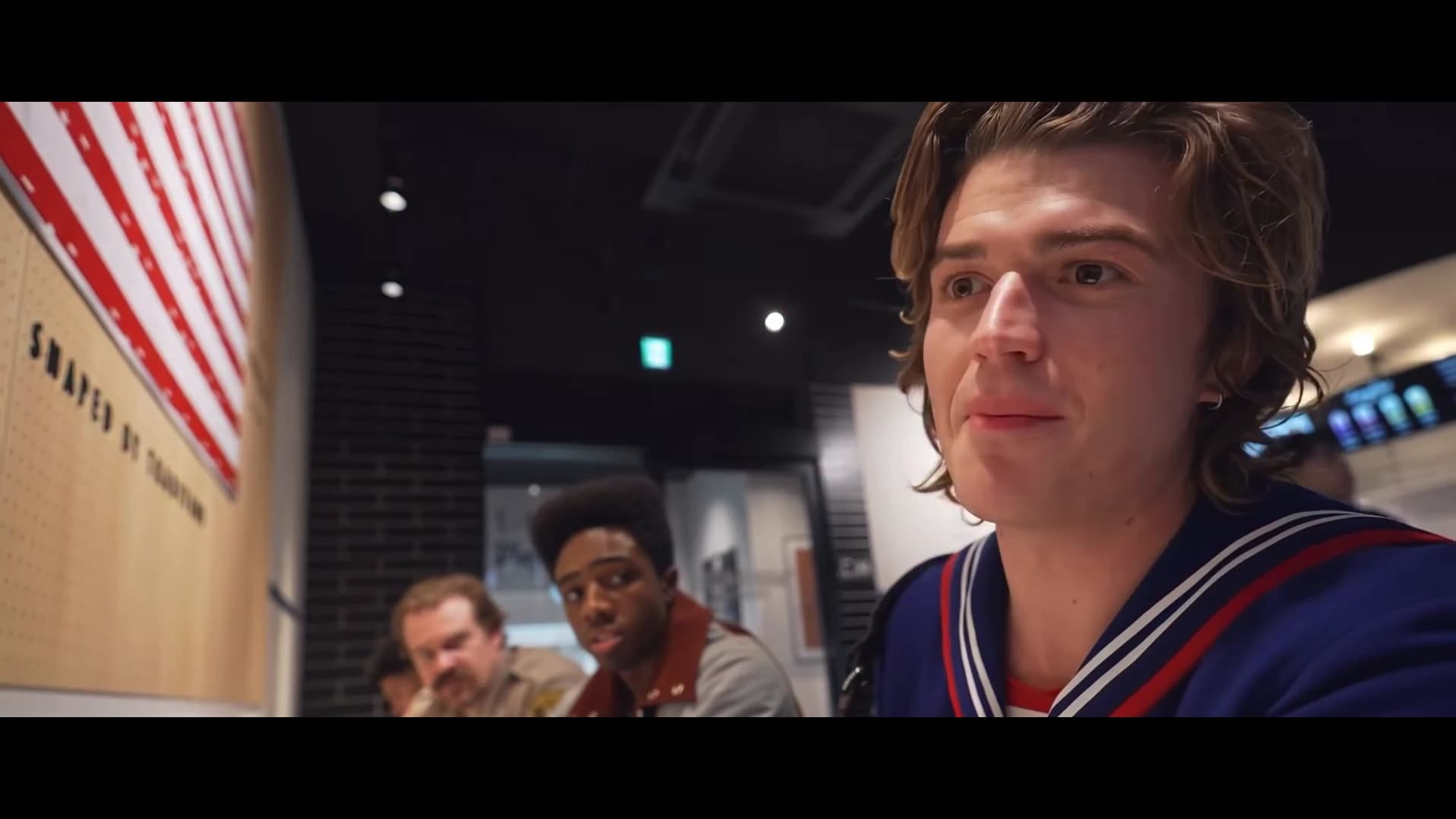
The I Be Thinking Bout My Bills AI trend recreates a restaurant-counter exchange in which a conversation about money becomes an awkward question about who is being addressed. The closest person talks and laughs; a nearby companion seems to take the exchange personally. The final camera move and hand-to-chest reaction explain why the clip is shared as a response meme.
If that is the scene you mean, open it in Oakgen. Before choosing your cast, understand the changing attention: this joke needs the person reacting as well as the person who starts talking.
Three names point to different parts of the joke
The names can make the reference sound like several different trends. They often describe an opening line, an answering reaction or the label attached to a remake. Use the scene to connect them.
| Name you encounter | What it points to here | What to look for |
|---|---|---|
| I Be Thinking Bout My Bills | The money topic that opens the exchange | A speaker nearest the camera, with two companions behind |
| DDG Bills | The short label used for the counter-conversation format | The same arrangement and shift toward the responder |
| You Talking Bout Me? | The question that makes the exchange feel personal | A nearby companion seeking confirmation, then reacting |
| Stranger Things restaurant remake | The supplied AI version's fictional cast | The familiar conversation performed by different characters |
Public Tenor tags associate the reaction phrase with DDG. The supplied @ausar.ai Reel is the character-remake reference. Those are different pieces of evidence: a reaction label helps identify the meme, while a remake shows one interpretation of it.
The DDG Bills overview shows the particular reference used by Oakgen. Compare that preview when a tutorial elsewhere uses a longer clip or a different ending.
What the confusing exchange means
The useful reading is a change in the conversation's apparent audience. At first, the closest speaker appears to be talking toward the camera. As that person laughs and turns toward the companions, the interaction becomes harder to read as a detached comment. The middle responder's question brings that uncertainty into the scene.
The humor depends on the mismatch between discussing bills and reacting as though someone has made a pointed personal remark. You do not need a detailed backstory about anyone's finances to follow it. The visible turns, laughter and repeated attention toward the group provide the explanation.
Watch the middle person before watching the loudest face again. Their response changes the subject from money to the relationship between the people: is this remark directed at me? The later chest gesture makes that interpretation visible even without subtitles.
The far companion contributes a quieter contrast. Their continued presence makes this feel like an awkward group conversation rather than a rehearsed exchange between two isolated speakers. That does not make every quiet glance a separate punchline. In the supplied excerpt, the camera's final emphasis is on the middle responder.
This is a reading of the inspected performance. It does not establish what the real participants intended outside the clip, and it should not become an invented story about them.
Which video is the original?
Separate the supplied remake, the recognizable human conversation and the earliest publication. The Instagram reference identifies @ausar.ai as the publisher of the supplied AI version. Its fictional characters do not turn the exchange into an actual Stranger Things scene.
A public reupload labelled as a DDG conversation is a provenance lead. We have not retrieved and verified the earliest full human upload. We therefore do not credit the remake publisher as the creator of the underlying conversation or assign an original filming date.
The Tenor page is useful for checking the reaction name. Its displayed creation date belongs to that GIF posting, not necessarily to the recording. A date on a repost, GIF or AI variant answers when that particular item was published; it does not automatically date the original event.
For a recreation plan, label your reference clearly: supplied AI remake of the DDG Bills counter format. That description identifies what you actually watched without claiming an origin you cannot substantiate.
A six-beat map of the 13-second scene
The following map comes from inspecting the supplied reference. Times are approximate visual boundaries, not a word-by-word transcript. The scene stays in one continuous handheld shot; a shift in attention does not mean an edit or a new seat assignment.
| Approximate time | Visible beat | What the audience learns | Preserve in your plan |
|---|---|---|---|
| 0–3.2 seconds | Closest speaker addresses the lens, grins and gestures | The opening belongs to the person nearest us | Enough opening time to establish the money topic |
| 3.2–4.6 seconds | A laugh, hand near the mouth and turn toward the companions | Attention starts moving away from the lens | The turn that connects the speaker to the group |
| 4.6–6.9 seconds | Closest person leans toward the middle with open palms | The exchange becomes visibly interpersonal | The relationship between the two active participants |
| 6.9–8.9 seconds | A brief exchange and answering gestures | The responder is part of the conversation | Space for a question and answer to register |
| 8.9–10.8 seconds | More laughter and renewed attention from the middle | The uncertainty has not been resolved | The pause before the last reaction |
| 10.8–13 seconds | Camera pans left; middle person gestures toward their chest | The personal reading becomes the closing image | The final responder, with the far companion still present |
The opening is the setup; the change in attention carries the payoff. A short edit that removes the closing pan can keep the recognizable sound while losing the part that explains the reaction.
Worked example: reading the final chest gesture
Suppose you are planning a version with three friends. Your story note says: one friend is talking about bills, another thinks the remark concerns them, and the third is present as a quiet witness. This is a planning example, not an additional transcript or a generated result.
At the opening, the audience needs to understand who owns the money statement. In the middle, the audience needs to notice the responder becoming involved. At the end, attention should rest on the person effectively asking whether they are the subject. The chest gesture completes that sequence visually.
Now imagine choosing a cover or adding an introductory caption. A cover showing only the nearest speaker emphasizes the setup. A caption such as “When every conversation sounds like it's about you” frames the responder's interpretation. That is an original caption suggestion, not a line spoken in the source.
Keep that caption brief enough that it does not explain the ending before the responder appears. Let the last gesture supply some of the meaning. If you make a shorter external edit, watch the complete question-to-reaction sequence before deciding where it can end.
You can preview the sequence in Oakgen while using the table as a story note. The fixed tool supplies the reference conversation and movement; this note is not a new script to paste into it.
Carry the meaning into a recreation
Decide whose point of view your version follows: the person making the remark or the person wondering whether it concerns them. That choice helps you choose a cover and caption without changing what happens in the reference. Keep the other role visible long enough for the audience to understand the relationship.
Oakgen's version requires three character photos and follows an approximately 13-second landscape reference. It retains the source dialogue; a photo does not supply that person's recorded voice. Generated expressions and mouth movements still need review, so a correct soundtrack alone does not prove the reaction reads properly.
For the actual creation steps, use the DDG Bills walkthrough. For selecting or assigning images, use the three-role photo and continuity guide. Those guides handle the input decisions; the beat map here handles the scene's meaning.
For another spoken misunderstanding, the Stop Sign guide follows a driver answering an offscreen officer. For a performance built around contrasting energy, the Oouuh duet walkthrough follows a steady player beside an expressive singer.
Frequently asked questions
What does the I Be Thinking Bout My Bills AI trend mean?
It turns a restaurant conversation about bills into an awkward question about who is being addressed. The nearby companion treats the exchange as personal, while laughter, a turn toward the group and a final chest gesture carry the joke.
Are DDG Bills and You Talking Bout Me the same meme?
In this restaurant-counter context, those names identify different parts of the same exchange: the opening money topic and the responder's question. The reaction phrase can also appear on unrelated clips, so compare the scene before choosing a template.
Is the Stranger Things restaurant version an original scene?
No. The supplied @ausar.ai Reel is an AI character remake of the counter format. It is not footage from Stranger Things, original DDG footage or a verified Oakgen generation.
Who first uploaded the original DDG Bills conversation?
We have not established the earliest upload or recording date. The supplied AI remake has a known publisher, while public reaction GIFs and a DDG-labelled reupload support the meme's naming without proving who first published the human conversation.
Which reaction should a recreation preserve at the end?
Preserve the camera's shift toward the middle responder and the hand-to-chest reaction. Ending on the closest speaker's laugh alone removes the final change in attention that makes this approximately 13-second reference readable.
Sources and review scope
The scene map and worked reading are original editorial analysis of the supplied clip and current preview, reviewed on October 18, 2026. The cover is a reference frame. No paid Oakgen generation was produced for this article.
- @ausar.ai supplied restaurant remake: the inspected character version and its publisher.
- Tenor's DDG reaction GIF: public reaction-name evidence, not the original recording date.
- DDG-labelled conversation reupload: a source-discovery lead, not a verified earliest upload.
Make your version in Oakgen when you know which reaction your audience should be watching at the end.