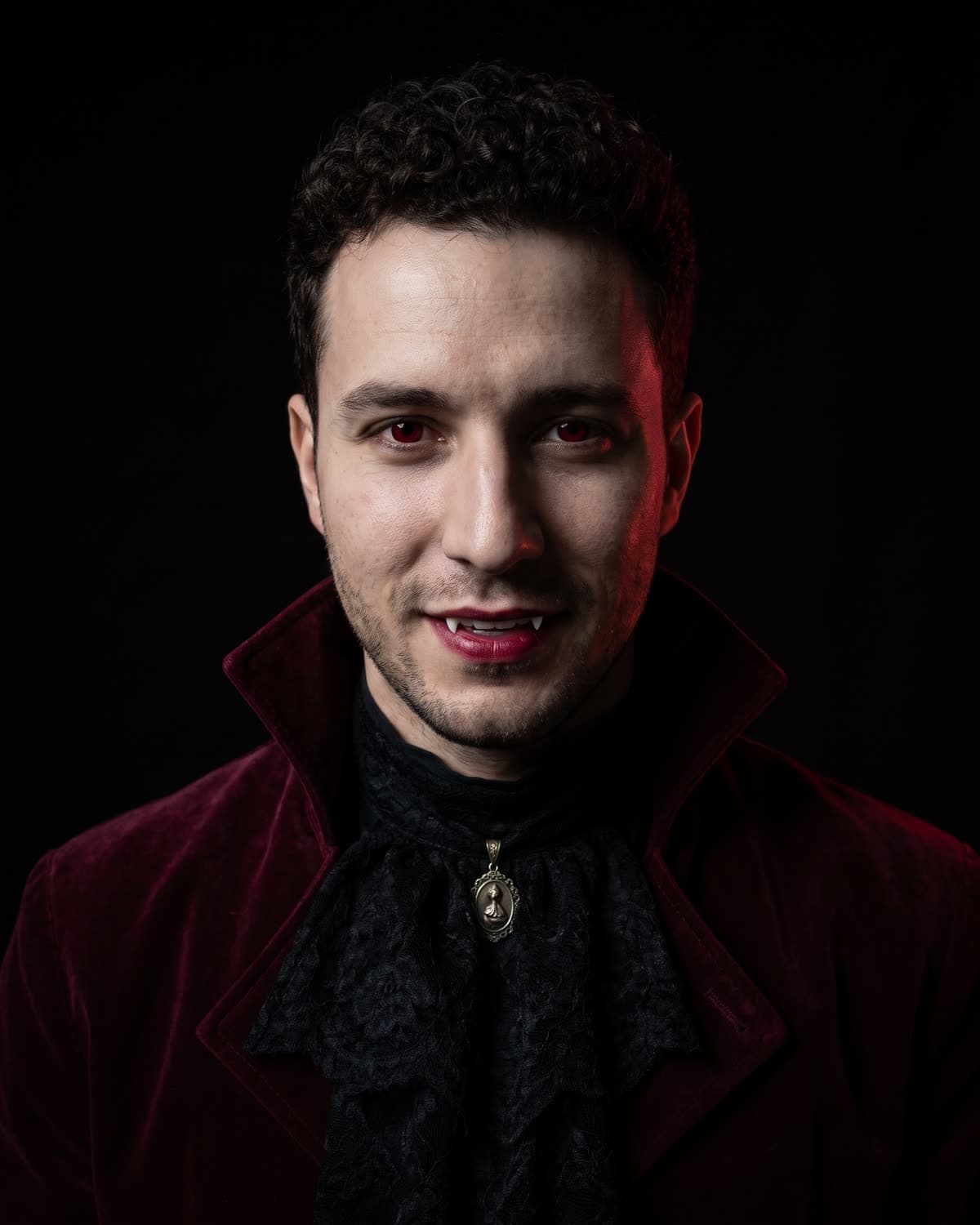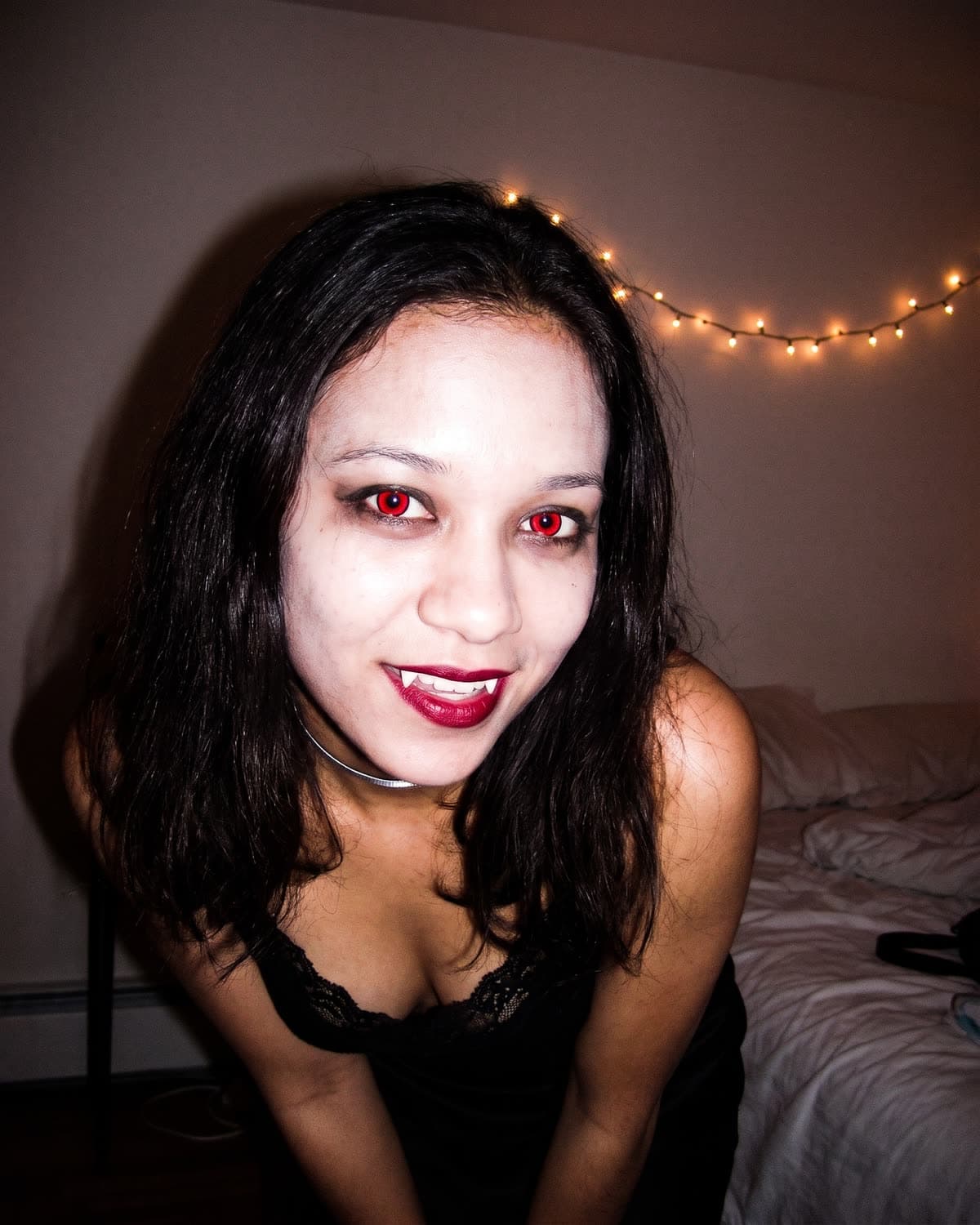
This Halloween, two looks turn up together in prompt guides and AI photo round-ups: the early-2000s flash snapshot and the red-eyed vampire selfie. Put them together and you get a picture that looks like it fell out of an old camera's memory card: a face blasted by flash, a hard shadow on the wall, grain in the dark corners, and a vampire grinning at the lens.
This article is about the photo style itself, why it looks the way it does and why vampires suit it, so you can recognise it, describe it and pick the right template. If you already know you want it and need post ideas and captions, go to Y2K vampire flash photo ideas.
Try the Y2K vampire flash look
One photo of you becomes a 2000s flash snapshot with red eyes and small fangs. No prompt to write.
Why 2000s flash photos look the way they do
Compact digital cameras from that era had a small flash built in right next to the lens, and most people left it on automatic at night. That one detail explains most of the look.
- Bright, flat faces. The flash is a small, hard light fired from the camera's position. Whatever is closest to the lens takes most of it, so faces come out bright and often slightly overexposed, with little of the soft shading a window or lamp would give.
- A dark background. Light from a small flash falls off quickly with distance. A face 50 cm from the camera is lit; the wall a couple of metres behind is much darker. That is why these photos look like a bright person in front of a dim room.
- One hard shadow. Because the flash sits slightly to one side of or above the lens, the subject casts a sharp-edged shadow on any wall just behind them. It is the single most recognisable sign of on-camera flash.
- Red eyes. In a dark room the pupils are wide open. A flash this close to the lens lights the back of the eye, which is rich in blood vessels, and bounces that red straight back into the lens.
- Grain and washed colour. Small sensors at night produced noise in the shadows and colour that could look either too warm or a little faded. Highlights on skin and shiny surfaces often clipped to white.
- Crooked framing. Many of these photos were taken at arm's length or handed to a friend, so they are tilted, off-centre and cropped in places no photographer would choose.
None of these were stylistic choices at the time. They are side effects of a small camera and a bright flash in a dark room, which is exactly why they now read as a time stamp.
Why vampires suit the flash look
The flash look and the vampire look happen to want the same things.
Flash already makes skin pale and bright, so a vampire's pallor looks natural rather than painted on. Flash already causes red eyes, so glowing red irises look like an exaggerated version of something people remember from real photos. Smudged black liner and deep red lipstick hold up under harsh light where subtle makeup would vanish. And the hard shadow behind the head gives the picture a slightly menacing outline for free.
The look also does not need a full costume. Black lace, a choker, coloured contacts and a pair of small fangs are enough to say "vampire" in a close-up, which suits a camera that only ever caught people from the chest up.
How to recognise or describe the look
If you are trying to name a picture you have seen, or describe it to a person or a prompt tool, these are the parts to mention:
| Element | What to look for | Words people use |
|---|---|---|
| Light | Bright frontal flash, one hard shadow behind | direct flash, on-camera flash, harsh flash |
| Camera | Grain, faded or blown-out colour, slight vignette | Y2K flash photo, digicam, 2000s digital camera |
| Framing | Tilted, off-centre, close, candid | candid snapshot, party photo |
| Eyes | Red or glowing irises, like contacts | red eyes, red contacts, vampire eyes |
| Makeup | Pale skin, smudged dark liner, dark red lips | vampire makeup, grunge liner |
| Mouth | Two small fangs, smirk | fangs, vampire smile |
| Setting | Plain dim bedroom wall, fairy lights, unmade bed | bedroom, sleepover, late night |
We did not find one established public name for this exact combination. "Y2K flash photo" and "digicam" are commonly used for the camera style, and "vampire filter" is commonly used for the eyes-and-fangs edit. Y2K Vampire Flash is Oakgen's descriptive name for the two together; the Y2K vampire AI photo page explains how to spot it.
A prompt tool or a fixed template
There are two ways to make this picture with AI.
Writing a prompt in a general image tool gives you control: you can change the eye colour, keep your outfit or move the scene to a club. The cost is that you have to describe every element in the table above, and the more you change about the light and the face, the more the model tends to change your features too. You may need several attempts and some prompt editing to keep the person recognisable.
Using a fixed template such as Y2K Vampire Flash removes the writing. The flash, makeup, outfit, bedroom and grain are already specified, and the instruction to keep your face shape, eyes, nose, lips, hair and skin tone is part of the recipe. You upload one photo and get one 4:5 image in about a minute. The trade-off is that nothing can be changed: no costume choice, no different eye colour, no couple mode.
If you want exactly this look, the template is the shorter route. If you want a variation it does not make, a prompt tool is the better fit. The how-to guide walks through the template step by step.
Where it sits among the vampire trends
Oakgen has four vampire looks, and the camera is what separates this one. Y2K Vampire Flash is the only one lit by harsh on-camera flash, and the only playful one: a smirk in a messy snapshot. The Gothic Vampire Portrait is a still, low-lit studio portrait in burgundy velvet on black. The Vampire Couple Portrait takes two photos and seats one person in front of the other in a candlelit stone room. Halloween Costume is a full-length caped vampire at a candlelit house party.
So the flash look suits a casual, funny post that could pass for a night-out photo, while the other three use candlelight and shadow for a more formal picture. For a side-by-side comparison of all four, with one question to decide between them, read which AI vampire photo look is for you.
If you want a 2000s-era horror picture but not a vampire, Ghostface Call is a bedroom phone-call scene with a masked figure in the doorway. It shares the era but is a different picture: wide, with a second figure, and no vampire makeup.
Posting a flash photo honestly
The flash look is persuasive precisely because it imitates a real, unplanned photo. That makes the label more important than it is for a painted or cartoon style. Say that the image is AI-made in the caption, do not tag a real venue or friend as if the night happened, and only use photos of people who agreed. Caption lines and profile-picture notes are in Y2K vampire flash photo ideas and the captions guide.
Before posting, zoom in on the eyes, the fangs and the wall behind you; the result check lists the usual flaws. For the rest of this season's image trends, see Halloween AI photo trends 2026.
This article describes the template's fixed recipe and general photography behaviour; it does not claim tested results or search demand.
Frequently asked questions
What is a Y2K flash photo?
A photo that looks as if it was taken on an early-2000s compact digital camera with the built-in flash: a bright, slightly overexposed face, a hard shadow just behind the subject, a dark background, grain and casual, tilted framing.
Why do flash photos give people red eyes?
In a dark room the pupils are wide open. A flash mounted close to the lens lights the back of the eye, which is rich in blood vessels, and reflects that red straight back into the lens. The vampire template uses glowing red eyes as a deliberate look, like coloured contacts, rather than as an accident.
Is Y2K Vampire Flash the same as the Ghostface photo trend?
No. Both use a 2000s-era bedroom, but Ghostface Call is a wide scene of someone on a corded phone with a masked figure in the doorway. Y2K Vampire Flash is a close, flash-lit portrait of you as a vampire, with no second figure.
Which Oakgen vampire trend should I use for two people?
Vampire Couple Portrait. It takes two photos and places both people together in a candlelit room. Y2K Vampire Flash and Gothic Vampire Portrait each take one photo.
Continue your project
Y2K Vampire Flash · Y2K vampire flash photo ideas · Best selfie for the red-eye vampire photo · Gothic Vampire Portrait · Vampire Couple Portrait