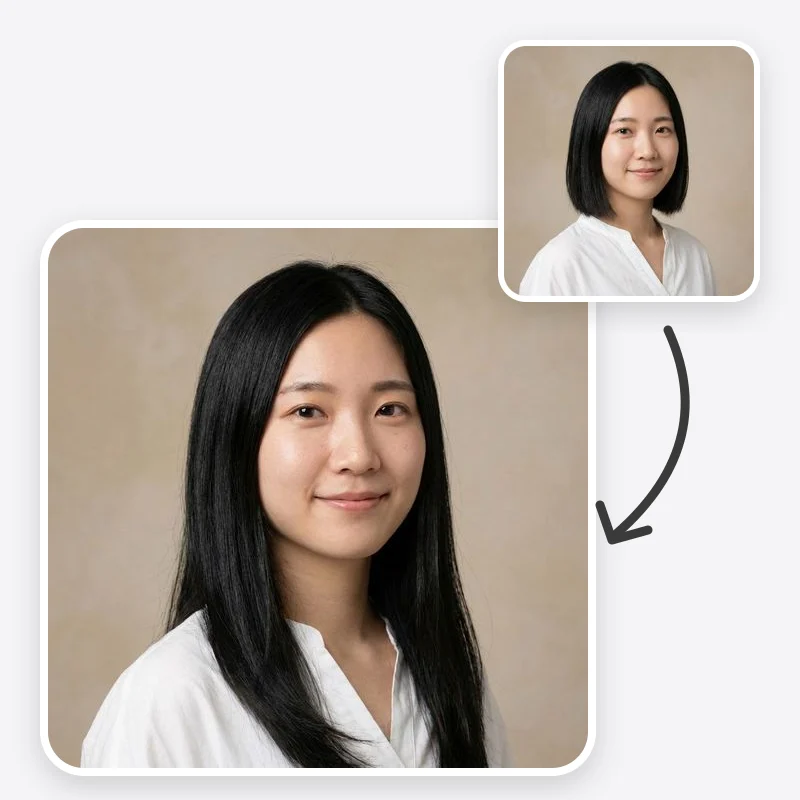
Long hair is a decision with a lead time. Growing it can take a long while, and extensions are a real cost with ongoing upkeep. Either way, it pays to know which length you actually want before you start, rather than discovering at the salon that mid-back felt better in your head than in the mirror.
This guide is about planning: choosing a target length, deciding between growing and extensions, and turning a hair extensions length preview into a clear brief for your stylist. For the step-by-step on using the tool, see the companion guide, How to see yourself with long hair using AI.
Why length is the first decision
Most conversations about long hair jump straight to methods and products. Length should come first, because it affects everything else:
- How it looks on your frame. The same length sits differently on a short and a tall person, and on narrow and broad shoulders.
- How much hair you need. Longer extensions generally need more hair to look full to the ends, which affects weight and cost.
- How long the wait is. If you are growing your own, a longer target simply means more time.
- Upkeep. Longer hair takes longer to wash, dry and detangle, whether it is yours or added.
A preview lets you settle the length question on your own face and body before you spend time or money on the others.
A practical length guide
The long hair filter uses three length marks that match how stylists commonly describe length:
| Length | Where the ends sit | Good for |
|---|---|---|
| Shoulder | On the collarbones, just past the shoulders | A first step from short hair; a modest change with extensions |
| Mid-back | Past the shoulder blades, middle of the back | The classic "long hair" look; the most common target |
| Waist | At the waist | A dramatic look; needs the most hair to look full |
Where a length lands depends on your height and build, so the same label can look different on different people. That is exactly why previewing on your own photo helps more than looking at someone else's pictures.
Compare three lengths on your own photo
Preview shoulder, mid-back and waist length with your natural color, then try extensions-style fullness.
Growing out vs. extensions
Growing your own hair
Growing out costs time, patience and some trims along the way. It also means passing through in-between lengths, which some people find awkward. The upside is that the length is yours, with no fitting or removal appointments.
For a grow-out plan, preview your target with Keep Natural Texture and Natural Volume. That combination shows your own hair grown out, rather than a fuller ideal. Then preview the in-between length (often shoulder) so you know what the middle stage looks like.
Growth speed differs from person to person, and the filter cannot tell you how long it will take. If you notice shedding, thinning or hair that does not seem to grow, that is a question for a dermatologist rather than a stylist; the American Academy of Dermatology's hair loss resource center explains common causes and treatments.
Extensions
Extensions get you length quickly. There are several broad methods, such as clip-ins you put in yourself, and salon-fitted options such as tape-ins, sewn-in wefts and bonded strands. They differ in how long they stay in, how they are maintained and how they suit different hair types. A stylist who fits extensions is the right person to recommend one for your hair.
For extensions planning, preview with Extensions-Style Fullness. It thickens the lengths to the ends the way added hair does, which is closer to what extensions usually look like than a natural grow-out. Compare it with Natural Volume at the same length: if you prefer the fuller version, that tells your stylist something useful.
Texture matters as much as length
The same length looks very different straight, wavy or curly. Curly and coily hair also looks shorter than its stretched length, so a waist-length goal means something different for curly hair than for straight hair.
- If you are growing your own, preview with Keep Natural Texture first. That is your everyday hair.
- If you are choosing extensions, preview the texture you plan to buy. Extensions should match how you usually wear your hair, so if you straighten daily, Straight is fair; if you wear your curls, Curly is.
- If you are planning an event look, preview the finish you will have on the day, such as Wavy.
Questions to answer before you book
Before you take a preview to a salon, answer a few questions for yourself. They shape which length makes sense more than the preview does.
- When do you need the length? If it is for a wedding or a shoot on a fixed date, growing alone may not get you there, and the choice is really between extensions and a shorter target.
- How do you wear your hair day to day? If you usually tie it up, very long lengths spend most of their time in a ponytail. If you wear it down, length shows more.
- How much time do you spend on your hair now? Longer hair, natural or added, generally takes more time to wash, dry and detangle. Picture your morning with it.
- What happens after the event? Extensions for a single occasion and extensions as an ongoing look are different plans. Ask your stylist about removal and upkeep before you start.
- Are you planning a color change too? Settle color and length separately, then preview them together, so you know which change you actually like.
Write your answers next to your preferred preview. Together they make a much clearer brief than a photo alone.
Turn the preview into a stylist brief
A preview is most useful when it ends up in a short, specific brief. Bring:
- Your original photo and two previews at different lengths, with the one you prefer marked.
- The texture and volume settings you used, so the stylist knows whether you previewed natural density or extensions-style fullness.
- What you like about the preferred preview, for example "ends just past the shoulder blades, fuller at the bottom, face-framing pieces at the front".
- Questions for the stylist: Can my hair support this length and weight? Which method suits my hair? How will the color be matched? What upkeep should I expect?
Keep the preview honest by changing one thing at a time. If you want face-framing layers, add that in Additional Instructions on its own, and compare with and without.
What a preview cannot tell you
A preview is a visual estimate. It cannot tell you:
- How extensions will blend with your cut and color in real light.
- How heavy a given length will feel, or how it moves.
- How long it will take to grow your own hair.
- Whether your hair suits a particular method.
Those are questions for a stylist in person. The preview's job is narrower: making sure you both picture the same target length.
Pair it with other changes, one at a time
Length is rarely the only change people consider. Try them separately so each one is clear:
- Color: preview a new shade at your current length with the hair color changer.
- Cut or style: preview a bob, braids or an updo with the hairstyle changer.
- Going much shorter instead: the bald filter covers a shaved head and a very short buzz.
For step-by-step help with the long hair filter's settings and troubleshooting, read How to see yourself with long hair using AI.
Pick your target length first
Preview natural grow-out and extensions-style fullness side by side before you book.
Frequently asked questions
How do I choose the right length for hair extensions?
Preview two or three lengths on your own photo, pick the one that still looks like you, then confirm with your stylist that your own hair can blend with and support that length and weight.
Can a preview show how extensions will blend with my hair?
Only roughly. A preview shows the overall length and fullness. Blending depends on the method, the color match, your cut and how the extensions are fitted, which a stylist needs to judge in person.
Should I grow my hair out or get extensions?
It depends on how soon you want the length, your budget and how much upkeep you accept. A preview helps you pick the target length; a stylist can tell you whether extensions suit your hair.
Can the long hair filter tell me how long my hair will take to grow?
No. It shows a length, not a timeline. Growth speed differs from person to person. If your hair is not growing or is thinning, ask a dermatologist.