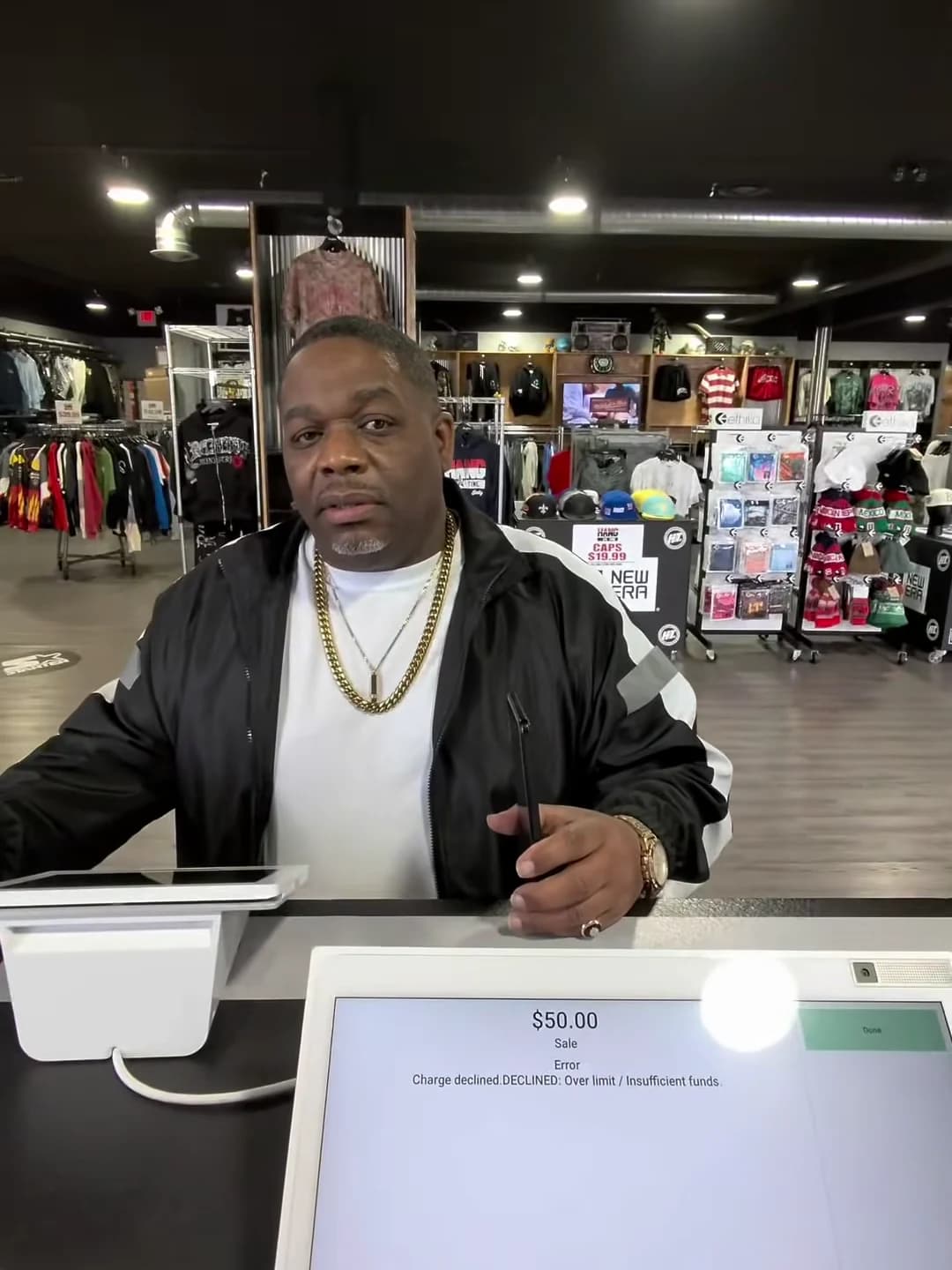
You have a finished video from the Card Declined template and something may look slightly off. This guide is for checking, not making: what to look at in each stretch of the 14 seconds, which photo choices can sit behind a flaw, and what single change to try next. The whole clip is one handheld take from behind a store counter, so every flaw stays on screen. The recipe for making the video is on How to Make the Card Declined AI Trend.
Not made it yet?
Add one photo for the customer, review the credit quote for your resolution, and make the 14-second video.
How to watch your result
Watch it three times. The first time, turn the sound off and look only at the face, the hands and the phone. The second time, turn the sound on and watch only the mouth. The third time, ignore the customer and look at the counter, the till screen and the store behind. Keep the reference clip from the trend page open next to yours. It is a window of the original TikTok, not an Oakgen output, so it shows what the scene should do and says nothing about the quality to expect.
One fact makes this review simpler. The cashier films the whole thing, so you only ever hear the cashier. The only mouth on screen is the customer's, which is yours.
What to check at each timestamp
Times come from a machine transcript checked against the visible mouth, so treat them as approximate. This guide names each line by what it does; the words themselves are on every line with times.
0 to 3 s: the card goes on the reader
The cashier tells the customer to keep the card on the reader while a hand reaches in for it. The customer has his phone at his ear at the start, then lowers it and answers from about 1.3 seconds.
Look for a hand that comes in from the bottom of the frame and stays a hand, a phone that sits naturally at the ear, and a face that holds steady as the head turns from the phone toward the camera.
3 to 5 s: the rushing exchange
The cashier and the customer trade one short line each about who is rushing whom, the customer's at about 4 to 5 seconds. The lines follow each other with almost no gap, so check that the mouth makes no word-forming movement during the cashier's line and articulates again on the customer's. The cashier's hand also enters briefly at about 4.8 to 5.3 seconds as the repeats begin.
5 to 8 s: the repeats
The cashier says "the card declined" around four times in a flat voice. The customer is silent. In the reference he faces the camera until about 6.5 seconds, looks down from about 6.8 seconds, takes the card off the terminal, raises the phone near his ear by about 7.5 seconds and lowers it again by 8.
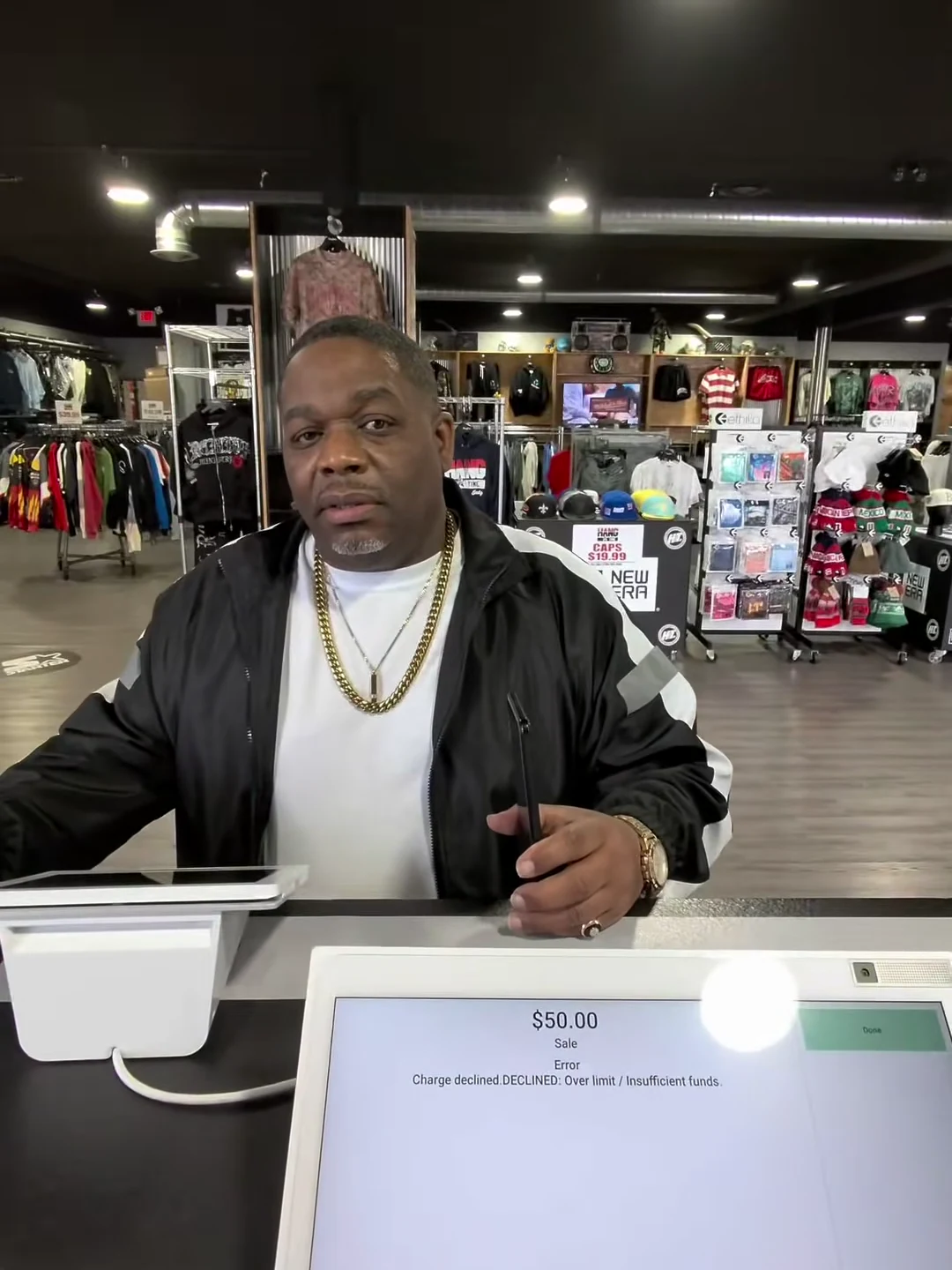
Frame at about six and a half seconds from the reference clip. This is the reference scene, not an Oakgen output.
This is the easiest stretch to judge. The face can keep its expression, but the mouth should make no word-forming movement. A mouth that shapes words here is following the cashier's voice. In the second half, check that the card leaves the terminal in one piece and the phone comes up near the ear without merging into the face. The screen should keep showing the sale and the decline without the text melting into noise.
8.2 to 10.5 s: the comeback
The customer's comeback is his longest line, said facing the camera. The cashier's hand comes in to point at the screen from about 9.8 to 11.5 seconds.
Look for lips that keep moving across the whole line instead of stalling halfway, and a face that stays the same person while the hand passes in front of the screen.
11.8 to 14 s: the jab and the phone
The cashier's two-word reply comes just before, and the customer delivers the quiet ChatGTT jab while lifting the phone back to his ear. The clip ends on him on the phone, with no reply and no cut.
Look for the phone reaching the ear without merging into the face or hair. If your result adds an extra pose, a line or a closing flourish after 13 seconds, that is drift from the reference.
Throughout: the store
The counter, the white card terminal on the left, the till screen, the clothing racks and the cap displays should stay put. With no cuts, background drift is easy to spot on the third watch.
Photo-choice mistakes to look for
These are the problems we would expect from the way the template works. We have not measured how often each one happens.
| Photo choice | What it can look like | Where to look |
|---|---|---|
| Face small, turned away or hidden by sunglasses | Weak or unstable mouth on the comeback | 8.2 to 10.5 s |
| Hand or phone covering the face in the photo | Odd shapes when the phone goes to the ear | 0 to 1.3 s, about 7.5 s and from 11.8 s |
| Photo with a heavy filter, pattern or overlay lines | Texture lingering on the face | Any close frame |
| More than one person or animal in the photo | The wrong face at the counter | The first frame you check |
| A pet photo with the head turned away | A face that changes between frames | 5 to 6.5 s, when the face is front-on and silent |
Fix it with one change
Change one thing, then re-run, so you learn which change helped. Each run is charged at the quote the studio shows for your selection.
| What is wrong | One change to try |
|---|---|
| Mouth forms words while the cashier repeats the line | Use a sharper, front-facing photo with the mouth clearly visible |
| Mouth stalls during the comeback | Use a photo where the face is larger in the frame, in even light |
| Phone merges with the face or hair | Use a photo with nothing near the face: no hand, phone or hood |
| Face looks like someone else | Use a plain, recent photo without heavy filters or makeup effects |
| Counter or screen drifts | Nothing in the studio controls the scene, so re-run once; if it persists, try a different photo |
Before you post
Say that the video is AI-made. Use only a photo of yourself, of someone who agreed, or of your own pet. If you post the reference next to yours, label them separately and credit @hangtimeindytv for the original clip. Our transcript is machine-made and approximate, especially the opening reply and the quiet closing jab.
For the rest of the story, see what ChatGTT lookin' ahh means, every line with times and the dog version. If your result feels flat rather than broken, the timing and delivery guide explains how the take is meant to move.