This article is about how the 14-second card declined take moves: its rhythm, the repeats, and what the customer does with his body and his phone. It is not about what the joke means; that is on ChatGTT Lookin' Ahh AI Video. In short, a cashier keeps announcing a declined card like a machine, and the customer calls him out, first as a robot and then as "ChatGTT". What follows is about timing and delivery, and how to pick a photo that suits them. Timings come from a machine transcript checked against the visible mouth and are approximate.
Take your place at the counter
Add one photo for the customer, check the quote for your resolution, and make the 14-second video with the original sound.
One take, filmed by the cashier
The clip is one continuous handheld portrait shot. The cashier holds the camera from behind the counter, so the cashier is a voice and a hand, never a face. That sets up the whole joke. The viewer sits where the cashier sits, and the customer's irritation is aimed straight at the lens.
It also changes how the clip is cut, which is not at all. The trend uses a 14-second window, 38.95 to 52.95 seconds, of an 84-second TikTok that @hangtimeindytv posted on 26 July 2026. Inside that window there is no edit to hide a slow moment, so the pace comes entirely from the speech.
Lines with no room between them
The exchange runs as eight turns in 14 seconds: two short rounds of bickering, the cashier's repeats, the comeback, a two-word reply and the closing jab. The full dialogue page lists every line with its speaker and time.
The gaps between lines are a fraction of a second throughout. The only quiet moment is the last stretch, after the jab, while the phone goes back to the ear. Our reading is that the speed is what sells the irritation: neither person lets the other finish a thought. That is an interpretation of the clip, not a claim about how it was made.
The repeats are the engine
The longest single block of the clip is the cashier's three seconds of "the card declined". Two things make it work. The words do not change, and neither does the voice. Each repeat lands in the same flat tone, which is exactly what the customer then names: "like a robot". The customer's silence during those three seconds matters just as much. He does not interrupt; he waits, and the comeback comes out all at once.
For your version, those three seconds are where the face is most exposed. In the reference the customer faces the camera until about 6.5 seconds, then looks down from about 6.8 seconds, takes the card off the terminal and raises the phone near his ear by about 7.5 seconds, lowering it again by 8 seconds. His face changes expression but makes no word-forming mouth movement. A photo that holds up front-on and as the head tips down will hold up here.
What the customer does
From our frame review of the reference:
- 0 to 1 s: phone at his ear, as the cashier's hand reaches in for the card.
- 1.3 to 5 s: phone lowered, turned to the camera, arguing about who is rushing whom.
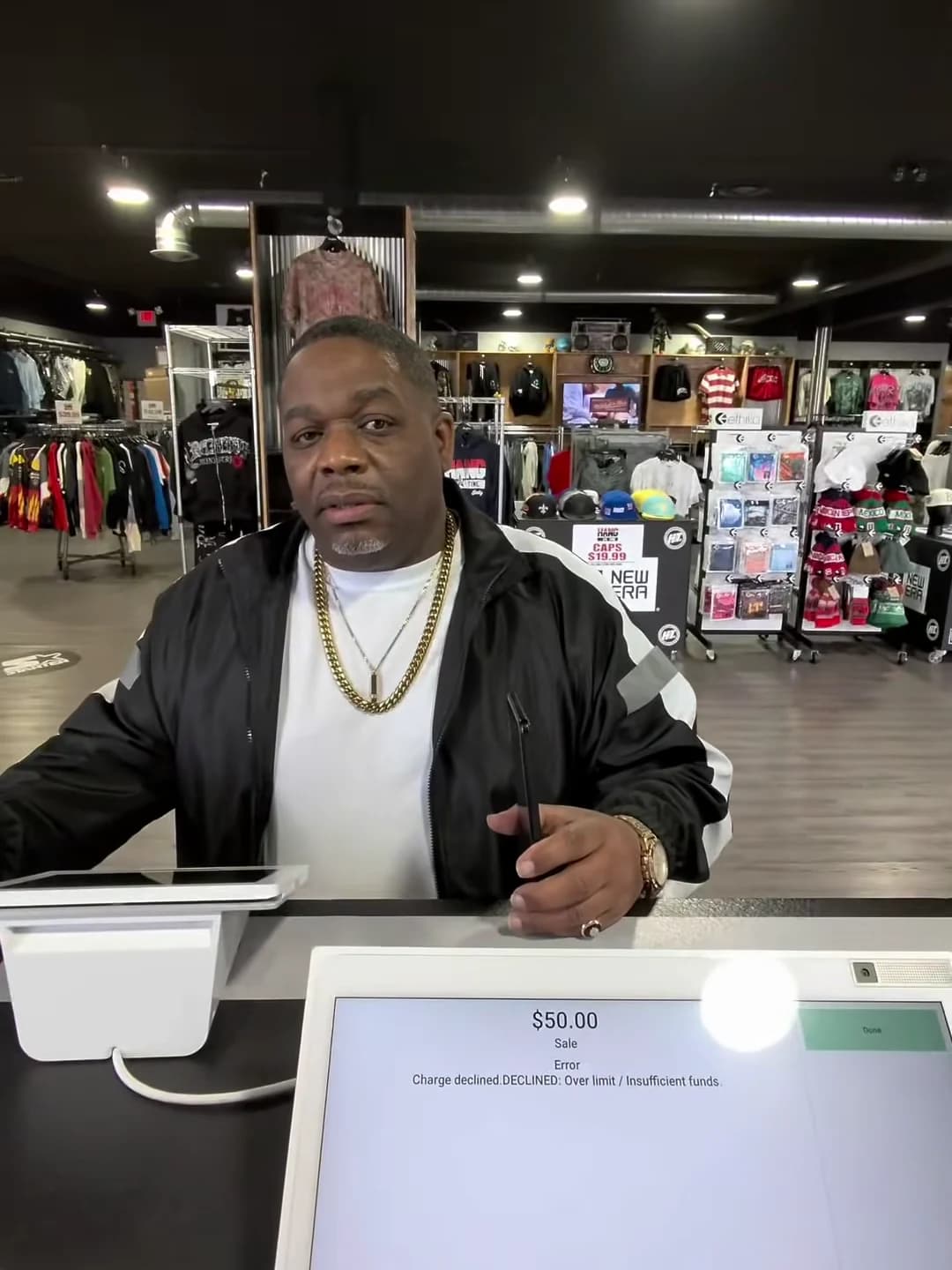
- 5 to 8 s: silent while the till screen shows the decline. A cashier's hand enters briefly at about 4.8 to 5.3 s as the repeats begin. He faces the camera until about 6.5 s, looks down from about 6.8 s, takes the card off the terminal, raises the phone near his ear by about 7.5 s and lowers it again by 8 s.
- 8.2 to 10.5 s: the comeback, facing the camera. The cashier's hand points at the screen from about 9.8 to 11.5 s, as the comeback ends and the cashier replies.
- 11.8 to 14 s: lifts the phone back to his ear as he delivers the jab, and stays on the call to the end.
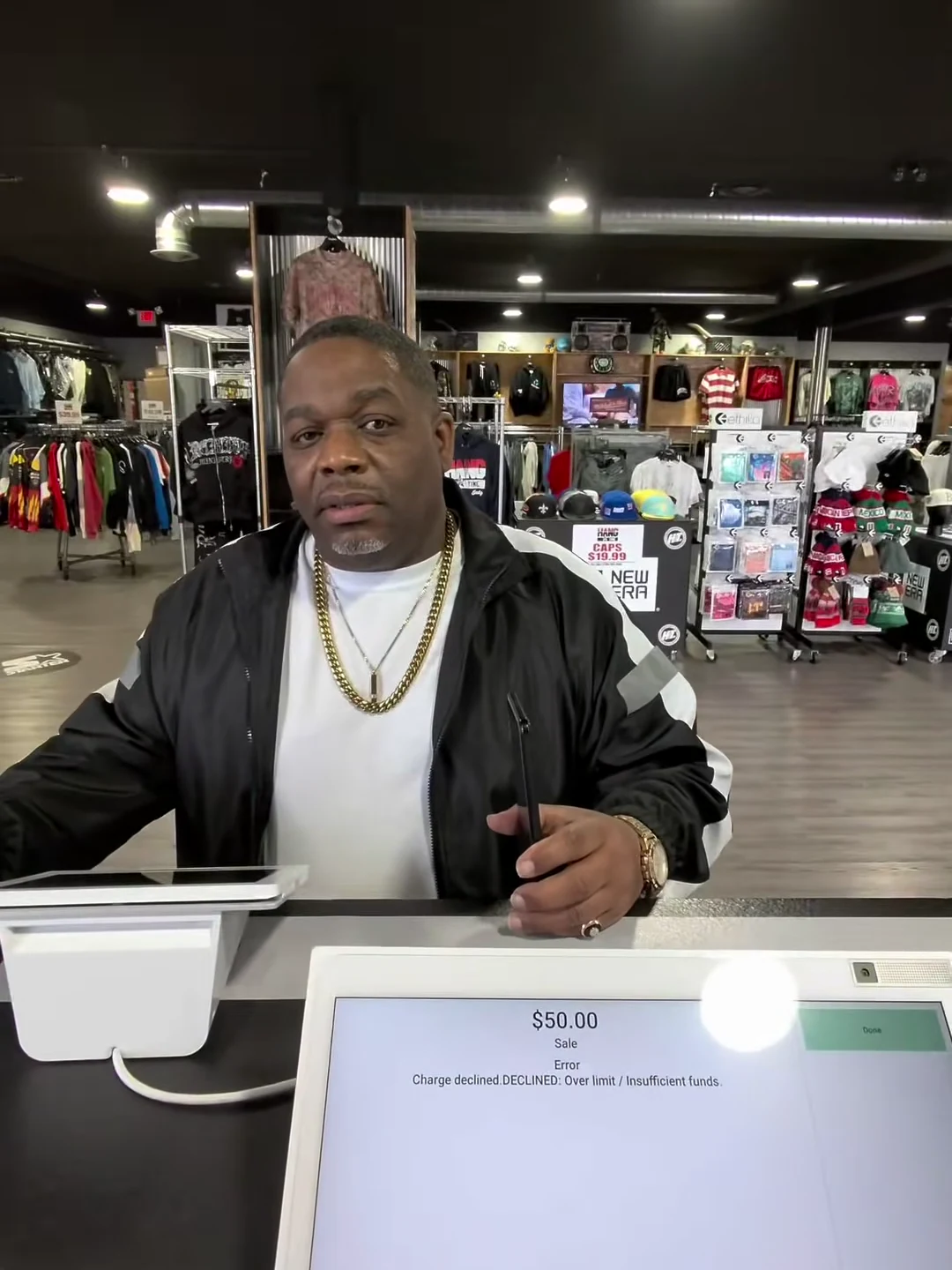
Frame at about six and a half seconds, during the repeats, from the reference clip. It is not an Oakgen output.
The phone frames the scene. He arrives on a call, half-raises the phone again during the repeats, and leaves on a call, which tells the viewer the cashier has been an interruption the whole time. The closing jab is said half to the cashier and half on the way back to the call, which is why it is so quiet.
Choosing a photo that fits
The reference supplies the posture, the phone movement and the camera. Your photo supplies identity: face, hair and outfit. So fit here means the face reads well in the frames where it is shown. This is a judgment from watching the reference, and we have not tested it.
| Moment | What the face does | A photo that suits it |
|---|---|---|
| The repeats, 5 to 8 s | Front-facing, then looking down with the phone raised; no word-forming mouth movement | A sharp, front-facing face with a neutral expression |
| The comeback, 8.2 to 10.5 s | Speaking for over two seconds toward the lens | A face large in frame, in even light |
| Phone near the ear: start, about 7.5 s and end | Head turns slightly, hand near the face | Nothing near the face in the photo: no hand, phone or hood |
If you use a pet photo, the same logic applies: one animal, head in view, face toward the camera. Pet accounts have posted versions with a dog at the counter, covered on the dog version page. We have not reviewed a pet result from Oakgen yet.
Captions
Caption placement and timing for this trend are covered in one place, on I Heard You the First Time Bro AI Video.
Where to go next
For the recipe, read How to Make the Card Declined AI Trend. Once you have a result, check it second by second. Oakgen's Card Declined template keeps the original sound, and the clip on the trend page is the reference clip, not an Oakgen result. Use a photo of yourself, of someone who agreed, or of your own pet, and say your video is AI-made.