You have seen it. Hit generate, wait 60 seconds, stare at a spinner, and then: "Generation failed. Please try again." Your credits are gone. Your prompt is gone. Your momentum is gone. You close the tab and do something else.
This is not a rare edge case. If you use AI generation tools regularly -- images, video, audio, music -- you have hit this wall. Maybe once a week. Maybe once a day. The failure rate across major AI providers is higher than most platforms will admit, and the way most platforms handle those failures costs you money you should never have lost.
This article breaks down why AI generations actually fail, what happens to your credits when they do, and why the architecture behind a platform matters more than the marketing on its landing page.
The Failure Rates Nobody Talks About
Every AI generation request travels through a chain: your browser, the platform's API, the AI provider's infrastructure, the GPU cluster running inference, and back again. A failure at any point in that chain kills your generation. Here are the most common failure modes, ranked by how often they actually occur:
Provider Outages
AI providers go down. Not occasionally -- regularly. FAL, Replicate, Stability AI, RunwayML, ElevenLabs -- every major provider has experienced multi-hour outages in 2026. When your platform relies on a single provider for a given model, an outage means zero generations until that provider recovers. You wait, you refresh, you check their status page, and you eventually give up.
Rate Limits and Queue Saturation
Even when a provider is technically "up," their GPU clusters have finite capacity. During peak hours -- typically 10 AM to 4 PM Pacific, when both North American and European users are active -- queue times spike and requests start timing out. Your generation enters the queue, sits there for 90 seconds, and the platform gives up waiting. Failed. Credits deducted.
Content Filter False Positives
Every provider runs content moderation on incoming prompts. These filters are aggressive by design -- providers would rather block a legitimate request than risk generating prohibited content. The result: completely innocent prompts get flagged and rejected. "Professional headshot of a woman in a business suit" can trigger filters if the model's classifier assigns too high a probability to certain keywords. Your generation fails, and most platforms still charge you.
GPU Memory Errors
Large models -- especially video and high-resolution image models -- require significant GPU memory. When a GPU is already partially loaded from a previous job, your request can fail with an out-of-memory error. This is invisible to you. You just see "generation failed." The platform may or may not refund your credits depending on how they handle backend errors.
Network Timeouts
AI inference is slow relative to typical web requests. A video generation can take 2-5 minutes. Image upscaling can take 30-60 seconds. If any network hop between you and the GPU cluster drops a connection during that window, the generation fails. The work may have completed on the provider's end, but the result never reaches the platform.
Based on aggregate data from multi-provider platforms in 2026, the baseline failure rate for AI generation requests is 3-8% across all providers and model types. During provider incidents, that number can spike to 30-50% for affected models. Video generation has the highest failure rate (5-12%) due to longer processing times and higher resource requirements. Image generation is the most reliable (2-5%).
What Happens to Your Credits When a Generation Fails
This is where the difference between platforms becomes a financial issue, not just a convenience issue.
Most AI platforms follow one of three patterns when a generation fails:
Pattern 1: Deduct and Forget. The platform deducts credits when you click generate. If the generation fails, your credits are gone. Some platforms offer a manual refund process -- submit a support ticket, wait 24-48 hours, maybe get your credits back. Most users never bother for a $0.15 failure. The platform knows this.
Pattern 2: Deduct and Auto-Refund. Better platforms deduct credits upfront but automatically refund them if the generation fails. This protects you financially, but you still lose time. If the model is down, you will keep trying, keep failing, and keep waiting for refunds. You cannot actually generate anything.
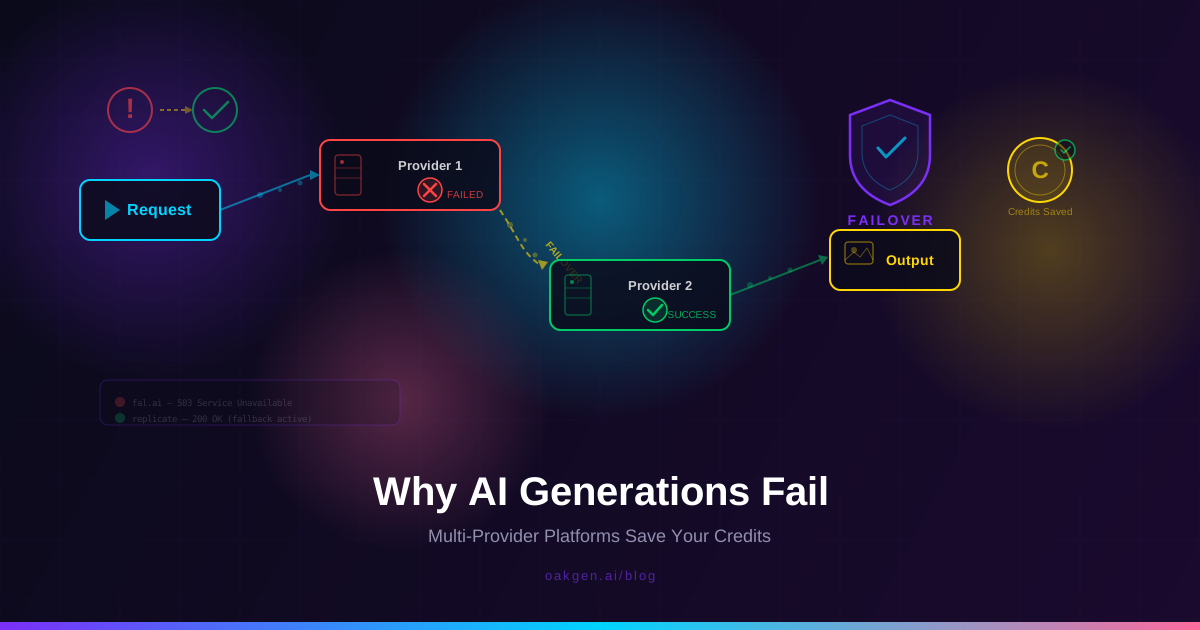
Pattern 3: Deduct, Auto-Refund, and Failover. This is what a multi-provider platform does. Credits are deducted upfront. If the primary provider fails, the platform automatically routes your request to a backup provider -- same model or equivalent model -- without you doing anything. If all providers fail, credits are refunded automatically. You either get your generation or you get your credits back. No limbo.
Oakgen uses Pattern 3. Every generation request goes through an orchestrator that tries providers in priority order. If the first provider returns an error, the orchestrator moves to the next provider before you ever see a failure message. Credits are only permanently deducted when a generation actually succeeds and delivers output.
| Behavior | Single-Provider Platform | Multi-Provider Platform (Oakgen) |
|---|---|---|
| Provider goes down | Generation fails. Wait for recovery. | Automatic failover to backup provider. Generation completes. |
| Rate limit hit | Generation fails or queues indefinitely. | Reroutes to provider with available capacity. |
| Content filter false positive | Generation blocked. Credits may be lost. | Tries alternate provider with different filter. If all block, credits refunded. |
| GPU memory error | Generation fails. May or may not refund. | Retries on different GPU cluster via backup provider. |
| Network timeout | Generation lost. Manual refund process. | Retries automatically. If all attempts fail, credits refunded. |
| Credit handling on failure | Varies: lost, manual refund, or auto-refund. | Always refunded if no output delivered. |
| User action required | Re-submit manually. Check provider status. | None. Failover is automatic and invisible. |
| Effective uptime | Tied to single provider (~97-99%). | Combined across providers (~99.9%+). |
How Multi-Provider Failover Actually Works
The concept is simple. The implementation is not. Here is what happens behind the scenes when you click "Generate" on a multi-provider platform like Oakgen:
Step 1: Credit reservation. Before anything hits an AI provider, the platform calculates the exact credit cost for your request and reserves those credits in your account using an atomic database transaction. This prevents double-spending but does not permanently deduct until the generation succeeds.
Step 2: Provider selection. The orchestrator checks the priority list for your chosen model. Most models are available through multiple providers. The orchestrator picks the highest-priority provider that is currently healthy -- meaning it has not returned errors recently and is within rate limits.
Step 3: Request submission. Your prompt, parameters, and model configuration are sent to the selected provider. For async generations (video, music), the platform receives a job ID and waits for a webhook callback. For sync generations (text-to-speech), the platform waits for the response directly.
Step 4: Failure detection. If the provider returns an error -- timeout, rate limit, content filter, server error -- the orchestrator evaluates whether the error is retryable. A rate limit is retryable (try another provider). A malformed prompt is not (your prompt has an issue regardless of provider). This distinction prevents wasting time on requests that will fail everywhere.
Step 5: Automatic failover. For retryable errors, the orchestrator moves to the next provider in the priority list and repeats Step 3. This happens without any notification to you. From your perspective, the generation is still in progress.
Step 6: Completion or refund. If a provider succeeds, the output is uploaded to storage, your generation record is created, and the credit reservation becomes a permanent deduction. If all providers fail, the credit reservation is released and your balance returns to where it was before you clicked generate.
This entire sequence typically completes in under 5 seconds for image generation, even when the first provider fails. You click generate, you wait the normal amount of time, and you get your result. The failover happened invisibly.
If you are running an agency producing 200+ generations per day, a 5% failure rate means 10 failed generations daily. On a single-provider platform, that is 10 interruptions, 10 re-submits, and potentially 10 lost credit charges. On a multi-provider platform with failover, most of those failures resolve automatically. Your team keeps working without noticing. Over a month, that difference compounds into hours of saved time and hundreds of dollars in protected credits. See how Oakgen works for agencies.
The Five Provider Failures You Will Hit This Month
These are not hypothetical. If you generate AI content regularly, you will encounter every one of these within the next 30 days.
1. The Tuesday Morning Outage
A major provider pushes an infrastructure update. Something breaks. Their status page says "investigating." For the next 2-4 hours, every generation request to that provider fails. If your platform only uses that provider for your model, you are locked out. A multi-provider platform routes around the outage before you finish reading the error message.
2. The Rate Limit Wall
You are batch-generating product photos for an e-commerce catalog. After 30 images in quick succession, you hit the provider's per-minute rate limit. Generations start failing. You did not do anything wrong -- you are just generating faster than the provider allows. A multi-provider platform spreads your requests across providers, effectively multiplying your rate limit ceiling.
3. The Phantom Content Filter
Your prompt says "athletic woman running on a beach at sunset." The content filter flags "woman" combined with "beach" and blocks the request. The generation fails. You spend 10 minutes rewording the prompt, trying "female athlete," "person," "runner." A multi-provider platform tries the same prompt on a different provider whose filter handles it correctly.
4. The Silent GPU Crash
Your video generation enters the queue, a GPU processes it for 3 minutes, the GPU encounters a memory error, and the job dies silently. The provider's webhook never fires. The platform eventually times out and marks your job as failed. On a single-provider platform, you lose the credits and the time. On a multi-provider platform, the timeout triggers a retry on a different provider's infrastructure.
5. The Weekend Capacity Crunch
Saturday afternoon. Everyone is generating. GPU clusters are at capacity. Queue times stretch from 30 seconds to 5 minutes. Requests start timing out because they exceed the maximum wait time. A multi-provider platform checks capacity across providers and routes to whichever has the shortest queue, keeping your generation times consistent.
What to Look for in an AI Platform's Reliability
Not every platform that claims "multi-provider" actually implements failover correctly. Here is what to check:
Automatic credit refunds. Ask the platform: if a generation fails, do I get my credits back automatically? If the answer involves "submit a ticket" or "refunds are reviewed case by case," the platform is profiting from failures.
Provider transparency. Does the platform tell you which providers power each model? Platforms that hide this information are usually single-provider and do not want you to know.
Failover documentation. A platform that has built real failover is proud of it. They document it. They explain how it works. If you cannot find any mention of failover, backup providers, or reliability architecture, it probably does not exist.
Uptime history. Check the platform's status page. If individual tools (image generator, video generator) show separate uptime metrics, that suggests independent provider backends with failover. If the entire platform goes down as a single unit, it is likely a monolithic single-provider setup.
Oakgen publishes which providers power each model and routes between them automatically. You can browse the full model catalog on the tools page and see the providers listed for each model.
The Math: How Much Do Failed Generations Actually Cost You?
Let's run the numbers for a typical creator generating 500 images and 50 videos per month.
At a 5% failure rate on a single-provider platform with no auto-refund:
- 25 failed image generations x $0.05 average = $1.25 lost
- 2.5 failed video generations x $0.50 average = $1.25 lost
- Total monthly loss: $2.50 in wasted credits
- Annual loss: $30.00
That does not sound catastrophic. But add the time cost: each failed generation requires you to notice the failure, re-submit, and wait again. At 2 minutes per failure event, 27.5 failures per month = 55 minutes of wasted time monthly. At a freelancer's rate of $75/hour, that is $68.75 in lost productivity per month -- $825 annually.
For an agency running 200+ generations per day, multiply those numbers by 12. The financial case for multi-provider failover is not about the credits. It is about the time.
Stop Losing Credits to Failed Generations
Why Oakgen Built Multi-Provider Failover
Most AI platforms start with a single provider integration. It is faster to build, simpler to maintain, and works fine when that provider is healthy. The problem surfaces at scale: more users means more generation requests, which means more exposure to provider failures. A 3% failure rate across 10,000 daily generations is 300 failures per day. That is 300 angry support tickets, 300 credit disputes, and 300 users questioning whether the platform is reliable.
Oakgen was built from the ground up with multiple providers per model type. The image generator draws from multiple providers for Flux, Stable Diffusion, and other models. The video generator does the same for video models. When you compare Oakgen to single-provider platforms, the reliability difference is the feature that matters most over months of daily use -- more than UI polish, more than model selection, more than pricing. Read our platform comparison with Higgsfield and Krea for a deeper breakdown.
The agent chat extends this same philosophy to conversational AI workflows, routing between LLM providers for consistent uptime.
For a complete view of model availability across providers, see 200+ AI Models, One Dashboard. For the credit economics behind all of this, read The Real Cost of AI Generation: A Pricing Breakdown.
How to Protect Yourself on Any Platform
Even if you are not on a multi-provider platform, you can reduce the impact of generation failures:
-
Save your prompts. Before clicking generate, copy your prompt to a note. Failed generations on many platforms lose the prompt entirely. Oakgen preserves your prompt history regardless of outcome, but not every platform does.
-
Generate during off-peak hours. Early morning (before 8 AM Pacific) and late evening (after 8 PM Pacific) have lower failure rates across every provider. Queue times are shorter, rate limits are less likely to trigger, and GPU clusters have available capacity.
-
Check provider status pages. Before starting a large batch, check whether the underlying provider is reporting issues. If you are using Flux models and FAL's status page shows degraded performance, wait or switch to a different model.
-
Use platforms with transparent credit policies. Read the refund policy before you buy credits. If the policy does not explicitly guarantee automatic refunds for failed generations, assume you will lose credits on failures.
-
Track your failure rate. Spend one week logging every failed generation. If your failure rate exceeds 5%, your platform has a reliability problem. If it exceeds 10%, switch platforms.
Earn 25% recurring on every referral.
Share Oakgen, get paid every month they stay.
FAQ
What does "AI generation failed" actually mean?
An "AI generation failed" error means something went wrong between your request and the AI model's output. Common causes include provider server outages, GPU memory errors, rate limit throttling, content filter false positives, and network timeouts. The error message you see is usually generic -- the platform may not know (or may not tell you) the specific cause. On a multi-provider platform, many of these failures are resolved automatically through failover before you ever see an error.
Do I lose my credits when an AI generation fails?
It depends on the platform. Some platforms deduct credits when you click generate and do not refund on failure. Others auto-refund failed generations. Oakgen uses atomic credit transactions: credits are reserved when you submit a request, permanently deducted only when the generation succeeds and delivers output, and automatically refunded if all provider attempts fail. You never lose credits to a failed generation.
How does multi-provider failover improve AI generation reliability?
Multi-provider failover means the platform routes your generation request to multiple AI providers in sequence. If the primary provider fails (outage, rate limit, GPU error), the platform automatically tries a backup provider without any action from you. Since provider outages rarely affect all providers simultaneously, this dramatically increases effective uptime -- from the 97-99% of a single provider to 99.9%+ across combined providers. Your generation either succeeds on one of the available providers or your credits are refunded.
Why do AI image and video generators go down so often?
AI generation requires specialized GPU hardware running at high utilization. Unlike standard web services that run on easily scalable CPU infrastructure, GPU clusters have hard capacity limits. When demand spikes -- during business hours, after a viral model launch, or when a provider pushes an update that breaks something -- the system has no room to absorb the surge. Video generation is especially fragile because each job occupies a GPU for minutes rather than seconds, making queue saturation a constant risk.
How can I tell if my AI platform uses multi-provider failover?
Check three things: (1) Does the platform document which providers power each model? Multi-provider platforms are transparent about this. (2) Does the platform guarantee automatic credit refunds for failed generations? This is a strong indicator of proper failover architecture. (3) Does individual tool uptime stay high even when specific AI providers report outages? If your platform's image generator works fine during a FAL outage, it is routing to a backup provider. If the whole image generator goes down with FAL, it is single-provider.
What to Read Next
- Oakgen vs Higgsfield vs Krea: Platform Comparison
- 200+ AI Models, One Dashboard
- The Real Cost of AI Generation: A Pricing Breakdown
- AI Product Photography: Save 80% on E-commerce Shoots
- AI Video for E-commerce: Complete Guide
- AI Headshot Generator: Professional Photos in Minutes