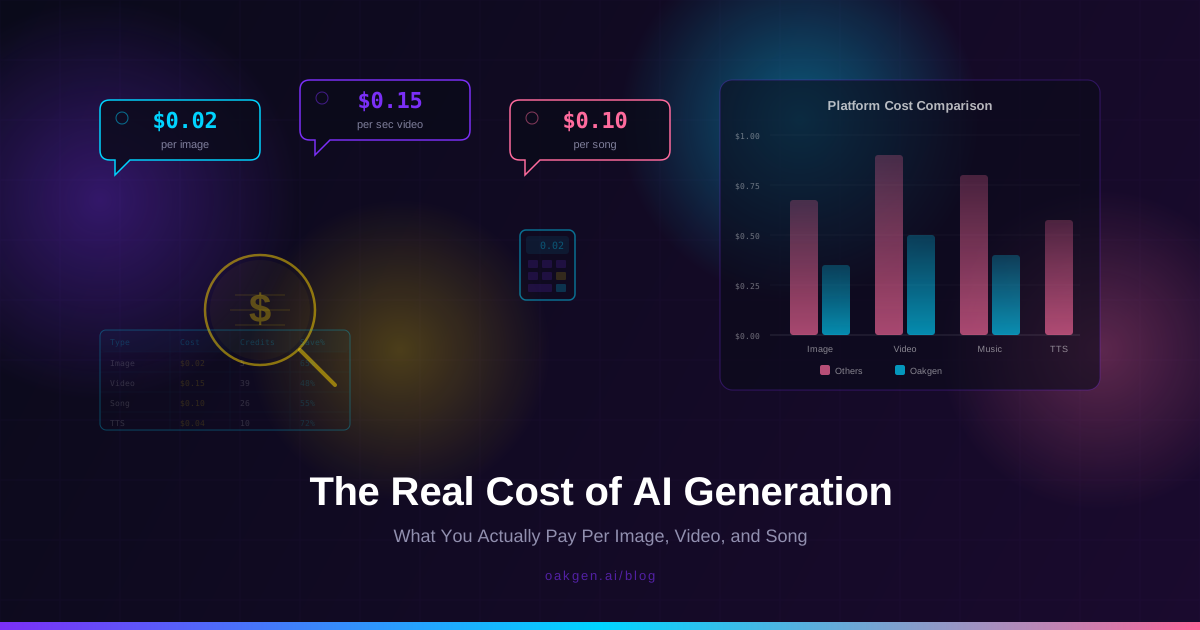
Every AI platform publishes a pricing page with monthly plan costs. Almost none of them tell you what you actually pay per image, per second of video, or per song. The number that matters -- the per-unit cost of a finished generation -- is buried behind credit systems, token buckets, tiered resolution multipliers, and fine print about "fast" versus "relaxed" queues.
We did the math across five major platforms: Midjourney, Runway, ElevenLabs, Suno, and Oakgen. Not the marketing numbers. The actual cost-per-output when you divide your subscription by what you realistically produce in a month. This post is the breakdown nobody publishes.
Why Per-Unit Cost Is the Only Number That Matters
A $30/month subscription sounds cheap until you realize it buys you 60 images at $0.50 each. A $10/month plan sounds expensive when it actually delivers 3,333 images at $0.003 each.
The subscription price is a ceiling. The per-unit cost is what you actually spend. Two things determine it:
- How many generations your plan includes -- credits, GPU minutes, "fast hours," or whatever unit the platform uses
- How much each generation consumes -- which varies by model, resolution, duration, and quality setting
Most platforms make #2 deliberately hard to calculate. Credits get abstracted through conversion ratios. GPU minutes vary by model. "Fast hours" run at different speeds depending on server load. The result is that you cannot compare platforms without sitting down with a spreadsheet.
So we built the spreadsheet.
The Real Per-Unit Cost: Images
Here is what you actually pay per AI-generated image on each platform, calculated from the most popular plan tier (the one most individual creators actually buy).
| Platform | Plan Used | Monthly Cost | Images Included | Cost Per Image | Notes |
|---|---|---|---|---|---|
| Midjourney | Standard | $30/mo | ~900 (15 fast hrs) | $0.033 | Fast mode only; Relax mode is unlimited but queued |
| DALL-E 3 (ChatGPT Plus) | Plus | $20/mo | ~50 (GPT-4o limit) | $0.40 | Hard daily cap; API pricing is $0.04-$0.08/image separately |
| Stable Diffusion (API) | Pay-as-you-go | Usage-based | Unlimited | $0.002 - $0.006 | Self-hosted or API; no subscription needed |
| Leonardo.ai | Artisan | $24/mo | ~8,500 tokens | $0.003 - $0.01 | Varies heavily by model; premium models 5-10x base cost |
| Oakgen (Ultimate) | Ultimate | $29/mo | ~3,333 | $0.009 | All 200+ models included; same credit pool |
| Oakgen (Creator) | Creator | $99/mo | ~13,333 | $0.007 | Priority queue + 4K exports; 15% off add-on credits |
A few things stand out.
Midjourney is not expensive per image -- if you use your fast hours efficiently. The problem is that "15 fast hours" is a moving target. Complex prompts, upscales, and variations all eat time at different rates. Most users do not come close to 900 images; realistic output for a Standard plan user is 200-400 images per month, which pushes the effective cost to $0.075-$0.15 per image.
DALL-E 3 through ChatGPT Plus is the most expensive option by far. The daily generation cap means most users get 40-60 images per month for $20. That is $0.33-$0.50 per image. The API is dramatically cheaper, but requires technical setup.
Oakgen's per-image cost drops as you move up tiers. On the Ultimate plan, each image costs roughly $0.009. On the Creator plan, it drops to $0.007. The pricing calculator shows the exact credit cost for any model and resolution before you generate.
Oakgen uses a credit system where 260 credits = $1 USD. A standard image generation costs approximately 3 credits. On the Ultimate plan ($29/month for 10,000 credits), that is 3,333 images at $0.009 each. The credit cost varies by model -- some premium models cost 5-8 credits per image -- but 3 credits is the baseline for the most popular models like Flux Pro and SDXL.
The Real Per-Unit Cost: Video
Video is where pricing gets genuinely confusing. Some platforms charge per second, some per generation, some by resolution tier. Here is the normalization.
| Platform | Plan Used | Monthly Cost | Video Output | Cost Per 5s Clip | Cost Per Second |
|---|---|---|---|---|---|
| Runway (Gen-3 Alpha) | Standard | $28/mo | 625 credits | $0.45 - $0.90 | $0.09 - $0.18 |
| Pika | Standard | $10/mo | 700 credits | $0.07 - $0.14 | $0.014 - $0.028 |
| Kling (Pro) | Pro | $66/mo | 6,600 credits | $0.10 - $0.50 | $0.02 - $0.10 |
| Sora (ChatGPT Pro) | Pro | $200/mo | ~50 videos/day | $0.13 - $0.27 | $0.027 - $0.053 |
| Oakgen (Ultimate) | Ultimate | $29/mo | ~526 clips | $0.055 | $0.011 |
| Oakgen (Creator) | Creator | $99/mo | ~2,105 clips | $0.047 | $0.009 |
Runway is the most expensive mainstream video generator. Their Standard plan gives you 625 credits per month. A single 5-second Gen-3 Alpha clip at 1080p costs 50-100 credits depending on settings. That is 6-12 clips per month for $28, or $2.33-$4.67 per clip. Even being generous with the math, you are paying well over $0.45 per 5-second clip.
Sora requires a $200/month ChatGPT Pro subscription just to access video generation. OpenAI does not publish a clear credit-per-video number, but community testing suggests roughly 50 standard videos per day at peak capacity. If you actually hit that limit daily, the per-video cost is reasonable. Most users do not.
Oakgen routes through multiple video providers -- HappyHorse 1.0, Seedance 2.0, Kling 3.0, Vidu Q3 -- under a single credit pool. A standard 5-second video costs approximately 19 credits. On the Ultimate plan, that is 526 clips for $29, or $0.055 per clip. The AI video generator shows credit costs per model before you generate.
The Real Per-Unit Cost: Audio and Music
Audio splits into two categories: text-to-speech (TTS) and music generation. The pricing models are completely different.
Text-to-Speech
| Platform | Plan Used | Monthly Cost | Characters Included | Cost Per 1,000 Characters | Notes |
|---|---|---|---|---|---|
| ElevenLabs | Creator | $22/mo | 100,000 chars | $0.22 | Voice cloning included; 29 languages |
| ElevenLabs | Pro | $99/mo | 500,000 chars | $0.20 | Professional voice cloning + API access |
| Play.ht | Creator | $31.20/mo | 200,000 chars | $0.156 | Clone + ultra-realistic voices |
| Oakgen | Ultimate | $29/mo | Shared credit pool | $0.10 - $0.15 | ElevenLabs voices via Oakgen; credits shared with image/video |
ElevenLabs is the industry standard for TTS quality, and their pricing reflects it. The Creator plan at $22/month is good value if you only need voice generation. The catch: those 100,000 characters are siloed. You cannot use leftover TTS credits for image or video work.
Oakgen integrates ElevenLabs voices directly through the audio generator. You pay from the same credit pool you use for images and video. If you need TTS plus image generation plus video, this eliminates the "three separate subscriptions" problem. We wrote about this exact issue in why we stopped paying for four AI subscriptions.
Music Generation
| Platform | Plan Used | Monthly Cost | Songs Included | Cost Per Song | Notes |
|---|---|---|---|---|---|
| Suno | Pro | $10/mo | 500 songs/mo | $0.02 | 2-minute songs; commercial license included |
| Suno | Premier | $30/mo | 2,000 songs/mo | $0.015 | Priority queue + 10 concurrent jobs |
| Udio | Standard | $10/mo | 1,200 songs/mo | $0.008 | Quality varies; interface is less polished |
| Oakgen | Ultimate | $29/mo | Shared credit pool | Varies by model and length | 2 music models: Lyria 3 Pro and Eleven Music |
Suno is genuinely cheap for music. At $0.02 per song on the Pro plan, it is hard to argue with the per-unit economics if music is all you need. Oakgen's per-song cost is typically higher because the music generator runs premium models (Lyria 3 Pro and Eleven Music, each with different quality characteristics and costs), and the credits come from a shared pool.
The value proposition is different: Suno gives you music only. Oakgen gives you music plus images plus video plus TTS plus AI chat from the same $29/month. If you are a freelancer or small business producing content across multiple formats, the consolidated cost almost always wins.
The Hidden Costs Nobody Mentions
The per-unit costs above are the clean math. Real-world costs are higher because of factors the platforms do not advertise.
Failed Generations
Not every generation produces something usable. Industry-wide, roughly 30-60% of AI generations get discarded -- wrong composition, artifact issues, prompt misinterpretation, or just not what you wanted. Your effective cost per usable output is 1.5-2.5x the per-generation cost.
On platforms with hard caps (Midjourney fast hours, DALL-E daily limits), failed generations hurt more because they consume a finite resource. On credit-based systems like Oakgen, a failed generation still costs credits, but you can buy more without changing plans.
Resolution and Quality Multipliers
Most platforms charge 2-4x more for higher resolutions and quality settings. A Midjourney image at default quality costs one "fast GPU minute." The same image at --quality 2 with --stylize 750 and then upscaled costs 3-5x that. Runway's 4K mode consumes credits at roughly 2x the 1080p rate.
Oakgen's credit cost scales with resolution and model too -- a 4K Kling 3.0 video costs more credits than a shorter 720p clip. The difference is that the pricing calculator shows you the exact credit cost before you click generate. No surprises.
Subscription Overlap
This is the biggest hidden cost. If you need images (Midjourney, $30/mo), video (Runway, $28/mo), voice (ElevenLabs, $22/mo), and music (Suno, $10/mo), you are paying $90/month across four platforms. Each has its own credit balance that does not transfer. Leftover Midjourney fast hours do not become Runway credits.
Oakgen's Ultimate plan at $29/month gives you access to all four modalities from a single credit pool. Credits you do not spend on video can go to images, or voice, or music. This is not a small difference -- it is the difference between $90/month with fragmented balances and $29/month with a unified one.
See Your Exact Cost Per Generation
Use the pricing calculator to see credit costs for every model, resolution, and duration before you generate. No surprises.
Oakgen's Credit Math, Fully Transparent
We are not going to pretend Oakgen is the cheapest option for every single use case. If you only generate music, Suno at $10/month is cheaper. If you only need TTS, ElevenLabs standalone at $22/month gives you more characters per dollar.
Where Oakgen wins is multi-format production. Here is the full breakdown of what the plans actually deliver:
| Plan | Monthly Cost | Credits | Images (~3 cr each) | Videos (~19 cr each) | Effective $/Image | Effective $/Video |
|---|---|---|---|---|---|---|
| Basic | $9/mo | 2,000 | ~666 | ~105 | $0.014 | $0.086 |
| Pro | $19/mo | 5,000 | ~1,666 | ~263 | $0.011 | $0.072 |
| Ultimate | $29/mo | 10,000 | ~3,333 | ~526 | $0.009 | $0.055 |
| Creator | $99/mo | 40,000 | ~13,333 | ~2,105 | $0.007 | $0.047 |
The credit ratio is 260 credits per $1. The platform margin is 0% -- Oakgen charges the third-party API cost directly with no markup. When Fal charges $0.012 for a Flux Pro image, Oakgen converts that to 3 credits and charges 3 credits. That is it.
Credit add-ons follow the same math: $10 buys 1,800 credits, $50 buys 10,000 credits (10% bonus), and $100 buys 25,000 credits (20% bonus). Full pricing details are on the pricing page.
The Subscription Stack Problem
Here is a realistic scenario. You are a content creator who needs:
- 200 images per month for social media and blog posts
- 30 short videos per month for Reels and TikTok
- 10 voiceovers per month for YouTube
- 5 background music tracks per month
The multi-platform approach:
| Platform | Plan | Monthly Cost |
|---|---|---|
| Midjourney | Standard | $30 |
| Runway | Standard | $28 |
| ElevenLabs | Creator | $22 |
| Suno | Pro | $10 |
| Total | $90/month |
And you are still managing four logins, four billing cycles, four sets of unused credits that expire separately.
The Oakgen approach:
That workload consumes roughly: (200 x 3) + (30 x 19) + (10 x 50) + (5 x 30) = 600 + 570 + 500 + 150 = 1,820 credits. The Basic plan at $9/month covers it with credits to spare. Even if you double the volume, the Pro plan at $19/month handles it.
We are not claiming Oakgen's individual model quality beats every specialist platform on every task. Midjourney's aesthetic at high stylization is distinctive. ElevenLabs' voice cloning is best-in-class. But for 80% of content production work, the quality difference is marginal and the cost difference is 4-10x.
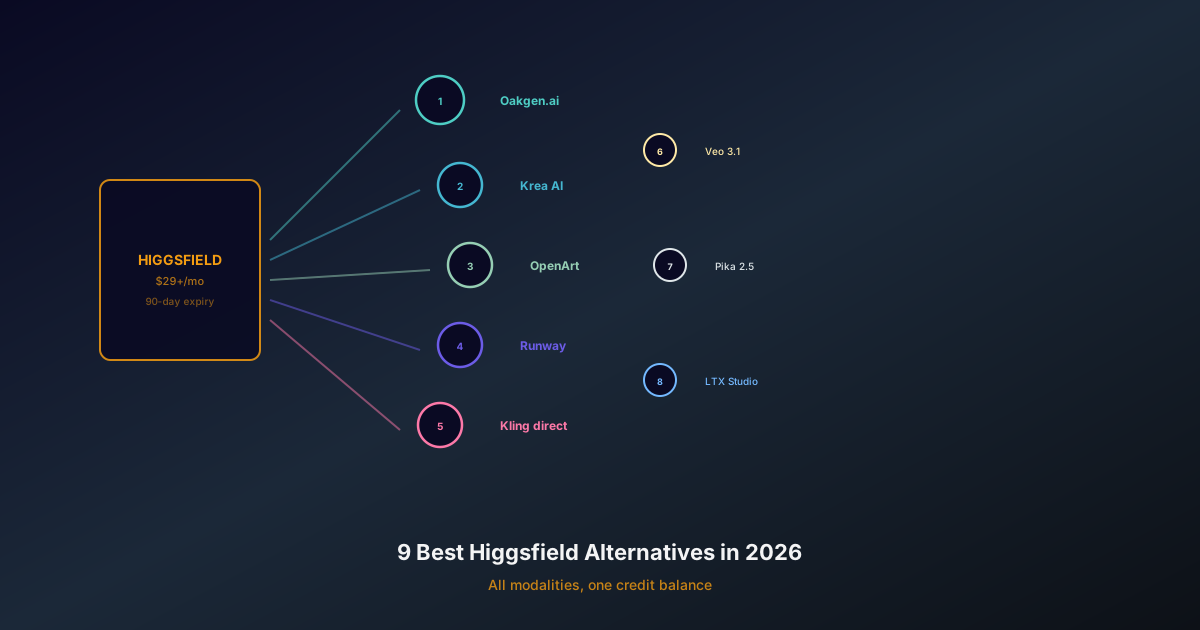
For a deeper comparison of the platform consolidation approach, see Oakgen vs Higgsfield vs Krea and 200+ AI models, one dashboard.
How to Calculate Your Real AI Generation Cost
If you want to run this analysis for your own usage, here is the formula:
Effective cost per generation = (Monthly subscription + add-on purchases) / Usable outputs produced
Not total generations. Usable outputs -- the ones you actually shipped, posted, or delivered to a client. Track this for one month and the number will likely surprise you.
On Oakgen, you can see your exact credit spend per generation in your dashboard. The image generator shows credit cost before you generate. The pricing calculator breaks down cost by model, resolution, aspect ratio, and duration.
For platforms without transparent per-unit pricing, divide your monthly cost by the number of files you actually downloaded and used. That is your real cost, and it is almost always higher than the platform's marketing suggests.
Most creators use 2-3 models for 80% of their work. Identify which models you actually use, check their per-generation credit cost, and pick the plan that covers your real volume. Do not pay for the highest tier "just in case" -- start with Ultimate and add credit packs if you need more.
Frequently Asked Questions
How much does a single AI-generated image cost?
It depends entirely on the platform and model. On Oakgen, a standard image (Flux Pro, SDXL, or similar) costs approximately 3 credits, which translates to $0.007-$0.014 depending on your plan tier. On Midjourney Standard, the effective cost is $0.033-$0.15 per image depending on how much of your fast time you use. DALL-E 3 through ChatGPT Plus is the most expensive at $0.33-$0.50 per image due to daily caps.
How much does AI video generation cost per second?
On Oakgen, a standard 5-second video clip costs about 19 credits, or roughly $0.009-$0.017 per second depending on your plan. Runway Gen-3 Alpha costs approximately $0.09-$0.18 per second on their Standard plan. Kling Pro runs $0.02-$0.10 per second depending on resolution. Video is the modality where pricing varies most dramatically across platforms.
Is it cheaper to pay for one AI platform or multiple specialized tools?
For most creators producing content across multiple formats (images, video, audio, music), a single consolidated platform is 3-5x cheaper. The typical multi-tool stack (Midjourney + Runway + ElevenLabs + Suno) runs $90/month. Oakgen's Ultimate plan covers the same workload for $29/month from a shared credit pool -- no wasted credits siloed in one platform while another runs dry.
What are AI credits and how do they work?
Credits are a unit of account that maps to real API costs. On Oakgen, 260 credits equal $1 USD, and each generation consumes a specific number of credits based on the model and settings used. A Flux Pro image costs about 3 credits. A 5-second HappyHorse video costs about 19 credits. The system exists so you can use one balance across all modalities -- images, video, audio, and music -- instead of managing separate quotas for each.
Which AI image generator is cheapest in 2026?
For raw per-image cost, Stable Diffusion via API ($0.002-$0.006/image) is cheapest but requires technical setup. Among subscription platforms, Oakgen's Creator plan at $0.007/image and Leonardo.ai's base models at $0.003-$0.01/image are the most affordable. Midjourney and DALL-E are significantly more expensive per image. The "cheapest" answer changes if you also need video or audio -- paying $10/month for a cheap image tool plus $28/month for video plus $22/month for TTS adds up faster than a single $29/month plan that covers all three.
Do unused AI credits roll over or expire?
This varies by platform. For Oakgen, check the pricing page for current credit terms. Midjourney fast hours reset monthly. Runway credits expire at the end of the billing period. Always check the fine print on credit expiration before choosing a plan, especially if your usage is inconsistent month to month.
Earn 25% recurring on every referral.
Share Oakgen, get paid every month they stay.
The Bottom Line
The AI generation market in 2026 has a transparency problem. Platforms publish subscription prices and bury per-unit costs behind credit systems designed to obscure direct comparison. When you normalize the math, the differences are stark: a single AI image costs anywhere from $0.003 to $0.50 depending on platform and plan. A 5-second video clip ranges from $0.05 to $4.67. A voiceover runs $0.10 to $0.22 per thousand characters.
The cheapest path depends on what you make. Single-modality creators (music only, TTS only) may find specialized platforms cheaper. Multi-format creators -- and that is most professional content producers in 2026 -- pay dramatically less with a consolidated credit pool.
Oakgen is not the cheapest for every individual modality. It is the cheapest way to access all of them without paying four subscriptions, managing four credit balances, and watching unused credits expire across platforms you forgot to cancel.
Check the pricing page and run the numbers for your own workflow. The math is straightforward once someone actually shows it to you.
What to Read Next
- Why We Stopped Paying for 4 Separate AI Subscriptions -- The real cost of running ChatGPT Plus, Midjourney, ElevenLabs, and Runway simultaneously, and what we learned when we consolidated.
- 200+ AI Models, One Dashboard -- How Oakgen's unified interface works across image, video, audio, and music models without switching platforms.
- Oakgen vs Higgsfield vs Krea: Platform Comparison -- Head-to-head comparison of multi-modal AI platforms for creators who need more than one content type.