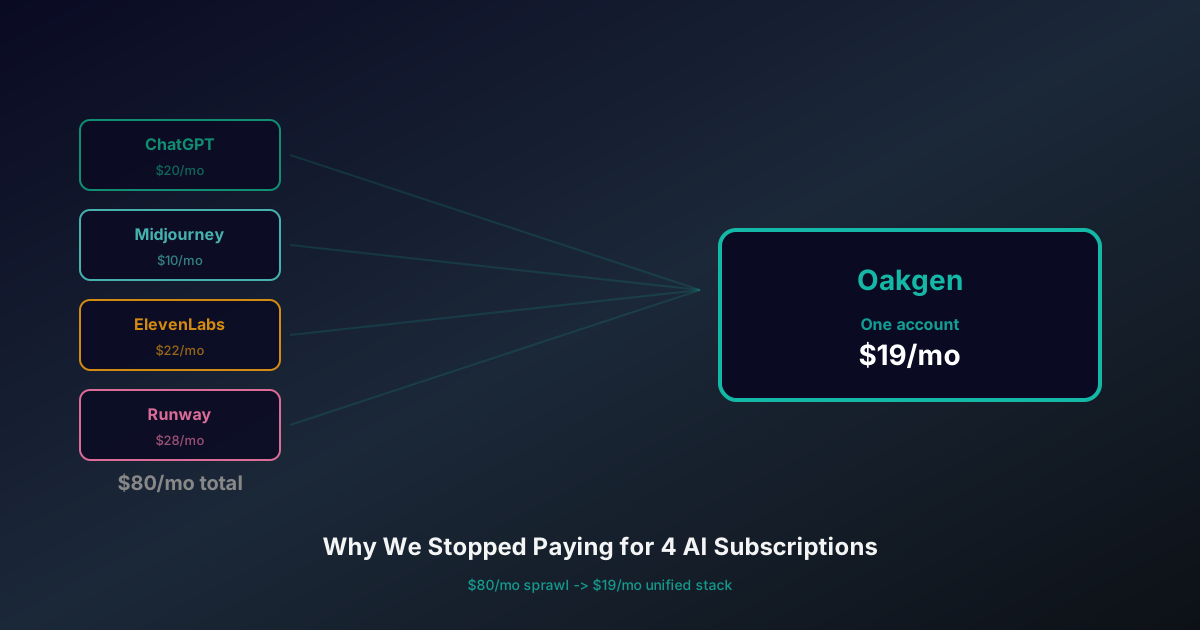
Last year we were paying for four AI subscriptions. ChatGPT Plus for writing and ideation. Midjourney for images. ElevenLabs for voice. Runway for video. $81 per month across four separate bills, four separate accounts, four separate credit balances, and four separate login flows.
We didn't decide to do this. It happened the way most AI stacks happen: one tool at a time, each solving a specific need, each small enough to not feel like a big decision. Three months into running this stack, it felt fine. Six months in, something was off. A year in, we sat down and did the actual math on what this subscription sprawl was costing us -- in dollars, in workflow friction, and in results.
The answer wasn't what we expected.
The Dollars Math
Straight subscription cost at list pricing in early 2026:
- ChatGPT Plus: $20/month
- Midjourney Basic: $10/month
- ElevenLabs Creator: $22/month
- Runway Standard: $28/month
Total: $80/month, $960/year.
That's before you count any overage. ElevenLabs at Creator gives 100,000 characters -- we hit that cap roughly monthly, which meant another $22 for Pro or topping up. Runway's 625 credits at Standard covered about 40 video generations, which we regularly exceeded. Real annual spend was closer to $1,400.
The Workflow Math Nobody Counts
But the dollars were only half the story. The other half was workflow friction.
Every project that used multiple modalities -- which was every project -- required:
- Switching browser tabs 20-40 times per session
- Copy-pasting prompts, scripts, and outputs between tools
- Managing four separate credit balances, each with different top-up cadences
- Tracking four different generation histories in four different places
- Remembering which tool was best for which specific task
- Handling version sprawl when ElevenLabs updated but Runway didn't
The easy number to measure is dollars. The hard number is the creative cost of friction. Every context switch between tools is a micro-distraction. Every copy-paste is an opportunity for error. Every "wait, which tool had that draft?" moment is compounding tax on your attention.
When we actually tracked it, the four-tool workflow was costing us roughly 90 extra minutes per video compared to a consolidated workflow. Over a month of 10-15 videos, that's 15-22 hours of pure friction tax.
The Results Math That Surprised Us
Here's the part we didn't see coming. The four-tool workflow wasn't just more expensive and slower -- it was producing worse results.
The reason is subtle. When your tools are fragmented, you don't experiment across them. You use Midjourney for images because you pay for Midjourney. You use Runway for video because you pay for Runway. But what if, for this specific project, Nano Banana Pro produces a better image than Midjourney? What if Kling 3.0 gives you a better video than Runway Gen-4.5? You never find out, because running an A/B across subscriptions is too much friction.
When we moved to a multi-model platform that lets us run the same prompt across Midjourney, Nano Banana Pro, FLUX 2 Pro, and GPT Image 2 in parallel -- we discovered that Midjourney was winning our A/Bs less than 40% of the time. For specific categories (text-heavy images, editorial illustration), it won. For most general-purpose creative work, it didn't. We were paying for a tool we were over-indexing on out of habit.
The same thing happened with video. Running prompts across Kling, Veo, Seedance, and Wan simultaneously showed us that Runway Gen-4.5 -- the tool we'd defaulted to -- was actually the weakest performer on most of our prompts in 2026.
Subscription sprawl was locking us into inferior tools because changing providers mid-project was too expensive in time and setup friction.
What We Consolidated To
We moved to a multi-model platform -- in our case, Oakgen -- that bundles:
- Chat with Oakgen Auto, Max and Pro Max (our replacement for ChatGPT Plus)
- Image across Nano Banana Pro, GPT Image 2, FLUX 2 Pro, Midjourney-class, plus 200+ others (replaces Midjourney)
- Video across Kling 3.0, Veo 3.1, Seedance 2, Kling v3 Pro, Pika, Luma, and 50+ more (replaces Runway)
- Audio including ElevenLabs voice library and MiniMax Speech HD (replaces ElevenLabs)
- Music via Suno and Udio (net new)
Monthly cost: $19/month on the starter paid tier. Down from $80/month list or $1,400/year at actual spend.
We're Oakgen's team, and yes -- this post is written by the people who make the product. The story above is the actual team workflow we ran and consolidated. We're not pretending to be neutral. But the underlying insight -- that AI subscription sprawl costs more in friction than the dollars reveal -- applies whether you consolidate on Oakgen, or on another multi-model platform, or even on a homegrown stack.
The Consolidation Math for Different Creator Types
Not every creator should consolidate the same way. Here's what we've seen work:
Solo creators producing mixed content (video + audio + image + writing): Full consolidation wins. A multi-modal platform at $19-30/month beats 4-5 separate subscriptions on both cost and workflow.
Specialists whose work lives in one modality: Consolidation saves less. A pure image creator who only uses Midjourney may not need a full stack. But even here, access to Image Arena-style multi-model comparison produces better output than Midjourney alone.
Teams with dedicated production roles: Consolidation still wins -- usually more. Teams that previously managed shared accounts across five tools benefit from unified billing, unified credit management, and unified history.
Developers building AI features: A unified API that covers multiple models beats separate integrations with each provider. Our developer customers cite API consolidation as the second-biggest reason to switch, after cost.
High-end studios producing at scale: Sometimes consolidation is less economic. If you use one premium tool 95% of the time and need best-in-class for a specific task (say, the absolute best Midjourney v7 output for editorial illustration), keeping that one specialty subscription plus a consolidated platform for everything else is often the right stack.
The Subscription Audit Everyone Should Run
Whether or not you consolidate, run this audit on your current AI stack:
Step 1 -- List every AI tool you pay for. Include LLMs, image generators, video tools, voice tools, music, transcription, anything AI-branded.
Step 2 -- Add up the monthly cost. Include the highest tier you've been on in the last 6 months, not your current tier. Most creators downgrade and re-upgrade around projects.
Step 3 -- Count context switches per project. For your last three projects, roughly how many times did you switch between AI tools? Multiply by projects per month.
Step 4 -- Ask: am I experimenting across models, or defaulting to subscriptions I already pay for? This is the biggest insight. If you're only using the tools you pay for without ever A/B testing against alternatives, you may be paying for inferior output.
Step 5 -- Project what consolidation would cost. List-price a multi-model platform that covers your use cases. Subtract from current spend. Add back the projected productivity from reduced workflow friction.
If the math favors consolidation (which it usually does for anyone running 3+ AI subscriptions), test it for a month. If it doesn't, your specialist stack is the right call. Either way, you now know.
What Didn't Work About Consolidation
Full disclosure on what we lost by consolidating:
Some specific advanced features are still better on dedicated platforms. Midjourney's Discord community, Runway's motion brush precision, ElevenLabs' professional voice cloning at the highest tier -- each has edges that consolidated platforms don't fully match. If those specific edges are critical to your work, keep the specialist.
New model launches sometimes hit dedicated platforms first. When OpenAI releases a new capability, it hits ChatGPT before partner integrations. For creators who need Day 1 access to the newest model, a direct subscription may be faster.
Brand communities live on specific platforms. Midjourney's Discord, ElevenLabs' forums, Runway's showcase -- the communities that build around individual tools add value that consolidated platforms replicate less organically.
For us, none of these outweighed the cost and friction savings. But they're real tradeoffs worth understanding before you cancel anything.
The Real Argument
The strongest argument for consolidation isn't the dollars saved. It's the quality of output from multi-model workflows.
When you can A/B the same prompt across four image models in parallel, you produce better images -- not always, but often enough to matter. When you can test four video models on the same shot and pick the strongest, you produce better video. When your chat and image and video and audio tools share state and context, you produce more coherent multi-modal content.
That creative advantage compounds. Month 1, you save some money and some friction. Month 6, your output is noticeably better than it would have been on a fragmented stack, because you've been experimenting across models the whole time.
That was the part we didn't expect. It turned out to be the biggest win.
See related reading: best AI video generators of 2026, best AI image generators of 2026, Runway alternatives, ElevenLabs free alternatives, and our Sora 2 vs Veo 3 vs Kling 3 vs Seedance 2 test.
Consolidate Your AI Stack, Keep the Results
Chat, image, video, voice, music -- every modality, every top model, one credit balance from $9/month. Test it for a month and see the friction savings for yourself.