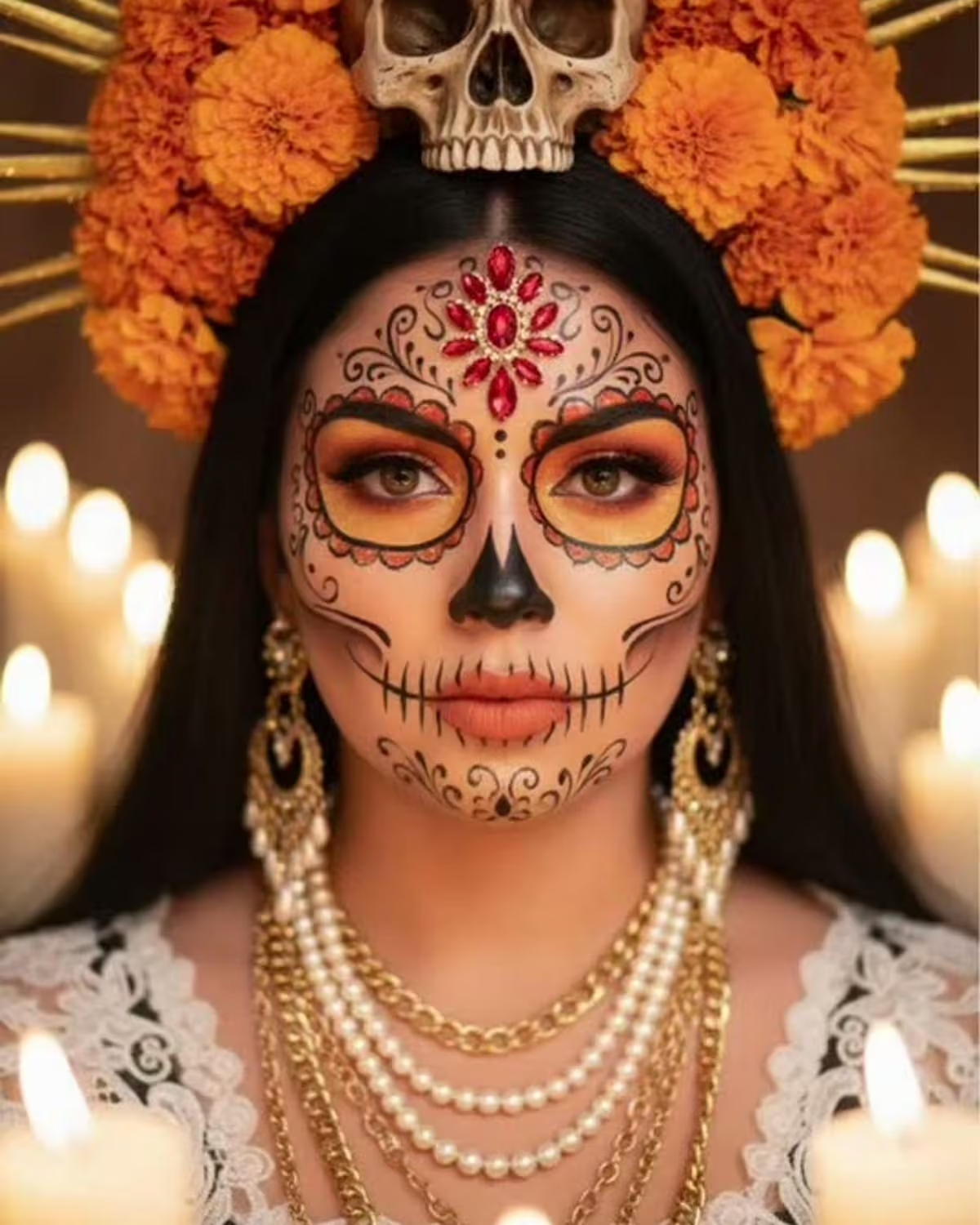
Every October, a wave of Catrina portraits fills social feeds: white painted faces, dark eye sockets ringed with petals, flowers in the hair and candlelight. In 2025, Mexican outlets including Milenio and TV Azteca published guides to making a "foto de Catrina con IA", an AI photo of yourself as La Catrina. Before you make one, it helps to know who she is and what the season means.
This post is the background. For the practical side, photo prep, captions and posting, see the companion post on Catrina makeup portrait ideas.
Make your Catrina portrait
Upload one clear, front-facing photo of your face and get a candlelit Day of the Dead portrait with a crown of red roses.
Where La Catrina comes from
Posada's satirical skull
La Catrina began as a zinc etching by the Mexican printmaker José Guadalupe Posada. According to Wikipedia's article on La Calavera Catrina, the image is usually dated to about 1910–1912, and its first certain publication was a 1913 satirical broadside printed for Day of the Dead. Wikipedia says the print was meant to satirise upper-class women of the Porfiriato, the era of President Porfirio Díaz.
How she got the name "Catrina"
The name came later. The 1913 broadside's title referred to garbanceras, working-class women who sold garbanzo beans, and Wikipedia notes that the title "Calavera Catrina" was first attached to the image in a 1930 book. A catrín is a dandy, so the name roughly means "the dapper skull". The Catrín is now her male counterpart.
Rivera's mural
Diego Rivera gave her a place in his mural Sueño de una tarde dominical en la Alameda Central (Dream of a Sunday Afternoon in the Alameda Central), painted in 1946–47. Wikipedia credits the mural with turning Posada's satirical figure into a Mexican national symbol, after which she became a staple of Día de Muertos festivities.
Día de Muertos, briefly
UNESCO lists the Indigenous festivity dedicated to the dead on its Representative List of the Intangible Cultural Heritage of Humanity, inscribed in 2008. It describes a celebration held from the end of October to the beginning of November, when families welcome the temporary return of deceased relatives. They lay flower petals, candles and offerings along the path from the cemetery to their homes and prepare favourite dishes for the home altar.
That is why marigolds and candles appear in so many Catrina images. They are not only decoration; they belong to the way the dead are guided home.
Catrina makeup, sugar skulls and the AI version
"Sugar skull makeup" is the common English phrase for this kind of calavera face paint, and TV Azteca's guide also uses calavera de azúcar for the style. Today, Catrina and Catrín costumes with calavera makeup are popular for Día de Muertos in Mexico and elsewhere, as Wikipedia notes.
The AI version is a newer habit. The 2025 guides walked readers through pasting a prompt into a chat image tool; TV Azteca's example showed a wide-brimmed hat and a marigold field, with hashtags such as #iacatrina and #catrinamexicana. Catrina Makeup works differently: you upload one face photo, and the portrait is fixed. You get a white base, petal-ringed eye sockets, a stitched smile line and floral swirls, a crown of red roses, a lit candle in your hands, and marigolds and small candles glowing behind you. There is no hat, field or outfit choice.
For a detail-by-detail reading of that portrait, see La Catrina AI photo: what each detail means.
Making and sharing it with respect
A Catrina portrait can be a warm way to take part in the season. A few habits keep it that way:
- Name the tradition. Say it is for Día de Muertos, and if you like, credit Posada's original.
- Keep it apart from horror. Posting it next to Halloween gore edits blurs two very different occasions.
- Do not call it real makeup. Label it as AI-made, since no paint was applied.
- Do not present it as an ofrenda. The portrait is not an altar, a ritual or a picture of a loved one who has died.
- Ask before using anyone else's photo, especially during a family remembrance.
Respectful caption wording, in English and Spanish, is in Día de Muertos AI portrait captions. If you want to make sure the result still looks like you under the paint, use the Catrina or Catrín result check.
For other seasonal looks, see the Halloween trends hub or the Halloween AI photo trends guide.
Frequently asked questions
Who created La Catrina?
The Mexican printmaker José Guadalupe Posada made the original satirical skull etching, usually dated to about 1910–1912. Diego Rivera later painted her into his 1946–47 mural, which helped make her a national symbol.
Is a Catrina portrait the same as a Halloween costume?
Not quite. Catrina is tied to Día de Muertos, a Mexican tradition of remembering the dead that UNESCO lists as intangible cultural heritage. It falls right after Halloween, but its meaning is different.
Is the makeup in the AI portrait real?
No. The Catrina Makeup template paints the design onto your photo with AI. No makeup is applied, so label the image as AI-made when you share it.