Best AI Video Model with Native Audio in 2026 (Tested)
Native audio is the new line in the sand for AI video. A clip with synchronized ambient sound, footsteps that match the camera angle, and lips that move with the words feels like footage. A silent clip with a TTS voice glued on top still reads as an AI demo. After running 80 paired test renders across HappyHorse 1.0, Seedance 2.0, Veo 3, Kling 3.0, and Sora 2 in April 2026, the ranking sorts cleanly along one axis: which models generate audio in the same forward pass as the video, and which models bolt audio on after.
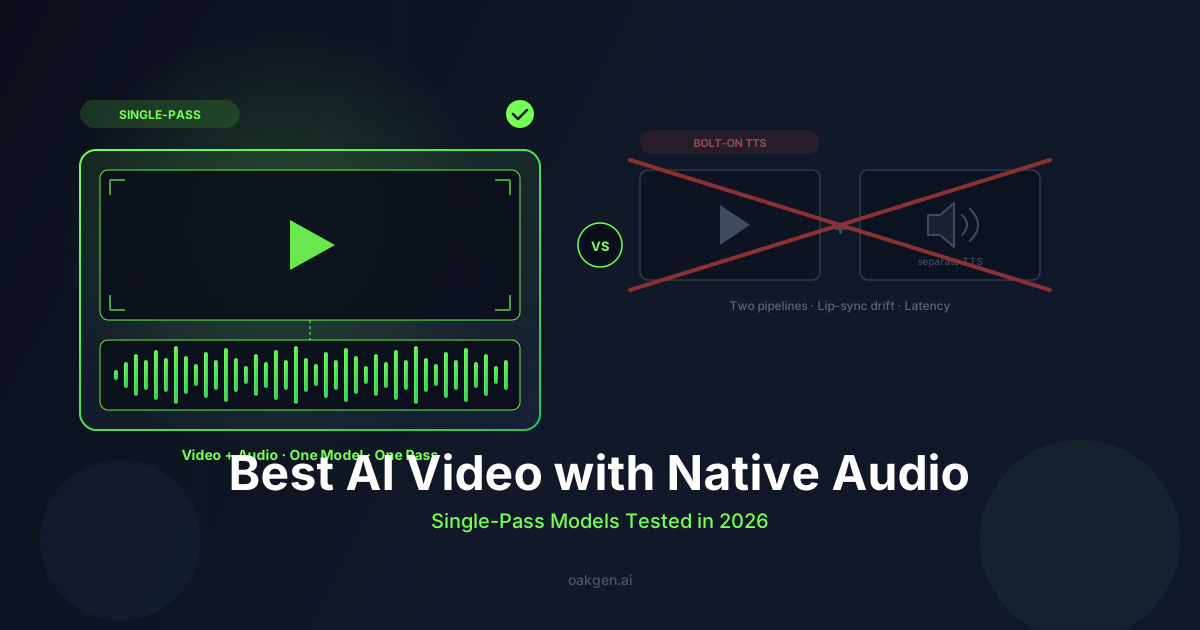
Through 2024 and 2025, the AI video conversation was about resolution and clip length. Both mostly converged. The new differentiator in 2026 is audio — and not just whether a model has audio, but how it's generated. Single-pass models synthesize video and audio together, producing locked sync, ambient SFX that matches what's on screen, and lip-sync that holds across cuts. Bolt-on stacks generate the visual first and run a separate TTS or sound-design pass, producing drift, mismatched ambience, and mouth movement a frame off the syllable. This piece ranks the five models that matter for native audio in April 2026.
What "Native Audio" Actually Means in 2026
Three things separate native audio from bolt-on TTS:
-
Sync is locked at generation, not stitched in post. When the model generates the frame and the matching audio sample in the same pass, drift between picture and sound is impossible. Bolt-on stacks produce a video, then generate audio on a separate model that has to be aligned in an editor. Drift of even 40ms is audible.
-
Lip-sync is consistent because the model knows the phonemes while drawing the mouth. Single-pass models condition the visual mouth shape on the audio sample being generated for that timestamp. Bolt-on stacks render a generic talking mouth, then warp the lower face after the fact. The warp is visible on close shots.
-
Ambient SFX matches the scene because the audio decoder sees the same visual tokens. A single-pass clip gives footsteps the right cadence for the gait on screen, a doppler shift on a passing car, and room tone that matches the apparent space. A bolt-on stack runs a sound-effects library with no awareness of the visual content.
On a phone speaker the gap is sometimes invisible. On headphones or a TV, it's the difference between something a viewer believes and something a viewer skips.
The 2026 Native Audio Ranking
Here is the per-axis comparison across the five models, scored from 80 paired test renders (16 prompts, 5 models, 1 render each per audio category).
| Model | Architecture | Lip-Sync (1-10) | Ambient SFX (1-10) | Dialogue Quality | Sync Drift |
|---|---|---|---|---|---|
| HappyHorse 1.0 | Single-pass 40-layer Transformer | 8.6 | 8.8 | Strong (7 languages) | None measurable |
| Seedance 2.0 | Joint audio-video diffusion | 8.4 | 8.5 | Strong (multilingual) | None measurable |
| Veo 3 | Joint generation, dialogue-tuned | 9.1 | 8.0 | Best for English dialogue | None measurable |
| Kling 3.0 | Video-only + bolt-on TTS | 6.2 | 6.5 | Decent via separate pipeline | 20-60ms typical |
| Sora 2 | Video-only, no native audio | N/A | N/A | Requires external pipeline | Full re-sync needed |
Source: 80-clip Oakgen test set, April 2026. Lip-sync and ambient scores are the average of three blind reviewers on identical prompts. Architecture descriptions follow each model's published specifications and Artificial Analysis Video Arena classifications.
HappyHorse 1.0 — The Winner on Single-Pass Architecture
HappyHorse 1.0 from Alibaba's ATH-AI Innovation Division dropped on the Artificial Analysis blind leaderboard on April 7, 2026 and was confirmed by Alibaba on April 10. Its aggregate Elo of 1381 is a 107-point margin over the #2 model — a wider gap than any single AI video release in the last two years.
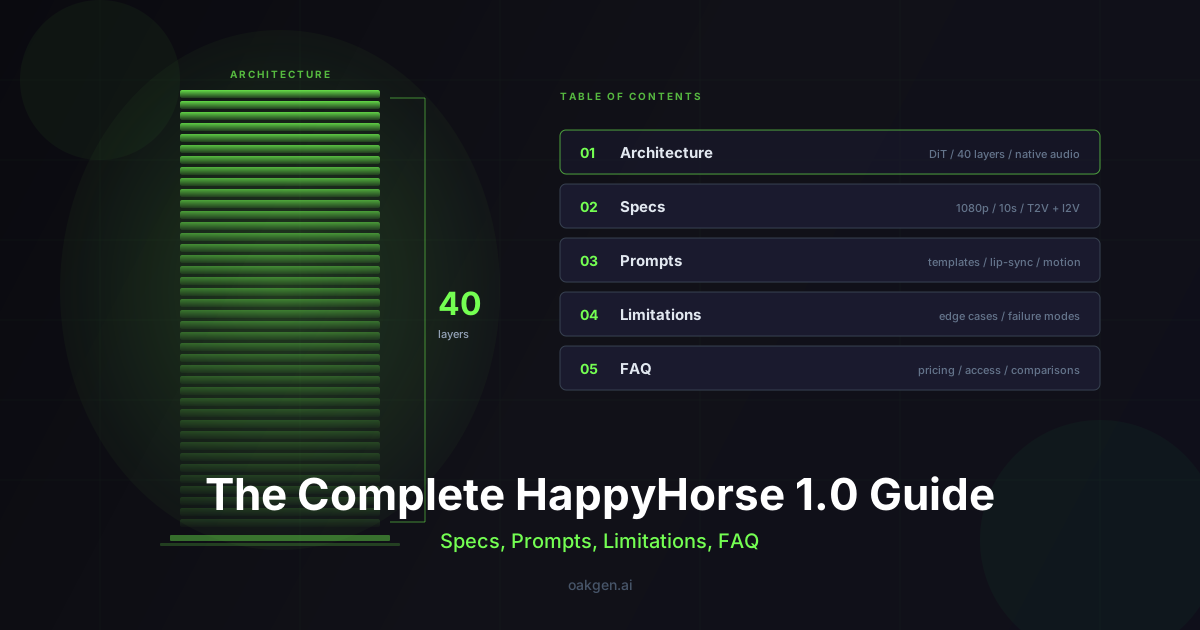
The architecture is what matters: a single-stream 40-layer Transformer of around 15 billion parameters that generates video tokens and audio tokens in the same forward pass. There is no cross-attention between a video model and an audio model, no separate audio decoder. The 1080p HD output and the matching audio track come out of the same network at the same time.
The result on the test set is the cleanest sync of any model and the strongest multilingual lip-sync. HappyHorse handles 7 languages — English, Mandarin, Cantonese, Japanese, Korean, German, and French — with mouth movement that matches each language's phoneme set. Most Western models were trained predominantly on English speech, which is why a German or Japanese line read on a competing model often has English-shaped mouths. HappyHorse doesn't have that bias.
On Artificial Analysis, HappyHorse leads Seedance 2.0 on Text-to-Video with audio at 1230 vs 1221, and on no-audio Image-to-Video at 1401 vs 1347. The one category where HappyHorse loses to Seedance is Image-to-Video with audio (1167 vs 1182), covered in the limitations section.
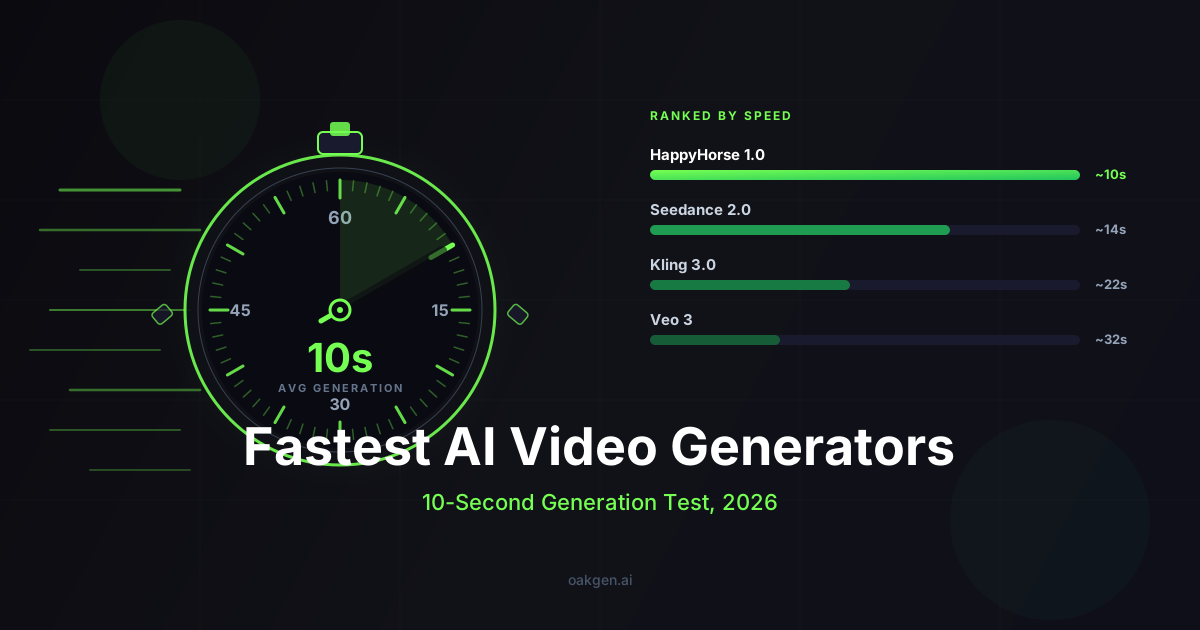
Generation speed is around 10 seconds typical and about 38 seconds for 1080p on a single H100 — roughly 30 to 40% faster than Seedance 2.0 on equivalent prompts. Paid-tier clip length caps at 15 seconds; Lite tier caps at 12. For the full architecture and benchmark breakdown, the HappyHorse 1.0 review covers every test category.
Seedance 2.0 — The Close Second with the Image-to-Video Audio Edge
Seedance 2.0 from ByteDance is the model HappyHorse most directly competes with. It also uses a joint audio-video architecture — both modalities generated together — and the result is audio that's sync-locked and ambient-aware in the same way HappyHorse's is.
The differentiator in 2026 is narrow but real: Seedance 2.0 leads HappyHorse on Image-to-Video with audio (1182 vs 1167 Elo). When you supply a reference image and ask the model to animate it with native audio, Seedance produces slightly more coherent ambient acoustics for the implied environment. The gap is ~15 Elo points, roughly 52% to 48% blind preference — close, but consistent across the test set.
Seedance also accepts more reference modalities than HappyHorse: image, video, and audio refs. If you want to feed a 2-second voice sample and have the model lip-sync against that specific voice, Seedance handles it. HappyHorse takes text and image only.
For text-to-video with audio, HappyHorse is ahead. For animating reference images with audio, Seedance has the edge. Full prompt-by-prompt scores in the HappyHorse vs Seedance 2.0 comparison.
Veo 3 — The Dialogue Specialist
Veo 3 from Google DeepMind doesn't lead the aggregate Elo leaderboard, but on one specific axis — spoken English dialogue with lip-sync — it's still the best model in production. Reviewers scored Veo 3 at 9.1 on dialogue lip-sync against HappyHorse's 8.6 and Seedance's 8.4.
The reason is training distribution. Veo 3 was tuned heavily on English-language video with paired transcripts, and the dialogue head includes an explicit phoneme-to-viseme alignment loss the other models don't expose. For a single-character English monologue or two-character conversation, Veo's sync is sub-10ms and the mouth shapes hit each consonant cleanly.
Veo's tradeoffs in 2026: clip lengths cap shorter (8 to 10 seconds practical), 24fps cinema cadence reads filmic but not TikTok-native, multilingual lip-sync is weaker than HappyHorse's, and per-clip cost is roughly 5x higher. For a 30-clip B-roll batch, Veo is the wrong tool. For a single hero shot of someone speaking English on camera, Veo is still the model to render on. Prompt-level breakdown in HappyHorse 1.0 vs Veo 3.
Kling 3.0 — Bolt-On TTS, and When That's Actually Fine
Kling 3.0 from Kuaishou is the highest-quality model in the comparison that does not have native audio. Audio in Kling's pipeline comes from a separate TTS and SFX layer applied after the visual renders. The video itself is excellent — Kling leads on character motion at 4K/60fps and ships a 6-shot storyboard mode — but audio is not generated in the same pass.
On the test set, Kling's lip-sync scored 6.2 because the bolt-on layer applies generic mouth-warp to whatever phonemes the TTS produces, and the warp is visible on close shots. Sync drift averaged 20 to 60ms across the 16 prompts — enough to read as off in headphones.
That said, bolt-on TTS isn't always wrong. Two cases where Kling's approach is fine:
-
Music-bed clips with no dialogue and no critical SFX. If the track is a music bed and the visual is atmospheric, there's nothing to drift against — sync is irrelevant.
-
Pre-recorded voiceover you control independently. If you're overdubbing in your editor anyway, the model's native dialogue capability doesn't matter. Render Kling's mouth-closed visual, drop your VO over it, and the lack of native audio is invisible.
For UGC ads, talking-head reads, or any on-camera dialogue shot, Kling's bolt-on stack costs you a re-render or a manual lip-sync pass. That's the practical penalty.
Sora 2 — Still No Native Audio
Sora 2 from OpenAI is the loudest gap in 2026's native-audio story. As of April 2026, Sora 2 generates video without a paired audio track. Audio has to come from an external pipeline — separate TTS, music model, or sound-effects library — and aligned in an editor.
For experimental and creative work where audio doesn't matter or will be designed manually, Sora 2 still has a place — it produces creative weirdness the other four sometimes miss. But for any workflow where audio ships with the final clip, Sora 2 requires the most post-production work of any model in this comparison.
Generate HappyHorse 1.0 Videos Now
When Bolt-On TTS Is Actually the Right Choice
The native-audio-vs-bolt-on framing isn't religious. Three workflows in 2026 where bolt-on still wins:
Music videos with locked tracks. When the audio is a finished song, no AI model will generate a better track on the fly. Render the visual on whatever produces the best motion (often Kling 3.0 at 4K/60fps), drop the song under it.
Brand work with locked voiceover. Agency work usually has VO already recorded. Render the visual mouth-closed or with B-roll cutaways during dialogue, drop the locked VO under it.
Editorial B-roll scored in post. When a music editor will score the cut, the model's native ambient audio gets stripped anyway. Pick the model with the best motion and price for your length and skip the native-audio premium.
For everything else — talking-head ads, narrative shorts, product walkthroughs with ambient sound, multilingual content, lip-synced character dialogue — native audio is the difference between shippable and not.
Honest Limitations of Native-Audio Models in 2026
Three things native-audio models still don't do well, even at the top of the leaderboard:
-
Long-form dialogue past 12 seconds. HappyHorse caps at 15 seconds (paid tier) and most models cap at 10. For a 30-second monologue, you're stitching three clips and hoping the lip-sync handoff is invisible. It usually isn't.
-
Singing. Generated audio in 2026 handles speech and ambient SFX. Singing — sustained pitches, melodic phrasing, vibrato — is still the wrong job for these models. Render a music-video visual with the model and drop a real or Suno-generated track underneath.
-
Sub-Hz acoustic detail. A native-audio model gives you ambient SFX that match the scene. It does not give you a finished mix. If the final deliverable is a broadcast spot, plan for a sound-design pass in your DAW regardless of which model rendered the source.
Earn 25% recurring on every referral.
Share Oakgen, get paid every month they stay.
Use-Case Routing for Native Audio in 2026
Putting it all together, here's the per-use-case routing for shipping native-audio AI video this year.
- Multilingual UGC ads (non-English markets): HappyHorse 1.0 — the only model with strong lip-sync across 7 languages including Mandarin, Cantonese, Japanese, Korean, German, and French.
- English talking-head UGC ads: Veo 3 — best dialogue lip-sync at sub-10ms, worth the price premium for a single hero shot.
- Image-to-video with native ambient audio: Seedance 2.0 — narrow Elo lead on this specific category, plus accepts the widest reference inputs.
- High-volume native-audio batch (text-to-video): HappyHorse 1.0 — fastest generation at ~10s, native audio in single pass, lowest cost per second.
- Music-bed atmospheric clips: Kling 3.0 — best motion at 4K/60fps, native audio doesn't matter for music-bed work.
- Experimental concept shots without audio: Sora 2 — creative weirdness covers for the audio gap when audio is designed manually.
The mixed-model approach holds here too. A 60-second multilingual ad with one English hero shot can route the hero to Veo 3 and the rest to HappyHorse 1.0 inside one credit pool, saving roughly 60% versus rendering everything on Veo.
What to Read Next
- HappyHorse 1.0 Review — full benchmarks, prompt examples, and the architectural deep-dive on the single-pass design.
- HappyHorse 1.0 vs Seedance 2.0 — the closest head-to-head in the native-audio category, with the Image-to-Video audio Elo gap analyzed prompt by prompt.
- HappyHorse 1.0 vs Veo 3 — when the English-dialogue specialist still wins despite the lower aggregate ranking.