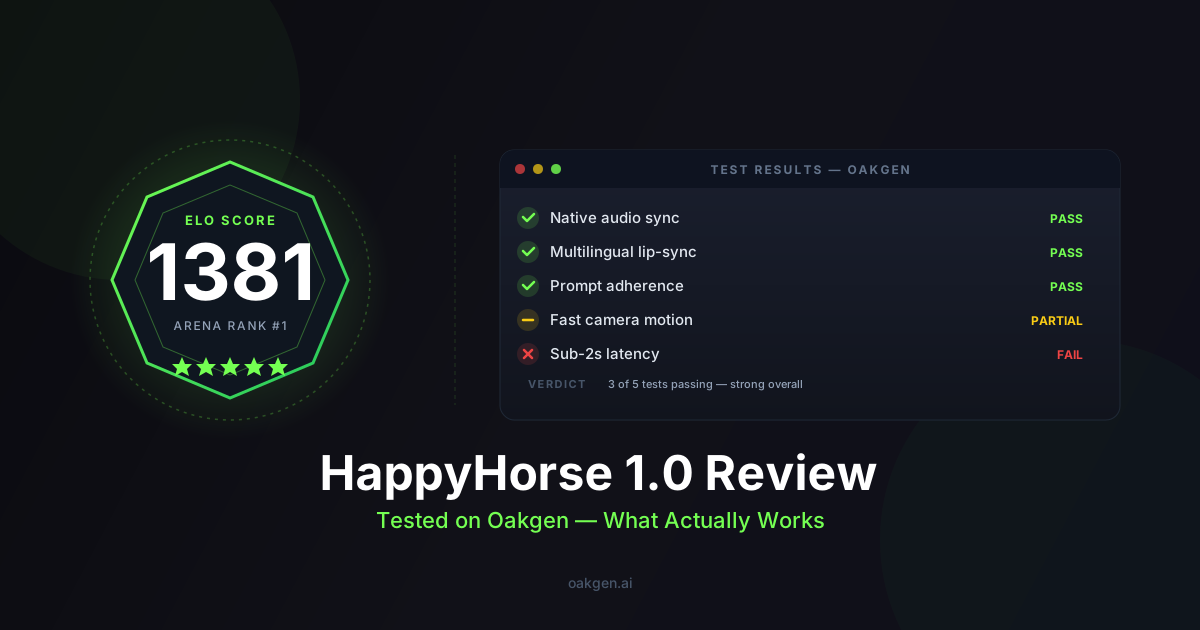
On April 7, 2026, an unnamed entry called "HappyHorse" appeared on the Artificial Analysis Video Arena leaderboard and quietly took the #1 slot. No press release, no demo reel — just a 1381 Elo score and a 107-point margin over the rest of the field. Three days later, Alibaba's ATH-AI Innovation Division confirmed it was theirs. By April 26 it was on fal. As of today, April 29, 2026, HappyHorse 1.0 is live on Oakgen alongside Seedance 2.0, Veo 3.1, Kling 3.0, and 30+ other video models, with the same credit balance covering all of them. This is the definitive guide.
What HappyHorse 1.0 Is and How It Dropped
HappyHorse 1.0 ("快乐小马" — literally "Happy Horse") is an AI video generation model built by Alibaba's ATH-AI Innovation Division. It generates 1080p video with native synchronized audio in roughly 10 seconds per clip.
The actual timeline:
- April 7, 2026 — A model labeled only "HappyHorse" appeared on the Artificial Analysis Video Arena (a public blind-evaluation leaderboard) and took the top spot with a 1381 Elo aggregate score.
- April 10, 2026 — Alibaba publicly confirmed on X that HappyHorse 1.0 was theirs.
- April 26, 2026 (9 PM PST) — fal launched the public API.
- April 29, 2026 — HappyHorse 1.0 went live on Oakgen, joining Seedance 2.0, Veo 3.1, Kling 3.0, Kling v3 Pro, and the rest of the 30+ video model lineup under the same credit pool.
Three weeks from stealth leaderboard appearance to general availability is fast. What matters is not the rollout speed but what HappyHorse actually is under the hood.
Architecture Deep-Dive: Single-Stream Transformer, Single-Pass Audio + Video
Most "native audio" AI video models are not actually native. They are video models with an audio module bolted on through cross-attention layers, or they pipe the silent video output through a separate text-to-audio system as a second pass. The result is technically synchronized audio, but generated by a different network than the one that generated the video.
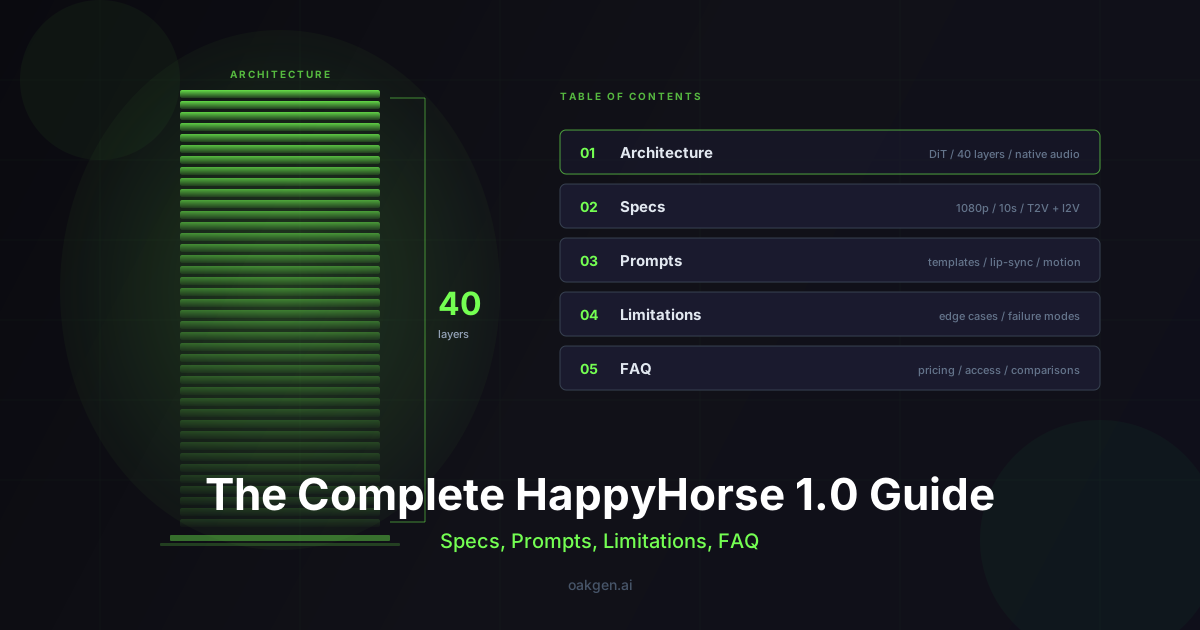
HappyHorse 1.0 is structurally different. It is a single-stream 40-layer Transformer with roughly 15 billion parameters that generates video and audio tokens in one forward pass. There is no cross-attention bridge between a video tower and an audio tower. There is no separate audio model. The same Transformer that decides what the next visual frame looks like also decides what the next audio sample sounds like, in the same pass, with the same attention context.
Why this matters in practice
Three downstream consequences:
- Phoneme-frame alignment is structural, not learned post-hoc. When a character's mouth opens on frame 47, the audio sample for the consonant at that timestamp is generated in the same forward pass with the same hidden state. No "video model said X, audio model tried to match" handoff where drift accumulates.
- Single set of attention weights covers both modalities. The model can use audio context to inform visual decisions and vice versa within a single generation step — a footstep sound and a foot landing are not two separate events that need to be reconciled.
- Inference cost stays manageable. A 40-layer single-stream architecture at ~15B parameters runs at ~38 seconds for a 1080p clip on a single H100, and ~10 seconds in typical user workloads. Bolt-on audio architectures usually run two passes, doubling latency.
The trade-off is capacity. A 15B-parameter single-stream model has less raw representational headroom than, say, a 28B video-only model with a separate 8B audio model. HappyHorse compensates with training data and the structural alignment win.
In single-pass generation, the model produces synchronized lip-sync in 7 languages, environmental ambience matched to the scene (rain, café noise, wind, room tone), sound effects timed to visual events, and dialogue tracks — all from the same prompt, no separate audio request.
Full Specs
| Specification | HappyHorse 1.0 |
|---|---|
| Maker | Alibaba ATH-AI Innovation Division |
| Architecture | Single-stream 40-layer Transformer, ~15B parameters |
| Multimodal Design | Video + audio in one forward pass (no cross-attention, no separate audio model) |
| Output Resolution | 1080p HD native |
| Generation Speed | ~10s typical, ~38s for 1080p on a single H100 |
| Speed vs Seedance 2.0 | ~30-40% faster |
| Max Length (Lite tier) | 12 seconds |
| Max Length (Paid tier) | 15 seconds |
| Lip-sync Languages | 7 — English, Mandarin, Cantonese, Japanese, Korean, German, French |
| Input Modalities | Text, image |
| Output Modalities | Video, audio (native) |
| Aggregate Leaderboard Rank | #1, 1381 Elo, 107-pt margin over #2 |
| Available on Oakgen | Yes — live April 29, 2026 |
The Leaderboard Story: Exact Elo Numbers
The Artificial Analysis Video Arena uses blind pairwise comparisons to rank models — users see two unlabeled video outputs and pick the better one, and the resulting preference data is used to compute Elo scores per category. HappyHorse 1.0 sits at the top of the aggregate ranking. Here is the breakdown by category.
| Category | HappyHorse-1.0 | Seedance 2.0 |
|---|---|---|
| Text-to-Video (no audio) | 1365 | 1270 |
| Image-to-Video (no audio) | 1401 | 1347 |
| Text-to-Video (with audio) | 1230 | 1221 |
| Image-to-Video (with audio) | 1167 | 1182 (Seedance leads) |
| Aggregate Ranking | #1, 1381 Elo, 107-pt margin over #2 | — |
The pattern is worth reading carefully. HappyHorse leads decisively on text-to-video (both with and without audio) and on image-to-video without audio. Seedance 2.0 still narrowly wins image-to-video with audio (1182 vs 1167). That is a small margin, but it is real, and it is the only category on the board where HappyHorse is not #1.
The aggregate 1381 Elo with a 107-point margin over the #2 model is the largest single-model lead the Video Arena has recorded since it launched. For context, 100 Elo points roughly corresponds to a 64% win rate in head-to-head matchups — a meaningful gap, not a rounding error.
How to Use HappyHorse 1.0 on Oakgen
Step 1: Open the tool. Go to /ai-video-generator?model=happyhorse-1-0. The deep-link pre-selects HappyHorse 1.0 from the model dropdown.
Step 2: Choose input mode. HappyHorse accepts text or text-plus-image. For text-to-video, write your prompt. For image-to-video, upload a reference image (character, product, or environment) and describe what should happen.
Step 3: Set duration and audio. Up to 12 seconds on the Lite tier, 15 seconds on paid plans. For cinematic shots without dialogue, audio-on adds environmental ambience that improves the result; for shots you plan to score yourself, audio-off saves credits.
Step 4: Pick lip-sync language (if applicable). If your prompt includes dialogue, set the language explicitly. HappyHorse supports English, Mandarin, Cantonese, Japanese, Korean, German, and French.
Step 5: Generate. Average wait is ~10 seconds. On Oakgen, generations from any model — HappyHorse, Seedance, Veo, Kling, Wan — spend from the same credit pool, so you can A/B the same prompt across models without juggling subscriptions.
Prompt Structures That Work
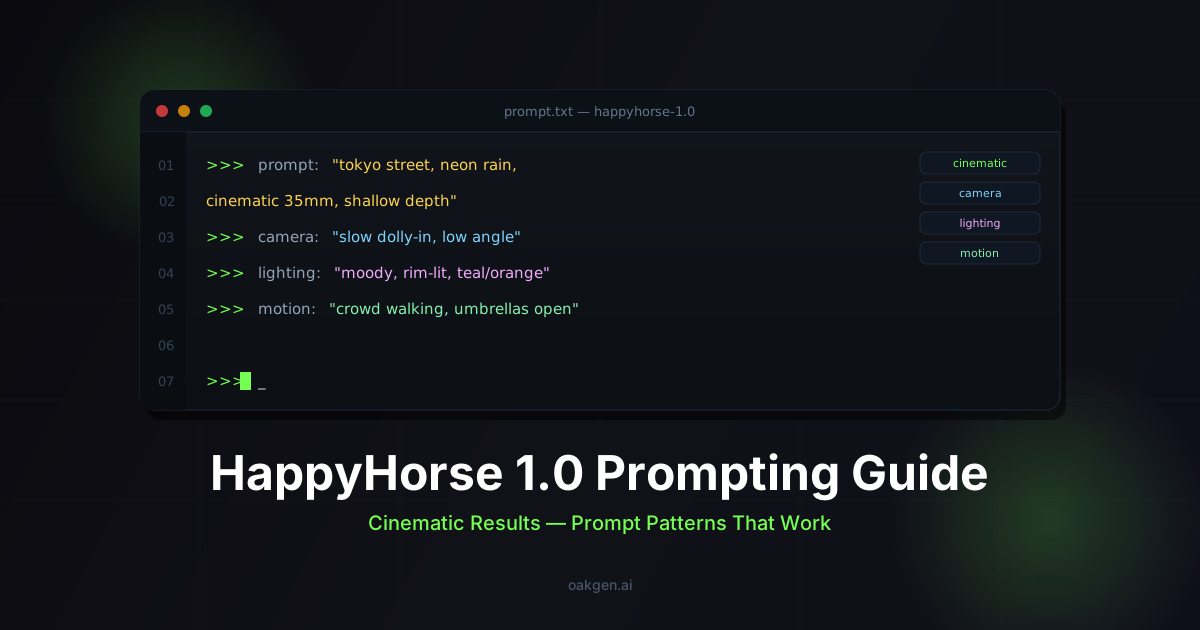
HappyHorse responds well to specific, layered prompts. The model just dropped, so there is no exhaustive prompt library yet — but the patterns below produce reliable results.
The structure that works best:
[shot type] of [subject] [doing action], [environment + lighting],
[camera movement], [audio cue if relevant], [style descriptor]
Each segment maps to something the single-pass architecture has to decide simultaneously, so being explicit on each helps the model converge on coherent output.
Example 1 — Text-to-video with native ambience
Wide cinematic shot of a Tokyo izakaya at night, paper lanterns
glowing red and orange, rain falling on the wooden street outside,
camera slowly tracking forward toward the entrance, ambient sound
of rain on tile and distant chatter, shallow depth of field,
35mm film grain, golden interior light spilling onto wet pavement
The audio cue ("rain on tile and distant chatter") is parsed in the same forward pass as the visual scene, so the rain you see and the rain you hear are the same event — not a video pass that got an audio pass glued to it.
Example 2 — Image-to-video with multilingual lip-sync
Upload a reference image of a character (a generated portrait, a brand spokesperson, etc.) and pair it with a prompt like:
The character speaks directly to camera in Japanese with a calm,
confident tone: "今日は新しい何かを始めましょう". Soft natural
window light from the left, slight head tilt as they finish the
sentence, eyes maintaining contact with camera, neutral background,
subtle ambient room tone
For this to land cleanly, set the lip-sync language to Japanese in the UI before generating. Phoneme alignment is structural in HappyHorse, but the explicit language flag tightens the result. The 7-language coverage (English, Mandarin, Cantonese, Japanese, Korean, German, French) is wider than Veo 3 or Kling 3.0 for synchronized lip-sync.
Prompting tips specific to HappyHorse
- Lead with shot type. "Wide cinematic shot," "medium tracking shot," "close-up" — the model treats this as a strong prior.
- Mention audio explicitly. The audio half of the single pass needs prompt context, not just the video half.
- Describe lighting twice if it's important. Once as source ("golden hour," "neon"), once as effect ("warm spill on wet pavement").
- For dialogue, write the actual line in quotes. The model performs lip-sync against the literal text inside quotes, in the language you specified.
Honest Limitations: What HappyHorse Is Not Best At
HappyHorse 1.0 leads the aggregate leaderboard, but it does not win every category.
Seedance 2.0 leads on image-to-video with audio. The one Video Arena category where HappyHorse is not #1. Seedance scores 1182 vs HappyHorse's 1167. The margin is small but real. For image-anchored video with synchronized audio, run the same prompt through both on Oakgen and pick the better result.
Veo 3 still has better dialogue lip-sync at sub-10ms latency for spoken English. HappyHorse's 7-language coverage is broader, but for English-only dialogue-heavy work — talking heads, explainers, extended monologue — Veo 3 is still the strongest option.
Kling 3.0 has higher max resolution. Kling generates at 4K natively. HappyHorse caps at 1080p. For billboards, large screens, or 4K masters, Kling's resolution advantage matters.
Sora 2 supports longer single clips. Up to 20 seconds in one pass vs HappyHorse's 15-second cap on paid tiers.
Documentation is thin. The model just dropped. No large public prompt library yet, no extensive cookbook. Expect to iterate more than on a mature model. (See the HappyHorse Prompting Guide for tested patterns.)
Limited input modalities. Text and image only. Seedance 2.0 accepts video and audio reference inputs too; HappyHorse does not. If your workflow depends on reference video clips for camera or motion replication, Seedance is the right tool.
Generate HappyHorse 1.0 Videos Now
When to Choose HappyHorse vs Seedance vs Veo vs Kling
Use the right model for the shot. Decision matrix below.
| Feature | HappyHorse 1.0 | Seedance 2.0 | Veo 3 | Kling 3.0 |
|---|---|---|---|---|
| Aggregate Leaderboard Rank | #1 (1381 Elo) | Top 5 | Top 5 | Top 5 |
| Max Resolution | 1080p | 2K (2048p) | 4K | 4K |
| Native Audio | Yes — single-pass | Yes — bolt-on | Yes — dialogue strong | No |
| Lip-sync Languages | 7 | 8+ (broad) | Strong English | Multilingual |
| Max Clip Length | 15s (paid) | 4-15s (extendable) | 4-8s (extendable) | 3-15s |
| Generation Speed | ~10s (fastest) | Fast | Medium | Medium |
| Input Modalities | Text, image | Text, image, video, audio (12 files) | Text, image | Text, image, video |
| Best For | Cinematic + native audio + speed | Multi-modal control + references | English dialogue + 4K | 4K resolution + motion control |
Choose HappyHorse 1.0 when:
- You want the highest blind-evaluation quality per generation (aggregate #1)
- You need fast turnaround (~10s typical)
- Native audio matters and you want it generated structurally, not bolted on
- Your dialogue is in English, Mandarin, Cantonese, Japanese, Korean, German, or French
- 1080p is enough for your delivery format
Choose Seedance 2.0 when:
- Your workflow is image-anchored with audio (Seedance narrowly leads this category)
- You need to upload reference video, audio, or multiple files (12-file multi-modal input)
- The @ reference system (camera, action, effect, style replication) fits your shot
Choose Veo 3 when:
- English dialogue is the centerpiece — long monologue, explainer, narrative talking-head
- You need 4K native delivery
- Sub-10ms lip-sync latency matters for the cut
Choose Kling 3.0 when:
- 4K is non-negotiable (billboards, large screens, premium streaming)
- Motion transfer from reference video drives the shot
For a deeper head-to-head specifically on HappyHorse vs Seedance, read HappyHorse 1.0 vs Seedance 2.0. For the native-audio angle across all four, see Best AI Video Model with Native Audio in 2026.
Earn 25% recurring on every referral.
Share Oakgen, get paid every month they stay.
FAQ
Is HappyHorse 1.0 really #1?
By aggregate Elo on the Artificial Analysis Video Arena (a public blind-evaluation leaderboard), yes — 1381 Elo with a 107-point margin over the #2 model as of April 29, 2026. It does not win every individual category (Seedance 2.0 narrowly leads image-to-video with audio at 1182 vs 1167), but the aggregate lead is the largest the leaderboard has recorded.
Who built HappyHorse 1.0?
Alibaba's ATH-AI Innovation Division. The model was confirmed by Alibaba on April 10, 2026, three days after it appeared on the leaderboard under the codename "HappyHorse" ("快乐小马" in Mandarin).
How is HappyHorse different from Seedance 2.0 architecturally?
HappyHorse is a single-stream 40-layer Transformer (~15B parameters) that generates video and audio tokens in one forward pass. Seedance 2.0 takes a multi-modal input approach (up to 12 files: text, images, video, audio) and uses a more complex pipeline. HappyHorse trades input flexibility for tighter audio-video alignment and ~30-40% faster generation.
What resolution does HappyHorse 1.0 generate?
Native 1080p HD. It does not generate native 4K — Kling 3.0 and Veo 3 are stronger choices for 4K-mastered work.
How fast is HappyHorse 1.0?
Typical generation time is around 10 seconds. A 1080p clip benchmarks at ~38 seconds on a single H100. That is roughly 30-40% faster than Seedance 2.0 for comparable output.
What languages does HappyHorse support for lip-sync?
Seven: English, Mandarin, Cantonese, Japanese, Korean, German, and French. The lip-sync is generated in the same forward pass as the video, so phoneme-frame alignment is structural rather than learned post-hoc.
What is the maximum clip length?
12 seconds on the Lite tier and 15 seconds on the paid tier. For longer single takes, Sora 2 (up to 20s) is the alternative.
Can I use HappyHorse 1.0 for commercial work?
Yes. Content generated through Oakgen is licensed for commercial use including marketing, advertising, social media, and product content. Check Oakgen's terms of service for specifics.
How do I try it without a paid plan?
Why does Seedance 2.0 still win image-to-video with audio?
Best guess: Seedance's multi-modal input pipeline is purpose-built to take an image plus audio reference and produce video that respects both anchors. The 15-point Elo gap (1182 vs 1167) is real but small enough that it can flip on individual prompts.
What to Read Next
Three companion pieces in this cluster go deeper on specific angles:
- HappyHorse 1.0 Prompting Guide: How to Get Cinematic Results in 2026 — Detailed prompt patterns, structure templates, and language-specific tips for getting cinematic output from the model.
- HappyHorse 1.0 vs Seedance 2.0: Which AI Video Model Wins in 2026? — Head-to-head comparison with category-by-category Elo breakdown and workflow recommendations.
- Best AI Video Model with Native Audio in 2026 (Tested) — How HappyHorse, Seedance, and Veo compare specifically on the native-audio dimension, with the architecture differences explained.
HappyHorse 1.0 is the strongest aggregate AI video model on the public leaderboard as of late April 2026. It is not the right tool for every shot — Seedance, Veo, and Kling each still win specific categories — but for fast, cinematic, audio-included generation in 1080p, it is the new default. Oakgen makes it accessible alongside the other 30+ video models in the same credit pool.